Analysis of the Best Timing for Communication and Confrontation in Mother-in-Law and Son-in-Law Family Conflicts
把这篇文章落到自己身上验证:先看结构,再进入个人分析,不做泛泛阅读。
你现在搜索的,
其实是一个要落到自己身上的判断。
当前页面主要回答「Parent-Child Relationships」这类搜索问题;真正有价值的下一步是把这套结构带进自己的报告、工具与案例验证。
Why This Decision Is Particularly Difficult in This Scenario
Friction with a spouse’s parents often involves multiple intertwined family dynamics, such as blurred boundaries, parenting interference, holiday visit pressures, and financial exchanges. The spouse is caught in the middle, becoming the emotional and responsibility buffer. Cultural expectations and familial bonds make conflicts not merely rational issues but deeply tied to emotional attachment and identity.
Family members have differing boundary needs, often accompanied by subconscious emotional blackmail, making direct communication risky. If the timing is inappropriate, defensive or confrontational reactions are easily triggered, escalating conflicts and hindering resolution of the root problems.
The Da Yun and Liu Nian in metaphysics, along with the interaction between the Day Master and Yong Shen, reflect personal psychological energy, external environmental pressures, and internal rhythm changes. They can to some extent reveal potential risks and opportunities for action timing. However, metaphysics is only an auxiliary tool and cannot replace professional psychological counseling and family therapy, especially when emotional trauma is involved, requiring cautious handling.
Therefore, the difficulty in decision-making lies in how to combine the subtle changes in family dynamics with positive signals in metaphysical rhythms to precisely grasp the communication and confrontation window, protecting one’s boundaries while avoiding emotional escalation.
Three Core Dimensions of Metaphysical Judgment
First, the relationship between the Day Master and the Yin Stars (印星, representing parents and elders) reveals the individual’s internal support system. Strong Yin Stars indicate easier recognition and assistance from elders, providing psychological confidence during communication; conversely, weak Yin Stars mean greater pressure from elders, requiring cautious timing.
Second, the Bi Jian and Jie Cai stars (比肩/劫财) reveal competition and support among siblings or peers. When these stars are strong, the individual has a strong self-awareness and boundary sense, suitable for proactively setting limits but prone to conflict, necessitating adjustment of emotions and communication strategies based on Liu Nian and Da Yun.
Third, the combination of Guan Sha (官杀) stars and Cai (财) stars reflects authority pressure and material connections. Guan Sha represent elder authority and rules, while Cai stars relate to money and resource exchanges. The clash or harmony between Guan Sha and Cai stars in Liu Nian and Da Yun indicates whether communication risks authority confrontation or financial disputes, a key indicator for judging confrontation risk.
Additionally, the interaction rhythm between Da Yun and Liu Nian determines the external environmental intensity and personal state for action. When Da Yun is stable and suited for maintaining status quo, and Liu Nian requires flexible adaptation, it is better to steadily advance communication; if Da Yun or Liu Nian show obvious clashes, with large emotional fluctuations, it is recommended to postpone direct confrontation.
Three Real BaZi Chart Case Studies
Case 1: The male Day Master is Yi Wood (乙, Yi) slightly strong, with a Shang Guan (伤官) pattern. The Yong Shen are Metal and Earth, and the Ji Shen is Water. Currently in the 7th year of Ren Xu (壬戌, Ren Xu) Da Yun, which is stable, and the Liu Nian is Bing Wu (丙午, Bing Wu), forming an interaction of flexible adaptation between Da Yun and Liu Nian. The Shang Guan pattern indicates strong expressive ability and emotional openness, with weak Yin Stars, meaning a lack of direct elder support and a tendency toward emotional reactions when facing spouse’s parents. This chart requires using the stability of Da Yun to select Liu Nian periods with calmer emotions for active communication, avoiding Ji Shen Water fluctuations that may trigger unfavorable emotional outbursts. The suggested judgment order is first to assess current emotional state, then rely on stable Da Yun to maintain, and combine Liu Nian observation of the other party’s reaction to gradually advance boundary setting.
Case 2: The female Day Master is Gui Water (癸, Gui) slightly weak, with a Pian Yin (偏印) pattern. The Yong Shen is Metal, and the Ji Shen are Wood and Fire. Currently in the 3rd year of Yi Hai (乙亥, Yi Hai) Da Yun, with a stable Da Yun and relatively prominent Yin Stars, indicating some degree of family support or spiritual resources. People with Pian Yin patterns tend to be introverted and compliant when facing elders, but the presence of Ji Shen Wood and Fire warns of possible emotional suppression or conflict during communication. She is suited to leverage the maintaining nature of the current Da Yun and the flexible adaptation of Liu Nian to strengthen listening and indirect expression, avoiding direct conflict and steadily promoting boundary setting. The suggested judgment order is first to observe the other party’s authority reaction, then raise demands at appropriate times, and use family therapy if necessary to help ease relations.
Case 3: The male Day Master is Xin Metal (辛, Xin) slightly strong, with a Shang Guan pattern. The Yong Shen are Fire and Wood, and the Ji Shen is Earth. Currently in the 2nd year of Ji Si (己巳, Ji Si) Da Yun, with both Da Yun and Liu Nian (Bing Wu) stable. The Shang Guan pattern gives strong expressive ability and self-awareness. The strong Day Master Metal and Yong Shen Fire and Wood symbolize the ability to actively regulate emotions during communication and strong action capability. The presence of Ji Shen Earth warns to guard against external environmental suppression and obstruction during communication. This chart is suitable for choosing a time when both Da Yun and Liu Nian are stable to proactively confront spouse’s parents and set boundaries, while maintaining flexible emotional adjustment. The suggested judgment order is first self-regulate emotions, then combine observation of the other party’s reactions, gradually proceed with communication, and avoid immediate intense conflicts.
Common Misjudgments and Blind Spots in This Scenario
Many people, when dealing with friction with spouse’s parents, easily fall into emotional blackmail traps, mistakenly believing that forceful confrontation can quickly resolve issues, ignoring the complexity of blurred boundaries and emotional dependence in family dynamics, which leads to conflict escalation.
When using metaphysics as an auxiliary judgment, some over-rely on the luck quality of a single Da Yun or Liu Nian, neglecting the overall chart structure and the comprehensive influence of Yong Shen and Ji Shen, resulting in one-sided judgments and poor timing choices.
They overlook the spouse’s role and pressure as the intermediary, simplifying communication problems as personal will alone, without considering the subtle balance between spouse and both sets of parents, which increases internal family tension.
Furthermore, lacking professional psychological counseling support and relying solely on metaphysical rhythms to guide actions ignores potential psychological trauma and deep emotional issues, making problems harder to resolve.
Practical Judgment Sequence
First, check the emotional states of oneself and the other party, combining the current Da Yun and Liu Nian to judge whether conditions are relatively stable or conducive to emotional regulation. When Da Yun is stable and Liu Nian is non-clashing, it is suitable to attempt proactive communication; otherwise, prioritize emotional stabilization and avoid direct confrontation.
Second, observe the spouse’s attitude and endurance as the intermediary, ensuring they can support the communication plan and help alleviate pressure on both sides. The spouse’s involvement often determines the actual effectiveness of communication.
Finally, combine the guidance of Yong Shen and Ji Shen to select time windows when the other party’s authority pressure or financial stress is relatively low, steadily advancing boundary setting and confrontation. Throughout the process, it is recommended to cooperate with professional psychological counseling or family therapy to address potential emotional trauma and avoid relying solely on metaphysical judgment for decision-making.
FAQ
Question 1: How do Da Yun and Liu Nian specifically affect communication timing in metaphysics? Answer: Da Yun represents longer-term fortune trends, while Liu Nian reflects environmental changes in the current year. When Da Yun is stable, personal state is more steady, favoring maintenance and prudent communication; Liu Nian’s flexible adaptation indicates possible sudden changes requiring flexible communication strategies. Together, they assist in judging emotional and external environmental fluctuations to guide the best communication window.
Question 2: If the Ji Shen is prominent in the chart, should communication be avoided? Answer: Ji Shen indicates a higher likelihood of conflict or emotional fluctuations, but it does not mean communication must be avoided. Instead, one should choose timing and methods more cautiously, combining the overall trends of Da Yun and Liu Nian to proceed gradually and avoid intense direct conflict.
Question 3: Can metaphysics replace psychological counseling or family therapy? Answer: Metaphysics is only a rhythmic auxiliary tool to help grasp action timing and energy states; it cannot replace professional psychological counseling and family therapy. In cases involving PUA, violence, or similar issues, professional help should be sought first to ensure personal safety and mental health.
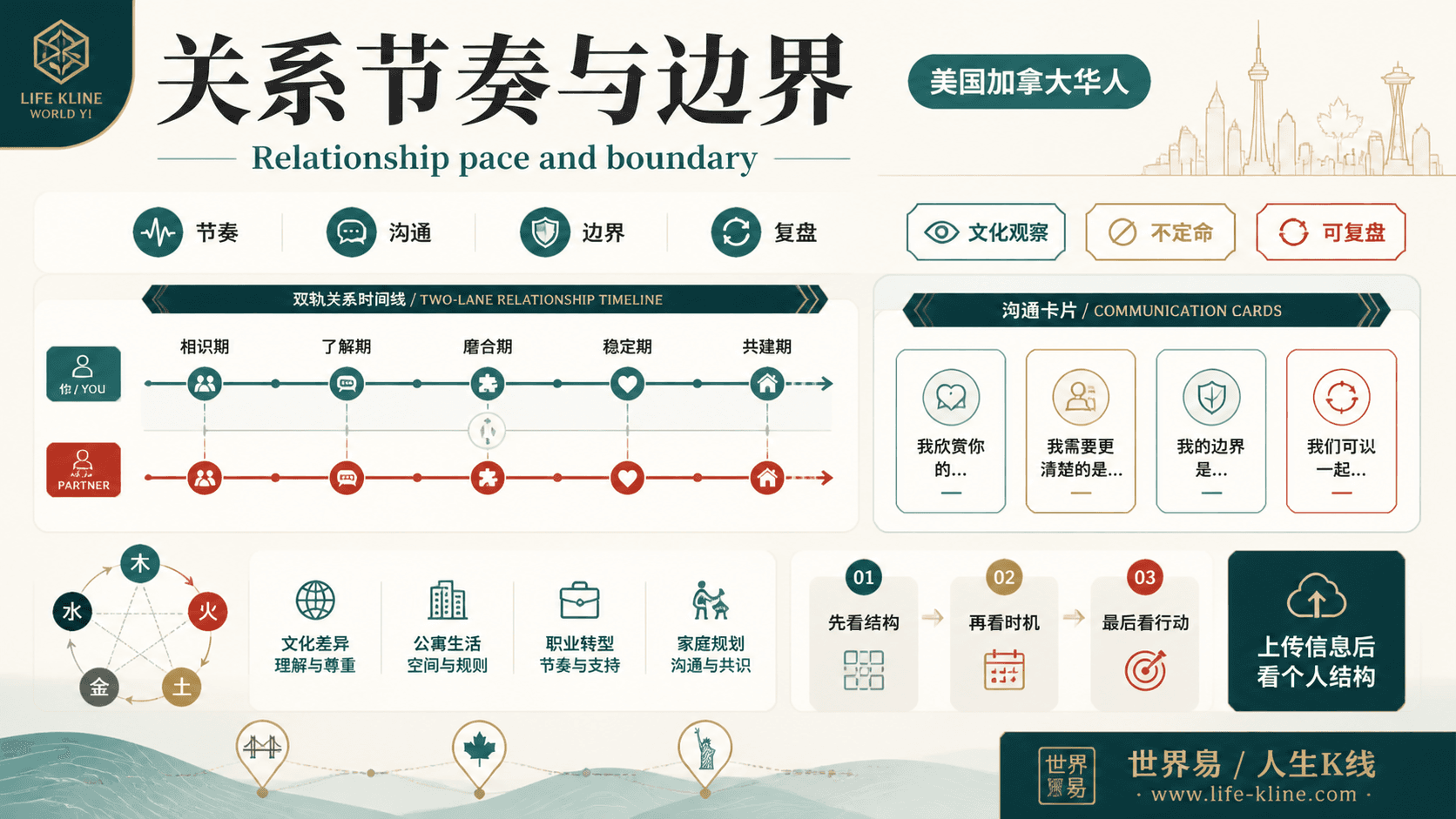
关系节奏与边界|美国加拿大华人
这张图把《Analysis of the Best Timing for Communication and Confrontation in Mother-in-Law and Son-in-Law Family Conflicts》里的命理概念转成关系、边界和应用场景,适合先看图建立结构,再回到知识文章正文理解细节。
关系节奏与边界不应被写成固定结论。更适合美国加拿大华人的读法,是把传统术语翻译成结构、时机、环境、行动和复盘。
查看图片解读