How BaZi Supports Career Timing Decisions Without Replacing Professional Judgment
建议先读完本页摘要,再开始个人分析,避免信息跳转过早。
What problem sits underneath the trend
Rising interest in Bazi among professionals stems from the persistent challenge of making high-stakes career decisions amid uncertainty—whether to switch roles, launch a venture, or wait for promotion—when traditional analysis like market trends, skills assessment, and networking often leaves timing questions unanswered. In an era of rapid industry shifts, economic volatility, and extended career spans, many seek a structured lens to evaluate when conditions might favor bold moves or prudent consolidation, without surrendering judgment to rigid predictions or mystical promises.
The core misunderstanding lies in viewing Bazi as a shortcut to certainty rather than a supplementary framework for pattern recognition in personal energy cycles, which can highlight favorable windows for action but cannot override real-world variables such as effort, competition, or external events. Readers drawn to the topic are often frustrated by oversimplified online claims of 'lucky years' or definitive career paths, yet remain curious because the system offers a way to layer probabilistic timing insights onto evidence-based planning, helping reduce second-guessing in moments where data alone feels insufficient.
How a practical reader should interpret it
A practical approach to Bazi begins by treating the chart as a layered timing map rather than a collection of standalone fortune-telling labels. Instead of fixating on dramatic phrases like 'wealth star arrives' or 'officer harms day master,' focus on the underlying structure—such as the strength of the day master, the seasonal quality of the chart, and the major ten-year pillar cycle—then layer on the specific annual or monthly triggers that activate or suppress key elements. This method shifts interpretation from vague prediction to conditional reasoning: under what combination of circumstances does a particular career window open or close, and what trade-offs come with each phase. Readers who adopt this lens avoid the common trap of over-relying on isolated, eye-catching statements that rarely survive contact with real-life complexity.
Decision boundaries emerge most clearly when you map Bazi conditions against actual choice points rather than seeking absolute certainty from the system itself. For instance, a favorable luck pillar may signal improved resource flow or visibility, but whether it translates into a worthwhile job switch still depends on observable variables: market conditions, personal skill alignment, financial runway, and competing obligations. By explicitly separating what Bazi can indicate (recurring timing patterns and energetic emphasis) from what it cannot replace (real-time data, risk assessment, and personal values), the framework becomes a calibration tool instead of a decision shortcut. This disciplined reading habit turns abstract metaphysical information into sharper probabilistic judgment without pretending the chart holds all the answers.
Which variables build a real framework
A solid BaZi framework for career timing rests on three essential layers that prevent oversimplification and misuse. The baseline structure comes from the Four Pillars and the Day Master, which establish your core elemental balance, strengths, and innate tendencies through the interactions of Heavenly Stems, Earthly Branches, and the Ten Gods relationships. This foundation remains relatively stable across life, defining what kinds of roles or industries align with your natural disposition, such as whether your chart favors structured authority positions or more creative, fluid pursuits. Without grasping this layer first, any timing analysis risks projecting generic predictions onto a mismatched personal profile.
The second layer involves time-based triggers, primarily the 10-year Luck Pillars and annual influences, which introduce shifting elemental energies that interact with your natal chart to signal periods of opportunity or challenge. These cycles highlight when favorable elements amplify career momentum—such as wealth or output stars supporting advancement—or when unfavorable ones suggest consolidation and skill-building instead of bold moves. The third layer, real-world constraints, requires integrating these insights with actual circumstances like market conditions, personal skills, network strength, and immediate decision pressures. Professionals gain the most value by treating public BaZi education as orientation that identifies stable traits, temporary windows, and the need for individualized chart analysis to refine judgment under genuine uncertainty.
How to turn public knowledge into personal use
Public explanations of Bazi offer a structured lens for viewing career timing through elemental cycles, luck pillars, and recurring patterns, giving professionals a way to map periods of opportunity against real-world pressures without claiming to deliver definitive forecasts. Readers gain orientation by recognizing that general principles highlight stable factors like day master strength or useful gods alongside temporary influences from annual and decadal shifts, helping distinguish between broad trends that apply widely and the specific interactions that only emerge in an individual chart.
The practical next step involves applying this framework to your own birth data—exact time, place, and current circumstances—to test how the public model aligns with your lived experience and pressing decisions. This self-testing process reveals where generalized insights fall short, clarifying why a personalized analysis addresses nuanced questions about favorable windows for advancement, risk thresholds during challenging cycles, or alignment between innate strengths and immediate career choices.
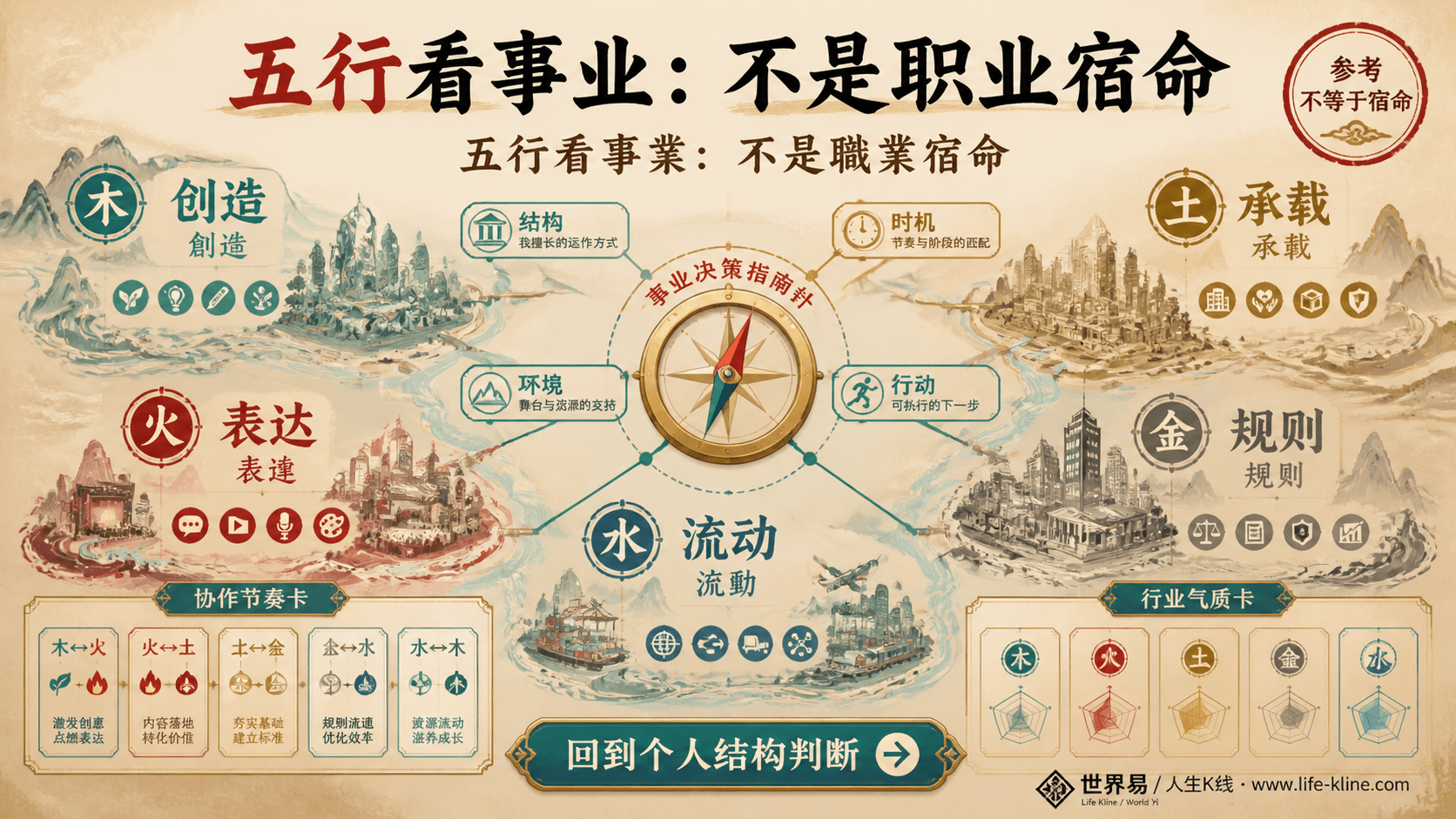
五行与事业领域图
这张图把《How BaZi Supports Career Timing Decisions Without Replacing Professional Judgment》里的命理概念转成关系、边界和应用场景,适合先看图建立结构,再回到知识文章正文理解细节。
五行不是职业标签,而是观察个人在事业中偏好的工作模式、环境适配性以及协作节奏的结构性工具。它帮助我们在特定时位与环境中做出更清晰的动作选择,降低决策中的不确定性。
查看图片解读