Feng Shui Huan Hexagram: The Symbolism of Dispersion and the Metaphysical Analysis of Turning Danger into Safety
把这篇文章落到自己身上验证:先看结构,再进入个人分析,不做泛泛阅读。
Concept Definition
Feng Shui Huan is one of the sixty-four hexagrams, composed of the lower trigram Kan (Water 坎, Kǎn) and the upper trigram Xun (Wind 巽, Xùn). The character 'Huan' (涣) means to scatter or disperse. The image of wind moving over water forms the symbolic representation of Feng Shui Huan. This hexagram symbolizes the state of dispersion and dissolution, reflecting the transformation of things from gathering to scattering, from obstruction to smooth flow.
The sixty-four hexagrams are formed by stacking two of the eight basic trigrams, each hexagram consisting of six lines (yao) arranged from bottom (first yao) to top (sixth yao). The structural characteristics of Feng Shui Huan determine its symbolic meaning and scope of application, emphasizing the dynamic movement of wind over water, and implying the power of dispersion and turning danger into safety.
In metaphysical divination, Feng Shui Huan is not merely an abstract symbol but an important basis for judging the developmental trend of matters. It reminds people that when facing chaos or crisis, one should adopt strategies of dispersion and relief to resolve difficulties, avoiding chaotic scattering without direction.
Traditional Metaphysical Significance
In traditional I Ching and metaphysics, the Feng Shui Huan hexagram primarily represents the power of dispersion and resolution. The phrase 'Huan zhe san ye, feng xing shui shang' (涣者散也,风行水上) expresses how wind disperses the mist on the water surface, symbolizing the gradual elimination of difficulties and obstacles, leading to clarity and smooth progress.
This hexagram emphasizes 'Yi yi san ji xian' (宜以散济险), meaning that through appropriate dispersion and relief, danger can be transformed into safety, preventing deterioration of the situation. Feng Shui Huan indicates that when handling complex situations, one should avoid forcibly gathering which causes tension and blockage, and instead flexibly adjust and disperse pressure to achieve the effect of turning crisis into peace.
Moreover, Feng Shui Huan also warns against 'Si san wu gui' (四散无归), meaning chaotic scattering without return leads to lack of belonging and is unfavorable for stability and development. In metaphysical interpretation, Feng Shui Huan reminds people to maintain order and affiliation while dispersing, ensuring dispersion without disorder to reach the ideal state of dissolution and clarity.
Practical Configuration and Interpretation
In Six Yao divination, the application of Feng Shui Huan depends on the specific configuration of the Shi Yao (世爻, the self line), Ying Yao (应爻, the opposite line), and Yong Shen (用神, favorable element), combined with the Sheng-Ke (生克, generating and overcoming) relationships to judge the auspiciousness and inauspiciousness of matters. The dispersion and danger-resolving characteristics of Feng Shui Huan often suggest the need to adopt flexible and adaptive strategies to resolve conflicts and obstacles.
In Plum Blossom Numerology (Meihua Yishu), the auspiciousness of Feng Shui Huan is interpreted through the Sheng-Ke changes between the Ti (体, body) and Yong (用, function). The reasonable Sheng-Ke relationship reflects the wisdom of 'dispersing to aid danger' embodied in Feng Shui Huan, indicating that even in seemingly dispersed situations, solutions can be found to achieve stability and development.
In practical life, the concept of Feng Shui Huan can be used to resolve interpersonal conflicts, bottlenecks in career, and so forth. By appropriately dispersing resources and pressure, one can avoid escalation of tense situations and thus achieve easing of circumstances and problem resolution.
Common Misunderstandings
Many people misunderstand the Feng Shui Huan hexagram as merely indicating negative dispersion and disorder. In fact, Feng Shui Huan emphasizes orderly dispersion and the wisdom of turning danger into safety. Blindly scattering without return is precisely what Feng Shui Huan warns against; true 'Huan' is dissolution and clarity, where dispersion carries the power of resolution and reorganization.
Another misunderstanding is equating Feng Shui Huan simply with Feng Shui (风水) practice related to environmental arrangement, overlooking its unique symbolic meaning as one of the sixty-four I Ching hexagrams. Feng Shui Huan more so reflects the state and trend of change in matters rather than specific environmental layouts.
FAQ
Question: What is the specific meaning of the character 'Huan' (涣) in the Feng Shui Huan hexagram? Answer: 'Huan' means to disperse or dissolve. The Feng Shui Huan hexagram symbolizes wind moving over water, indicating that things scatter from gathering, enabling difficulties to gradually dissolve and reach a state of clarity and dissolution.
Question: How is the Feng Shui Huan hexagram interpreted in Six Yao divination? Answer: Six Yao divination centers on the Shi Yao (self line), Ying Yao (opposite line), and Yong Shen (favorable element), combined with Sheng-Ke relationships to determine auspiciousness. Feng Shui Huan suggests adopting strategies of dispersion and resolution to cope with danger, avoiding chaotic scattering that leads to stagnation.
Question: What does 'Yi yi san ji xian' (宜以散济险) mean in the Feng Shui Huan hexagram? Answer: It means that when facing danger and difficulties, one should adopt methods of dispersing and guiding to resolve risks, avoiding accumulation that causes blockage or exacerbates problems.
Question: How does Feng Shui Huan differ from other sixty-four hexagrams? Answer: Feng Shui Huan is composed of the lower trigram Kan (Water 坎, Kǎn) and the upper trigram Xun (Wind 巽, Xùn), symbolizing wind moving over water and emphasizing the process of dispersion and danger resolution. Its unique hexagram meaning focuses on the wisdom of dissolving obstacles within the I Ching system.
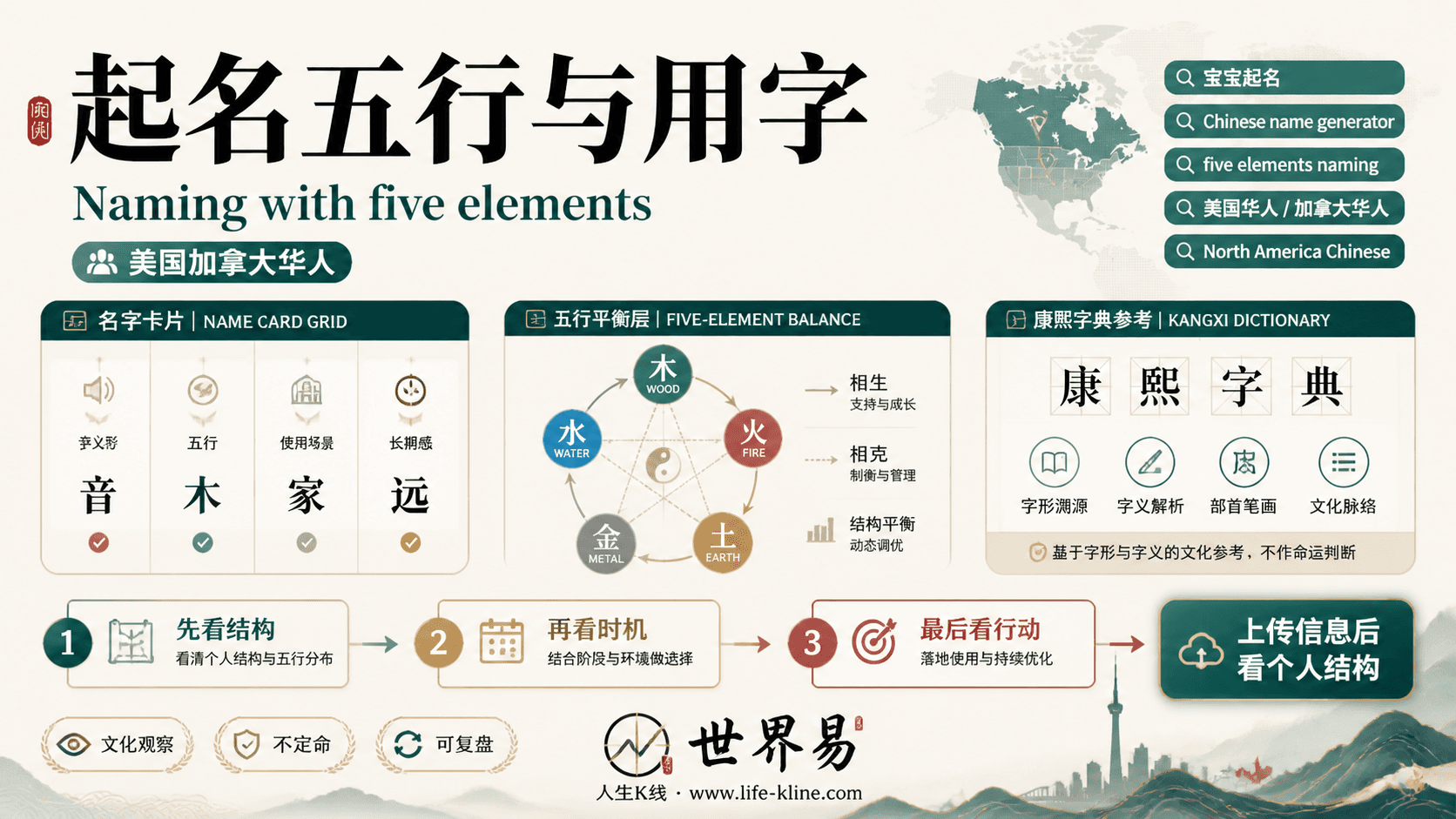
起名五行与用字|美国加拿大华人
这张图把《Feng Shui Huan Hexagram: The Symbolism of Dispersion and the Metaphysical Analysis of Turning Danger into Safety》里的命理概念转成关系、边界和应用场景,适合先看图建立结构,再回到知识文章正文理解细节。
起名五行与用字不应被写成固定结论。更适合美国加拿大华人的读法,是把传统术语翻译成结构、时机、环境、行动和复盘。
查看图片解读