Feng Shui Huan: The Mysteries of Wind Over Water and Six Line Divination
把这篇文章落到自己身上验证:先看结构,再进入个人分析,不做泛泛阅读。
Concept Definition
Feng Shui Huan is the sixteenth hexagram of the sixty-four hexagrams. Its structural image consists of Kan water below and Xun wind above, meaning the lower trigram is Kan (Water) and the upper trigram is Xun (Wind). Within the system where the 64 hexagrams are formed by stacking two trigrams, each hexagram possesses six line positions, numbered sequentially from bottom to top as the First Line to the Sixth Line. The wind blows above while the water flows below; when they meet, they form the image of wind blowing over water.
Huan means dispersion. The core imagery of this hexagram lies in scattering and circulation. When wind blows over water, ripples spread, much like ice melting under the wind, hence the meaning of 'complete melting of ice'. It represents both a state where things spread outward and a turning point where troubles are blown away and difficulties are resolved. This dynamic balance reflects the natural laws of Yin-Yang fluctuation and the flow of Qi (energy).
This hexagram holds an important position in the systems of fate and divination, regarded as a changing situation that requires active response. It does not simply represent decline; rather, it emphasizes finding vitality amidst dispersion to mitigate danger. When a situation presents the image of dispersion, forcing cohesion often backfires. Only by following the trend of wind blowing over water can one turn danger into safety and achieve a new state of harmony.
Traditional Metaphysical Significance
The meaning of the Huan hexagram is clear: it signifies dispersion and the complete melting of ice. Wind blowing over water causes the water to flow with the waves, symbolizing the scattering of human hearts or the dissipation of wealth. In traditional interpretations, this hexagram often appears in situations involving estranged interpersonal relationships, the disintegration of teams, or the loss of funds. However, its positive aspect lies in 'complete melting of ice,' meaning that long-standing stalemates and frozen states will be broken, and old grudges or predicaments may be resolved.
The principle of 'using dispersion to mitigate danger' is crucial for Feng Shui Huan. When facing massive risks or an unsolvable deadlock, stubbornly holding on will only intensify the risk. At such times, one should adopt a strategy of dispersion, such as breaking a whole into parts,分流 (diverting) resources, or adjusting direction, to overcome hardness with softness. The warning 'unsuitable for aimless scattering' alerts people that while energy or resources may need to be dispersed, there must be a clear destination and direction. One cannot scatter one's heart without a goal, leading to failure and chaos.
In the arrangement of the sixty-four hexagrams, Feng Shui Huan follows the Dui hexagram and precedes the Zhen hexagram, symbolizing a shift from joy to turmoil, and then from turmoil back to vitality. It reflects the wave-like progression of things in development. For personal fortune, this hexagram reminds one to remain alert amidst busyness and travel, avoiding blind expansion. One must learn to find stable pivots amidst flow to deal with various variables and challenges in life.
Practical Configuration and Interpretation
In Liu Yao divination, the core of Feng Shui Huan lies in the Self (Shi), Respondent (Ying), Useful God, and the Five Elements' generation and overcoming (Sheng Ke). The Useful God represents the matter being queried; for example, wealth is seen via the Wealth line, and official status via the Official/Ghost line. If the Self (Shi) represents oneself, one must observe its strength and its relationship with the Useful God. Under the image of the Huan hexagram, if the Useful God is severely overcome and lacks support, the matter signifies dispersion and failure. If the Useful God receives generation and can support the Self, although amidst dispersion, one can find resolution by adapting to the timing.
Plum Blossom Divination determines fortune and misfortune based on the generation and overcoming between the Body and Use. In the casting of Feng Shui Huan, usually the upper trigram is taken as the Use and the lower trigram as the Body, or vice versa. If the Body generates the Use, it signifies active giving, favorable for scattering wealth or sacrificing the small for the greater. If the Use generates the Body, it signifies passive gain, where the external environment's dispersion actually benefits oneself. If Body and Use overcome each other, it signifies obstacles; if they protect each other, it signifies stability. This method emphasizes dynamic balance, judging the trend of development through the flow of generation and overcoming.
In practical application, the Feng Shui Huan hexagram often appears at moments of decision-making. For example, in investment, seeing this hexagram suggests a strategy of phased investment and risk dispersion, unsuitable for placing heavy bets on a single project. In interpersonal relationships, if this hexagram appears, one should not force bonds but give each other space, expecting natural resolution over time. For enterprises, this hexagram suggests that organizational structures need flexible adjustments to avoid rigid hierarchies, using decentralization and flow to stimulate vitality, turning potential dispersion into a source of innovation.
Common Misconceptions
Misconception 1: Treating Feng Shui Huan as purely a bad hexagram. Many people, upon seeing the character 'Huan' (dispersion), associate it with scattering wealth or breaking up, believing all is lost. In reality, Feng Shui Huan also signifies 'complete melting of ice,' being a sign of predicament resolution. If encountering the predicament of Water and Fire not yet completed, seeing this hexagram often means a turning point is coming. The key lies in whether one can adapt to the wisdom of 'using dispersion to mitigate danger,' rather than resisting change blindly.
Misconception 2: Believing that if the hexagram image is one of dispersion, one should give up completely. The 'unsuitable for aimless scattering' of Feng Shui Huan clearly points out the importance of direction. Blindly running around aimlessly or dispersing resources without a destination will only lead to true failure. The correct approach is to maintain clarity of core goals amidst dispersion. Like water that scatters but ultimately returns to the sea, only a dispersion with a destination can achieve great undertakings.
FAQ
Question: When the Feng Shui Huan hexagram appears, is there hope for one's career? Answer: Yes, but strategy needs adjustment. Feng Shui Huan signifies 'complete melting of ice,' meaning old obstacles may be removed. However, a career should not cling to the status quo; one should adopt a flexible and varied approach with dispersed investment to deal with market or environmental fluctuations and find new breakthrough points.
Question: How to judge fortune and misfortune when seeking wealth sees Feng Shui Huan? Answer: Specific analysis must be combined with Liu Yao or Plum Blossom Divination. If the Useful God is prosperous and can support the Self, or if the Body receives generation from the Use, wealth sources may be scattered but will flow back to oneself, belonging to 'seeking wealth through dispersion.' If the Useful God is overcome or Body and Use overcome each other, it signifies the leakage of wealth Qi; one must be cautious of fund loss.
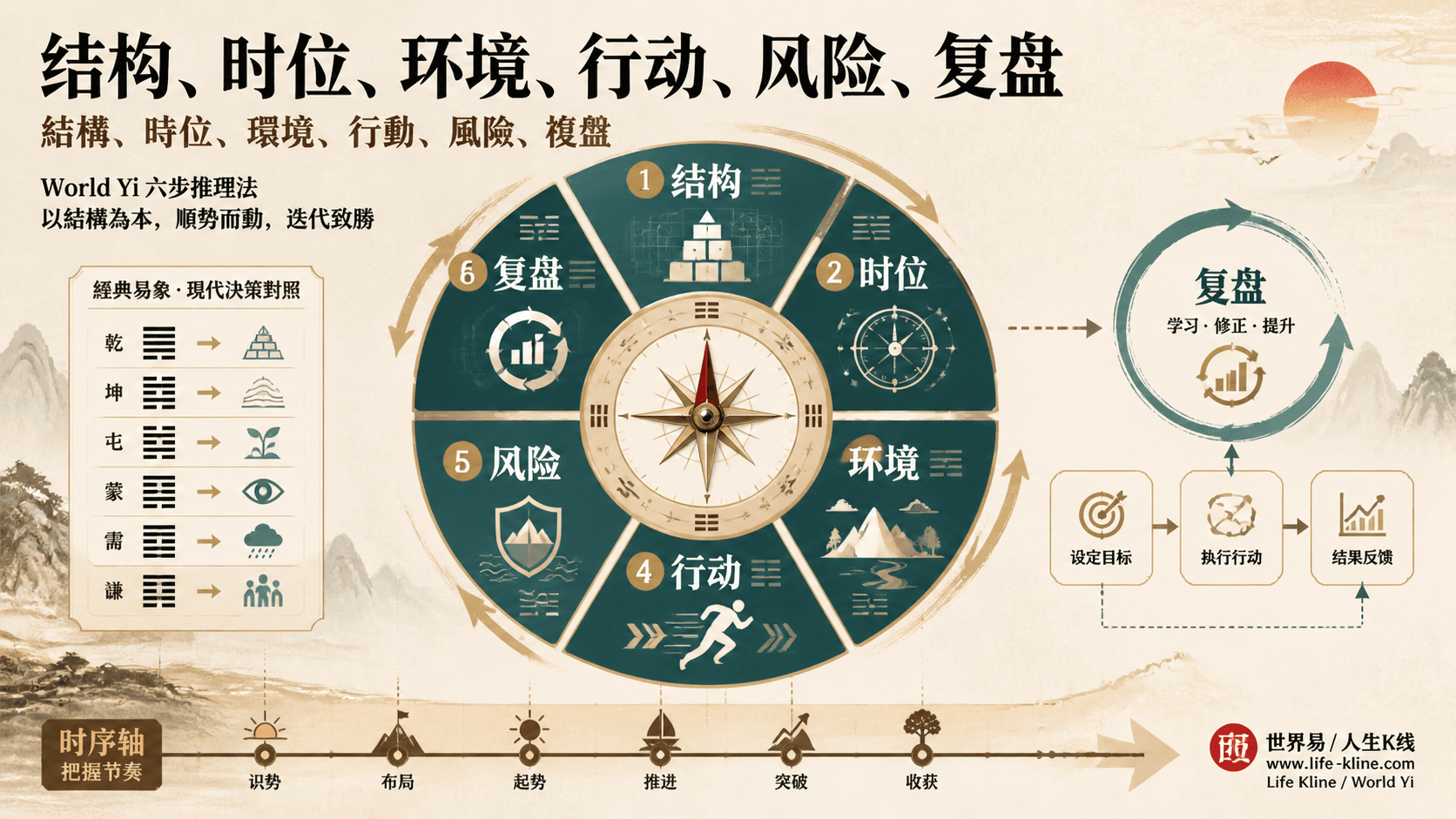
世界易六步判断法
这张图把《Feng Shui Huan: The Mysteries of Wind Over Water and Six Line Divination》接回世界易的判断语言:结构、时位、环境、行动与复盘,避免只停留在概念阅读。
世界易不是把未来说成固定结论,而是把判断拆成结构、时位、环境、行动、风险和复盘六个环节。