Detailed Explanation of the Thunder-Water Jie Hexagram and Its Applications in Fate Analysis
把这篇文章落到自己身上验证:先看结构,再进入个人分析,不做泛泛阅读。
Concept Definition
The Thunder-Water Jie Hexagram is one of the 64 hexagrams in the I Ching, composed of the lower trigram Kan (坎 Kǎn, Water) and the upper trigram Zhen (震 Zhèn, Thunder). According to the hexagram symbolism, Kan represents danger, and Zhen represents movement; combined, they symbolize the relief and mitigation of perilous difficulties. The character 'Jie' (解) originally means to ease or resolve, reflecting the process of emerging from adversity.
Each hexagram consists of six lines (Yao), counted from bottom to top as the first line (初爻 chū yáo) to the top line (上爻 shàng yáo). The structure of the Thunder-Water Jie Hexagram embodies the dynamic of thunder moving within water, implying a turning point and breakthrough amid obstacles. This hexagram emphasizes timely and decisive action, avoiding hesitation.
In ancient times, the 64 hexagrams of the I Ching were formed by stacking two of the eight fundamental trigrams. The Thunder-Water Jie is one such compound hexagram. Its meaning clearly indicates the removal and easing of danger, symbolizing the resolution of problems and escape from difficulties.
Traditional Fate Significance
The traditional meaning of the Thunder-Water Jie Hexagram revolves around the concept of 'Jie' (解), which signifies easing and resolving danger, embodying the ability to extricate oneself from crises. Kan (Water) represents danger, and Zhen (Thunder) represents movement; their combination symbolizes the interaction of yin and yang bringing about turning points and change, emphasizing overcoming difficulties through transformation.
This hexagram advocates liberation and easing, implying that when encountering obstacles, one should take action and actively seek ways to escape difficulties. It also suggests favoring the southwest direction, as in traditional directional theory, the southwest corresponds beneficially with this hexagram, promoting problem resolution.
However, the Thunder-Water Jie Hexagram simultaneously warns against hesitation. Fate analysis stresses the importance of decisiveness; hesitation often deepens danger and causes missed opportunities for relief. Therefore, when encountering this hexagram, one must act decisively to truly resolve difficulties and escape danger.
Practical Configuration and Interpretation
In Six Yao divination, interpreting the Thunder-Water Jie Hexagram depends on analyzing the relationships of Sheng (生, generating) and Ke (克, overcoming) among the Shi Yao (世爻, the self line), Ying Yao (应爻, the responding line), and the Yong Shen (用神, favorable element). By examining these factors, one can judge whether the matters indicated by the Jie Hexagram will be smoothly resolved. If the Yong Shen is supported (Sheng) and not overcome (Ke), it suggests the problem is likely to be solved and the Jie Hexagram’s effect manifests.
In Plum Blossom Numerology, the auspiciousness or inauspiciousness is determined by the Sheng-Ke relationships between the Ti (体, body) and Yong (用, use). The Thunder-Water Jie Hexagram similarly symbolizes overcoming danger and difficulty. It advises the diviner to seize the moment and take appropriate action, avoiding hesitation and delay.
In practical applications, the Thunder-Water Jie Hexagram is commonly used to judge whether a predicament can be resolved, whether an illness will improve, or whether disputes will be settled. When configuring, attention should be paid to the dynamic changes and Sheng-Ke relationships within the hexagram, combined with directional guidance to enhance interpretative accuracy.
Common Misconceptions
Many mistakenly believe that the Thunder-Water Jie Hexagram solely represents good fortune and liberation, overlooking its warning against hesitation. In fact, the Jie Hexagram emphasizes proactive initiative; indecision can deepen difficulties.
Another misconception is neglecting the beneficial southwest direction. Although directional influence may be lessened in modern life, traditional fate theory still emphasizes directional assistance. Properly utilizing the southwest’s favorable energy helps maximize the positive effects of the Jie Hexagram.
FAQ
Question: How is auspiciousness or inauspiciousness judged in the Six Yao method for the Thunder-Water Jie Hexagram? Answer: The Six Yao method analyzes the Sheng-Ke relationships among the Shi Yao (self line), Ying Yao (responding line), and Yong Shen (favorable element) to determine fortune. If the Yong Shen is generated (Sheng) and not overcome (Ke), it generally indicates the problem can be resolved and is auspicious; otherwise, obstacles to resolution may arise.
Question: Why does the Thunder-Water Jie Hexagram warn against hesitation? Answer: The Jie Hexagram advocates proactive and decisive action. Hesitation may cause missed opportunities to solve problems and even worsen danger. Thus, decisiveness and action are key to the hexagram’s success.
Question: Why is the southwest direction favored for the Thunder-Water Jie Hexagram? Answer: In traditional fate theory, the southwest direction aligns with the hexagram’s energy field, facilitating problem resolution and easing adverse factors. Utilizing this direction helps enhance the hexagram’s positive influence.
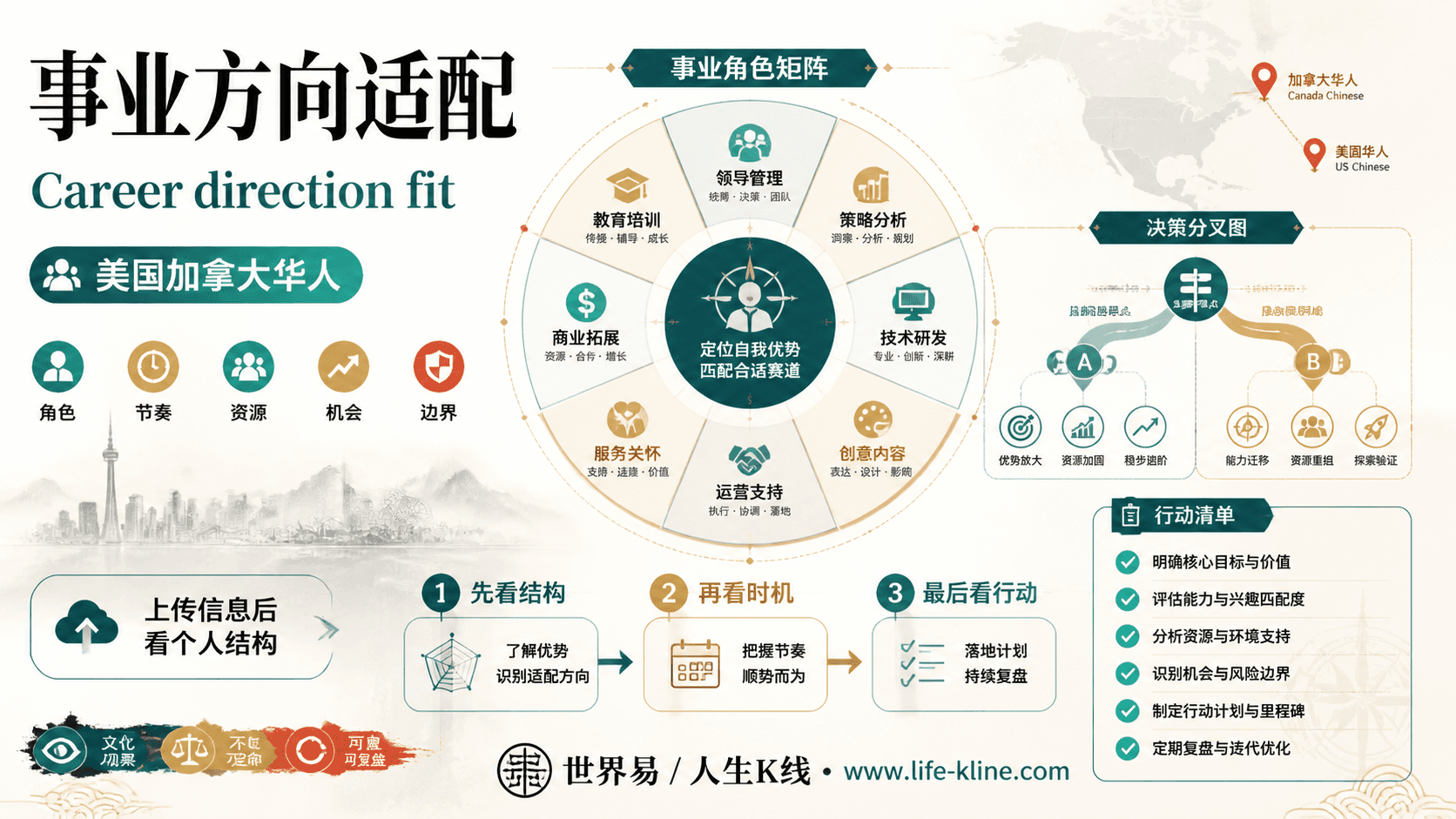
事业方向适配|美国加拿大华人
这张图把《Detailed Explanation of the Thunder-Water Jie Hexagram and Its Applications in Fate Analysis》里的命理概念转成关系、边界和应用场景,适合先看图建立结构,再回到知识文章正文理解细节。
事业方向适配不应被写成固定结论。更适合美国加拿大华人的读法,是把传统术语翻译成结构、时机、环境、行动和复盘。
查看图片解读