Detailed Explanation of the Lei Shan Xiao Guo Hexagram and Its Fate Applications
把这篇文章落到自己身上验证:先看结构,再进入个人分析,不做泛泛阅读。
Concept Definition
The Lei Shan Xiao Guo hexagram is one of the 64 hexagrams in the I Ching, formed by stacking the Gen hexagram (艮, Mountain) below and the Zhen hexagram (震, Thunder) above. According to the structure rules of the 64 hexagrams, each hexagram consists of two trigrams of three lines each, combined to form six lines (Yao) from bottom to top, named the first Yao, second Yao, third Yao, fourth Yao, fifth Yao, and top Yao. The image of the Xiao Guo hexagram shows thunder beneath the mountain, symbolizing a slight surpassing or minor fault, hence the name “Lei Shan Xiao Guo.”
In terms of meaning, “Xiao Guo” (small excess) refers to a slight deviation beyond the norm, reminding people that small matters can be moderately transcended, but major affairs require caution. The hexagram’s statement particularly emphasizes “favor softness over hardness and avoid drastic actions,” indicating that one should handle matters gently and avoid aggressive moves or excessive risk-taking.
As one of the 64 hexagrams, Lei Shan Xiao Guo has a clear position and application within traditional fate studies and divination systems. Combined with Six Yao methods and Plum Blossom numerology, it can provide a basis for judging auspiciousness and inauspiciousness, as well as for seeking benefits and avoiding harm.
Traditional Fate Significance
In traditional fate studies, the Lei Shan Xiao Guo hexagram symbolizes a subtle state that holds both the possibility of breakthrough and accompanying risks. Gen (艮) represents the mountain, symbolizing stillness and cessation; Zhen (震) represents thunder, symbolizing movement and activation. Their combination reflects a slight change on a stable foundation, implying that small matters can be surpassed, but rash major actions should be avoided to prevent unfavorable outcomes.
From a fate perspective, the Xiao Guo hexagram advises people to pay attention to moderation when handling affairs, especially in important decisions or significant changes, recommending caution and restraint. A gentle approach can resolve conflicts and avoid the clashes and losses caused by rigidity, which aligns closely with the hexagram’s guiding principle of “favor softness over hardness.”
Moreover, the meaning of the Xiao Guo hexagram is also reflected in fate elements such as solar terms and monthly pillars, emphasizing the need to follow natural rhythms and to adjust actions appropriately and timely to maintain overall balance and harmony.
Practical Configuration and Interpretation
In Six Yao divination, the core interpretation of the Lei Shan Xiao Guo hexagram revolves around the interactions of the Shi Yao (世爻, the ‘Self’ line), Ying Yao (应爻, the ‘Other’ line), and the Yong Shen (用神, favorable element) through their generating and overcoming (sheng-ke) relationships. By observing the changes in the Yao texts and their interactions with the Yong Shen, one can judge the auspiciousness or inauspiciousness of the matters involved. Xiao Guo emphasizes that small matters can be passed, meaning that when divining relatively minor issues, the hexagram tends to be auspicious, but major matters require caution.
Plum Blossom numerology uses the generating and overcoming relationships between the Ti (体, body) and Yong (用, function) to determine the hexagram’s auspiciousness. The Xiao Guo hexagram reflects a slight boundary crossing within the Ti-Yong generating and overcoming cycle, advising the diviner to favor softness over hardness and to avoid drastic actions or recklessness. In practical configurations, when encountering the Xiao Guo hexagram, the diviner should carefully analyze the urgency and importance of the event and combine other hexagram information to make reasonable judgments.
In daily life, the Xiao Guo hexagram can be likened to walking under thunder in the mountains—there is external shaking influence from thunder, yet the mountain provides stable support. Actions at this time should be cautious and gentle, avoiding impatience and drastic moves to ensure safety and smooth progress.
Common Misunderstandings
First, some mistakenly believe that the Xiao Guo hexagram encourages bold recklessness. In fact, the hexagram clearly states “small matters can be passed, major matters require caution,” emphasizing moderate breakthrough rather than ignoring risks with drastic actions. Being overly aggressive easily contradicts the hexagram’s original intent and leads to unfavorable situations.
Second, some ignore the distinction between softness and hardness and blindly insist on rigidity. The Lei Shan Xiao Guo hexagram particularly forbids drastic moves and hardness, favoring softness over hardness. Ignoring this may exacerbate conflicts and cause loss of the original stable foundation.
FAQ
Question: Why does the Lei Shan Xiao Guo hexagram emphasize “favor softness over hardness”? Answer: Because the mountain (Gen, 艮) symbolizes stillness and stability, while thunder (Zhen, 震) symbolizes movement and activation. Their combination indicates that during change, one must maintain gentleness and avoid rigid conflict, handling matters cautiously to ensure safety and smoothness.
Question: How should one judge auspiciousness or inauspiciousness when encountering the Xiao Guo hexagram in Six Yao divination? Answer: One should analyze the generating and overcoming relationships among the Shi Yao (Self line), Ying Yao (Other line), and Yong Shen (favorable element), considering the importance and urgency of the matter. The Xiao Guo hexagram suggests that small matters are mostly auspicious, while major matters require caution; thus, flexible judgment according to the specific situation is necessary to avoid recklessness.

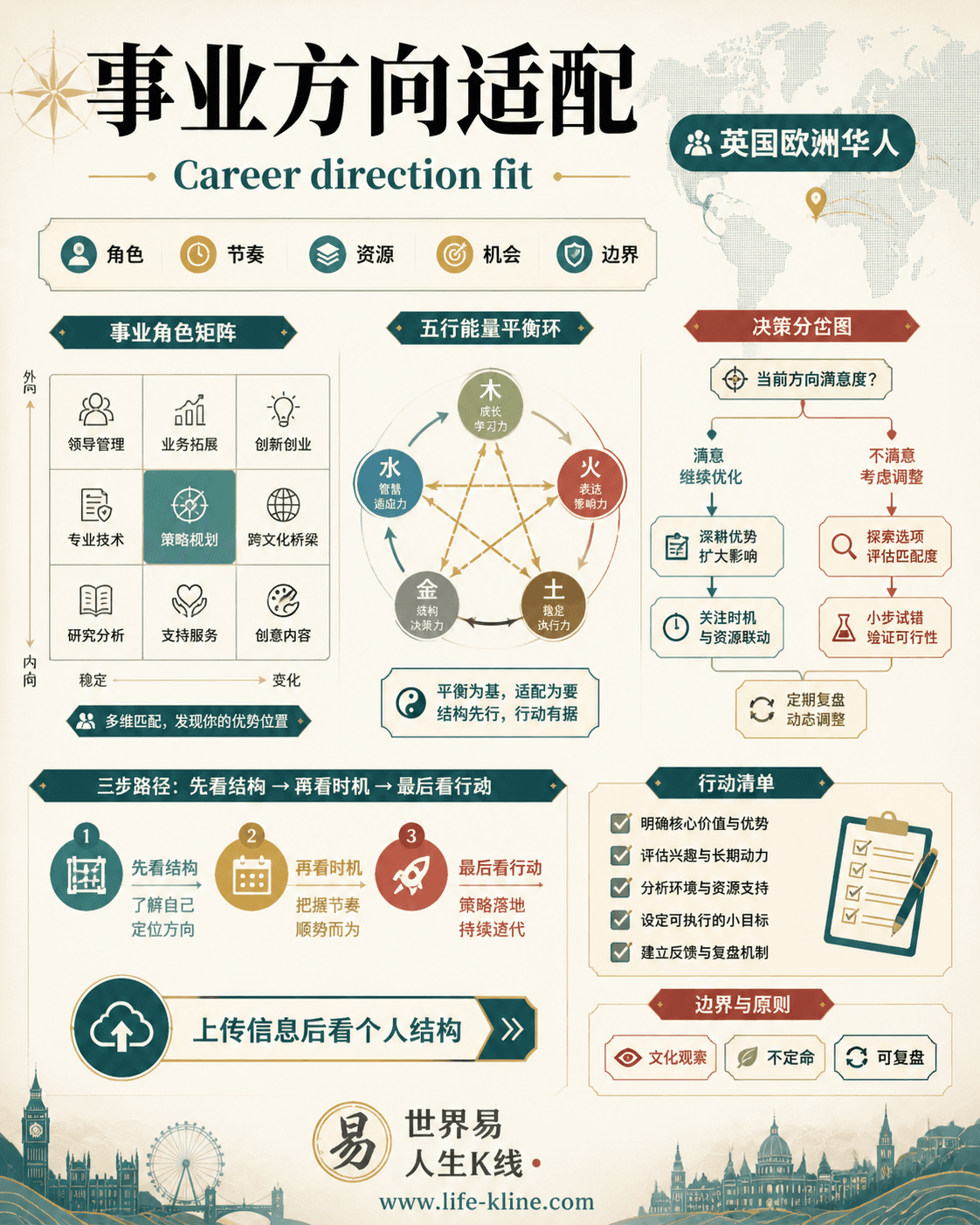
事业方向适配|美国加拿大华人
这张图把《Detailed Explanation of the Lei Shan Xiao Guo Hexagram and Its Fate Applications》里的命理概念转成关系、边界和应用场景,适合先看图建立结构,再回到知识文章正文理解细节。
事业方向适配不应被写成固定结论。更适合美国加拿大华人的读法,是把传统术语翻译成结构、时机、环境、行动和复盘。
查看图片解读