Detailed Explanation of the Fire-Wind Ding Hexagram and Its Applications in Fate Analysis
把这篇文章落到自己身上验证:先看结构,再进入个人分析,不做泛泛阅读。
Concept Definition
The Fire-Wind Ding hexagram is one of the sixty-four hexagrams in the I Ching, formed by stacking two three-line trigrams: the lower trigram is Xun (巽, Wind), and the upper trigram is Li (离, Fire). The entire hexagram consists of six lines (yao), arranged from bottom (first yao) to top (sixth yao). The character 'Ding' (鼎) originally refers to a vessel commonly used for cooking and positioning, symbolizing a fixed and stable state.
From the hexagram’s structure, Xun represents wind and Li represents fire. The interaction of wind and fire forms the Ding, implying achieving new establishment through stability and dedication. In the I Ching, the Fire-Wind Ding hexagram symbolizes the establishment and regulation of things, emphasizing that behavior should be solemn and courteous, reflecting a respect for tradition and order.
In fate divination, the Fire-Wind Ding hexagram not only represents stability and dedication but also warns against frivolous conduct. Its symbolism is rich, encompassing both the material aspect of positioning and the spiritual aspect of reverence and propriety, serving as an important window to understand the cultural connotations of the hexagram.
Traditional Fate Significance
In traditional fate studies, the Fire-Wind Ding hexagram signifies new establishment and stability. The 'Ding' as a cooking vessel symbolizes cooking and positioning, implying that after adjustments, matters tend toward stability. This hexagram stresses that in career building and life decisions, one should maintain inner firmness and pay attention to rules and etiquette to achieve lasting development.
The hexagram emphasizes 'respect propriety, avoid frivolity,' indicating that respect and etiquette are keys to success in actions and interpersonal dealings, while rashness and impatience often lead to failure. Traditional fate theory holds that respecting ritual and law is the foundation of stability and growth, aligning with the spirit of the Fire-Wind Ding hexagram.
Within the sixty-four hexagram system, the Fire-Wind Ding hexagram guides people to focus on dedication and responsibility, embodying social and familial accountability. This sense of responsibility and stability is a valued traditional cultural virtue and an important reference in fate judgment.
Practical Configuration and Interpretation
In Six Yao divination, interpreting the Fire-Wind Ding hexagram depends on the generating and overcoming relationships among the Shi Yao (世爻, self line), Ying Yao (应爻, opposing line), and Yong Shen (用神, favorable element). By analyzing the yin-yang changes of the six lines and their interactions combined with generating and overcoming transformations, one judges the auspiciousness and outcomes of events. Due to its characteristics of stability and dedication, the Fire-Wind Ding hexagram is often regarded as favorable for new establishment and maintaining achievements.
Plum Blossom Numerology determines fortune through the generating and overcoming relationships between the Ti (体, body) and Yong (用, use) elements. For the Fire-Wind Ding hexagram, the Ti is Xun (Wind) and the Yong is Li (Fire); these two elements generate and assist each other, reflecting a stable yet vibrant nature. In practical divination, this structure suggests conforming to natural laws and respecting propriety to overcome difficulties.
In application scenarios, the Fire-Wind Ding hexagram suits situations requiring the establishment of a new phase or consolidation of foundations, such as entrepreneurship or family stability. By understanding the hexagram’s symbolism, combined with specific line texts and generating/overcoming relationships, one can analyze event development trends in detail to guide decisions and actions.
Common Misconceptions
Many people oversimplify the Fire-Wind Ding hexagram by interpreting 'Ding' merely as a cooking tool, limiting understanding to the material level and neglecting its symbolic meaning in fate analysis. In fact, 'Ding' emphasizes the spiritual connotations of stability, positioning, and dedication, which is crucial when interpreting the hexagram.
Another common misconception is ignoring the admonition 'respect propriety, avoid frivolity.' Treating matters rashly may lead to misjudgments. The Fire-Wind Ding hexagram stresses etiquette and steadiness; therefore, in practical use, one should avoid subjective impulsiveness and impatience to ensure actions align with the hexagram’s guidance.
FAQ
Question: What does the Fire-Wind Ding hexagram symbolize among the sixty-four hexagrams? Answer: The Fire-Wind Ding hexagram symbolizes new establishment, stability, and dedication, emphasizing achieving stable development in career and life through respect for propriety and steady behavior.
Question: How is the Fire-Wind Ding hexagram interpreted in Six Yao divination? Answer: In Six Yao divination, the judgment mainly relies on the generating and overcoming relationships among the Shi Yao, Ying Yao, and Yong Shen. The Fire-Wind Ding hexagram usually indicates a stable foundation, advising respect for rules and caution against frivolous conduct.
Question: In what life scenarios is the Fire-Wind Ding hexagram suitable for application? Answer: This hexagram is suitable for situations requiring new establishment and consolidation, such as starting a business, family stability, or important decisions, emphasizing steadiness and dedication to ensure smooth development.
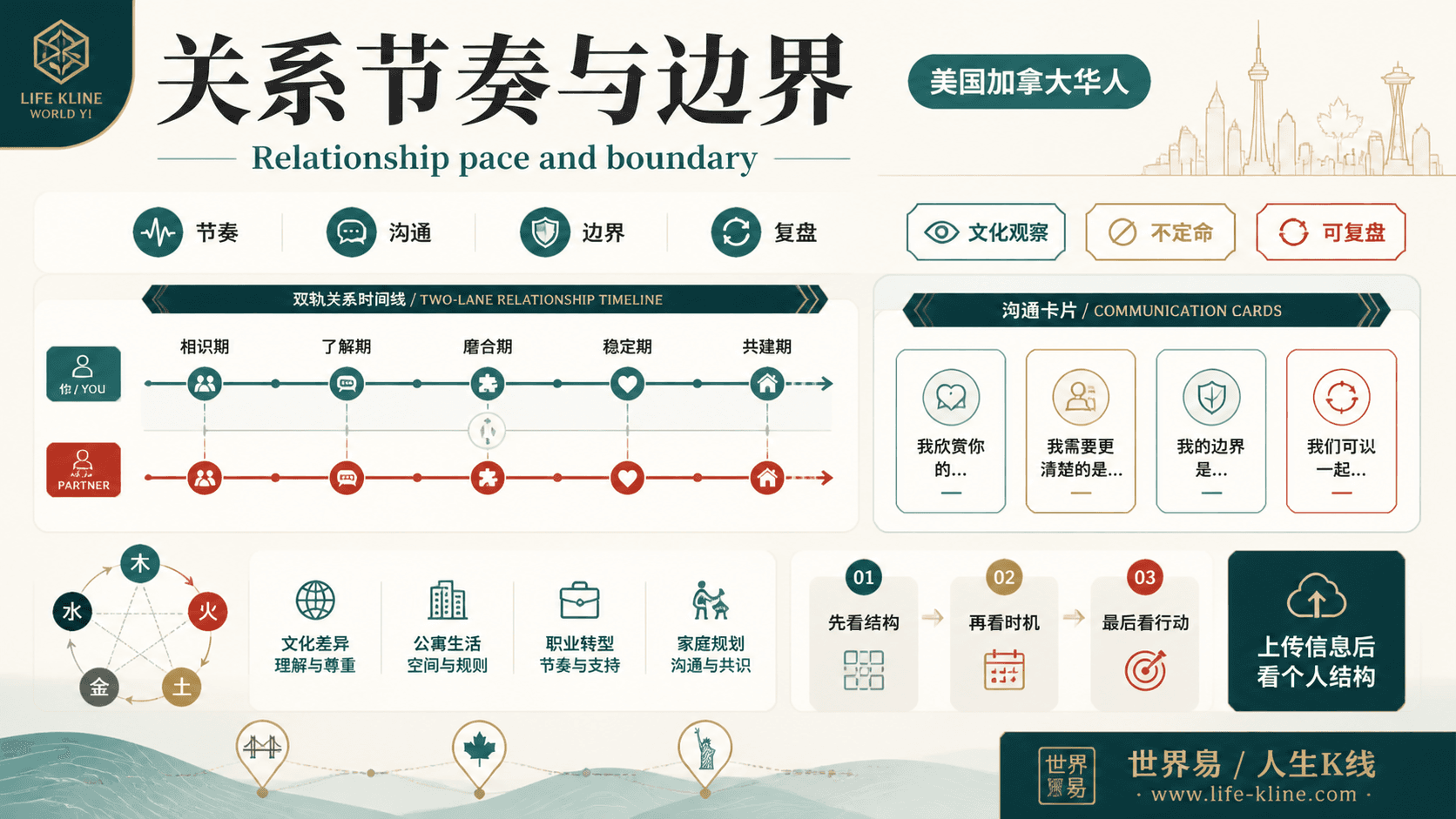
关系节奏与边界|美国加拿大华人
这张图把《Detailed Explanation of the Fire-Wind Ding Hexagram and Its Applications in Fate Analysis》里的命理概念转成关系、边界和应用场景,适合先看图建立结构,再回到知识文章正文理解细节。
关系节奏与边界不应被写成固定结论。更适合美国加拿大华人的读法,是把传统术语翻译成结构、时机、环境、行动和复盘。
查看图片解读