Water-Fire Ji Ji Hexagram: The Profound Metaphysical Meaning of Success and Maintenance
把这篇文章落到自己身上验证:先看结构,再进入个人分析,不做泛泛阅读。
Concept Definition
The Water-Fire Ji Ji hexagram is the 63rd of the 64 hexagrams, formed by the superposition of two trigrams: Li Fire below and Kan Water above. Its structure is rigorous, with the six lines of each hexagram arranged from bottom to top, forming a complete energy field from the initial line to the upper line. Li represents fire, symbolizing brightness and reliance, while Kan represents water, symbolizing danger and flow; their superposition creates a unique hexagram pattern.
The name of this hexagram originates from a profound observation of natural phenomena: water is above fire, fire does not burn the water, and water does not extinguish the fire; the two elements rely on each other to achieve balance. In the metaphysical system, this structure is regarded as a special state of stability, marking a critical node in the process of development. The order of counting the lines from bottom to top not only determines the arrangement of the hexagram but also implicitly contains the timeline and causal logic of the unfolding of affairs.
Within the system of the 64 hexagrams, Water-Fire Ji Ji and Fire-Water Wei Ji serve as the beginning and end, symbolizing the completion of development and a new beginning. It is not a state of eternal immobility, but rather a moment of dynamic balance. Understanding this concept requires grasping its structural characteristics and symbolic meaning, using it as an important coordinate for analyzing changes in fortune.
Traditional Metaphysical Significance
The hexagram meaning explicitly states Li below Kan above, water and fire harmonizing, and affairs being completed. This symbolizes that after a period of effort, contradictions have been resolved, goals have been achieved, and affairs have entered the concluding phase. At this time, the fortune is in a relatively stable and successful state, like having crossed the river to the other side where risks are temporarily eliminated; however, it also means that crisis is lurking.
Governing success and harmony is the core characteristic of this hexagram, but it is accompanied by a warning against complacency. The law of reversal at extremes is a basic principle in metaphysics; when everything seems perfect, it often signals the prelude to a turning point. The hexagram text emphasizes the need for maintenance, meaning that at this time one should not blindly expand or engage in high-risk changes, but rather consolidate existing achievements and maintain the current state of balance.
Discouraging rash action means one must not act impulsively due to temporary success, as this easily disrupts the existing harmony and leads to new imbalance. This metaphysical meaning reminds the querent to keep a clear head when facing success, to know how to sheath their sword, and to avoid losing everything due to excessive confidence or reckless behavior.
Practical Configuration and Judgment
In Liu Yao divination, the core to judging auspiciousness and inauspiciousness lies in the relationship between the world line, response line, useful god, and generation and control. When casting a hexagram yields Water-Fire Ji Ji, one must combine it with the specific useful god; if the useful god is in its proper position and supports the world line, it indicates achieving twice the result with half the effort, favoring the acquisition of wealth or official rank. The world line represents the querent themselves, while the response line represents the external environment; the generation and control relationship between the two directly determines the smoothness of the matter.
Mei Hua Yi Shu determines auspiciousness and inauspiciousness based on the generation and control between body and use. The moving trigram is regarded as the use hexagram, and the static trigram as the body hexagram. By observing the five elements generation and control between body and use, the result is inferred. If the body hexagram receives support from the use hexagram, the matter proceeds to completion; if the use hexagram controls the body hexagram, the matter faces obstacles. Within the framework of Water-Fire Ji Ji, special attention must be paid to the interaction between Li Fire and Kan Water five elements on the body and use.
In practical application, this hexagram often appears in consultations regarding career success, family harmony, or project completion. If asking about the future, it mostly indicates temporary stability, but one must be wary of undercurrents. If asking about illness, it indicates a stable condition but one must guard against recurrence. Regardless of what is being asked, maintenance should be the primary focus; one should not rashly start new projects or make major investment decisions to avoid disrupting the existing balance.
Common Misconceptions
The most common misconception is to regard Water-Fire Ji Ji as an absolute perfect ending state, believing that one can rest easy from this point forward. In reality, this hexagram is merely a阶段性 (staged) achievement in the process of development, not the endpoint. Metaphysics emphasizes dynamic change; success is often followed by new challenges and opportunities, and one must remain vigilant at all times.
Another misconception is ignoring the warning against complacency, believing that since affairs are completed, one can act with impunity. In fact, the hexagram meaning's discouragement of rash action is precisely a warning against this mindset. Many people make wrong decisions due to excessive confidence in favorable conditions, causing original success to turn into failure. This is the consequence of failing to understand the deep meaning of the hexagram.
FAQ
Question: Does the appearance of the Water-Fire Ji Ji hexagram mean all things will succeed? Answer: Not all things will succeed. The hexagram meaning governs success and harmony, but the premise is adhering to the principle of favoring maintenance and discouraging rash action. If one acts blindly at this time, it may instead disrupt the existing balance and lead to failure.
Question: How to judge specific auspiciousness and inauspiciousness in the Water-Fire Ji Ji hexagram? Answer: One needs to conduct specific analysis based on the world and response generation and control of Liu Yao method or the body and use generation and control of Mei Hua Yi Shu. If the useful god supports the world line or the body hexagram receives support, it is auspicious; otherwise, it is inauspicious, and one must pay special attention not to act rashly.
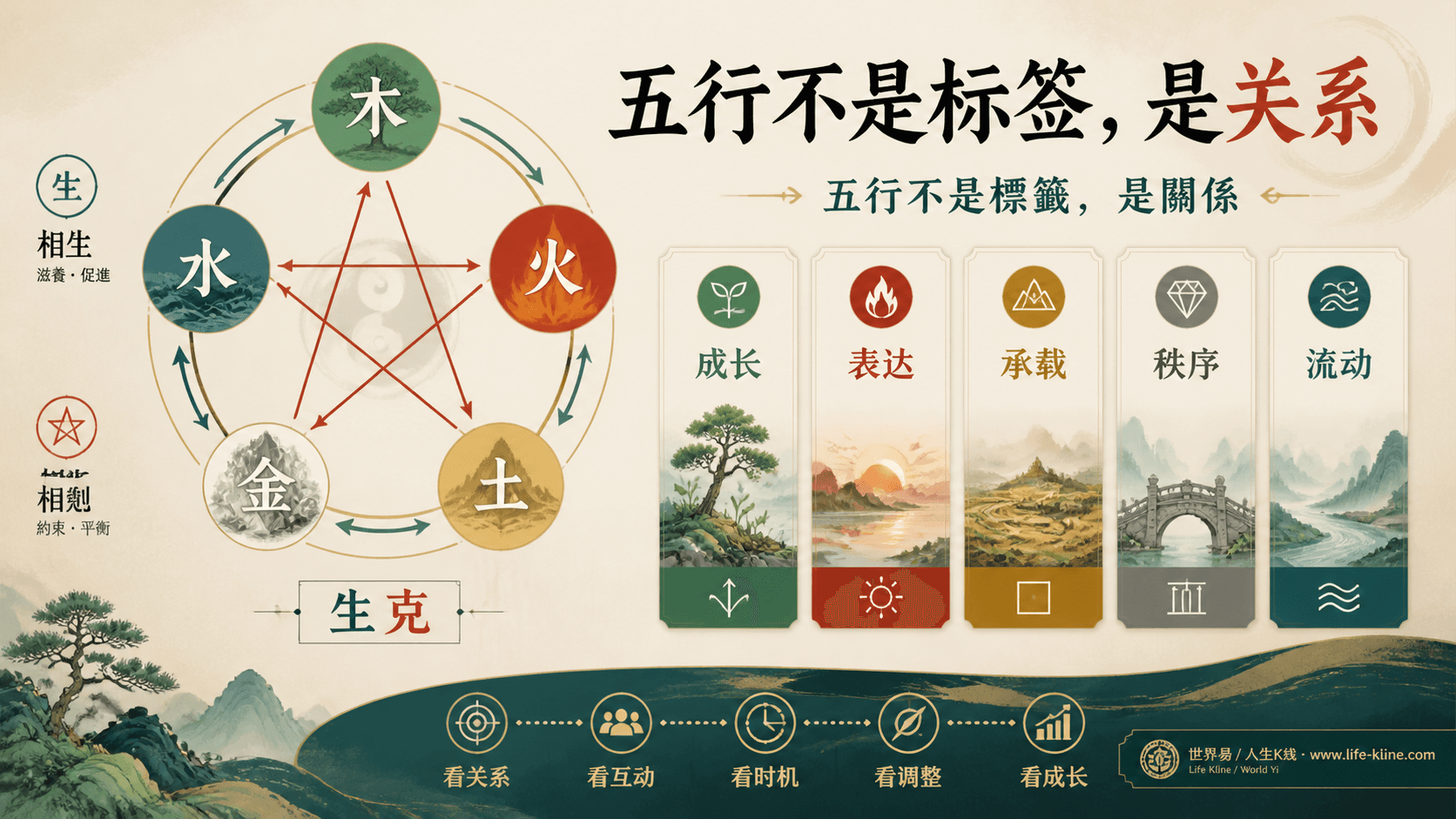
五行现代翻译图
这张图把《Water-Fire Ji Ji Hexagram: The Profound Metaphysical Meaning of Success and Maintenance》里的命理概念转成关系、边界和应用场景,适合先看图建立结构,再回到知识文章正文理解细节。
五行图把金木水火土从人格标签翻译成系统关系,帮助用户理解生克、承载和转化。