Detailed Explanation of Shan Huo Bi (Mountain Fire Bi) Hexagram: The Beauty of Ornamentation and Symbol of Etiquette Cultivation
把这篇文章落到自己身上验证:先看结构,再进入个人分析,不做泛泛阅读。
Concept Definition
Shan Huo Bi is one of the sixty-four hexagrams, formed by the lower trigram Li (Fire) and the upper trigram Gen (Mountain). Li represents fire, Gen represents mountain, symbolizing fire illuminating the mountain, creating a beautiful decorative scene. The character “Bi” (贲) means ornamentation, emphasizing the beauty of decoration, representing the meaning of adornment and embellishment. This hexagram advocates beautifying oneself and the environment through civilized etiquette and literary elegance, reflecting a sense of beauty that integrates both internal and external cultivation.
In the structure of the sixty-four hexagrams, each hexagram is composed of two trigrams stacked together, consisting of six lines (yao) from bottom to top, named from the first line (chu yao) to the top line (shang yao). The combination of Li below and Gen above in the Shan Huo Bi hexagram often associates it with ornamentation, cultivation, and etiquette in divination, symbolizing a refined attitude and lifestyle.
In divination, the Shan Huo Bi hexagram is often used to judge the coordination between the external appearance and internal substance of matters, reminding people to emphasize civilized etiquette and avoid situations where the exterior is strong but the interior is hollow.
Traditional Metaphysical Significance
The character “Bi” (贲) in the Shan Huo Bi hexagram originally means decoration and ornamentation, symbolizing beautification and embellishment of things. In traditional metaphysics, this hexagram emphasizes cultivation centered on literary elegance and etiquette, advocating internalizing spiritual cultivation through external civilized expression to achieve unity of inside and outside, form and spirit.
The hexagram’s composition of Li (Fire) below and Gen (Mountain) above has Li representing brightness and literary talent, while Gen symbolizes steadiness and cessation. This combination reflects carrying the beauty of ornamentation illuminated by brightness on a stable foundation. This pairing implies that during the process of embellishment and beautification, one must maintain inner solidity and steadiness, avoiding superficial and empty decoration.
Traditional metaphysics holds that the Shan Huo Bi hexagram favors civilized etiquette and forbids being strong outside but hollow inside. Relying solely on an imposing exterior while lacking inner substance is considered inauspicious. This hexagram encourages people to focus on inner content in decoration and expression, avoiding ostentatious superficiality.
Practical Configuration and Interpretation
In the Six Yao divination method, the core interpretation of the Shan Huo Bi hexagram relies on the relationships of Sheng-Ke (generating and overcoming) among the Shi Yao (世爻, the self line), Ying Yao (应爻, the responding line), and Yong Shen (用神, the favorable element). By analyzing these factors, one can judge the auspiciousness regarding ornamentation and etiquette, deciding whether it is appropriate to proceed with decoration and beautification. This hexagram suggests that if the Yong Shen is supported (得到生), symbolizing proper literary talent and ornamentation, the outcome is mostly auspicious; otherwise, caution is advised.
In the Plum Blossom Numerology (Meihua Yishu), the Shan Huo Bi hexagram determines auspiciousness through the Sheng-Ke relationship between the Ti (体, root/foundation) and Yong (用, function/expression). Ti represents the fundamental base, while Yong represents external manifestation. If these two harmonize and support each other, it indicates that ornamentation and cultivation complement each other, which is auspicious; if the Sheng-Ke relationship is unfavorable, it implies disharmony between appearance and essence, potentially leading to failure or difficulties.
The Shan Huo Bi hexagram is suitable for configurations requiring attention to external beautification and cultural etiquette occasions. For example, in etiquette planning, cultural event organization, and image design, the hexagram can guide how to balance external decoration with inner cultivation to achieve the best results.
Common Misconceptions
One common misconception is to interpret the Shan Huo Bi hexagram solely as external decoration, neglecting its emphasis on internal solidity and etiquette cultivation. In fact, although the hexagram focuses on the beauty of ornamentation, it warns against being strong outside but hollow inside, reminding people to maintain a balance between internal and external cultivation.
Another misconception is ignoring the symbolic meanings of Li (Fire) and Gen (Mountain) in the hexagram, simply viewing it as superficial splendor without combining it with a stable foundation. The correct understanding is that the bright literary talent (Li) is established on a solid base (Gen), reflecting the deeper connotation of civilized etiquette.
FAQ
Question: What does the Shan Huo Bi hexagram mainly represent in divination? Answer: The Shan Huo Bi hexagram mainly represents the beauty of ornamentation, emphasizing decoration and beautification through civilized etiquette and literary elegance, reminding to focus on the unity of internal and external cultivation and to avoid being strong outside but hollow inside.
Question: Why does the Shan Huo Bi hexagram forbid being “strong outside but hollow inside”? Answer: This hexagram symbolizes the unity of decoration and cultivation. Being strong outside but hollow inside means having a strong exterior but an empty interior, which contradicts the hexagram’s meaning of a steady foundation and is therefore taboo.
Question: How to apply the philosophy of the Shan Huo Bi hexagram in daily life? Answer: It can be applied in etiquette cultivation, cultural event planning, and image design, focusing on coordinating external appearance with internal quality to achieve the best effect of civilized etiquette.
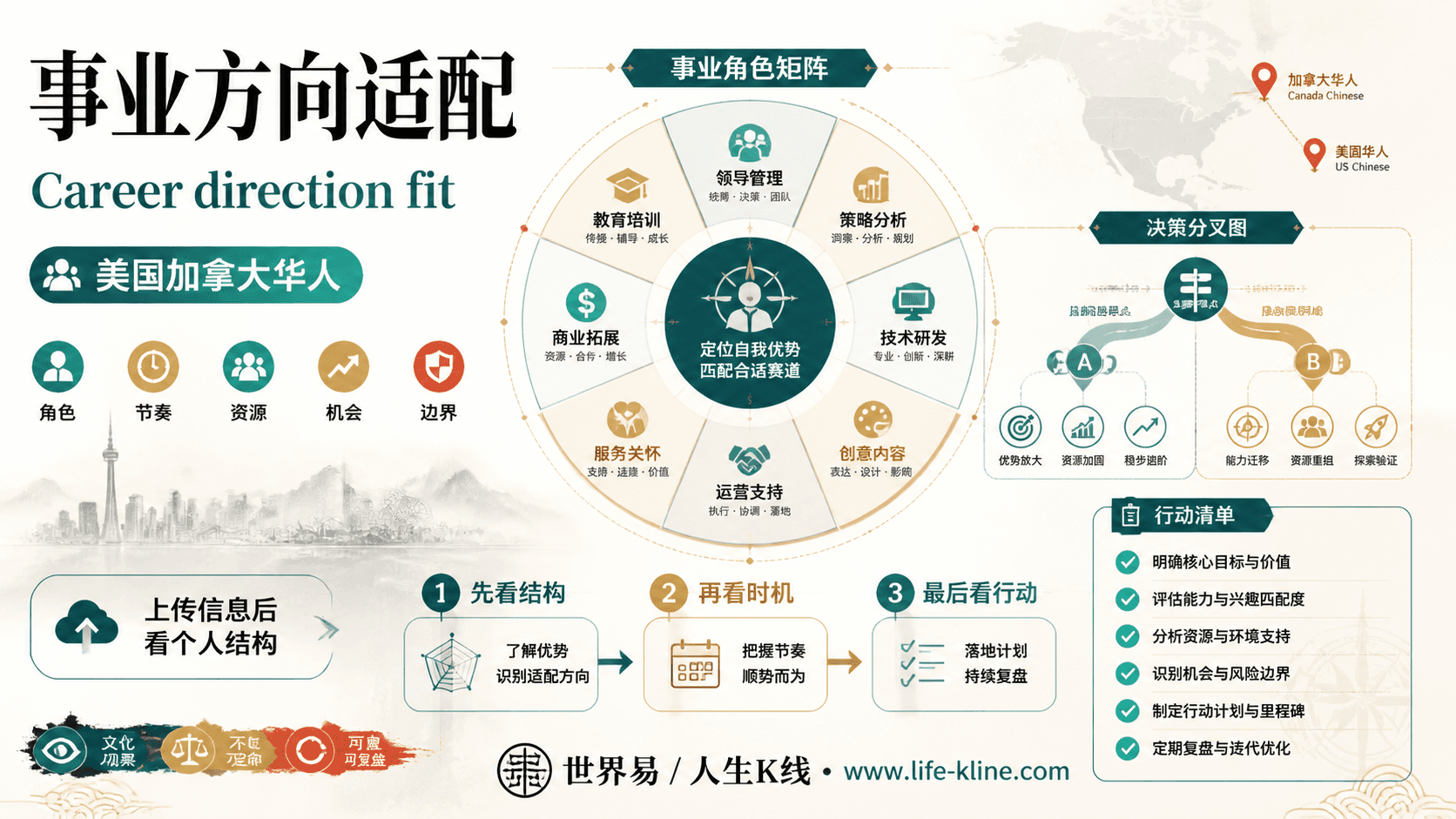
事业方向适配|美国加拿大华人
这张图把《Detailed Explanation of Shan Huo Bi (Mountain Fire Bi) Hexagram: The Beauty of Ornamentation and Symbol of Etiquette Cultivation》里的命理概念转成关系、边界和应用场景,适合先看图建立结构,再回到知识文章正文理解细节。
事业方向适配不应被写成固定结论。更适合美国加拿大华人的读法,是把传统术语翻译成结构、时机、环境、行动和复盘。
查看图片解读