Mountain over Earth (Shan Di Bo) Hexagram—Symbolism of Erosion and Stillness in the 64 Hexagrams
把这篇文章落到自己身上验证:先看结构,再进入个人分析,不做泛泛阅读。
Concept Definition
The Mountain over Earth (Shan Di Bo) hexagram is one of the 64 hexagrams, formed by the lower trigram Kun (Earth) and the upper trigram Gen (Mountain). The 64 hexagrams are composed by stacking two of the eight fundamental trigrams, each hexagram consisting of six Yao (lines) arranged from bottom (first Yao) to top (sixth Yao). The name “Bo” (剥) means peeling or stripping away, symbolizing a phase of decline or deterioration.
In the hexagram image, Kun represents Earth, and Gen represents Mountain; with Earth below and Mountain above, it forms the image of “Mountain over Earth” (Shan Di Bo), implying erosion of the mountain or degradation of the earth’s surface. This hexagram emphasizes the onset of erosion and warns the diviner to be mindful of decline and change in circumstances.
The core meaning of the Bo hexagram is the time of peeling or stripping away, primarily indicating erosion, decay, and guarding against malicious persons. It advocates stillness and non-action. This hexagram strongly cautions against acting against the trend, emphasizing conformity with natural laws and patiently waiting for the right timing.
Traditional Metaphysical Significance
Within the traditional metaphysical system, the Mountain over Earth (Shan Di Bo) hexagram symbolizes a phase of decline and erosion, reminding people to be alert to deterioration and damage. The appearance of the Bo hexagram often indicates instability in the environment or situation, requiring defensive measures to avoid losses.
Bo particularly stresses the importance of guarding against malicious people, meaning that during periods of decline or erosion, one is prone to external adverse factors or covert harm. Therefore, it is advisable to maintain stillness and retreat strategically, avoiding unnecessary conflicts and rash advances.
In classical Yi studies, aligning with the timing, geographical advantages, and human harmony is crucial. The Bo hexagram warns against acting against the trend, suggesting caution and patience when conditions are unfavorable, waiting quietly for a turning point. This hexagram embodies the ancient philosophical wisdom of “maintaining integrity while employing creativity.”
Practical Configuration and Interpretation
In Six Yao divination, the application of the Mountain over Earth (Shan Di Bo) hexagram mainly relies on analyzing the Shi Yao (世爻, representing the querent), Ying Yao (应爻, representing the environment or opponent), Yong Shen (用神, favorable element), and their generating/controlling (sheng-ke) relationships. By examining the interactions among these factors, the auspiciousness or inauspiciousness of the hexagram is revealed, guiding practical decision-making.
The Six Yao method emphasizes the selection of Yong Shen and the controlling of generating and restraining cycles. In the Bo hexagram, if the Yong Shen is restrained or drained, it indicates a clear trend of decline and erosion, suggesting that stillness and defense are appropriate. If the Yong Shen is supported or generated, although decline exists, there remains potential for reversal.
In the Plum Blossom Yi Numerology (Meihua Yishu) interpretation of the Shan Di Bo hexagram, the generating and controlling relationships between the Ti (体, the main body or subject of the hexagram) and Yong (用, the function or change) are also important. Ti symbolizes the core of the hexagram, Yong represents change; through their interaction via generating and controlling, one can infer auspicious or inauspicious trends, providing auxiliary judgment in divination.
Common Misunderstandings
Many people mistakenly believe that the Mountain over Earth (Shan Di Bo) hexagram solely represents failure or bad news, overlooking its positive guidance of “advocating stillness and guarding.” The Bo hexagram is not purely negative but reminds one to follow the trend and wait quietly for opportunities.
Another misunderstanding is neglecting the specific generating and controlling relationships among Shi Yao, Ying Yao, and Yong Shen within the hexagram, mechanically interpreting Bo as bad luck. In reality, Six Yao divination values dynamic changes, and with proper Yong Shen configuration, the Bo hexagram can also reveal turning points.
FAQ
Question: Why does the Mountain over Earth (Shan Di Bo) hexagram emphasize erosion and guarding against malicious people? Answer: The Bo hexagram symbolizes peeling away and decline; things are in a retreating phase and prone to external erosion and covert harm. Therefore, it stresses guarding against malicious people to prevent further damage.
Question: How does the Six Yao method determine the auspiciousness of the Mountain over Earth (Shan Di Bo) hexagram? Answer: The Six Yao method analyzes Shi Yao, Ying Yao, Yong Shen, and their generating/controlling relationships to judge auspiciousness. If the Yong Shen is heavily restrained, it usually indicates misfortune; if supported, it is auspicious. Detailed interpretation depends on specific Yao positions.
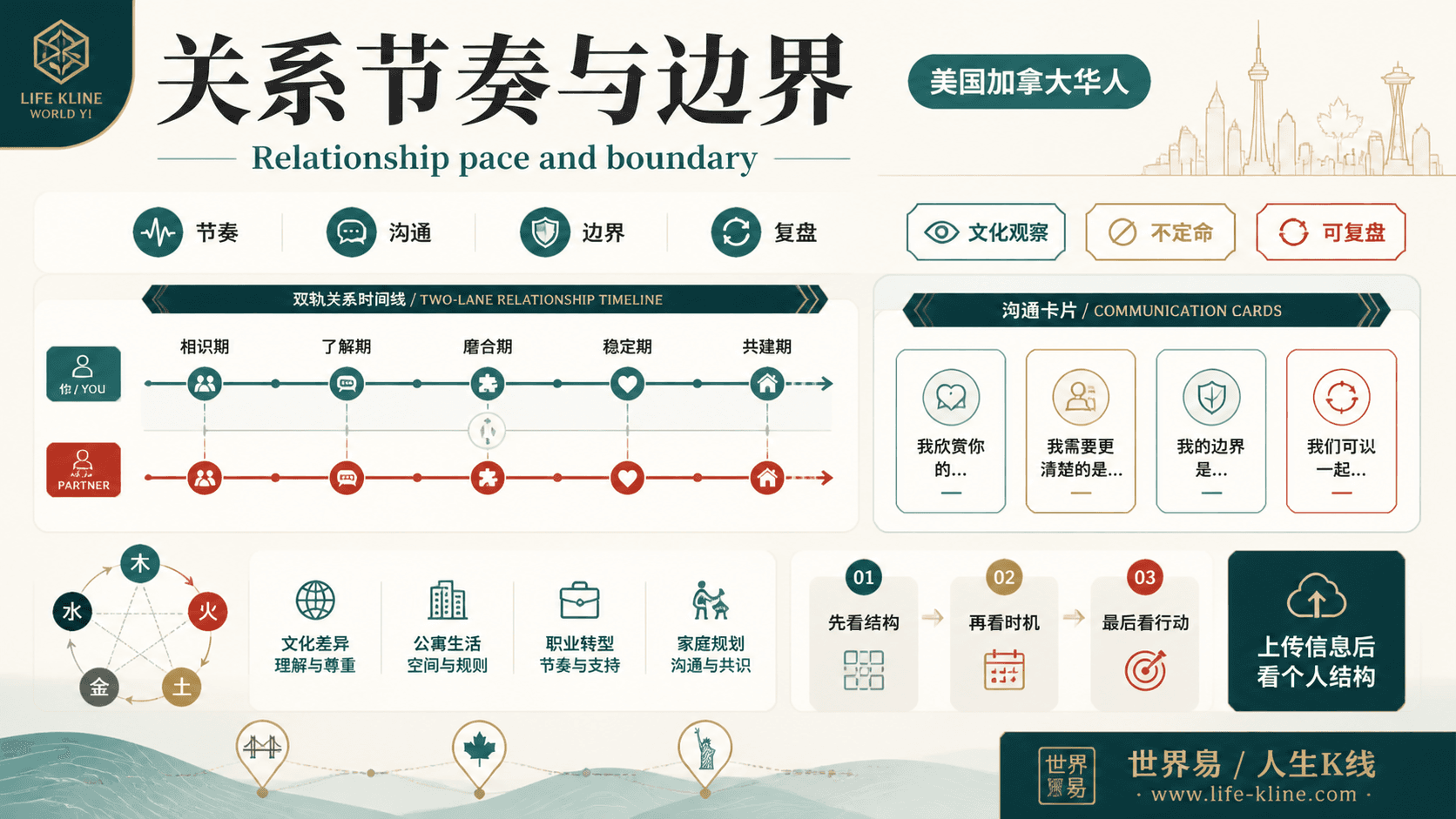
关系节奏与边界|美国加拿大华人
这张图把《Mountain over Earth (Shan Di Bo) Hexagram—Symbolism of Erosion and Stillness in the 64 Hexagrams》里的命理概念转成关系、边界和应用场景,适合先看图建立结构,再回到知识文章正文理解细节。
关系节奏与边界不应被写成固定结论。更适合美国加拿大华人的读法,是把传统术语翻译成结构、时机、环境、行动和复盘。
查看图片解读