Detailed Explanation of the Tian Feng Gou Hexagram: The Encounter of Softness Meeting Hardness and Its Cautionary Symbolism
把这篇文章落到自己身上验证:先看结构,再进入个人分析,不做泛泛阅读。
Concept Definition
The Tian Feng Gou hexagram is one of the sixty-four hexagrams in the ancient Chinese I Ching, formed by stacking two trigrams. Its hexagram image consists of the Xun trigram (巽, Xun, Wind) below and the Qian trigram (乾, Qian, Heaven) above. Xun represents wind, and Qian represents heaven, together called “Tian Feng Gou” (Heaven Wind Encounter). The character 'Gou' (姤) originally means 'to meet'; in the I Ching, it extends to signify softness encountering hardness—that is, the gentle wind meeting the strong heaven—symbolizing an unexpected encounter or sudden event.
This hexagram is composed of six lines (Yao), from bottom to top: the first Yao, second Yao, third Yao, fourth Yao, fifth Yao, and top Yao. Each line carries different symbolic meanings and transformations, collectively expressing the atmosphere and response attitude during an encounter. The Gou hexagram emphasizes maintaining vigilance during unexpected meetings to prevent minor issues from escalating into major troubles.
In metaphysical divination, the symbolism of the Tian Feng Gou hexagram mainly revolves around 'encounter' and 'vigilance,' reminding people to prevent small problems from growing when facing sudden situations, and to avoid blindly trusting others or appearances. Interpretation of this hexagram requires integrating the Six Yao method’s Shi Ying (世应, representing the querent and the other party), Yong Shen (用神, favorable element), and Sheng Ke (生克, generating and overcoming) relationships, as well as the Plum Blossom Numerology’s Ti Yong Sheng Ke (体用生克) to comprehensively judge fortune and misfortune.
Traditional Metaphysical Significance
In traditional metaphysics, the Tian Feng Gou hexagram symbolizes the state of softness encountering hardness, representing an unexpected meeting or event. Xun stands for wind, and Qian stands for heaven; wind blowing from the sky is sudden, indicating change and surprise. The Gou hexagram warns people to remain highly alert when encountering such sudden events, avoiding adverse outcomes caused by blind trust or neglect of details.
The softness meeting hardness in the hexagram reflects the philosophical concept of Yin-Yang interaction. The gentle Xun wind meets the strong Qian heaven, involving both conflict and integration, indicating the complexity and variability of developments. Metaphysicians analyze the generating and overcoming relationships among Yin and Yang lines in the hexagram to study the trend of events and guide people on how to respond to unknown changes.
Additionally, the Gou hexagram reminds people to 'prevent minor issues from escalating,' meaning to handle problems promptly at their inception to avoid turning into bigger crises. In ancient texts, Gou is often associated with warnings, emphasizing cautious handling of sudden situations and avoiding blind trust in others’ words to prevent misfortune.
Practical Application and Interpretation
In practical Six Yao divination, interpretation of the Tian Feng Gou hexagram depends on the Sheng Ke (generating and overcoming) relationships among Shi Yao (世爻, the line representing the querent), Ying Yao (应爻, the line representing the other party or situation), and Yong Shen (用神, the favorable element). Shi Yao represents the querent, Ying Yao represents the counterpart or the other side of the matter, and Yong Shen is the key factor in determining fortune or misfortune. By analyzing the interactions of these factors, one can judge the nature and development of the encountered event.
For example, when the Yong Shen is generated and not overcome, it indicates that the encountered matter is relatively smooth and it is suitable to seize the opportunity. Conversely, if the Yong Shen is overcome or restrained, it suggests hidden risks in the encounter, requiring cautious handling. At this time, the cautionary meaning of the Gou hexagram is especially prominent, reminding the diviner to prevent minor problems from becoming major troubles.
In Plum Blossom Numerology, the Ti Yong (体用) relationship in the Tian Feng Gou hexagram is equally important. Ti (体) symbolizes the foundation, and Yong (用) symbolizes the function; the Sheng Ke relationship between them determines fortune or misfortune. By examining the Sheng Ke between Ti and Yong, one can more accurately discern the deeper information behind the encountered event, helping decision-makers remain clear-headed and vigilant in uncertain situations.
Common Misconceptions
Many people mistakenly believe that the Tian Feng Gou hexagram only represents a pleasant encounter and opportunity, overlooking the hexagram’s emphasis on vigilance and prevention. In fact, Gou not only reminds people of the encounter itself but, more importantly, the attitude and caution during the encounter, warning against blind optimism or trust in others.
Another common misconception is neglecting the dynamic relationships among Shi Ying, Yong Shen, and Sheng Ke in the Six Yao method, relying solely on the literal meaning of the hexagram to judge fortune or misfortune. The complexity of the Gou hexagram lies in its variability, requiring integration of specific line statements and Sheng Ke relationships for correct interpretation, avoiding misjudgment and missing the chance to prevent minor issues from escalating.
FAQ
Question: What is the main reminder of the Tian Feng Gou hexagram in divination? Answer: The Tian Feng Gou hexagram mainly reminds one to remain vigilant during encounters, preventing adverse outcomes caused by blind trust or neglect of minor issues, emphasizing the importance of preventing small problems from escalating.
Question: How is the Gou hexagram composed? Answer: The Gou hexagram is composed of the Xun trigram (Wind) below and the Qian trigram (Heaven) above, symbolizing the gentle wind meeting the strong heaven, implying an unexpected encounter and the state of softness meeting hardness.
Question: How to use the Six Yao method to interpret the Tian Feng Gou hexagram? Answer: By analyzing the Sheng Ke relationships among Shi Yao (the querent), Ying Yao (the other party), and Yong Shen (the favorable element), one can judge the nature and development trend of the encountered event, thereby making reasonable responses and decisions.
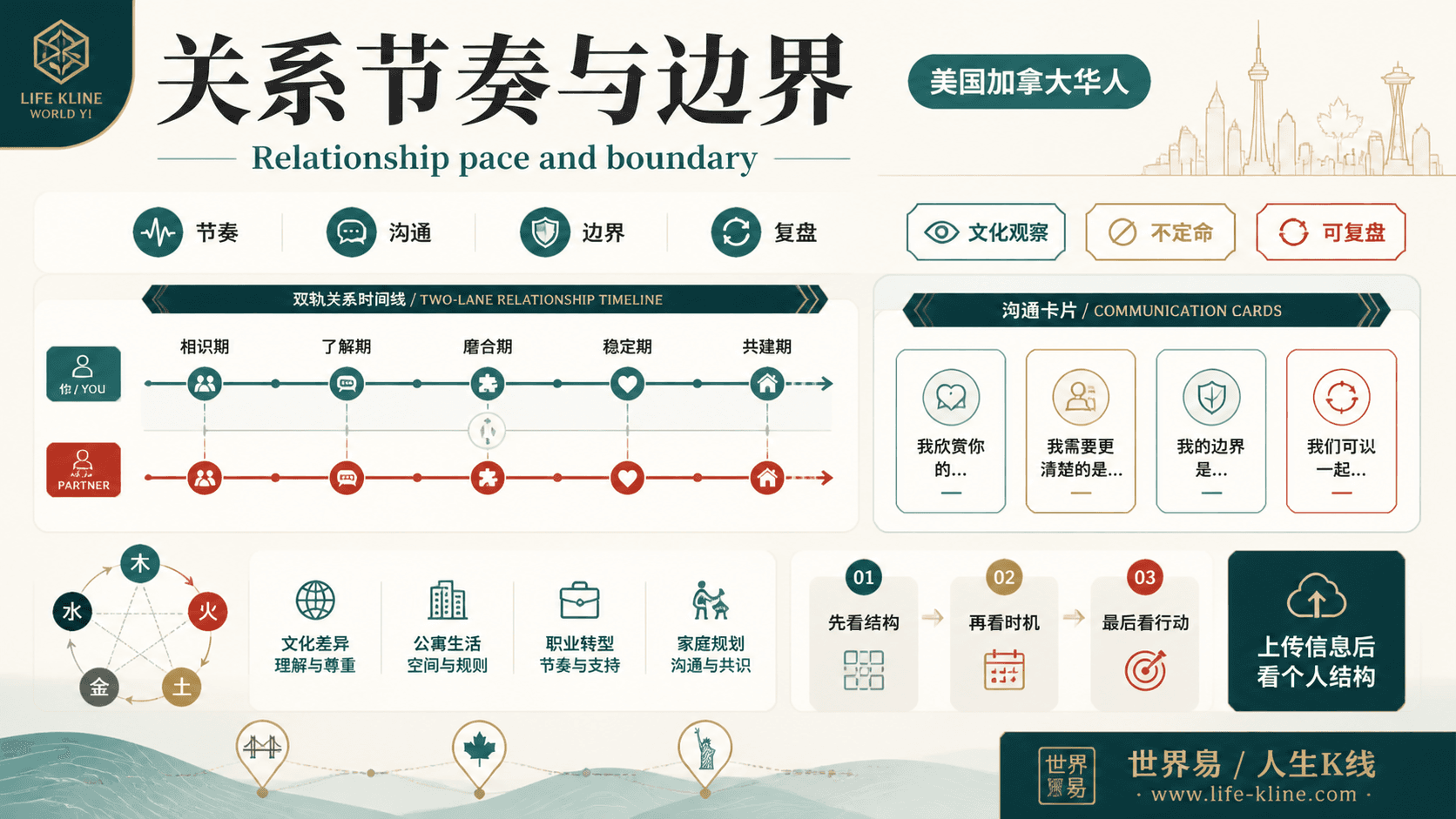
关系节奏与边界|美国加拿大华人
这张图把《Detailed Explanation of the Tian Feng Gou Hexagram: The Encounter of Softness Meeting Hardness and Its Cautionary Symbolism》里的命理概念转成关系、边界和应用场景,适合先看图建立结构,再回到知识文章正文理解细节。
关系节奏与边界不应被写成固定结论。更适合美国加拿大华人的读法,是把传统术语翻译成结构、时机、环境、行动和复盘。
查看图片解读