Detailed Explanation of the Tian Huo Tong Ren Hexagram and Its Applications in Fate Analysis
把这篇文章落到自己身上验证:先看结构,再进入个人分析,不做泛泛阅读。
Concept Definition
The Tian Huo Tong Ren hexagram is one of the 64 hexagrams in the I Ching, composed of the Qian (乾, Qián) hexagram on top and the Li (离, Lí) hexagram below. Specifically, the Li hexagram is at the bottom, and Qian is on top, forming a six-line (Six Yao) hexagram figure. The six lines are counted from bottom to top as the first line (初爻, Chu Yao), second line (二爻, Er Yao), third line (三爻, San Yao), fourth line (四爻, Si Yao), fifth line (五爻, Wu Yao), and top line (上爻, Shang Yao). The name “Tong Ren” (同人) emphasizes unity of purpose and virtue, reflecting the idea of harmonious coexistence with others.
In its hexagram meaning, Tian Huo Tong Ren advocates cooperation and comradeship, symbolizing a state of collective work. Qian represents heaven, embodying strength and grand ambition; Li represents fire, symbolizing brightness and passion. Their combination implies maintaining openness and integrity in cooperation, promoting principles of justice, opposing factionalism, and emphasizing collective interests above personal gains.
In fate divination, the Tian Huo Tong Ren hexagram holds important guiding significance. Through the Six Yao method’s analysis of the Self line (世爻, Shi Yao), Opposite line (应爻, Ying Yao), Yong Shen (用神, favorable element), and their generating (生) and overcoming (克) relationships, as well as the generating and overcoming relations between the main and functional elements in Meihua Yishu (Plum Blossom Numerology), one can determine the hexagram’s auspiciousness or inauspiciousness, providing decision-making references for interpersonal cooperation and social relations.
Traditional Fate Significance
In traditional fate studies, the Tian Huo Tong Ren hexagram symbolizes cooperation, unity, and justice. The Qian hexagram, representing Yang energy, signifies the vastness and strength of heaven; the Li hexagram symbolizes fire, representing brightness and warmth. Their combination reflects the ideal that people should unite with shared purpose and virtue, promoting collective harmony through a just and selfless attitude.
In fate theory, Tian Huo Tong Ren advises that when handling interpersonal relationships, one should emphasize cooperative spirit and a sense of justice, avoiding the formation of small cliques or factionalism that could disrupt overall harmony. This corresponds to the hexagram’s injunction to “favor justice and avoid factionalism,” stressing fairness in all social activities to promote common interests.
Moreover, Tian Huo Tong Ren symbolizes gathering and comradeship, making it suitable for predicting trends in team cooperation, collective decision-making, and public affairs. It reminds the diviner to focus on the cohesion and fairness within groups, assessing whether cooperation will proceed smoothly or if hidden concerns or conflicts exist.
Practical Configuration and Interpretation
In Six Yao divination practice, the core of interpreting the Tian Huo Tong Ren hexagram depends on the generating and overcoming relationships among the Self line (世爻, Shi Yao), Opposite line (应爻, Ying Yao), and Yong Shen (用神, favorable element). The Self line represents the querent or subject of inquiry; the Opposite line represents the external environment or counterpart. By analyzing their relationships with the Yong Shen, one can judge the auspiciousness of the cooperative relationship. Harmonious generating and overcoming relations indicate smooth cooperation; disharmony suggests obstacles.
In Meihua Yishu, the Tian Huo Tong Ren hexagram’s auspiciousness is further refined by the generating and overcoming relationship between the main (体, Ti) and functional (用, Yong) elements of the hexagram. The main element represents the hexagram’s core, and the functional element its operative role. Their generating and overcoming relationship reveals the development trend of the situation. The Yang energy and brightness inherent in Tian Huo Tong Ren generally predict relatively smooth cooperation, but caution is advised against the adverse effects of factionalism.
Practically, the Tian Huo Tong Ren hexagram is suitable for analyzing scenarios such as team collaboration, cooperative projects, and social relationships. The diviner adjusts decision strategies based on changes in the line statements (爻辞, Yao Ci) and the relationships among the Self line, Opposite line, and Yong Shen, emphasizing fairness to all parties to promote harmonious win-win outcomes. This hexagram also reminds participants to maintain transparency and integrity during cooperation to avoid conflicts caused by selfishness.
Common Misconceptions
Some learners mistakenly interpret the Tian Huo Tong Ren hexagram simply as “having many friends” or “good interpersonal relationships,” overlooking the important warning in the hexagram meaning to “favor justice and avoid factionalism.” In fact, Tong Ren emphasizes cooperative relationships based on shared ideals and just attitudes rather than general social popularity.
Another misconception is equating the cooperative spirit of Tian Huo Tong Ren with “compromise” or “unconditional obedience.” The hexagram stresses unity of purpose and righteous cooperation, which must be founded on fairness and justice rather than blind conformity or sacrificing principles. Understanding this helps apply the hexagram more accurately in practical guidance.
FAQ
Question: What unique symbolism does the Tian Huo Tong Ren hexagram have among the 64 hexagrams? Answer: The Tian Huo Tong Ren hexagram is composed of the Qian hexagram above and the Li hexagram below, symbolizing unity of purpose, cooperation, and gathering, emphasizing principles of justice and representing solidarity and collaboration.
Question: How to judge the auspiciousness of the Tian Huo Tong Ren hexagram using the Six Yao method? Answer: The Six Yao method centers on the Self line (世爻, Shi Yao), Opposite line (应爻, Ying Yao), Yong Shen (用神), and their generating and overcoming relationships. By analyzing line statement changes and these relationships, harmonious interactions indicate smooth cooperation, while disharmony suggests obstacles and unfavorable outcomes.
Question: In what practical scenarios is the Tian Huo Tong Ren hexagram applicable? Answer: This hexagram is suitable for predicting team cooperation, collective decision-making, interpersonal relationships, and public affairs, guiding how to maintain justice and harmony in cooperation.
Question: What is the relationship between the Tian Huo Tong Ren hexagram and factionalism? Answer: The hexagram explicitly warns against factionalism (“avoid factionalism”), reminding that cooperation should avoid forming small cliques to maintain overall fairness and unity.
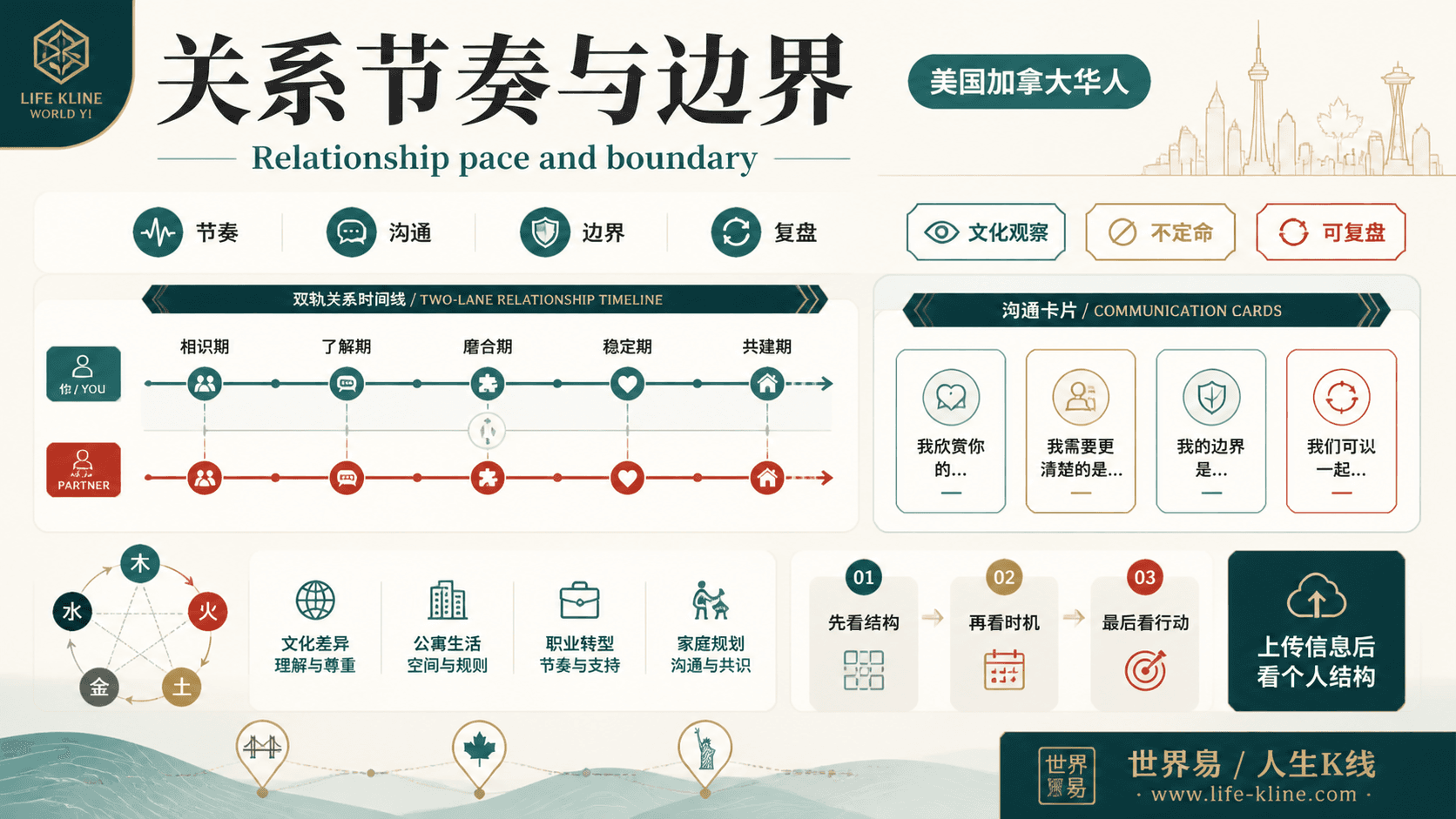
关系节奏与边界|美国加拿大华人
这张图把《Detailed Explanation of the Tian Huo Tong Ren Hexagram and Its Applications in Fate Analysis》里的命理概念转成关系、边界和应用场景,适合先看图建立结构,再回到知识文章正文理解细节。
关系节奏与边界不应被写成固定结论。更适合美国加拿大华人的读法,是把传统术语翻译成结构、时机、环境、行动和复盘。
查看图片解读