Detailed Interpretation and Application of the Tian Shan Dun Hexagram
把这篇文章落到自己身上验证:先看结构,再进入个人分析,不做泛泛阅读。
Concept Definition
The Tian Shan Dun Hexagram is one of the 64 hexagrams in the I Ching, composed by stacking the lower trigram Gen (艮, Mountain) beneath the upper trigram Qian (乾, Heaven), forming six lines (Yao) arranged from the first (bottom) to the sixth (top). Gen represents the mountain, Qian represents heaven; with heaven above and mountain below, it symbolizes a state of withdrawal and avoidance. The character Dun (遁) means retreat or evasion, indicating the choice to withdraw at certain times to avoid crises or difficulties.
This hexagram emphasizes strategies of withdrawal, avoidance, and self-preservation, advocating that when facing difficulties or conflicts, one should understand when to advance or retreat, choosing timely avoidance rather than forced confrontation. The meaning of Tian Shan Dun is not only physical withdrawal but also spiritual retreat and self-protection. The hexagram image, through the combination of heaven and mountain, symbolizes the way of yielding and concealment between heaven and earth.
In the system of 64 hexagrams, each hexagram is formed by two trigrams stacked together, each consisting of three lines. For Tian Shan Dun, Gen is the lower trigram and Qian the upper trigram, with six lines arranged from bottom to top, reflecting a process of withdrawal from inside out. This structure provides the foundation for understanding the hexagram’s meaning and helps diviners grasp the timing for retreat.
Traditional Metaphysical Significance
In traditional metaphysics, the Tian Shan Dun Hexagram symbolizes retreat and concealment, emphasizing the importance of knowing when to advance and retreat. Faced with external disturbances and unfavorable conditions, choosing to withdraw is a wisdom that preserves oneself. The Dun hexagram reminds people not to cling to current gains or losses, avoiding attachment that could lead to entrapment.
Ancient texts explain the Dun hexagram mainly as the ‘time to retreat,’ that is, wise withdrawal during crises or adverse situations. This retreat is not passive avoidance but an active strategy to better preserve strength and wait for the right moment to act. Therefore, the Dun hexagram is regarded as an iron rule of conduct, especially stressing timely yielding and avoidance.
In metaphysical studies, the Dun hexagram also symbolizes seclusion, withdrawal from the world, or temporary exit from conflict. Understanding this hexagram can guide people to reasonably arrange their advances and retreats in life and career, achieving self-preservation and long-term development. It embodies the traditional Chinese philosophy of ‘knowing when to stop leads to stability’ (知止而后有定).
Practical Configuration and Interpretation
In Six Yao divination, the interpretation of the Tian Shan Dun Hexagram centers on the Shi Yao (世爻, subject line), Ying Yao (应爻, responding line), Yong Shen (用神, favorable element), and their generating/controlling (sheng-ke) relationships. The Shi Yao represents the querent or main subject, while the Ying Yao represents the opponent or environment. By analyzing the interactions of these lines and elements, one judges the auspiciousness of the current situation. When the Dun hexagram appears, it often advises the querent to adopt a retreat strategy and avoid direct confrontation.
In Plum Blossom Numerology, the judgment of auspiciousness is based on the generating and controlling changes between the Tai (体, body) and Yong (用, function) elements. Tian Shan Dun emphasizes the timing of retreat under the coordination of Tai and Yong. By observing the interaction between Qian and Gen in the hexagram, one determines whether it is suitable to withdraw or temporarily avoid exposure. This hexagram is suitable for scenarios requiring weighing pros and cons and adjusting strategies, such as workplace changes or decision-making dilemmas.
Practically, the Tian Shan Dun Hexagram often serves as a reminder to avoid excessive attachment and to retreat timely for self-preservation. When configuring the hexagram, attention should be paid to changes in the line texts and the generating/controlling relationships between Shi Yao and Ying Yao to accurately grasp the timing and manner of advance or retreat. This hexagram is a representative symbol of ‘retreat’ in metaphysical divination, emphasizing flexibility and the wisdom of avoidance.
Common Misunderstandings
The Tian Shan Dun Hexagram is often misunderstood as simple passive escape, with the assumption that when it appears, one should always retreat. In fact, the Dun hexagram advocates ‘knowing when to advance and retreat’ as an active strategic choice rather than blind avoidance. Ignoring this point can lead to misjudgment of the situation and missed opportunities for counterattack or development.
Additionally, some believe the Dun hexagram only applies to situations of seclusion or withdrawal from society, limiting its scope. In reality, the Dun hexagram in metaphysics broadly refers to various forms of yielding and adjustment, applicable to handling complex interpersonal relationships, workplace environments, or life difficulties, embodying the principle of flexible response.
FAQ
Question: What is the specific meaning of the character ‘Dun’ (遁) in the Tian Shan Dun Hexagram? Answer: ‘Dun’ means retreat or evasion, indicating the choice to withdraw or avoid at unfavorable times to protect oneself from harm, reflecting the wisdom of knowing when to advance or retreat.
Question: How is the Tian Shan Dun Hexagram applied in Six Yao divination? Answer: By analyzing the generating/controlling relationships between Shi Yao (subject line), Ying Yao (responding line), and Yong Shen (favorable element), one judges whether it is suitable to retreat or withdraw, adjusting actions according to the hexagram’s guidance.
Question: Does the appearance of the Tian Shan Dun Hexagram mean one must completely give up? Answer: Not necessarily. The Dun hexagram emphasizes timing and strategy of retreat. Timely withdrawal is to better preserve strength and wait for the right moment to act, not total abandonment.
Question: How is auspiciousness judged for Tian Shan Dun in Plum Blossom Numerology? Answer: It is based on the generating and controlling relationships between Tai (body) and Yong (function) elements, determining whether it is suitable to withdraw or adjust strategy, thereby deciding auspiciousness.
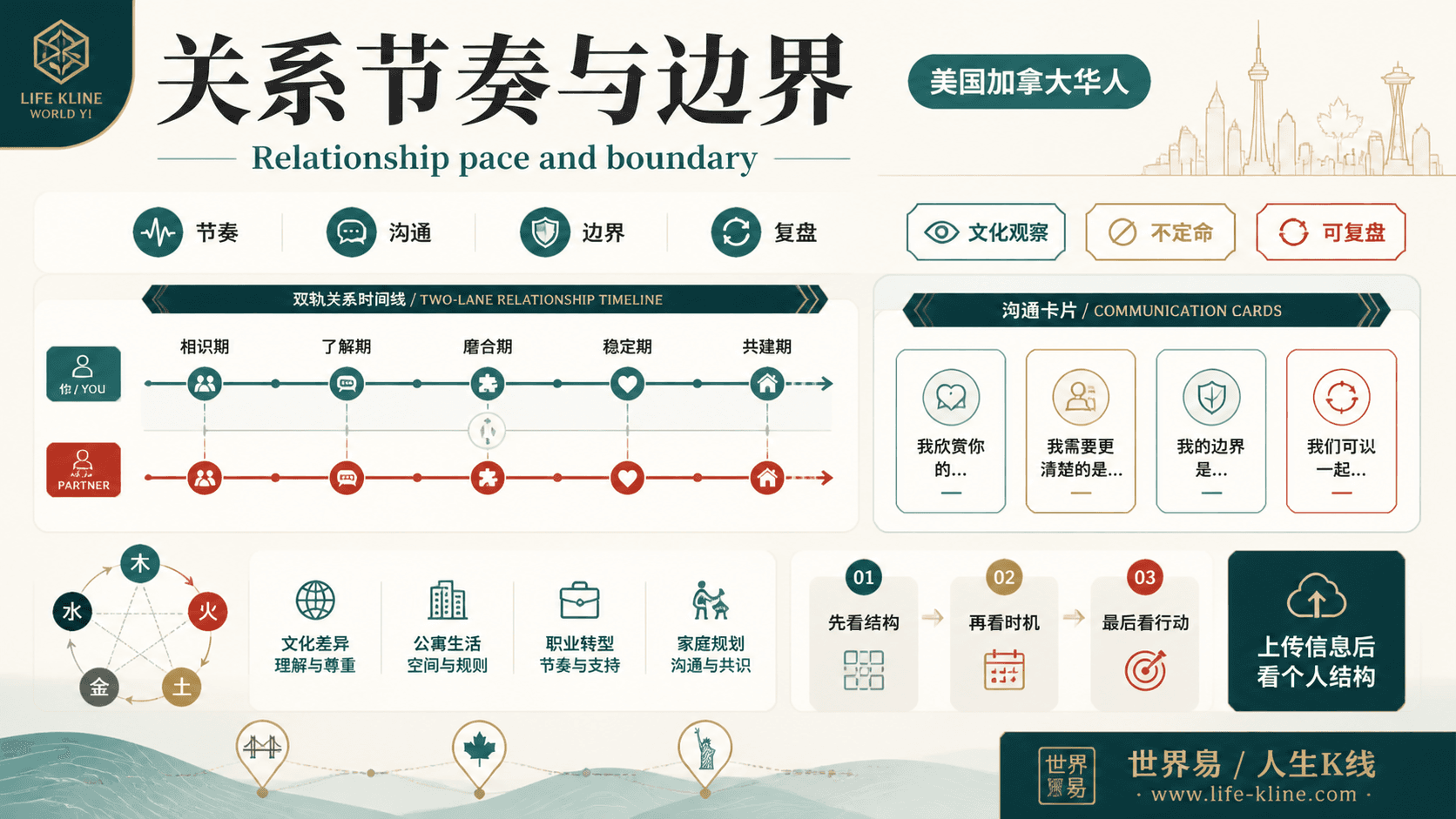
关系节奏与边界|美国加拿大华人
这张图把《Detailed Interpretation and Application of the Tian Shan Dun Hexagram》里的命理概念转成关系、边界和应用场景,适合先看图建立结构,再回到知识文章正文理解细节。
关系节奏与边界不应被写成固定结论。更适合美国加拿大华人的读法,是把传统术语翻译成结构、时机、环境、行动和复盘。
查看图片解读