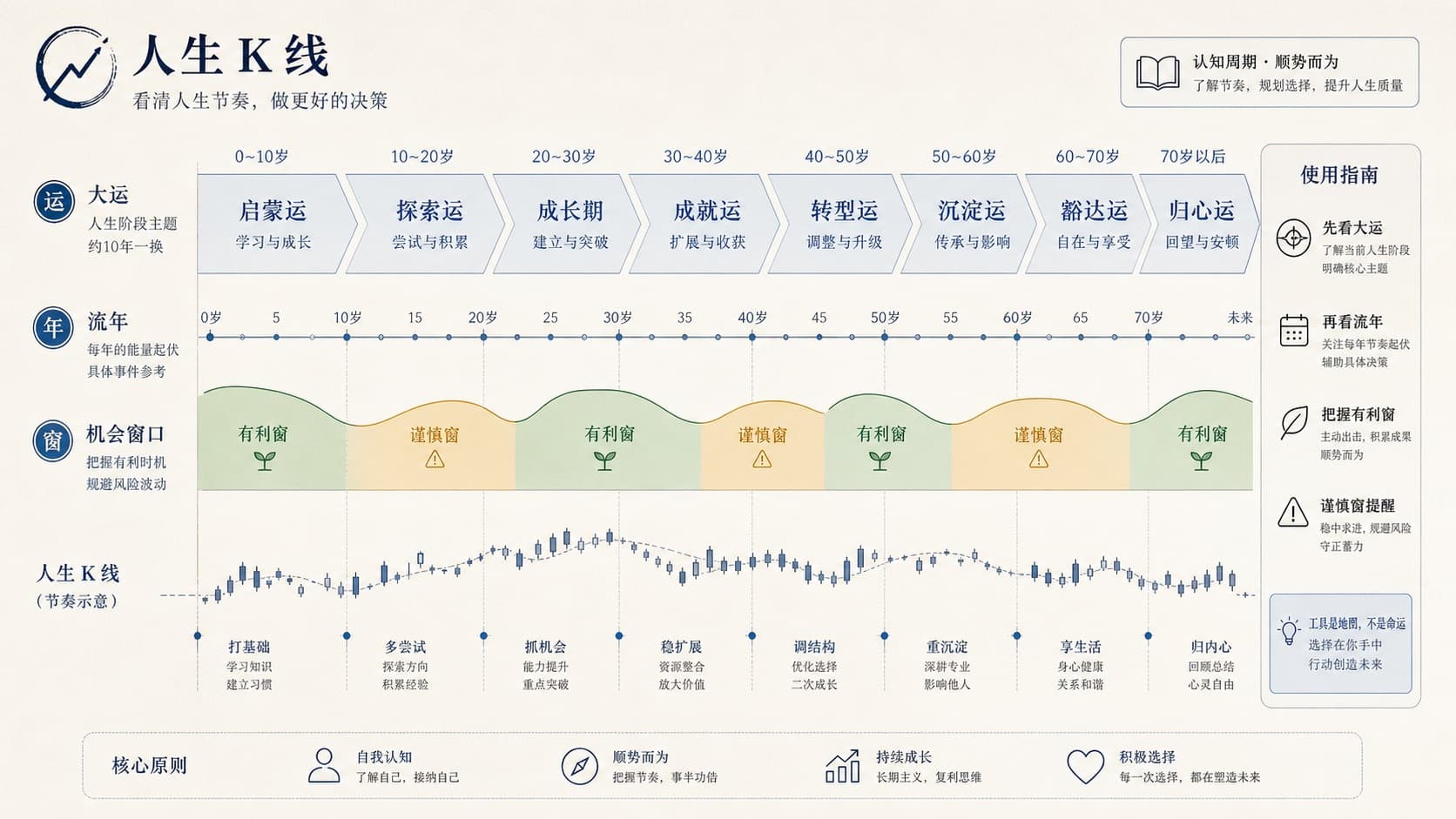
大运与流年窗口:把抽象判断拆成可看见的结构关系。
Concept Definition
The Dun Cu hexagram is formed by stacking the two trigrams Zhen below and Kun above, with each trigram containing six lines from the bottom up, numbered sequentially as the initial line to the upper line. In this hexagram image, the upper trigram is Kun, symbolizing Earth, while the lower trigram is Zhen, symbolizing Thunder. Thunder emerging from beneath the Earth, with quiet Earth containing motion, implies that life force is gesturing within silence, ready to break through the soil. The core meaning of the Dun Cu hexagram lies in its hexagram interpretation: one Yang returning. In the arrangement of the 64 hexagrams, it occupies the 25th position, immediately following Wu Wang. At this time, the solar term has passed, and Yang Qi begins to accumulate again. Although Yin Qi is still dominant, the presence of Yang Qi indicates the beginning of a critical turning point and return period in the development of affairs. From a structural perspective, one Yang is born in the initial line, while the remaining five lines are all Yin. This pattern intuitively displays the trend of Yang Qi being initially born, weak but unstoppable. It represents the revival of life force and the natural law of cyclic repetition of things, serving as an important node in the process of Yin and Yang growth and decline, reflecting the inevitable laws of the operation of the Heavenly Dao.
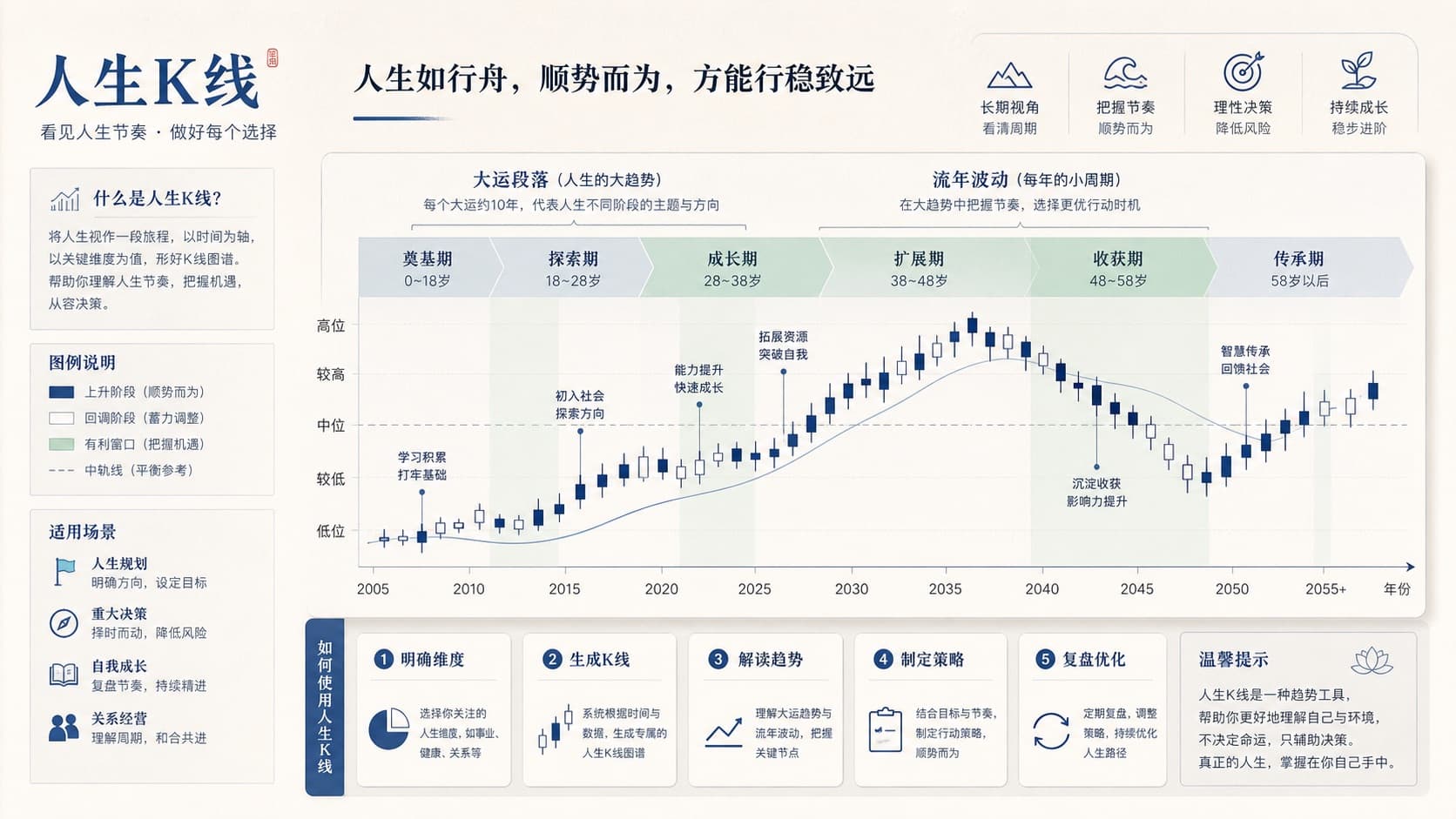
人生K线:节奏而不是宿命:把抽象判断拆成可看见的结构关系。
Traditional Metaphysical Significance
The hexagram interpretation of Dun Cu clearly states that it presages revival, return, and new birth. In the context of traditional culture, this symbolizes that new hope is about to appear after experiencing setbacks or silence. Whether it is personal fortune or the grand situation of the nation, as long as one follows this law, one can regain vitality in the low point and welcome a turning point for development. The timing is near is an important insight from the Dun Cu hexagram. It reminds the querent not to rush for success, because all changes are gradual. Yang Qi begins to grow from the initial line, requiring time to accumulate. Therefore, the hexagram image implies that the development of things needs to follow objective laws and cannot be rushed. Avoiding impatience is the clear warning of the Dun Cu hexagram. At the time when Yang Qi is initially born, if one forcibly pushes, not only will success be difficult, but it may also damage the new force. This teaches people to know how to wait and maintain patience, like the Earth bearing Thunder, silently accumulating power and waiting for the arrival of the best timing.
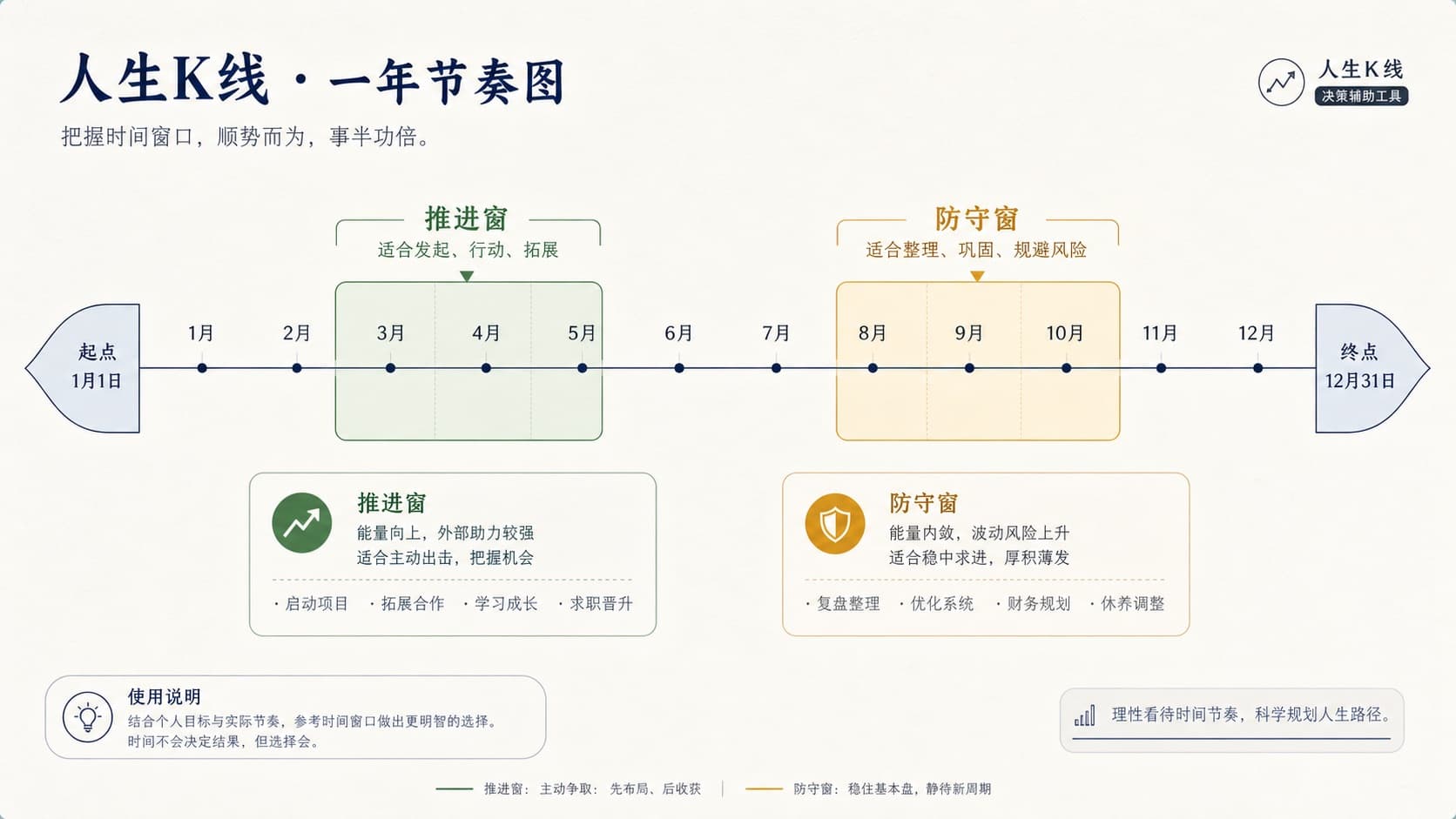
流年主窗口怎么用:把抽象判断拆成可看见的结构关系。
Practical Configuration and Interpretation
In the application of Liu Yao divination, the core to judging the auspicious or inauspicious nature of the Dun Cu hexagram lies in the World Line (Shi), Response Line (Ying), Useful God (Yong Shen), and the relationships of generation and control. If the Useful God is in its correct position and supports the World Line, then revival is hopeful; if the Useful God is controlled or if the World and Response lines clash, one must be cautious of obstacles. Although there is a trend of one Yang returning, if the Yin lines in the hexagram have overwhelming momentum, one must proceed with caution and not be blindly optimistic. Mei Hua Yi Shu determines auspicious or inauspicious nature based on the generation and control relationship between the Body Trigram (Ti) and Use Trigram (Yong). The hexagram image is divided into the Body Trigram and Use Trigram, observing the interaction of generation and control between the two. If the Body Trigram receives generation from the Use Trigram, or if the Body Trigram is weak but supported by a moving line, it presages a clear image of new birth, favorable for planning long-term development. The focus lies on whether the Body and Use are balanced, and whether the moving lines follow the trend of Yang Qi rising. In actual configuration scenarios, the Dun Cu hexagram often appears during a low point in career or a turning point in life. It is advised to focus on defense rather than attack, concentrating on internal rectification and solidifying the foundation. One can combine changes in solar terms; if around the Winter Solstice when Yang Qi begins to be born, it is the time when the Dun Cu hexagram is verified. Starting a new project or adjusting direction at this time often yields unexpected returns.
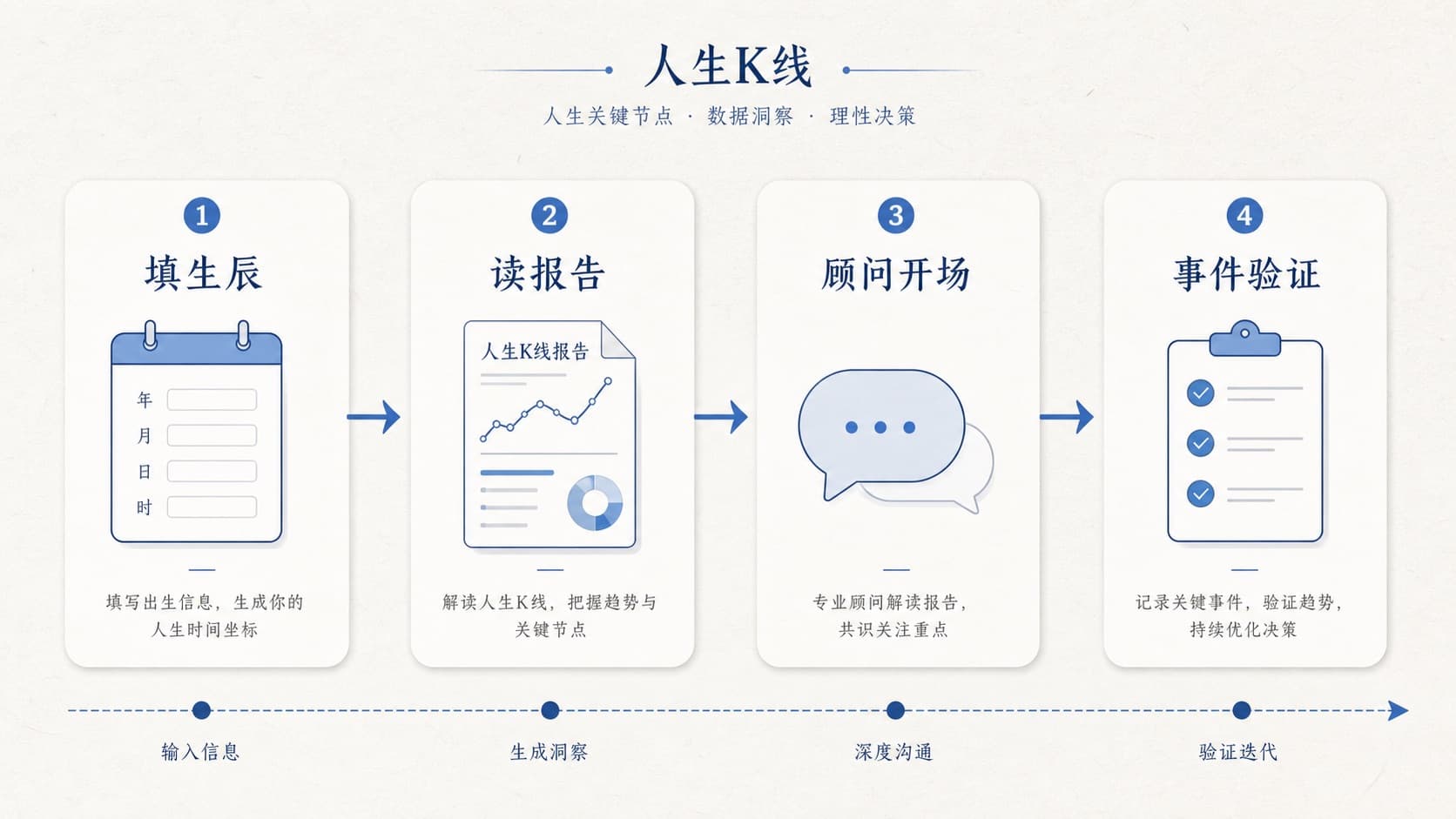
从生辰到可执行判断:把抽象判断拆成可看见的结构关系。
Common Misunderstandings
Many people mistakenly believe that one Yang returning means immediate great success, thus generating impatience. In fact, the Dun Cu hexagram emphasizes the process rather than the result. Yang Qi is initially born and still weak, needing time to be cultivated. If one rushes for success, one may miss the opportunity, or even cause damage to the original foundation, violating the main theme of repeating the path. Another common misunderstanding is to simply understand the Dun Cu hexagram as pure recovery, ignoring the principle of Yin-Yang balance behind it. The hexagram image shows that although Yang Qi has risen, Yin Qi still dominates, meaning the path to revival is full of challenges. One must recognize the fragility of the new force and be prepared for a long-term struggle, not acting lightly.
FAQ
Question: When the Dun Cu hexagram appears, does it mean everything will improve? Answer: The Dun Cu hexagram presages revival and new birth, implying that a turning point is approaching, but it does not automatically come to pass. Auspicious or inauspicious results still need to be comprehensively judged by combining the World and Response lines, the generation and control of the Useful God, and the relationship between Body and Use. If there are obstacles, one must wait patiently for the timing. Question: Why is impatience particularly emphasized in the Dun Cu hexagram? Answer: Because Yang Qi is initially born, its power is still weak, like a seedling just sprouting, needing the nourishment of the Earth. Impatient actions will disrupt this fragile balance, violating the laws of the Heavenly Dao cycle, leading to many troubles or failure.
本文含 4 张图解(封面/结构/时位/行动或风险)。图解用于建立判断框架,不构成宿命结论; 个人决策请结合测算报告与工具验证。