Detailed Explanation of the Di Tian Tai Hexagram: Symbolizing Harmony Between Heaven and Earth and Great Career Fortune
把这篇文章落到自己身上验证:先看结构,再进入个人分析,不做泛泛阅读。
Concept Definition
The Di Tian Tai hexagram is the 11th hexagram among the 64 hexagrams of the I Ching, composed of the lower trigram Qian (乾, Heaven) and the upper trigram Kun (坤, Earth). Qian represents Heaven, Kun represents Earth, hence the name Di Tian Tai (Earth over Heaven Tai). This hexagram symbolizes the union of heaven and earth and the smooth flow of all things, expressing a state of harmonious and unimpeded interaction between upper and lower. The six lines (yao) of the hexagram are arranged from bottom to top, forming a complete hexagram structure from the first to the sixth line.
The character “Tai” (泰) in the hexagram’s name means smoothness and success, implying that the operation of things is unobstructed and that harmony exists between humans and nature as well as between social strata. The image of the Di Tian Tai hexagram expresses the natural law of the fusion of heaven and earth and the growth of all things, reflecting a positive vitality and momentum for development.
Traditional Metaphysical Significance
In traditional I Ching metaphysics, the Di Tian Tai hexagram signifies smooth progress, harmony, and the harmonious interaction between upper and lower, symbolizing smooth development in career and interpersonal relationships. The union of heaven and earth and the smooth flow of all things indicate an optimal balance between humans and nature, and humans and society, thus regarded as an auspicious omen.
The Tai hexagram also emphasizes great career fortune but simultaneously warns against arrogance and complacency. Excessive pride may lead to adversity and disrupt the harmonious atmosphere. Therefore, the Tai hexagram in metaphysics is not only a symbol of auspiciousness but also contains a moral admonition for humility and caution.
The auspicious meaning of this hexagram is extensively recorded in classical I Ching literature and is often used to judge the rise and fall of personal career, family, and social relationships. Its representation of the fusion and harmony of heaven and earth embodies the ancient philosophical concept of “unity of heaven and humanity” (天人合一).
Practical Configuration and Interpretation
In the Six Yao (Six Lines) divination method, the interpretation of the Di Tian Tai hexagram depends on the relationships of Sheng Ke Zhi Hua (生克制化, generating, overcoming, controlling, and transforming) among the Shi Yao (世爻, the self line), Ying Yao (应爻, the responding line), and Yong Shen (用神, the favorable element). By analyzing the interactions among these core elements, the diviner can determine the success or failure of matters. The appearance of the Tai hexagram often indicates smooth progress and is suitable for advancing plans and cooperation.
In Plum Blossom Numerology (Mei Hua Yi Shu), the determination of auspiciousness is based on the Sheng Ke relationships between the Ti (体, the body or root) and Yong (用, the application or function). The Di Tian Tai hexagram, as an important symbol in the Ti-Yong relationship, represents overall smooth and harmonious qi (energy) flow. This hexagram is commonly used in practical divination to assess career development, official fortune, and interpersonal harmony.
In practical application scenarios, the Di Tian Tai hexagram is suitable for predicting cooperative projects, important decisions, and social interactions, especially those requiring coordination between upper and lower levels and resource integration. A deep understanding of the hexagram can assist individuals in seizing opportunities and avoiding misfortune.
Common Misunderstandings
Although the Di Tian Tai hexagram symbolizes smooth progress and harmony, it is not unconditionally auspicious. Many people mistakenly believe that the Tai hexagram means everything will go smoothly, overlooking the warning against arrogance contained within the hexagram. Ignoring this caution may result in adverse effects caused by pride and complacency.
Additionally, some diviners interpret the Tai hexagram in isolation without considering the specific Sheng Ke relationships among the Shi Yao, Ying Yao, and Yong Shen, which can lead to one-sided conclusions. In reality, Six Yao divination emphasizes overall coordination, and only by comprehensively considering multiple factors can one accurately judge auspiciousness or inauspiciousness.
FAQ
Question: What specific relationship between heaven and earth does the Di Tian Tai hexagram represent? Answer: The Di Tian Tai hexagram is composed of the lower trigram Qian (乾, Heaven) and the upper trigram Kun (坤, Earth), symbolizing the union of heaven and earth and the smooth, harmonious relationship between upper and lower.
Question: What does the appearance of the Di Tian Tai hexagram in divination imply? Answer: The Di Tian Tai hexagram generally indicates smooth progress and great career fortune but advises caution against arrogance and complacency to maintain harmony.
Question: How to interpret the Di Tian Tai hexagram using the Six Yao method? Answer: The Six Yao method judges auspiciousness through the Sheng Ke relationships among the Shi Yao, Ying Yao, and Yong Shen. When the Di Tian Tai hexagram appears with favorable Sheng Ke, it predicts smooth progress; otherwise, caution is required.
Question: How is the Di Tian Tai hexagram applied in Plum Blossom Numerology? Answer: Plum Blossom Numerology determines auspiciousness based on the Sheng Ke relationship between Ti (body) and Yong (application). The Di Tian Tai hexagram, as a favorable symbol in this relationship, represents overall smooth and harmonious qi flow.
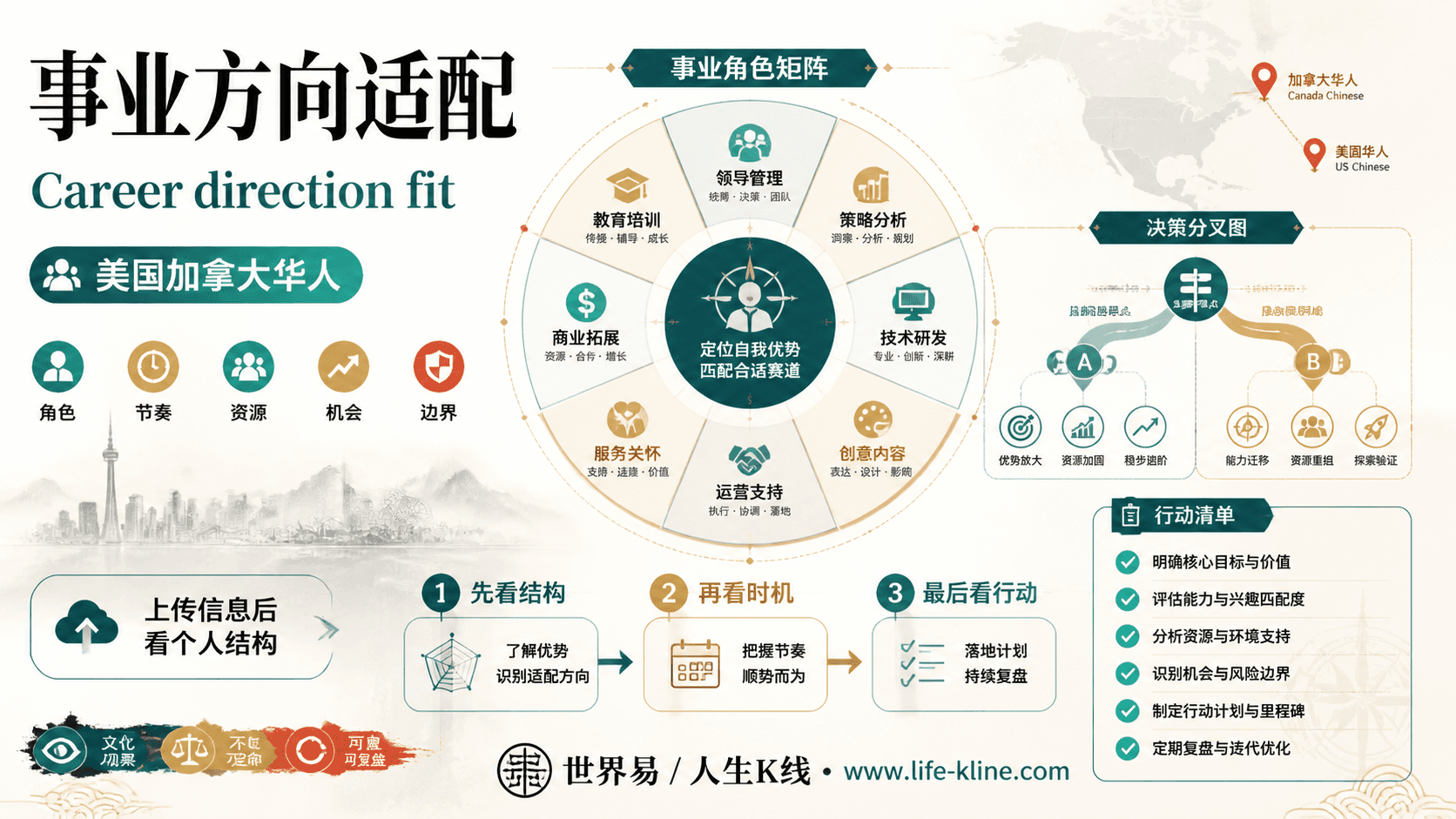
事业方向适配|美国加拿大华人
这张图把《Detailed Explanation of the Di Tian Tai Hexagram: Symbolizing Harmony Between Heaven and Earth and Great Career Fortune》里的命理概念转成关系、边界和应用场景,适合先看图建立结构,再回到知识文章正文理解细节。
事业方向适配不应被写成固定结论。更适合美国加拿大华人的读法,是把传统术语翻译成结构、时机、环境、行动和复盘。
查看图片解读