Astrological Analysis of the Optimal Rhythm and Cycle for Gold and Precious Metals Investment
把这篇文章落到自己身上验证:先看结构,再进入个人分析,不做泛泛阅读。
Why This Decision Is Especially Difficult in This Category
The core difficulty in the gold and precious metals market lies in the coexistence of its safe-haven attribute and cyclical volatility, with a complex and ever-changing market structure. Multiple factors such as central banks’ gold purchasing cycles, international political and economic situations, and the US dollar’s trend jointly cause frequent and large price fluctuations. Investors must continuously balance between swing trading and long-term holding strategies, making it critical to find the optimal rhythm.
Although market liquidity is high, differences between physical gold and paper gold expose investors to varying fees and tax costs. Physical gold involves storage and circulation expenses, affecting capital efficiency. Regulatory policy adjustments also cause short-term market sentiment shocks, further increasing decision-making difficulty.
Psychological biases such as overconfidence and herd behavior are particularly evident in gold investment. Investors tend to act emotionally during price fluctuations and overlook long-term trends. Astrological structures offer an auxiliary perspective of cyclical rhythms; by analyzing the Day Master’s strength, pattern, and Yong Shen coordination, combined with Da Yun and Liu Nian changes, investors can identify suitable timing for entering and exiting the gold market, thereby reducing blind decisions in a complex environment.
Therefore, deciding the rhythm and cycle of gold investment requires not only market analysis but also integration with astrological rhythms to form a multidimensional judgment framework, improving the scientific nature and success rate of operations.
Three Core Dimensions of Astrological Judgment
Firstly, the strength of the Day Master determines the investor’s energy orientation and risk tolerance. In gold investment, a Day Master with relatively strong or balanced Water and Metal attributes often corresponds to sensitivity to market information and risk control ability. A stronger Day Master usually copes better with market fluctuations, while a weaker one requires caution.
Secondly, the pattern type and Yong Shen selection reflect the investor’s wealth operation mode. A Zheng Cai (Proper Wealth) pattern emphasizes stable wealth growth, suitable for long-term holding and steady allocation; a Shang Guan (Hurting Officer) pattern carries innovation and challenge, better suited for swing trading; a Zheng Yin (Proper Resource) pattern focuses on resource support and external assistance, ideal for leveraging market or policy advantages.
Thirdly, the interaction of Da Yun and Liu Nian significantly influences short- and medium-term investment rhythms. Da Yun represents the overall fortune trend; a stable Da Yun favors consolidation, while a weaker Da Yun calls for caution. Liu Nian introduces variable factors, where key clashes and combinations can amplify or suppress market risks. The combination of wealth stars (Cai Xing), Bi Jian/Jie Cai (Peer and Rob Wealth stars), and Yin stars (Resource stars) is especially critical—strong wealth stars facilitate seizing wealth opportunities, abundant Peers share risks, and Resource stars provide protection and support.
In summary, integrating the Day Master, pattern, Yong Shen, and Da Yun-Liu Nian analysis offers a scientific reference for deciding the rhythm and cycle of gold investment, helping investors reasonably position themselves in a complex market.
Three Real BaZi Chart Cases
Case 1: Female, aged 50-55, with a relatively strong Ren Water (壬, Ren) Day Master, Zheng Cai (Proper Wealth) pattern, Yong Shen is Wood, Ji Shen (unfavorable element) is Metal. Currently in Gui Hai (癸亥, Gui Hai) Da Yun, a stable luck cycle favoring consolidation; Liu Nian is Bing Wu (丙午, Bing Wu), requiring flexible adaptation. The relatively strong Ren Water Day Master indicates sensitivity to market information and strong risk tolerance. The Zheng Cai pattern emphasizes stable wealth growth; Wood as Yong Shen supports wealth accumulation, while Metal as Ji Shen reflects caution toward gold’s Metal attribute. Considering the gold market, the stable Da Yun suggests maintaining current gold asset allocation, while the Bing Wu Liu Nian presents both opportunities and risks, necessitating flexible position adjustments. It is recommended to focus on macro signals such as central bank gold purchasing cycles during the stable Da Yun period and adjust holdings timely according to Liu Nian fluctuations, avoiding blind chasing or panic selling.
Case 2: Female, aged 25-30, with a balanced Ren Water Day Master, Zheng Yin (Proper Resource) pattern, Yong Shen is Metal, Ji Shen is Earth. Currently in Ji Mao (己卯, Ji Mao) Da Yun, a relatively weak luck cycle requiring caution; Liu Nian is Bing Wu (丙午, Bing Wu), necessitating careful response. The balanced Ren Water Day Master indicates a moderate market judgment ability but overall weaker fortune. The Zheng Yin pattern emphasizes reliance on external resources and support. Yong Shen Metal aligns with gold’s Metal attribute, indicating suitability for leveraging market favorable conditions. However, Ji Shen Earth may represent market resistance or cost pressures. Overall, the investor is in a cautious phase, advised to monitor regulatory and tax policy changes and avoid over-concentration in physical gold investments. It is recommended to participate cautiously when clear policy benefits or central bank gold purchasing cycles emerge, maintaining liquidity and avoiding high fees and liquidity risks.
Case 3: Female, aged 35-40, with a relatively weak Geng Metal (庚, Geng) Day Master, Shang Guan (Hurting Officer) pattern, Yong Shen is Earth, Ji Shen are Water and Wood. Currently in Ding Wei (丁未, Ding Wei) Da Yun, a stable luck cycle favoring consolidation; Liu Nian is Bing Wu (丙午, Bing Wu), requiring flexible adaptation. The relatively weak Geng Metal Day Master indicates sensitivity to market fluctuations and limited risk tolerance. The Shang Guan pattern brings transformation and challenge spirit. Yong Shen Earth represents stability and realistic foundation, while Ji Shen Water and Wood may affect liquidity and market judgment. Considering the gold market, the investor should avoid overly aggressive operations. The stable Da Yun supports consolidation, while Liu Nian requires flexible responses to market volatility. It is recommended to focus on gold swing opportunities, combining market liquidity and regulatory dynamics, using short-term price fluctuations for reasonable swing trades and avoiding long-term heavy positions.
All three cases demonstrate the critical role of Da Yun, Liu Nian, Day Master, and Yong Shen interactions in gold investment rhythm and cycle decisions. Investors should base decisions on their own astrological structure combined with actual market conditions to scientifically judge entry and exit timing and improve operational success.
Common Misjudgments and Blind Spots in This Category
The safe-haven nature of the gold market often leads investors to excessively pursue short-term security, neglecting its price cyclical fluctuations and macroeconomic cycle influences, resulting in frequent trading and emotional decisions. In astrological judgment, ignoring the trend of Da Yun and relying solely on single-year Liu Nian changes for entry decisions easily causes misjudgments.
Additionally, some investors blindly pursue the security of physical gold, ignoring its fees, storage costs, and liquidity limitations. Investors with Ji Shen Metal or Ji Shen Earth combinations should particularly note these risks. Although paper gold has strong liquidity, it is also affected by price volatility. Blindly following market hotspots without rhythm control often leads to being trapped at high prices.
Astrological tools without integration of market regulatory policies and macroeconomic trends, making decisions based only on Day Master strength or pattern, lack actual market risk control and can be misleading. Financial advice should combine astrological rhythm as an auxiliary judgment rather than replace professional market analysis and risk management.
Finally, neglecting psychological biases that cause repeated investment mistakes is another blind spot. Astrological rhythms can help identify high-risk periods and relatively safe phases, avoiding blind following and excessive trading.
Practical Judgment Sequence
Step one: Clarify your Day Master strength and pattern type, and combine Yong Shen and Ji Shen to assess personal risk tolerance and wealth operation mode. Those with relatively strong or balanced Day Masters and flourishing wealth stars as Yong Shen can appropriately seize market fluctuation opportunities; weaker Day Masters should hold cautiously and avoid high-risk operations.
Step two: Focus on the Da Yun trend and its interaction with Liu Nian. Stable Da Yun favors consolidation and maintaining existing gold allocations, avoiding frequent buying and selling; weaker Da Yun calls for caution, especially in Liu Nian years where Ji Shen is prominent. It is advisable to observe first and wait for clearer market signals. Clashes and combinations in Liu Nian provide short-term risk alerts and should be judged together with macro market data.
Step three: Combine core gold market factors such as central bank gold purchasing cycles, US dollar trends, and international political and economic environments to make entry and exit decisions based on astrological rhythms. When market volatility significantly amplifies, astrological rhythms can assist in confirming whether it is a state of Yong Shen support or Ji Shen clash, adjusting positions accordingly.
Overall, investment involves risk. Astrology serves only as a rhythm auxiliary reference and cannot replace professional financial advice. It is essential to combine professional market analysis and risk management strategies to reasonably arrange gold and precious metals investment rhythm and cycle.
FAQ
Question 1: How do Yong Shen and Ji Shen in astrology affect gold investment decisions? Answer: Yong Shen represents the favorable Five Elements that promote wealth growth. When Yong Shen is strong in gold investment, investors are more likely to seize market opportunities; Ji Shen represents obstructive or risk factors. When Ji Shen is prominent, cautious operations are advised to avoid blind market entry or heavy positions. Judging market rhythm by combining Yong Shen and Ji Shen helps mitigate potential risks.
Question 2: What guidance do Da Yun and stable Liu Nian provide for gold investment rhythm? Answer: Da Yun reflects long-term fortune trends; stable Da Yun suits consolidation and steady operations, while weaker Da Yun signals caution and risk reduction. Liu Nian offers short-term fluctuation information, where key clashes and combinations may amplify risks or opportunities. Combining both helps grasp the best timing for entry and exit.
Question 3: Can gold investment rely solely on astrological judgment? Answer: Investment carries risks. Astrology serves only as a rhythm auxiliary reference to identify cyclical opportunities and risk warnings. It cannot replace professional market analysis and financial planning. Investment decisions should integrate astrology, macroeconomics, technical market analysis, and personal risk tolerance to avoid misjudgments based on a single factor.
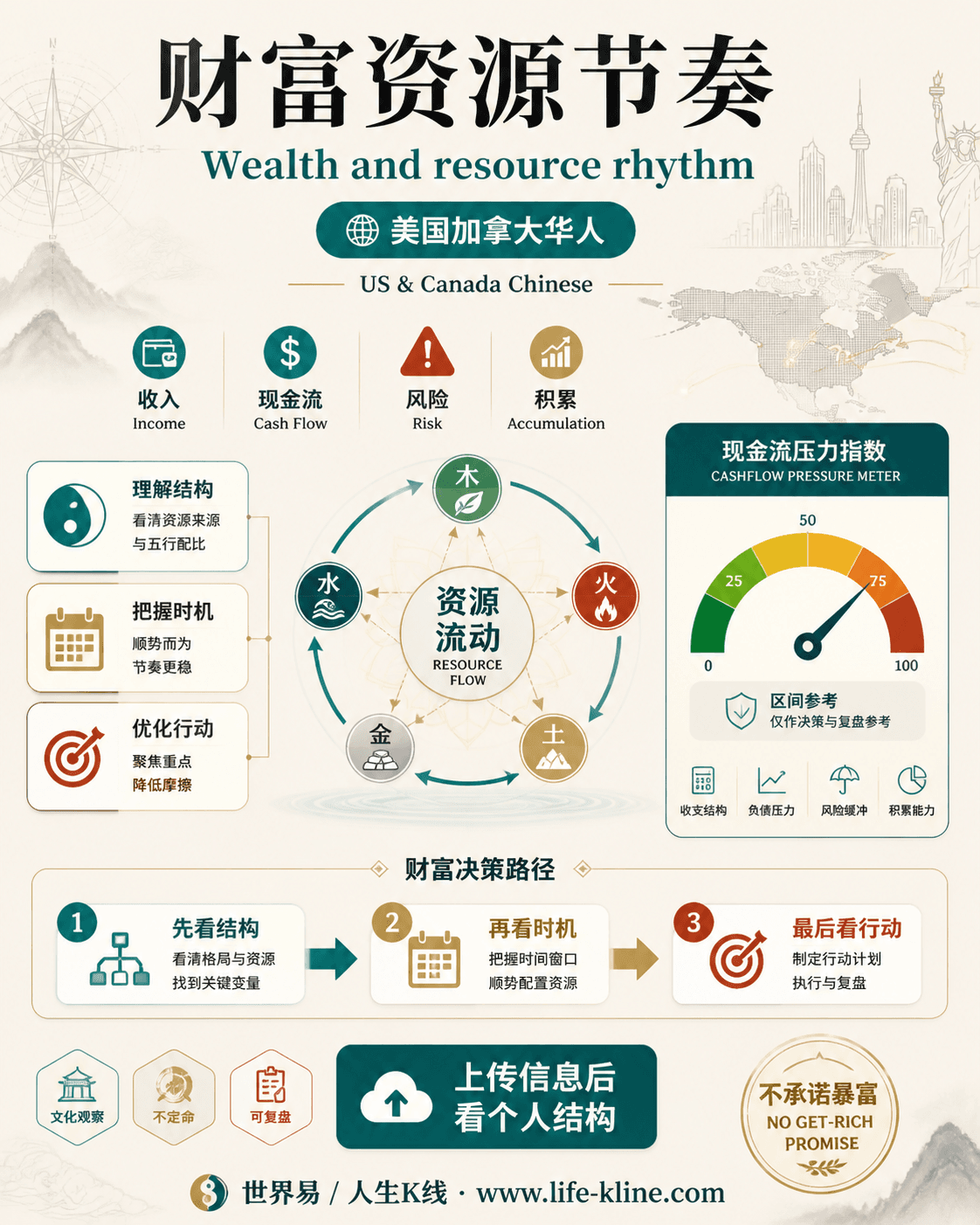
财富资源节奏|美国加拿大华人
这张图把《Astrological Analysis of the Optimal Rhythm and Cycle for Gold and Precious Metals Investment》里的命理概念转成关系、边界和应用场景,适合先看图建立结构,再回到知识文章正文理解细节。
财富资源节奏不应被写成固定结论。更适合美国加拿大华人的读法,是把传统术语翻译成结构、时机、环境、行动和复盘。
查看图片解读