BaZi Analysis of Gaokao Volunteer Advancement and Waiting Decisions: Day Master Patterns and Da Yun & Liu Nian Influences
把这篇文章落到自己身上验证:先看结构,再进入个人分析,不做泛泛阅读。
你现在搜索的,
其实是一个要落到自己身上的判断。
当前页面主要回答「Education Scenario」这类搜索问题;真正有价值的下一步是把这套结构带进自己的报告、工具与案例验证。
Why This Decision Is Especially Difficult at This Educational Stage
The Gaokao volunteer application phase is a critical node in students’ academic and life planning, where parents and students often face multiple challenges such as city selection, school tier, and major matching. Under the current Chinese education environment, the 'double reduction' policy has lessened reliance on extracurricular tutoring, but pressures remain due to school district housing and prestigious school resources. The risk of score slippage in the high school entrance exam (Zhongkao) and Gaokao volunteer application further complicates decision-making. Meanwhile, early batch admissions and the choice to retake exams increase parental anxiety, fearing missed opportunities or wasted resources.
At this stage, the conflict between parents’ expectations for their children’s future and the reality of educational resources often escalates intergenerational tensions. Many families hope to secure quality universities and majors early to ensure their children's future development path, but simultaneously worry whether retaking the exam is worthwhile and if waiting might bring greater risks. This dual psychological and practical pressure makes the decision to advance or wait especially difficult.
The overlay of BaZi structures at this time is particularly crucial. The strength or weakness of the Day Master, pattern characteristics, and the support or suppression by Yong Shen (favorable elements) — especially the roles of Shi Shen (Eating God), Yin Xing (Resource stars), and Guan Sha (Officer and Seven Killings) in learning expression and external pressure sensitivity — will be amplified or mitigated through interactions with Da Yun and Liu Nian. Understanding these metaphysical signals helps parents scientifically judge whether to proceed immediately with volunteer applications or choose to wait and improve by retaking exams.
Therefore, the difficulty of decisions at this stage lies not only in the variability of external environments and uneven resources but also in how to combine the child’s internal potential with external luck to make the choice best suited to their growth trajectory. BaZi provides a dynamic rhythm reference that helps mitigate the risks of blindly advancing or waiting.
Three Core Dimensions of BaZi Judgment
The first dimension is the Day Master and pattern. The Day Master represents the child’s fundamental energy and core personality; whether it is relatively strong or weak determines their intrinsic motivation and stress resistance. Patterns such as Shi Shen (Eating God) pattern, Yang Ren (Yang Blade) pattern, and Qi Sha (Seven Killings) pattern correspond respectively to different expressions of learning ability, drive, and external competitive pressure. Shi Shen reflects learning expression and creativity, Yin Xing (Resource stars) represent support and resources, and Guan Sha (Officer and Seven Killings) relate to pressure and competition. Understanding the Day Master and pattern helps assess the child’s adaptability to educational decisions.
The second dimension is Yong Shen (favorable elements) and Ji Shen (unfavorable elements). Yong Shen are the Five Elements in the BaZi chart that favorably balance the Day Master, promoting learning states and psychological adjustment; Ji Shen may cause bottlenecks or obstacles. For example, a Metal Yong Shen benefits a Metal Day Master, while Earth Ji Shen may bring blockage. The strength of Yong Shen directly impacts the child’s resilience under academic pressure and risk tolerance during decision-making.
The third dimension is Da Yun (decade luck cycles) and Liu Nian (annual fortune). Da Yun reflects the overall luck of the child over current and upcoming years; auspicious luck favors smooth academics and social relations, while neutral or stable luck requires more caution. Liu Nian represents the specific influence of the current year or period. The interaction between Liu Nian and Da Yun determines whether the timing is favorable. For instance, during auspicious Da Yun with supportive Liu Nian, signals to advance decisions are stronger; conversely, if Liu Nian conflicts with Da Yun, it may signal a need to wait or adjust.
These three dimensions work together to form a dynamic judgment system. BaZi is not a simple deterministic tool but a method to integrate educational realities and help identify risks and opportunities in advancing or waiting for Gaokao volunteer decisions, guiding parents to make scientific choices.
Three Real BaZi Chart Cases
Case 1: This female chart has a Day Master of Geng (庚, Metal), relatively strong, with a Yang Ren (Yang Blade) pattern. The Yong Shen is Metal, and the Ji Shen is Earth. Currently in the Geng Yin (庚寅) Da Yun, which is an auspicious luck phase, and the Liu Nian is Bing Wu (丙午), aligning with the trend. The Yang Ren pattern indicates the child has a strong competitive spirit and self-expression impulse. The Metal Yong Shen reinforces her learning and expressive abilities, making proactive advancement suitable. Combined with the current auspicious Da Yun, this suggests a good time to proceed with Gaokao volunteer application, especially favoring majors with strong competition and high expression demands. However, attention should be paid to the Ji Shen Earth influence to avoid excessive pressure causing fatigue or emotional fluctuations.
Case 2: This chart’s Day Master is Jia (甲, Wood), relatively strong, belonging to the Shi Shen (Eating God) pattern. The Yong Shen are Metal and Earth, while the Ji Shen is Water. Currently in the Ji Mao (己卯) Da Yun, which is auspicious, and the Liu Nian is Bing Wu (丙午), aligning well. The Shi Shen pattern endows the child with good learning expression and creativity. The Yong Shen Metal and Earth help balance the Wood Day Master, supporting steady growth. The auspicious Da Yun combined with a favorable Liu Nian means this is an appropriate period to advance volunteer applications, especially suitable for majors that allow creative and practical abilities to flourish. The Ji Shen Water influence reminds parents to monitor the child’s emotional regulation to prevent psychological burdens from excessive pressure, seeking professional psychological support if necessary.
Case 3: This chart has a Xin (辛, Metal) Day Master that is relatively weak, with a Qi Sha (Seven Killings) pattern. The Yong Shen is Earth, and the Ji Shen are Water and Wood. Currently in the 8th year of the Geng Yin (庚寅) Da Yun, which is a stable luck phase, and the Liu Nian is Bing Wu (丙午), requiring flexible adaptation. The Qi Sha pattern generally indicates the child faces significant competitive pressure, and the weak Day Master suggests limited stress resistance. The Earth Yong Shen helps stabilize the mind, but the Ji Shen Water and Wood bring potential emotional fluctuations and learning obstacles. Under this structure, cautious advancement is advised. If the child’s current academic or psychological state is not ideal, it is suitable to wait for retaking exams or adjust the major to avoid the risk of score slippage. Overall, decisions should flexibly combine the child’s current actual performance.
These three cases respectively illustrate how different BaZi structures present distinct signals for advancement or waiting. Children with a strong Yang Ren pattern and good luck are suited for immediate advancement; those with a stable Shi Shen pattern and auspicious Da Yun also benefit from following the trend; whereas children with a weak Qi Sha pattern and stable luck require more waiting and adjustment time to avoid rash moves.
Common Misjudgments and Blind Spots at This Stage
Many parents tend to overly rely on school reputation or city location when making Gaokao volunteer decisions, neglecting the child’s actual learning ability and psychological endurance. BaZi’s reflection of Day Master strength and pattern characteristics often reveals the child’s true potential and stress limits. Ignoring this can lead to advancing too quickly or waiting too long, adversely affecting the child’s development.
Another blind spot is neglecting the impact of Da Yun and Liu Nian changes on the child’s decision-making rhythm. Even with a good pattern, if the current Da Yun or Liu Nian is unfavorable, caution is needed before advancing. Conversely, when Da Yun and Liu Nian align favorably, seizing the opportunity to advance increases success chances. Ignoring these rhythm changes risks missing the best window.
Furthermore, ignoring psychological pressure and expression difficulties is a common error. The strength relationship between Shi Shen (Eating God) and Yin Xing (Resource stars) affects the child’s communication and expression ability. If clear pressure signals appear, blindly advancing can trigger emotional breakdowns. Parents need to heed BaZi indications and pay attention to the child’s mental health, seeking professional psychological help when necessary, rather than relying solely on BaZi judgment.
Finally, treating BaZi as an absolute conclusion rather than a reference tool is a major taboo in its application. BaZi should serve as an auxiliary rhythm reference, combined with the real educational environment and the child’s specific situation to make scientific decisions and avoid missing the best timing due to blind superstition.
Practical Judgment Sequence
Step one: Assess the child’s Day Master strength and pattern characteristics, combined with Yong Shen and Ji Shen, to preliminarily judge the child’s current learning motivation, expressive ability, and stress tolerance. A relatively strong Day Master with supportive Yong Shen often forms the basis for advancement; if the Day Master is weak or Ji Shen is prominent, caution is advised.
Step two: Analyze whether the current Da Yun and Liu Nian are auspicious to judge if the luck is favorable. With auspicious Da Yun and supportive Liu Nian, the risk of advancing decisions is lower; if Da Yun or Liu Nian clash, consider waiting or adjusting strategies.
Step three: Combine considerations of the real educational environment, such as school and major resource matching, city development potential, and score slippage risk, to determine if there is an urgent need to advance. If external conditions are clearly advantageous and BaZi supports it, seize the opportunity; otherwise, waiting is recommended.
Step four: Pay attention to the child’s psychological state, especially expression difficulties or pressure signals indicated by Shi Shen, Yin Xing, and Guan Sha. If significant psychological crises appear, prioritize seeking professional psychological assistance. BaZi should only be used as a rhythm reference to avoid blind actions.
In summary, judgment should be a comprehensive, dynamic process integrating BaZi and real-world factors. Priority is given to confirming internal energy and luck support, then combining external resources and psychological health to scientifically decide whether to advance or wait.
FAQ
Question 1: If the Day Master is relatively weak in BaZi, does that mean one must choose to wait and retake the exam? Answer: A weak Day Master indicates relatively lower stress resistance but does not necessarily mean waiting to retake is mandatory. One should comprehensively judge by combining Yong Shen support and suppression, Da Yun and Liu Nian, and the child’s current state. If the luck is smooth and external conditions are favorable, advancing appropriately is possible. The key is dynamic evaluation to avoid blind impulsiveness.
Question 2: How to understand the influence of Shi Shen (Eating God) and Yin Xing (Resource stars) on Gaokao decisions? Answer: Shi Shen represents learning expression and creativity, while Yin Xing represents support and resources. When Shi Shen is strong and Yin Xing moderate, it helps the child express smoothly and adapt to learning pressure, favoring timely advancement of volunteer applications. Conversely, if both are restrained, attention should be paid to the child’s psychological endurance, possibly requiring more preparation time.
Question 3: When Da Yun and Liu Nian conflict, must one pause advancing decisions? Answer: Conflicts between Da Yun and Liu Nian indicate significant luck fluctuations and increased risk. This does not necessarily require a complete pause but calls for cautious risk assessment and appropriate adjustment of mindset and strategy. If the child’s psychological state is stable and external resources sufficient, limited advancement is possible; otherwise, waiting for a better timing is advisable.
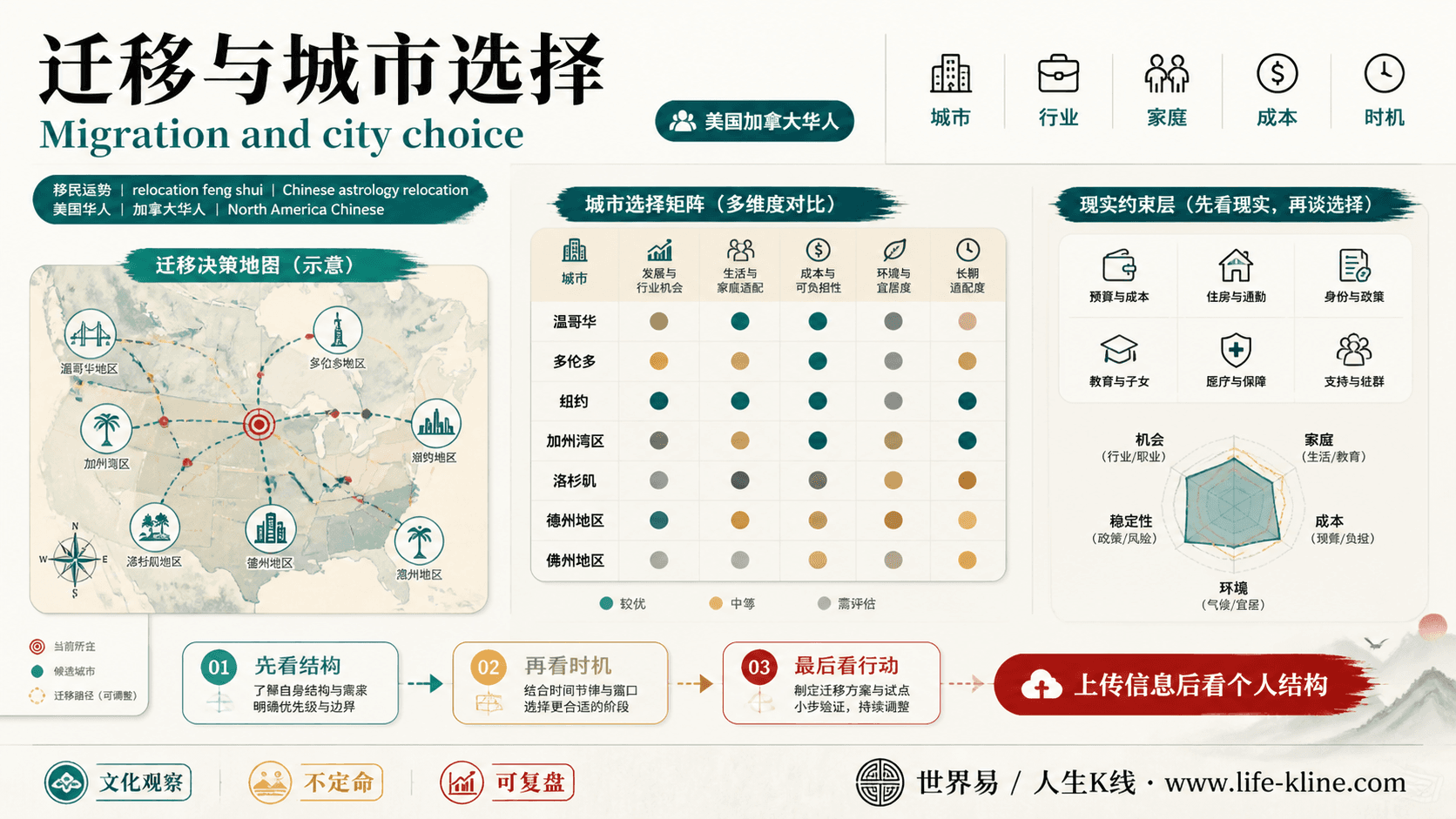
迁移与城市选择|美国加拿大华人
这张图把《BaZi Analysis of Gaokao Volunteer Advancement and Waiting Decisions: Day Master Patterns and Da Yun & Liu Nian Influences》里的命理概念转成关系、边界和应用场景,适合先看图建立结构,再回到知识文章正文理解细节。
迁移与城市选择不应被写成固定结论。更适合美国加拿大华人的读法,是把传统术语翻译成结构、时机、环境、行动和复盘。
查看图片解读