Interpreting Fate and Making Physical Fitness Decisions: Persist or Pause in Exercise Rhythm
把这篇文章落到自己身上验证:先看结构,再进入个人分析,不做泛泛阅读。
Why This Decision Is Particularly Difficult in This Health Scenario
The critical decision in sports and physical fitness management—whether to persist through discomfort or pause for adjustment—often faces a dual conflict between physical symptoms and psychological expectations. Signals such as fatigue, mild pain, and poor sleep are frequently overlooked, especially among middle-aged individuals whose recovery capacity gradually declines, while exercise plans are hard to interrupt, creating a rhythmic conflict. Additionally, seasonal climate changes subtly affect liver and kidney functions, increasing fluctuations in physical capacity and injury risk.
From a fate perspective, analyzing the Day Master’s Five Elements excess or deficiency and corresponding organ states can help reveal an individual’s internal physiological rhythms. For example, a Day Master of Earth (Wu 土) with excess may indicate a heavy burden on the spleen and stomach, with relatively weak kidney function. Ignoring necessary adjustments and persisting blindly can easily exacerbate liver and kidney stress. Conversely, when the Yong Shen (favorable element) is strong, physical recovery is faster, and moderate increases in exercise load can be tolerated.
Moreover, the current Da Yun (decade luck cycle) and Liu Nian (annual fortune) interactions affecting body energy can intensify or alleviate fatigue sensations. If both Da Yun and Liu Nian are stable, exercise intensity adjustments should be more cautious to avoid sudden excessive increases. Seasonal factors such as a Bing Wu (丙午, Fire Horse) Liu Nian with strong Fire may increase heart and liver burdens, making persistence more likely to cause insomnia, anxiety, and other psychological stress.
Therefore, the difficulty in this decision lies in accurately integrating Five Elements fate with real symptoms to scientifically judge the exercise intensity threshold—neither blindly overexerting nor overly conservative—ensuring balanced physical rhythm management and injury prevention.
Correspondence Between Fate and Five Elements Organs
The Day Master’s Five Elements excess or deficiency directly relates to the functional state of corresponding organs. A Wu Earth (戊土) Day Master with excess typically corresponds to strong spleen and stomach function, but if the liver Wood Yong Shen is insufficient, liver Qi stagnation may occur, causing indigestion and emotional fatigue. Excess Earth controlling Wood, combined with weak Kidney Water, reduces the kidney’s essence storage and recovery ability, making persistence prone to increasing liver and kidney burdens and injury risks.
When Ji Earth (己土) Day Master is excessive, spleen and stomach functions are also strong, but since the Yong Shen is Earth, it indicates a need to strengthen spleen and stomach nourishment to support physical fitness. The Ji Shen (unfavorable element) Fire excess may burden the heart and lungs, causing palpitations and insomnia symptoms. Exercise intensity must be reasonably controlled to avoid over-stimulating heart Fire, especially cautious during a Bing Wu (丙午) Fire-strong Liu Nian.
A Xin Metal (辛金) Day Master with excess implies strong lung Qi, but if Ji Shen Earth is excessive, Metal is restrained by Earth, limiting lung function and causing respiratory fatigue. Yong Shen Fire and Wood help warm the Metal lungs and promote Qi circulation. During the current Ji Hai (己亥) Da Yun with abundant Water nourishing kidneys, if Fire and Wood Yong Shen are strong, physical recovery is better, and exercise intensity can be moderately increased. However, attention must be paid to excessive Earth restraint to avoid lung and kidney burdens from persisting too hard.
The interaction between Da Yun and Liu Nian also reflects rhythm changes. Stable Da Yun suggests maintaining status quo, while a Bing Wu (丙午) Fire-strong Liu Nian where Fire restrains Metal and consumes Water may cause excessive liver Fire, inducing insomnia and anxiety, and insufficient Kidney Water slows recovery. Integrating Five Elements organ theory offers important references for adjusting exercise rhythm, guiding when to pause for recuperation and when persistence is still feasible.
Three Real BaZi Case Studies
Case 1: This gentleman’s Day Master is Wu Earth (戊土) with excess, classified as a Bi Jian (比肩) pattern, requiring Wood and Water as Yong Shen to harmonize the Earth excess. He is currently in the 9th year of Jia Wu (甲午) Da Yun and the Bing Wu (丙午) Liu Nian, where Fire is the Ji Shen and is strong, easily depleting liver and kidney energy. In reality, males aged 45-50 often experience fatigue, dull pain in the liver area, and poor sleep. The BaZi chart indicates insufficient liver Wood and weak Kidney Water; persisting in exercise easily worsens liver and kidney burdens. It is recommended to prioritize pausing and adjusting when obvious fatigue and sleep disturbances appear to avoid injury and excessive exhaustion. The judgment sequence should first assess emotional state and liver-kidney related symptoms, combined with whether the Yong Shen is strong, to decide on load reduction or exercise rhythm adjustment.
Case 2: This gentleman’s Day Master is Ji Earth (己土) with excess, a Shi Shen (食神) pattern, with Earth as Yong Shen and Fire as Ji Shen. He is currently in the 7th year of Yi You (乙酉) Da Yun and the Bing Wu (丙午) Liu Nian, where Fire is strong, heavily burdening heart and lungs. In practical terms, for males aged 45-50 managing fitness, heart and lung fatigue symptoms are particularly sensitive. The BaZi shows strong spleen and stomach but Fire excess disturbs the heart. Persisting excessively during exercise may trigger palpitations and anxiety. If symptoms such as shortness of breath or insomnia appear, immediate pause and recuperation are advised to protect cardiopulmonary function. The judgment sequence suggests focusing on respiratory system and heart rate changes, combined with Fire intensity in Five Elements, to scientifically adjust exercise intensity.
Case 3: This gentleman’s Day Master is Xin Metal (辛金) with excess, a Zheng Guan (正官) pattern, with Fire and Wood as Yong Shen and Earth as Ji Shen. He is in the 9th year of Ji Hai (己亥) Da Yun and the Bing Wu (丙午) Liu Nian. Fire is strong, helping to activate Metal Qi, but excessive Earth restrains Metal. Males aged 30-35 generally have stronger physical recovery, but Earth excess may cause lung function pressure and post-exercise shortness of breath. The BaZi suggests that when Fire and Wood Yong Shen are strong, moderate persistence can improve fitness, but if Earth excess is obvious, attention to respiratory fatigue signals is necessary. The judgment sequence should first assess respiratory endurance and fatigue, combined with whether the Yong Shen is balanced, to decide whether to continue or adjust exercise volume.
Common Misjudgments and Blind Spots in This Scenario
One common misjudgment in sports fitness management is misusing fate analysis results as medical diagnoses, ignoring actual body signals and blindly persisting. Fate analysis provides references on rhythms and organ states but cannot replace clinical medical evaluation. When obvious pain, severe discomfort, or acute symptoms occur, immediate medical attention is essential to avoid treatment delays.
Another blind spot is neglecting the impact of seasonal solar terms on the body. A Bing Wu (丙午) Fire-strong Liu Nian easily increases heart and liver burdens. If exercise intensity is not adjusted according to specific seasonal conditions, insomnia, anxiety, and other psychological symptoms may worsen, impairing recovery and causing greater fatigue.
Additionally, some individuals overly rely on the notion of Yong Shen being strong and thus relax vigilance, ignoring cumulative physical fatigue, leading to potential injuries. Fate analysis is an auxiliary tool and must be combined with real symptoms and professional examinations to scientifically decide exercise rhythm.
Finally, ignoring the dynamic changes between Da Yun and Liu Nian and rigidly applying fixed exercise plans often results in failure to timely adjust during physical fluctuations, increasing injury risk. Dynamic observation and feedback adjustment are especially crucial.
Practical Judgment Sequence
First, observe actual physical symptoms, focusing on liver area distension or pain, sleep quality, palpitations, and shortness of breath. If severe pain, breathing difficulty, or obvious palpitations (red-flag symptoms) occur, seek immediate medical care as fate analysis cannot substitute medical diagnosis.
Second, combine the BaZi Day Master’s Five Elements excess or deficiency to identify corresponding organ functional states. Excess Earth spleen requires attention to digestive and metabolic burdens; excess Fire calls for monitoring cardiopulmonary function; insufficient Kidney Water implies reduced recovery capacity. Judge the body’s adjustment ability based on whether the Yong Shen is strong.
Finally, evaluate current exercise volume suitability according to Da Yun and Liu Nian rhythms—whether to maintain or adjust the pace. If Yong Shen is strong and no significant symptoms appear, moderate persistence can enhance fitness; if Yong Shen is restrained and symptoms are evident, timely load reduction, rest, and recuperation are recommended.
The entire judgment process should be dynamically adjusted, integrating body feedback and fate rhythms to ensure balanced exercise rhythm, avoiding injury and excessive fatigue.
FAQ
Question 1: Can fate analysis directly determine specific exercise intensity values? Answer: Fate analysis provides rhythmic references on Five Elements organ functions, helping to assess overall body endurance and recovery status, but cannot directly quantify specific exercise intensity. Detailed training plans still require integration with physical fitness tests and medical advice.
Question 2: If mild pain occurs during exercise, how does fate analysis determine if immediate pause is necessary? Answer: It requires combining the pain location, duration, and whether the Yong Shen is strong in the BaZi chart. If pain accompanies a weakened Yong Shen, it signals a body warning and load reduction with rest should be prioritized. If Yong Shen is strong and symptoms are mild, observation and adjustment are possible, but if pain worsens, seek medical care promptly.
Question 3: How significant is seasonal change’s impact on exercise decisions? Answer: Very significant. Seasonal solar terms affect Five Elements climate changes, thereby influencing organ functions. For example, a Bing Wu (丙午) Liu Nian with strong Fire, especially in summer when heart Fire intensifies, requires avoiding overly intense exercise to prevent cardiopulmonary overload. Adjusting exercise rhythm according to fate rhythms helps prevent injuries.
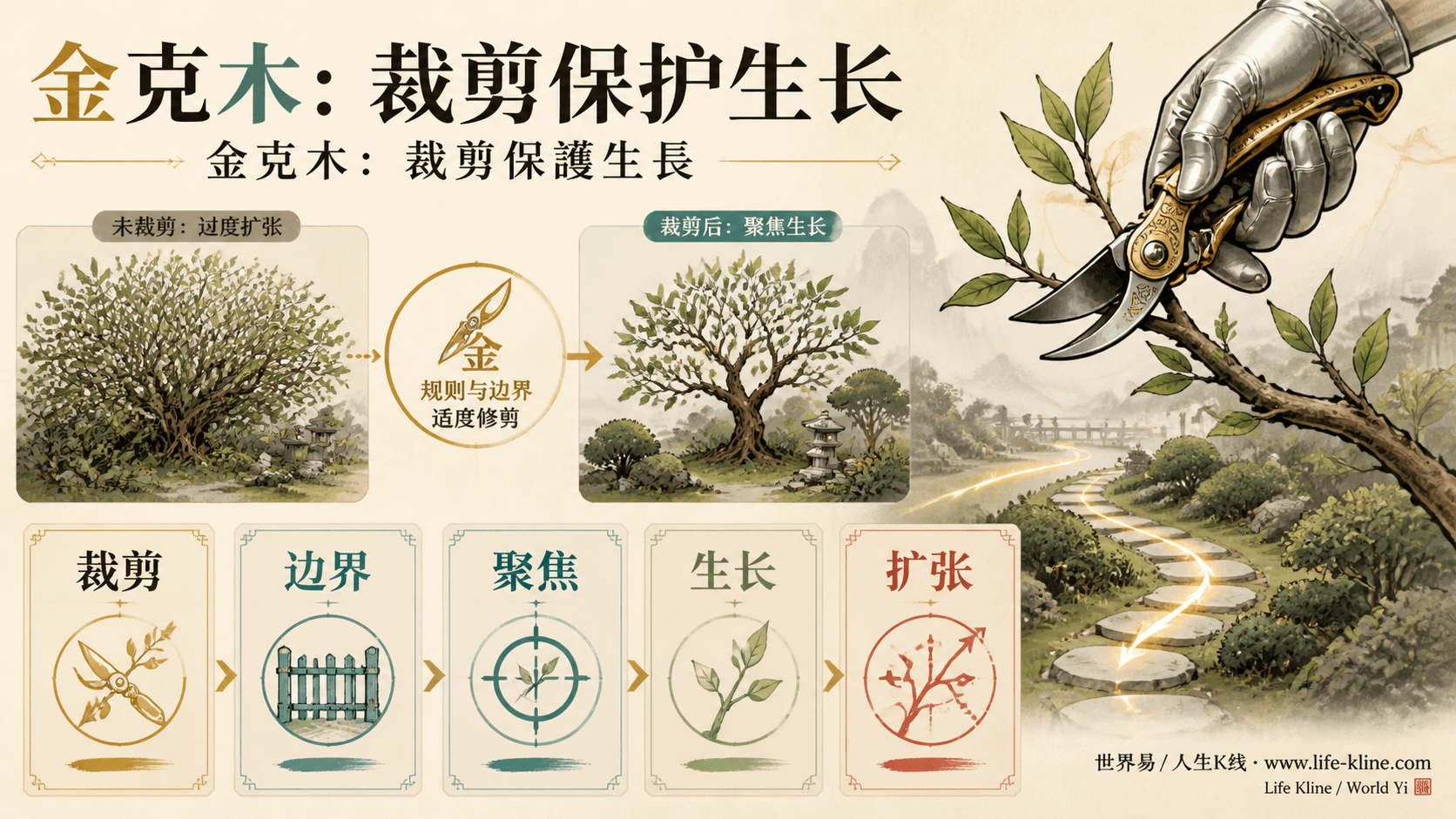
金克木调节图
这张图把《Interpreting Fate and Making Physical Fitness Decisions: Persist or Pause in Exercise Rhythm》里的命理概念转成关系、边界和应用场景,适合先看图建立结构,再回到知识文章正文理解细节。
在人生K线与世界易的框架中,金克木并非限制,而是通过规则与边界实现聚焦,让生长保持结构与效率。理解这一调节机制,能帮助我们在不同时位中主动优化路径。
查看图片解读