Analysis of Financial Crisis Risk Tolerance: A Practical Decision-Making Guide Based on Metaphysical Structure
把这篇文章落到自己身上验证:先看结构,再进入个人分析,不做泛泛阅读。
Why This Decision Is Especially Difficult in This Wealth Scenario
Risk tolerance decisions during the emergency phase of bankruptcy and financial crises face the dual pressures of cash flow disruption and debt burden. In real life, families often need to balance basic living needs with debt repayment, while high housing prices and persistent inflation severely limit disposable funds. The financial strain-induced psychological pressure tends to amplify emotional fluctuations in decision-making, thereby affecting rational judgment.
At the same time, debt defaults often come with credit risk and the complexity of borrowing relationships with relatives and friends, increasing psychological and social pressure. Under extreme stress, individuals tend to exhibit biases of excessive optimism or excessive conservatism, resulting in a mismatch between risk tolerance and actual capacity. At this moment, the combination of Wealth Stars (Cai Xing), Bi Jian (Peer Stars), and Yin Stars (Resource Stars) in the metaphysical structure provides an objective perspective of internal energy distribution, helping individuals understand their latent risk tolerance and capacity for action.
Especially under the intertwined influences of Da Yun (decade luck cycles) and Liu Nian (annual fortune), an individual's financial behavior motivation and risk preference fluctuate significantly. The metaphysical structure not only reflects innate resource endowment but also reveals intrinsic coping ability and potential risk tolerance limits during financial crises, which is crucial for formulating practical financial emergency plans.
Three Core Dimensions of Metaphysical Judgment
First, the strength of the Day Master directly affects an individual's self-regulation and stress resistance when facing crises. A relatively weak Day Master usually indicates insufficient energy, susceptibility to fatigue and stress, requiring Yong Shen (favorable element) support; a relatively strong Day Master manifests as stronger initiative and decisiveness but may lead to rashness if overly strong, thus requiring balance through Yong Shen.
Second, the combination of Wealth Stars (Cai Xing) and Bi Jian (Peer Stars) reflects the energies of wealth acquisition and wealth contention. Wealth Stars represent the acquisition and accumulation of financial resources, while Bi Jian symbolizes competition, sharing, and peer pressure. During crises, an excessive Bi Jian may cause resource dispersion and internal friction, and weak Wealth Stars make it difficult to effectively sustain cash flow, impacting risk tolerance.
Third, Yin Stars (Resource Stars), as the nurturing force for the Day Master, reflect internal spiritual support and learning adaptability. Strong Yin Stars indicate robust recovery and rebuilding ability, helping individuals to rebound from financial downturns through knowledge, information, or networks. The dynamic interactions of Liu Nian and Da Yun influence the strength of these three factors, determining actual risk tolerance and timing for action during the period.
Three Real BaZi Chart Case Studies
Case 1: This female's Day Master is 甲 (Jia) Wood, relatively weak, belonging to the Shi Shen (Eating God) pattern. Her Yong Shen is Water, and Ji Shen (unfavorable elements) are Fire and Earth. Currently, she is in the 10th year of the 壬寅 (Ren Yin) Da Yun, which is generally auspicious, with the Liu Nian 丙午 (Bing Wu) supporting the trend. Although the Wealth Star is not prominent in this chart, Bi Jian 甲 (Jia) Wood appears twice, indicating some internal friction in financial resources. The lack of the Water Yong Shen may result in insufficient regulation ability, making her vulnerable to passivity under the real pressures of bankruptcy and cash flow disruption. It is recommended that when judging risk tolerance, priority be given to assessing the actual support strength of the Water Yong Shen, avoiding rash actions, and relying more on stable cash flow management and external support.
Case 2: This female's Day Master is 丙 (Bing) Fire, relatively strong, belonging to the Zhuan Wang (Specially Strong) pattern. Her Yong Shen is Earth, and Ji Shen is Wood. She is currently in the 6th year of the 庚申 (Geng Shen) Da Yun, with stable luck, and the Liu Nian 丙午 (Bing Wu) allows flexible adaptation. The Wealth Star 戊 (Wu) Earth is evident, and Bi Jian 己 (Ji) Earth appears, showing relatively strong wealth accumulation ability. However, the presence of Ji Shen Wood warns of susceptibility to external environmental influences in investment and risk-taking. Facing financial crises, her strong Day Master gives her strong proactive coping ability, but caution is advised against excessive optimism caused by an overly strong Day Master. It is recommended that risk tolerance judgment focus on sensitivity to external risk factors, emphasizing risk diversification and prudent operation.
Case 3: This male's Day Master is 己 (Ji) Earth, relatively strong, belonging to the Pian Cai (Indirect Wealth) pattern. His Yong Shen is Fire, and Ji Shen is also Fire. He is currently in the 2nd year of the 戊申 (Wu Shen) Da Yun, with stable luck, and the Liu Nian 丙午 (Bing Wu) allows flexible adaptation. The Wealth Star is relatively strong, and Bi Jian 己 (Ji) Earth appears twice, indicating abundant financial resources. However, the coexistence of Yong Shen Fire and Ji Shen Fire suggests contradictions in action and recovery ability under financial pressure. Facing bankruptcy and financial crises, he has considerable risk tolerance potential, but the Fire conflict may cause emotional fluctuations during decision-making. It is recommended that when judging risk tolerance, emphasis be placed on emotional management ability and external support systems, favoring steady progress and avoiding high-leverage risks.
Common Misjudgments and Blind Spots in This Scenario
First, many individuals facing bankruptcy tend to overestimate their risk tolerance, especially in charts with strong Bi Jian. They may blindly increase risk exposure due to peer pressure and competitive psychology, neglecting the actual capacity of cash flow, which exacerbates the breakage of the capital chain.
Second, ignoring the balance between Yong Shen and Ji Shen is a common blind spot. For example, when the Day Master is weak and Yong Shen is insufficient, blindly undertaking high-risk investments or borrowing often leads to an inability to withstand financial pressure. Conversely, when the Day Master is strong but Ji Shen strongly interferes, emotional operations and impulsive decisions frequently occur, increasing bankruptcy risk.
Third, the interaction between Liu Nian and Da Yun is underestimated. When Da Yun is auspicious, individual risk tolerance relatively increases, suitable for steady recovery and moderate risk-taking; when Da Yun is stable but Liu Nian has significant clashes, conservative strategies should be prioritized to avoid blind expansion. Ignoring these dynamic changes easily leads to missed decision-making opportunities.
Practical Judgment Sequence
Step one, assess the strength of the Day Master and whether the Yong Shen receives effective support. When the Day Master is weak and Yong Shen is lacking, risk tolerance is limited; basic living cash flow must be guaranteed first to avoid rash moves. When the Day Master is strong but Ji Shen is obvious, focus should be on emotional and impulsive risks, suitable for formulating prudent plans.
Step two, analyze the relationship between Wealth Stars and Bi Jian. When Wealth Stars are strong and Bi Jian moderate, it indicates relatively sufficient wealth resources and higher risk tolerance, allowing moderate risk-taking to achieve turnaround. If Bi Jian is too strong, beware of internal friction and peer competition pressures, and act conservatively.
Step three, combine the current Da Yun and Liu Nian relationship to judge timing. When Da Yun is auspicious and Liu Nian aligns, action is strong, suitable for actively adjusting debt structure and seeking external funding support. When Da Yun is stable or Liu Nian clashes are significant, priority should be given to waiting for risk mitigation before considering expansion or investment.
FAQ
Question 1: Does a weak Wealth Star in the chart mean I cannot bear any financial risk? Answer: A weak Wealth Star mainly reflects limited ability to accumulate and attract wealth, but it does not mean one cannot bear any risk. The key is to combine the strength of the Day Master and the status of the Yong Shen. If the Yong Shen can effectively regulate, risk tolerance can still be improved through prudent fund management and reasonable planning.
Question 2: Does a strong Bi Jian mean I am suitable for borrowing and partnership entrepreneurship? Answer: A strong Bi Jian indicates active peer competition and resource sharing but also brings internal friction risks. Borrowing and partnership entrepreneurship require careful consideration of team cooperation stability and cash flow to avoid greater financial pressure caused by internal conflicts.
Question 3: How should risk tolerance be adjusted when Liu Nian conflicts with Da Yun? Answer: Conflicts between Liu Nian and Da Yun usually indicate instability in external environment or internal energy, reducing risk tolerance. Conservative strategies are recommended at such times, reducing large expenditures or high-risk investments, prioritizing cash flow and debt stability, and considering expansion only after conditions improve.
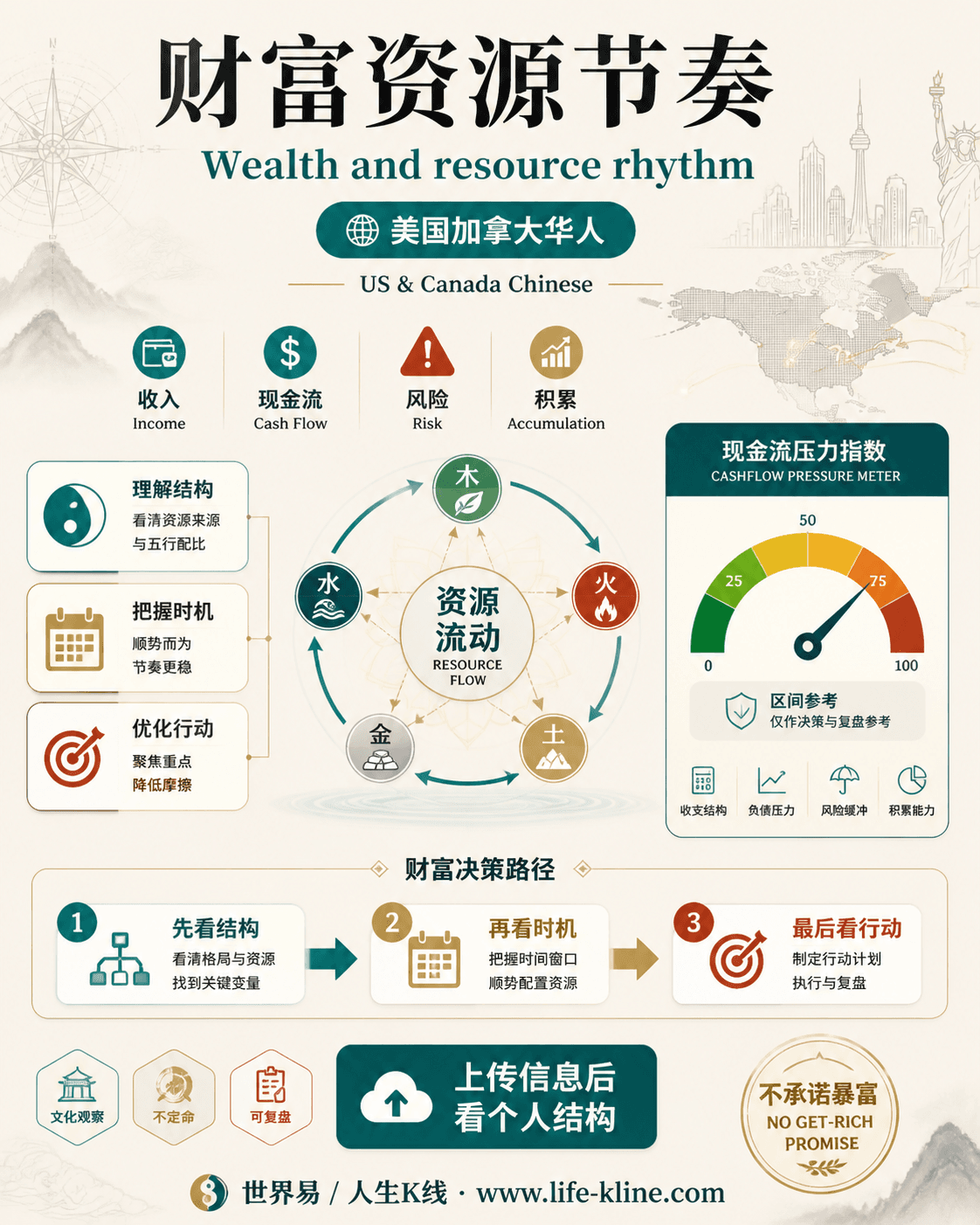
财富资源节奏|美国加拿大华人
这张图把《Analysis of Financial Crisis Risk Tolerance: A Practical Decision-Making Guide Based on Metaphysical Structure》里的命理概念转成关系、边界和应用场景,适合先看图建立结构,再回到知识文章正文理解细节。
财富资源节奏不应被写成固定结论。更适合美国加拿大华人的读法,是把传统术语翻译成结构、时机、环境、行动和复盘。
查看图片解读