Career Decision-Making for Financial Practitioners: BaZi Analysis of Starting Independently vs. Staying in an Organization
把这篇文章落到自己身上验证:先看结构,再进入个人分析,不做泛泛阅读。
Why This Decision Is Especially Difficult in This Industry
Career decisions in the financial industry are complex and highly stressful. On one hand, financial practitioners must be highly sensitive to numbers, bear significant risk appetite, maintain client relationships, and cope with psychological pressure during market volatility. On the other hand, strict industry compliance regulations mean that violations can severely damage one’s career. This complex environment makes the choice between starting independently and staying within an organization extremely challenging.
Regarding income structure, staying in a large financial institution usually offers stable income and benefits but limited promotion opportunities constrained by organizational hierarchy; starting independently may bring higher income potential but also greater income volatility, requiring strong risk tolerance, market development, and compliance management capabilities, significantly increasing psychological pressure.
From a BaZi perspective, the common Ten Gods (Shi Shen) in finance are Zheng Cai (Direct Wealth) and Pian Cai (Indirect Wealth), representing wealth acquisition paths and risk tolerance. The strength of the Day Master, overall pattern, and Yong Shen directly influence an individual’s risk preference and adaptability, thereby amplifying or suppressing their decision-making performance in the financial industry.
Therefore, when financial practitioners decide whether to start independently, they must consider not only the external economic environment and industry characteristics but also their own BaZi structure, weighing risks and rewards while adjusting mindset and strategy. This multidimensional overlay makes the decision a critical and complex node in one’s career.
Three Core Dimensions of BaZi Judgment
Firstly, the strength of the Day Master determines one’s fundamental energy and ability to cope with external changes. In finance, a relatively strong Day Master usually reflects strong personal willpower and stress resistance, suitable for proactive initiatives and starting independently; a relatively weak Day Master is better suited to relying on organizational resources for steady development.
Secondly, the pattern (ge ju) reflects the structural characteristics of the entire BaZi chart. For example, the Bi Jian (Peer) pattern often indicates competitiveness and strong autonomy, suitable for entrepreneurship and starting independently; the Yang Ren (Goat Blade) pattern brings strong drive and subjective initiative but also hides risks, requiring cautious consideration.
Thirdly, the key Yong Shen reflects the favorable elements that regulate the chart. For example, Earth as Yong Shen represents stability and preservation, suitable for staying within an organization to cultivate deeply; Fire as Yong Shen brings motivation and vitality, fitting for an environment of both risks and opportunities in independent ventures. Meanwhile, Da Yun and Liu Nian influence overall fortune, determining auspicious timing for action, guiding practitioners to choose appropriate moments to change or maintain their status.
By integrating these three dimensions, financial practitioners can more objectively assess their suitable career path and decision type, avoiding blind following or impulsive choices, thereby increasing the success rate of career development.
Three Real BaZi Case Studies
Case 1: The Day Master is Xin Metal (辛, Xin), relatively weak; the pattern is Bi Jian (Peer) pattern; Yong Shen is Earth; Ji Shen (unfavorable elements) are Water and Wood. Currently in the Yi Wei (乙未, Yi Wei) Da Yun, a period of steady preservation. This 40-45-year-old male financial practitioner’s weak Day Master means limited personal energy, requiring reliance on Yong Shen Earth for stability and regulation. The Bi Jian pattern shows some competitiveness and autonomy, suitable for seeking stable development within an organization rather than recklessness. The current Yi Wei Da Yun is stable, with Liu Nian Bing Wu (丙午, Bing Wu) allowing flexible response. It is advised to maintain stability during this phase and avoid impulsively starting independently, which could lead to excessive risk.
Case 2: The Day Master is Ji Earth (己, Ji), relatively strong; the pattern is Yang Ren (Goat Blade) pattern; Yong Shen is Fire but also Ji Shen; currently in the Gui Hai (癸亥, Gui Hai) Da Yun, overall stable. This 50-55-year-old female’s strong Day Master reflects strong personal execution and stress resistance; the Yang Ren pattern brings drive and subjective initiative, but Fire as both Yong Shen and Ji Shen indicates internal energy contradictions requiring careful handling. The Gui Hai Da Yun is stable, with Liu Nian Bing Wu (丙午, Bing Wu) allowing flexible response. The overall environment suits steady progress. She has potential for independent entrepreneurship but must also pay attention to risk management. It is recommended to evaluate her psychological endurance and market conditions before deciding whether to shift to entrepreneurship or continue relying on organizational resources.
Case 3: The Day Master is Jia Wood (甲, Jia), relatively strong; the pattern is Bi Jian (Peer) pattern; Yong Shen are Metal and Earth; Ji Shen is Water. Currently in the Geng Shen (庚申, Geng Shen) Da Yun, a very auspicious luck cycle. This 40-45-year-old male financial practitioner’s strong Day Master combined with Bi Jian pattern shows very strong autonomy and competitiveness. Yong Shen Metal and Earth help harmonize the Day Master, enhancing stability and execution. The Geng Shen Da Yun is auspicious, with Liu Nian Bing Wu (丙午, Bing Wu) supporting going with the flow. His BaZi structure suits starting independently, capable of seizing opportunities in the high-risk financial environment and leveraging personal strengths. It is recommended to actively prepare for entrepreneurship during this favorable Da Yun, while reasonably planning risk and resource allocation.
Common Misjudgments and Blind Spots in This Industry
A common misjudgment among financial practitioners is over-reliance on short-term external environmental fluctuations while neglecting the Day Master’s strength and the regulating role of Yong Shen in their BaZi structure, leading to impulsive choices of starting independently that they cannot bear in terms of market risk and psychological pressure.
Another blind spot is ignoring the influence of pattern on personality and decision-making style. For example, both Bi Jian and Yang Ren patterns have autonomy and competitiveness tendencies, but their internal conflicts and Yong Shen/Ji Shen contradictions are often not fully understood, resulting in unbalanced decisions.
Additionally, many neglect the impact of Da Yun and Liu Nian on overall fortune and overlook the importance of timing. Acting too early or too late may miss the best development window, affecting career success.
Finally, the financial industry’s compliance constraints and client relationship management are complex. BaZi judgment without integrating practical work scenarios such as risk appetite and income structure tends to become theoretical and idealized, ignoring the realistic demands and challenges of the profession.
Practical Judgment Sequence
First, assess the strength of the Day Master to determine personal energy and stress tolerance; those with weak Day Masters should adopt a steady and conservative approach, while those with strong Day Masters can consider starting independently. Second, combine with the pattern to clarify competitiveness and autonomy tendencies, judging whether one has the internal drive for entrepreneurship.
Third, analyze Yong Shen and Ji Shen to confirm favorable regulating elements, paying special attention to any internal contradictions that may affect decision stability. Fourth, combine with the current Da Yun and Liu Nian to judge the timing of action, choosing to follow the trend and avoid impulsive moves against the luck cycle.
Finally, integrate the specific work pressures, income volatility, and compliance risks of the financial industry to evaluate psychological endurance and resource integration ability, determining whether one is more suitable to stay within the organization to cultivate or has the conditions and timing to start independently, thereby making scientific decisions and steadily advancing career development.
FAQ
Question 1: How can financial practitioners determine if they are suited to start independently or stay in an organization? Answer: By combining BaZi analysis of Day Master strength, pattern, and Yong Shen. Charts with relatively strong Day Masters and patterns supporting autonomy are suitable for starting independently; those with weak Day Masters and Yong Shen emphasizing stability are better off staying in organizations. Timing should also be judged by Da Yun and Liu Nian.
Question 2: What role do Da Yun and Liu Nian play in decision-making? Answer: Da Yun and Liu Nian influence overall fortune and are key to judging the timing of actions. During favorable luck cycles, proactive changes are suitable; during unfavorable cycles, it is better to maintain and wait, avoiding risky moves that may cause failure.
Question 3: What are the pros and cons of the Yang Ren pattern in financial industry decisions? Answer: The Yang Ren pattern brings strong drive and subjective initiative, suitable for proactive moves and innovation, but it may also lead to impulsiveness and excessive risk-taking. Careful consideration of one’s Yong Shen is necessary to prevent over-adventurous behavior.
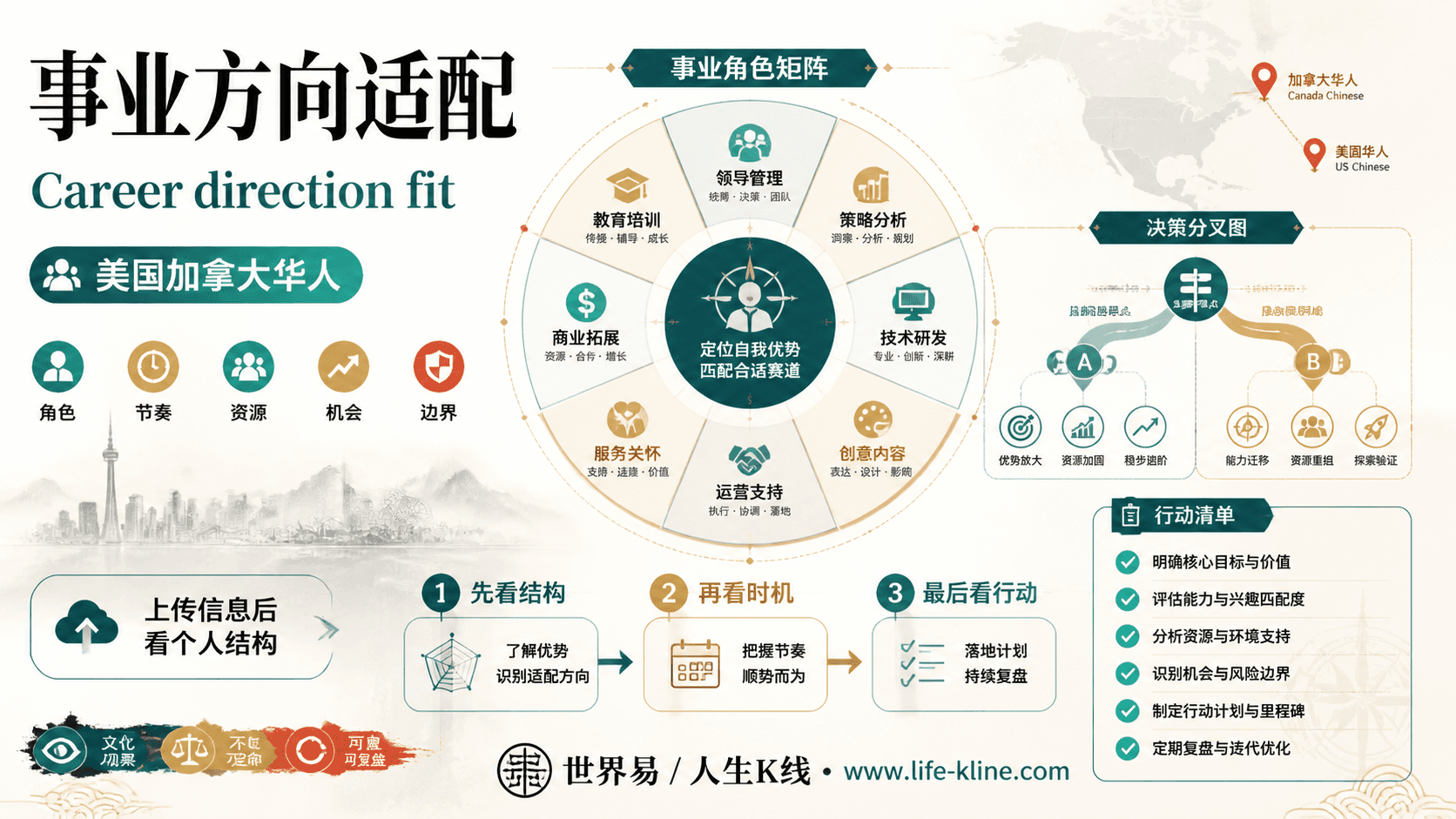
事业方向适配|美国加拿大华人
这张图把《Career Decision-Making for Financial Practitioners: BaZi Analysis of Starting Independently vs. Staying in an Organization》里的命理概念转成关系、边界和应用场景,适合先看图建立结构,再回到知识文章正文理解细节。
事业方向适配不应被写成固定结论。更适合美国加拿大华人的读法,是把传统术语翻译成结构、时机、环境、行动和复盘。
查看图片解读