BaZi Analysis of Shi Shan, Cai, and Yin Elements in Side Business Decisions for Financial Professionals
把这篇文章落到自己身上验证:先看结构,再进入个人分析,不做泛泛阅读。
Why This Decision Is Especially Difficult in This Industry
The core characteristic of financial professionals’ work is extreme sensitivity to numbers. They must respond quickly to market fluctuations within compliance frameworks, bearing high levels of responsibility and pressure. Their income structure largely depends on performance and client relationships, so fluctuations in their main career directly affect financial stability. Therefore, side business decisions must consider not only returns but also risk and reasonable time allocation.
Side businesses often serve as supplementary channels for wealth accumulation for financial professionals, but the nature of side businesses can be in tension with the risk appetite and compliance standards of their main career. In their BaZi structures, Cai stars represent wealth and Shi Shan stars represent creative drive, while Yin stars reflect support and resources. The balance of these metaphysical elements directly affects whether a side business can develop steadily.
At the same time, the volatile mindset common in the financial industry tends to amplify the negative impact of Ji Shen (unfavorable elements) in BaZi. If a side business choice conflicts with the Yong Shen (favorable elements) of the main career, it may lead to scattered energy and increased financial risk. Therefore, side business decisions are extremely sensitive to BaZi structures and require precise identification of Yong Shen and Ji Shen to avoid blind expansion.
In summary, financial professionals must consider the configuration of Shi Shan, Cai stars, and Yin stars in their BaZi charts when deciding on side business directions. Combining this with practical risk management and client relationship maintenance enables stable wealth growth and effective utilization of personal resources in side businesses.
Three Core Dimensions of BaZi Judgment
First, the strength of the Day Master (Ri Zhu) determines the individual's foundation and energy base. In the financial industry, the strength of the Day Master reflects personal risk tolerance and proactive control ability. Those with a relatively strong Day Master are suitable for active innovation, while those with a weaker Day Master should adopt a stable and conservative approach.
Second, the Cai stars and Shi Shan stars reflect ways of acquiring wealth and creativity. Zheng Cai (Direct Wealth) and Pian Cai (Indirect Wealth) represent different wealth channels, while Shi Shen (Eating God) and Shang Guan (Hurting Officer) represent expressive ability and creative problem-solving. Side business paths that align with the strengths of Cai stars and Shi Shan often bring additional income and career breakthroughs.
Finally, Yin stars symbolize resource support and internal motivation. In side business development, those with strong Yin stars often gain external support and inner stability, helping balance pressures between main and side careers. The current Da Yun (10-year luck cycle) and Liu Nian (annual fortune) reflect the energy flow of life stages, influencing timing and risk tolerance in decision-making.
By integrating these three dimensions, financial professionals should focus on the balance between the Day Master and Yong Shen, clarify the interaction between Cai stars and Shi Shan, and use Da Yun and Liu Nian to judge the timing of actions, thereby achieving steady wealth growth in side businesses.
Three Real BaZi Case Studies
Case 1: This gentleman’s Day Master is Ren Water (壬, Ren), with a Cong Sha (从杀) pattern. His Yong Shen are Earth and Fire, while Ji Shen are Metal and Water. He is currently in the first year of the Ding You (丁酉) Da Yun. As a financial professional, his work environment requires him to manage numerical fluctuations and compliance risks. The Earth and Fire Yong Shen favor stability and action, while the Metal and Water Ji Shen warn against overreliance on money and emotional volatility. Regarding side business direction, the Earth and Fire Yong Shen suggest he can choose side businesses related to stable asset management or the real economy, avoiding high-risk speculation. Given the conservative nature of the current Da Yun, a steady progress approach is suitable. The key judgment is to confirm whether the side business can strengthen the Yong Shen; if it introduces Ji Shen, caution is advised.
Case 2: This lady’s Day Master is Geng Metal (庚, Geng), with a Cong Er (从儿) pattern. Her Yong Shen are Water and Wood, and Ji Shen is Earth. She is currently in the first year of the Ji Si (己巳) Da Yun. Facing dual challenges of client relationships and risk control in finance, her Water and Wood Yong Shen represent flow and creativity, while the Earth Ji Shen indicates rejection of heavy constraints and pressure. For side business selection, she is suitable for flexible projects relying on networks and information flow, such as consulting or knowledge services. The relatively weak Da Yun and cautious Liu Nian suggest avoiding capital-intensive projects. She should evaluate the impact of side business on personal resource consumption before acting.
Case 3: This gentleman’s Day Master is Ding Fire (丁, Ding), with a Yang Ren (羊刃) pattern. His Yong Shen is Water, and Ji Shen is Wood. He is in the seventh year of the Ren Shen (壬申) Da Yun. Being young with a relatively strong Day Master, he is rapidly growing in finance and facing challenges of numbers and risk management. The Water Yong Shen represents regulation and wisdom, while the Wood Ji Shen warns against overexpansion. Suitable side business directions include fintech or data analysis projects, leveraging his strong innovation and wisdom resources. The Da Yun is auspicious, and the Liu Nian supports momentum, making it favorable to actively start side businesses. However, he must avoid resource dispersion caused by excessive expansion. Priority should be given to confirming the side business’s support for the Water Yong Shen.
These three cases illustrate the close integration of BaZi and reality in financial professionals’ side business decisions. Precise analysis of Yong Shen and Ji Shen, combined with Da Yun and Liu Nian, provides a scientific basis for side business selection.
Common Misjudgments and Blind Spots in This Industry
Financial professionals often misjudge side business suitability by overly relying on the short-term wealth allure of Cai stars, neglecting the influence of Shi Shan and Yin stars on side business sustainability and resource support. A strong Cai star does not guarantee side business success; without Yin star support, side businesses are prone to interruption due to resource depletion.
Another blind spot is ignoring changes in Da Yun and Liu Nian, often blindly expanding side businesses during unfavorable luck cycles or conflicting annual fortunes, leading to amplified risks. Side business decisions should align with the rhythm of Da Yun and Liu Nian, avoiding excessive pressure during low fortune periods.
Additionally, compliance constraints and complex client relationships in finance mean that ignoring main career compliance requirements in side business choices can cause resource conflicts and professional risks. Risks indicated by Ji Shen in BaZi must be taken seriously to avoid conflicts between side business directions and Ji Shen, preventing scattered energy and financial drain.
In summary, financial professionals should avoid relying solely on Cai stars in side business decisions. They must comprehensively consider Shi Shan, Yin stars, and Da Yun/Liu Nian, and rationally plan according to industry characteristics to prevent blind expansion and resource waste.
Practical Judgment Sequence
First, clarify the Yong Shen and Ji Shen in the individual’s BaZi chart and assess whether the side business direction can enhance the Yong Shen’s strength while avoiding introducing Ji Shen. Side businesses supported by Yong Shen are more conducive to resource integration and stable returns; if Ji Shen is involved, risks must be carefully weighed.
Second, combine the current Da Yun and Liu Nian to evaluate personal energy status and market environment, deciding whether to actively expand side businesses or conservatively wait. When Da Yun is auspicious and Liu Nian is favorable, proactive action is suitable; if Da Yun is weak or Liu Nian unfavorable, it is better to consolidate and plan.
Finally, consider whether the side business’s industry attributes are compatible with main career compliance and time allocation, avoiding negative impacts on main career performance and client relationships. Side business choices should align with metaphysical advantages and real-world conditions to achieve steady wealth growth.
FAQ
Question 1: Why should financial professionals focus on Shi Shan and Yin stars when choosing side businesses? Answer: Shi Shan represents creativity and expressive ability, which are the driving forces for side business innovation and sustainable development; Yin stars symbolize resources and support, providing a stable backing. Balancing these two helps side businesses grow steadily and avoid blind expansion and resource depletion.
Question 2: How significant is the impact of Da Yun and Liu Nian on side business decisions? Answer: Da Yun and Liu Nian reflect personal energy and external environment. Auspicious cycles favor active side business expansion, while unfavorable periods call for caution or waiting. Ignoring the rhythm of luck cycles can lead to increased risks or wasted resources in side businesses.
Question 3: How should one handle Ji Shen appearing in side business-related fields? Answer: Ji Shen represents unfavorable factors. If a side business involves Ji Shen, the risks must be assessed for controllability. If necessary, adjust the side business direction or strategy to avoid energy and financial drain, ensuring coordinated development between main and side careers.
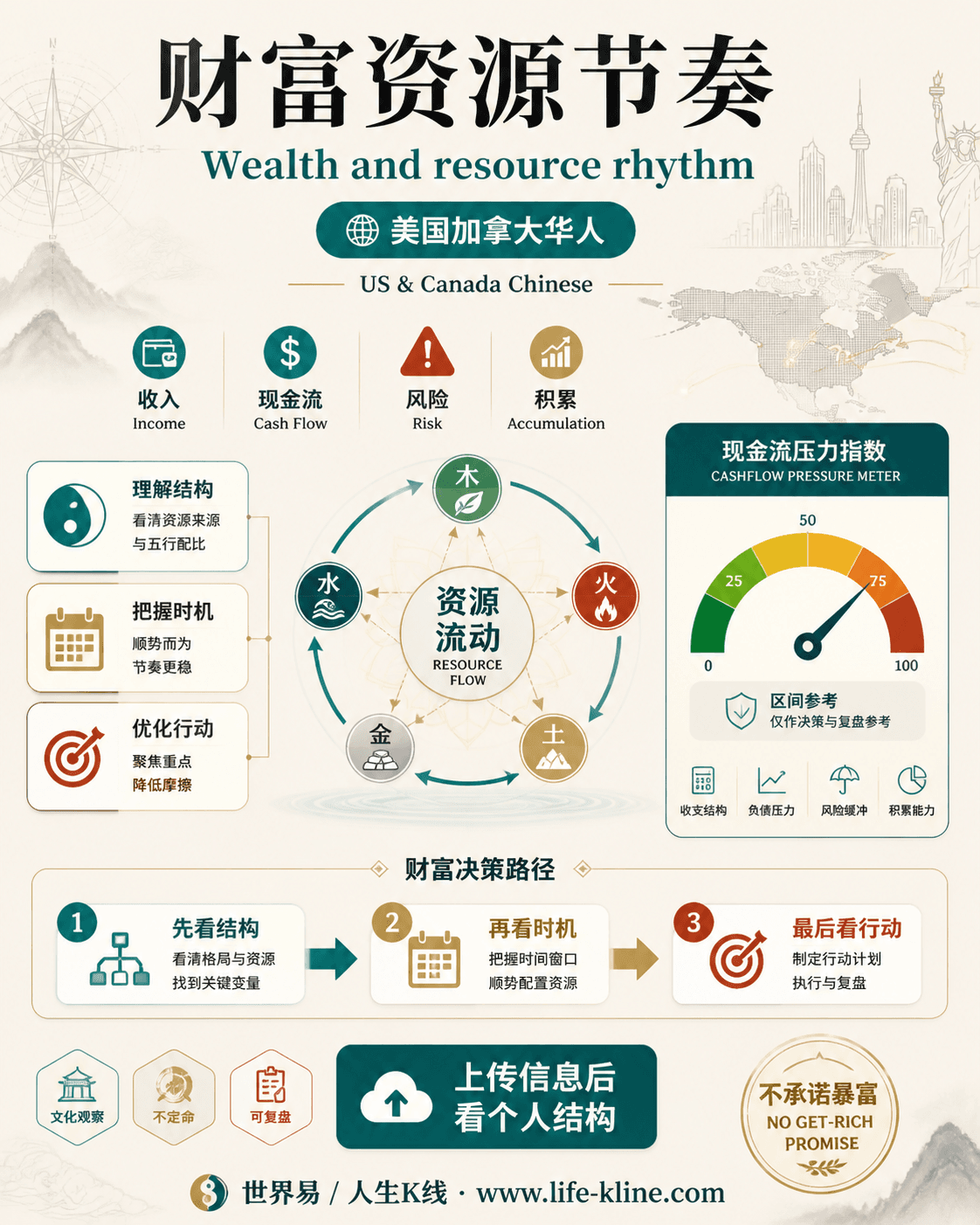
财富资源节奏|美国加拿大华人
这张图把《BaZi Analysis of Shi Shan, Cai, and Yin Elements in Side Business Decisions for Financial Professionals》里的命理概念转成关系、边界和应用场景,适合先看图建立结构,再回到知识文章正文理解细节。
财富资源节奏不应被写成固定结论。更适合美国加拿大华人的读法,是把传统术语翻译成结构、时机、环境、行动和复盘。
查看图片解读