Decision-Making on Parental Estrangement: Timing and Observation Strategies from a Metaphysical Perspective
把这篇文章落到自己身上验证:先看结构,再进入个人分析,不做泛泛阅读。
Why This Decision Is Especially Difficult in This Context
Whether to sever ties in parental relationships involves deep emotional attachment and cultural expectations, especially in Chinese societies where strong social stigma and guilt often accompany such decisions. Estrangement is often seen as an irreversible extreme choice, causing psychological trauma and even family fractures, leading to inner conflict and hesitation during decision-making.
In family dynamics, blurred boundaries and emotional blackmail are common dilemmas. Parents often reinforce children's sense of responsibility through cultural traditions, while children find it difficult to break free from guilt and shame, creating a hard-to-break cycle. Although psychological counseling can provide support, actual actions still require cautious weighing.
Metaphysical structures reflect the interaction between an individual's internal energy and external pressures, particularly the strength of the Day Master, and the configuration of Yin Star (Zheng Yin / Pian Yin) and Bi Jian (Peer/Rob Wealth). These indicate the strength of self-protection and support systems. The Qi Sha (Seven Killings) and Zheng Guan (Proper Authority) combinations reveal conflicts and pressures in authority relationships, while Cai Xing (Wealth Stars) reflect material and emotional giving and taking.
In decisions about estrangement, these metaphysical elements combined with family dynamics require comprehensive observation of the rhythms of Liu Nian (annual fortune) and Da Yun (decade luck cycles) to judge whether current energy supports proactive boundary-setting or if it is better to wait, avoiding irreversible consequences caused by impulsiveness.
Three Core Dimensions in Metaphysical Judgment
First, the strength of the Day Master determines an individual's psychological resilience and stability of self-boundaries when handling family relationships. A relatively strong Day Master usually represents robust inner strength, enabling better boundary-setting; a relatively weak Day Master may fluctuate between emotional dependence and self-protection.
Second, Yin Star (Zheng Yin/Pian Yin) and Bi Jian (Peer/Rob Wealth) represent support and competition. Yin Star symbolizes spiritual and psychological support, representing nourishment and cultural inheritance from the original family; excessive Yin Star may lead to over-dependence. Bi Jian symbolizes peer strength or self-assertion space; when strong, it benefits boundary-setting and autonomy.
Third, the Qi Sha and Zheng Guan combinations are closely related to authority pressure, reflecting parental authority and its control and restriction over the individual. Excessively strong or impulsive Qi Sha can trigger intense conflicts, requiring careful handling. Cai Xing relates to emotional giving and material exchange; Pian Cai (Indirect Wealth) patterns may face dual entanglements of emotions and interests during estrangement.
Additionally, the interaction of Liu Nian and Da Yun indicates the current environmental rhythm. A stable and conservative Da Yun combined with flexible Liu Nian suggests it is suitable to observe and adjust steadily rather than act hastily.
Three Real BaZi Chart Case Studies
Case 1 (Based on Fact Package 1): This female chart has a relatively strong Day Master Geng (庚, Metal), with a Yang Ren (Yang Blade) pattern, which symbolizes strong individual energy and impact. The Yong Shen (favorable elements) are Fire and Wood; the Ji Shen (unfavorable element) is Earth. The current Da Yun is Gui Hai (癸亥), a stable luck cycle suitable for maintaining status quo. The Liu Nian Bing Wu (丙午) year aligns with the Yong Shen Fire, favoring active response to change. In the family power struggle over parental estrangement, the strong Day Master and Yang Ren pattern demonstrate strong self-protection awareness and decisiveness, but the unfavorable Earth warns against excessive stubbornness and internal conflict. The stable Da Yun suggests it is not advisable to rush into estrangement now; rather, it is better to first establish clear boundaries, gradually communicate, and observe parental reactions and family dynamics. The recommended judgment sequence: first confirm emotional stability, then combine psychological counseling support, gradually set boundaries, and avoid triggering irreversible conflicts.
Case 2 (Based on Fact Package 2): This male chart has a relatively weak Day Master Jia (甲, Wood), with a Zheng Yin (Proper Seal) pattern indicating strong dependence. Yin Star represents maternal or female elder nourishment. The Yong Shen is Water; the Ji Shen are Fire and Earth. The current Da Yun is Xin Si (辛巳), a stable luck cycle; the Liu Nian Bing Wu (丙午) year has strong Fire, exerting pressure on the Day Master. This chart shows strong emotional dependence and internal anxiety in the estrangement decision; the Zheng Yin pattern makes it difficult to sever ties easily, and the unfavorable Fire and Earth indicate potential dual spiritual and material pressures during estrangement. The Da Yun and Liu Nian suggest the environment is challenging but overall stable, recommending continued observation of family relations, strengthening external psychological support, and avoiding impulsive estrangement that may worsen inner trauma. The recommended judgment sequence: focus on building inner security, cooperate with professional psychological counseling, gradually explore boundary-setting possibilities, and postpone major estrangement decisions.
Case 3 (Based on Fact Package 3): This female chart has a relatively weak Day Master Xin (辛, Metal), with a Pian Cai (Indirect Wealth) pattern symbolizing complex emotional and material entanglements. The Yong Shen is Earth; the Ji Shen are Water and Wood. The current Da Yun is Ji Mao (己卯), a stable luck cycle, combined with the Liu Nian Bing Wu (丙午) year, creating an overall stable environment with opportunities for flexible response. The weak Day Master and Pian Cai pattern imply possible emotional and material dependence and entanglement with parents; estrangement decisions involve dual considerations of interests and feelings. The Yong Shen Earth supports boundary stability, while the Ji Shen Water and Wood warn of emotional fluctuations and external interference. This chart is suitable for rational analysis and psychological counseling assistance to gradually clarify responsibilities and boundaries in family relationships. Currently, observation and adjustment are advisable to avoid decision errors caused by emotional impulses. The recommended judgment sequence: first clarify personal needs and boundaries, rationally assess the actual impact of parental relationships, combine psychological counseling, steadily advance boundary-setting, and wait for the appropriate time to decide on estrangement.
Common Misjudgments and Blind Spots in This Context
Many individuals easily fall into extreme emotions when deciding whether to estrange, such as excessive guilt or completely denying parental influence, neglecting the gradual establishment of emotional boundaries. Those with a relatively weak Day Master are more easily controlled by emotions, leading to unbalanced decisions.
Another misconception is treating estrangement as a universal solution to all conflicts, overlooking the complexity of family systems and the profound influence of cultural expectations on individual behavior. When Qi Sha is excessively strong, impulsive estrangement may escalate authority conflicts and cause greater psychological harm.
Some ignore the rhythms of Da Yun and Liu Nian and environmental changes, acting blindly or hesitating for a long time. Metaphysics advises that when the current Da Yun favors maintaining the status quo, forced estrangement is more likely to bring adverse consequences. Rational observation and professional counseling are indispensable.
A common blind spot is relying solely on metaphysical assertions to decide on estrangement, ignoring the need for professional treatment of psychological trauma. Metaphysics can only assist in rhythm judgment and cannot replace psychological counseling and family therapy.
Practical Judgment Sequence
First, assess the strength of your Day Master and the state of your Yong Shen to judge whether your internal energy is sufficient to support boundary-setting or estrangement. With a relatively strong Day Master and supportive Yong Shen, consider gradually establishing boundaries; with a weak Day Master, strengthen psychological counseling support to avoid impulsive estrangement.
Second, combine the rhythms of Da Yun and Liu Nian to observe whether the current environment is stable and suitable for maintaining or if there are opportunities for flexible adjustment. Stable periods are suitable for observation and adjustment; when Liu Nian presents favorable timing, gradually promote decisions to reduce irreversible risks.
Finally, combine professional psychological counseling and family therapy to clarify attachment and emotional blackmail in family dynamics, and define personal boundaries and responsibilities. Estrangement is not the only option; assess psychological trauma and family cultural background, take gradual actions, and ensure psychological health.
FAQ
Question 1: Does the Yang Ren (Yang Blade) pattern in metaphysics mean immediate estrangement is appropriate? Answer: The Yang Ren pattern represents strong individual energy and self-protection awareness, but estrangement decisions need to consider Yong Shen and the rhythms of Da Yun and Liu Nian. Yang Ren is not an absolute signal for immediate estrangement and should be judged cautiously with psychological counseling.
Question 2: How should a person with a relatively weak Day Master judge the timing of estrangement? Answer: A relatively weak Day Master usually indicates strong emotional dependence, and estrangement can easily cause psychological imbalance. It is recommended to emphasize Yin Star and the rhythms of Da Yun and Liu Nian, first strengthen psychological support, gradually set boundaries, observe family reactions, and avoid hasty estrangement.
Question 3: Does a stable Da Yun mean estrangement is not advisable? Answer: A stable Da Yun suggests an environment favorable for maintaining and adjusting, but it does not absolutely prohibit estrangement. It is suitable for observation and steady handling. If family conflicts are intense and psychological burdens heavy, cooperate with professional counseling to assess whether conditions for estrangement have been met.
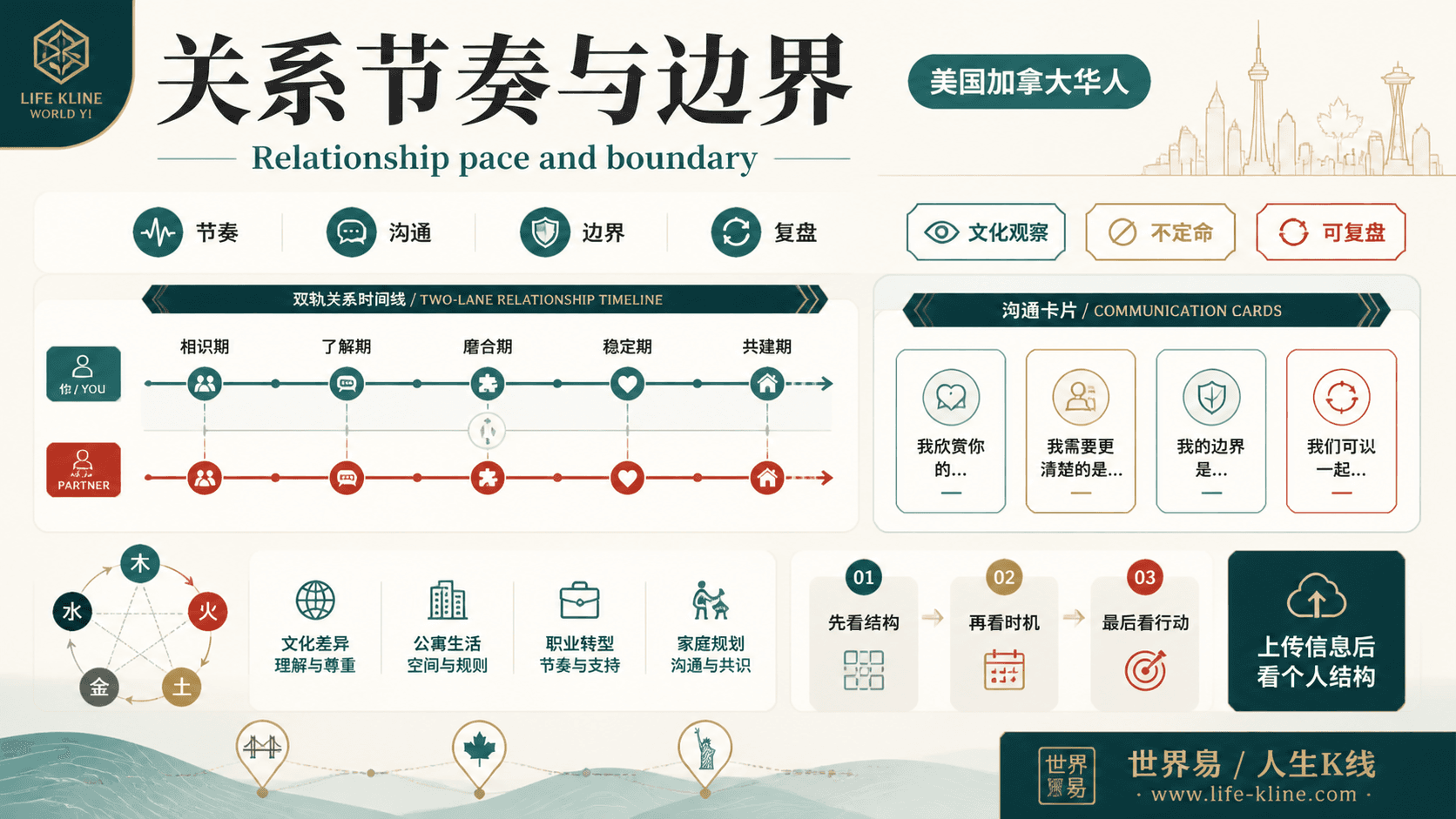
关系节奏与边界|美国加拿大华人
这张图把《Decision-Making on Parental Estrangement: Timing and Observation Strategies from a Metaphysical Perspective》里的命理概念转成关系、边界和应用场景,适合先看图建立结构,再回到知识文章正文理解细节。
关系节奏与边界不应被写成固定结论。更适合美国加拿大华人的读法,是把传统术语翻译成结构、时机、环境、行动和复盘。
查看图片解读