Metaphysical Analysis and Practical Guide for Entrepreneurs Choosing Between Starting Their Own Business and Staying in an Organization
把这篇文章落到自己身上验证:先看结构,再进入个人分析,不做泛泛阅读。
你现在搜索的,
其实是一个要落到自己身上的判断。
当前页面主要回答「Entrepreneurship」这类搜索问题;真正有价值的下一步是把这套结构带进自己的报告、工具与案例验证。
Why This Decision Is Especially Difficult in This Field
Entrepreneurs face core pressures mainly from the stability of the financial chain, recruitment and retention of talent, risks from policy and regulatory changes, and balancing personal and family life. Financial pressure requires entrepreneurs to have strong risk-bearing capacity and resource integration ability; otherwise, they easily fall into financial breakdown. Talent management relates to team stability and execution power. Especially in the startup phase, frequent conflicts during team integration test the leader’s emotional intelligence and wisdom.
Regarding income structure, early-stage entrepreneurship income is often unstable, sometimes even negative cash flow. The contradiction between family financial burdens and business investment easily intensifies family conflicts. In contrast, working within an institution provides relatively stable income but limited promotion space, requiring balancing personal development and institutional constraints within an existing framework. Entrepreneurs’ personal heroic periods are short, requiring high-risk decisions at critical moments; missing opportunities may lead to business failure.
From a metaphysical perspective, common Ten Gods (Shi Shen) for entrepreneurs like Qi Sha (Seven Killings) and Pian Cai (Indirect Wealth) represent external competition and wealth opportunities but also bring uncertainty and pressure. The strength of the Day Master, the pattern, and the combination of Yong Shen (favorable elements) determine the individual’s endurance and adaptability to these pressures. For example, a relatively strong Day Master with a Jie Cai (Rob Wealth) pattern has strong self-drive and stress resistance, suitable for starting their own business; whereas a relatively weak Day Master with Yong Shen favoring Earth is more suitable for stable maintenance and better suited to staying within an organization.
Therefore, when entrepreneurs choose between starting their own business or staying in an organization, they should consider not only external environment and personal ability but also their metaphysical structure, finding the path that best matches their BaZi chart advantages to maximize the probability of career success and reduce physical and mental depletion caused by excessive pressure.
Three Core Dimensions of Metaphysical Judgment
First, the strength of the Day Master determines the individual’s dominant energy and ability to bear pressure. A relatively strong Day Master means abundant vitality and stress resistance, suitable for undertaking various entrepreneurial challenges; a relatively weak Day Master is more suited to relying on external support and a stable environment, making staying within an organization safer.
Second, the pattern type reflects the overall structure and energy distribution of the BaZi chart. The Jie Cai (Rob Wealth) pattern represents competition and self-expression, usually suitable for starting one’s own business; the Zhuan Wang (Exclusive Strength) pattern tends toward focus and maintenance, suitable for steady development within an institution; the Zheng Cai (Direct Wealth) pattern emphasizes wealth accumulation and stability, suitable for maintaining or managing existing resources in a mature stage.
Third, the choice of Yong Shen reveals the key regulating elements of the chart. Yong Shen of Fire and Wood indicates a need to stimulate internal motivation and external resources, suitable for aggressive entrepreneurship; Yong Shen of Earth implies a need for stability and conservatism, suitable for maintenance and steady development. The presence of Ji Shen (unfavorable elements) requires avoiding conflicting elements that bring adverse effects to ensure smooth career progress.
Additionally, the interaction between Da Yun (decade luck cycle) and Liu Nian (annual fortune) must be considered. Favorable Da Yun combined with supportive Liu Nian is conducive to seizing entrepreneurial opportunities; stable or maintenance-oriented Da Yun is better for consolidating existing achievements and reducing blind risks. These three core metaphysical dimensions collectively form an important reference basis for entrepreneurs making decisions between starting their own business and staying within an organization.
Three Real BaZi Chart Cases
Case 1: This female chart has a Day Master of Geng Metal (庚, Geng), relatively strong, with a Jie Cai (Rob Wealth) pattern. The Yong Shen are Fire and Wood, and Ji Shen is Earth. The current Da Yun is Jia Shen (甲申, Jia Shen), a favorable luck cycle. This chart possesses strong self-drive and external competitiveness; the Fire and Wood Yong Shen stimulate motivation, suitable for proactive action. Considering the entrepreneur’s financial pressure and talent recruitment realities, this chart is more suitable for starting one’s own business, courageously bearing risks and responsibilities, and leveraging the favorable Da Yun period to expand the business. However, attention must be paid to the Earth Ji Shen to avoid resource waste caused by poor management. The suggested judgment sequence is to first confirm whether the Yong Shen is sufficient, then evaluate if the Da Yun and Liu Nian are supportive, and finally combine with personal and family support to decide the timing of action.
Case 2: This male chart has a Day Master of Ren Water (壬, Ren), relatively strong, with a Zhuan Wang (Exclusive Strength) pattern. The Yong Shen is Earth, Ji Shen is Wood, and the current Da Yun is Yi Si (乙巳, Yi Si), a stable luck cycle. The relatively strong Ren Water Day Master expresses delicate emotions and strong adaptability, but the Earth Yong Shen indicates a need for stability and maintenance, and the Wood Ji Shen suggests avoiding excessive external changes. Considering the entrepreneur’s work pressure, this type of chart is suitable for staying within an organization to cultivate deeply, using a stable environment to accumulate capital and resources and reduce unnecessary risks. The judgment sequence recommends first assessing the stability of the current Da Yun, then confirming the impact of Ji Shen on the environment, and finally combining with personal career planning to make a prudent choice.
Case 3: This female chart has a relatively weak Day Master of Geng Metal (庚, Geng), with a Zheng Cai (Direct Wealth) pattern. The Yong Shen is Earth, Ji Shen are Water and Wood, and the current Da Yun is Xin Mao (辛卯, Xin Mao), also a stable luck cycle. The relatively weak Geng Metal Day Master indicates insufficient internal energy; the Zheng Cai pattern emphasizes wealth accumulation and management; the Earth Yong Shen supports stability; the Water and Wood Ji Shen require avoiding external disturbances. This chart suits maintenance-type entrepreneurs or those responsible for finance and management positions within an organization, facilitating balance between family and career pressures. The judgment sequence suggests prioritizing confirmation of sufficient Earth Yong Shen to ensure stability, combining Da Yun and Liu Nian to judge suitability for change, and finally evaluating family support strength.
All three cases illustrate how metaphysical structure amplifies or offsets entrepreneurs’ decisions between starting their own business and staying in an organization. Centering on Day Master strength, combined with pattern and Yong Shen, and considering actual Da Yun and Liu Nian situations, can scientifically guide career path choices.
Common Misjudgments and Blind Spots in This Field
A common misjudgment in applying metaphysics for entrepreneurs is ignoring the relationship between Day Master strength and Yong Shen matching, blindly pursuing starting their own business without considering their own endurance and external resource support, leading to financial chain breaks and team collapse. Additionally, over-reliance on Da Yun auspiciousness while neglecting the interaction between Liu Nian and Da Yun often results in wrong decisions at critical moments.
Another blind spot is neglecting Ji Shen, failing to identify the impact of unfavorable elements in the chart, which leads to career development obstacles or intensified family conflicts. Especially under pressure, entrepreneurs often experience emotional volatility and overlook the hidden risks brought by Ji Shen, affecting decision quality.
Furthermore, some entrepreneurs overlook the important factor of balancing family. Even if the Yong Shen is strong in the chart, lacking stable support causes imbalance between career and family, ultimately affecting career sustainability. Entrepreneurial decisions are not only individual choices but comprehensive considerations of resources, networks, and emotions. Metaphysical judgment must integrate actual work and life scenarios.
Therefore, entrepreneurs should avoid mechanically applying metaphysical conclusions but deeply understand the interaction between metaphysical structure and real environment, scientifically assess their conditions, and reasonably plan their career paths.
Practical Judgment Sequence
Step one: Clarify the strength level of the Day Master to determine whether one has the capability to bear high risk and high pressure in entrepreneurship. A relatively strong Day Master usually has the potential to start their own business, while a relatively weak Day Master is advised to be steady and maintain, prioritizing staying within an organization.
Step two: Combine the pattern type and Yong Shen to evaluate the overall energy configuration. Jie Cai (Rob Wealth) and Pian Cai (Indirect Wealth) patterns suit proactive entrepreneurship; Zheng Cai (Direct Wealth) and Zhuan Wang (Exclusive Strength) patterns are more suitable for steady management. Confirming whether the Yong Shen is properly stimulated and whether the Ji Shen is controlled is an important basis for judging suitability for entrepreneurship.
Step three: Analyze the compatibility of the current Da Yun and Liu Nian. Favorable Da Yun combined with supportive Liu Nian is the best window for entrepreneurial action; stable or maintenance-oriented Da Yun is suitable for observation or deep cultivation within an organization. Combine family support and financial status to reasonably plan the startup timing.
Throughout the overall judgment process, strategies need dynamic adjustment to avoid being blindly aggressive or overly conservative, ensuring balance between career development and personal life, maximizing metaphysical advantages, and mitigating potential risks.
FAQ
Question 1: Are people with a relatively weak Day Master absolutely unsuitable for entrepreneurship? Answer: A relatively weak Day Master does not absolutely mean unsuitability for entrepreneurship. It indicates weaker ability to bear pressure and sudden risks. It is recommended to choose a steady entrepreneurial direction or play a supporting role within a team to avoid blind recklessness.
Question 2: Why are people with Fire and Wood Yong Shen more suitable for starting their own business? Answer: Fire and Wood Yong Shen represent motivation and growth energy, capable of stimulating innovation and the utilization of external resources. They are suitable for facing the variable environment and competitive pressure in entrepreneurship, helping to break through bottlenecks and achieve rapid career development.
Question 3: Does a stable Da Yun and Liu Nian mean one should not start a business? Answer: Stable Da Yun and Liu Nian usually favor maintenance and accumulation but do not exclude entrepreneurship through reasonable planning and resource integration. The key is to combine one’s metaphysical structure and external environment to choose the appropriate timing and method.
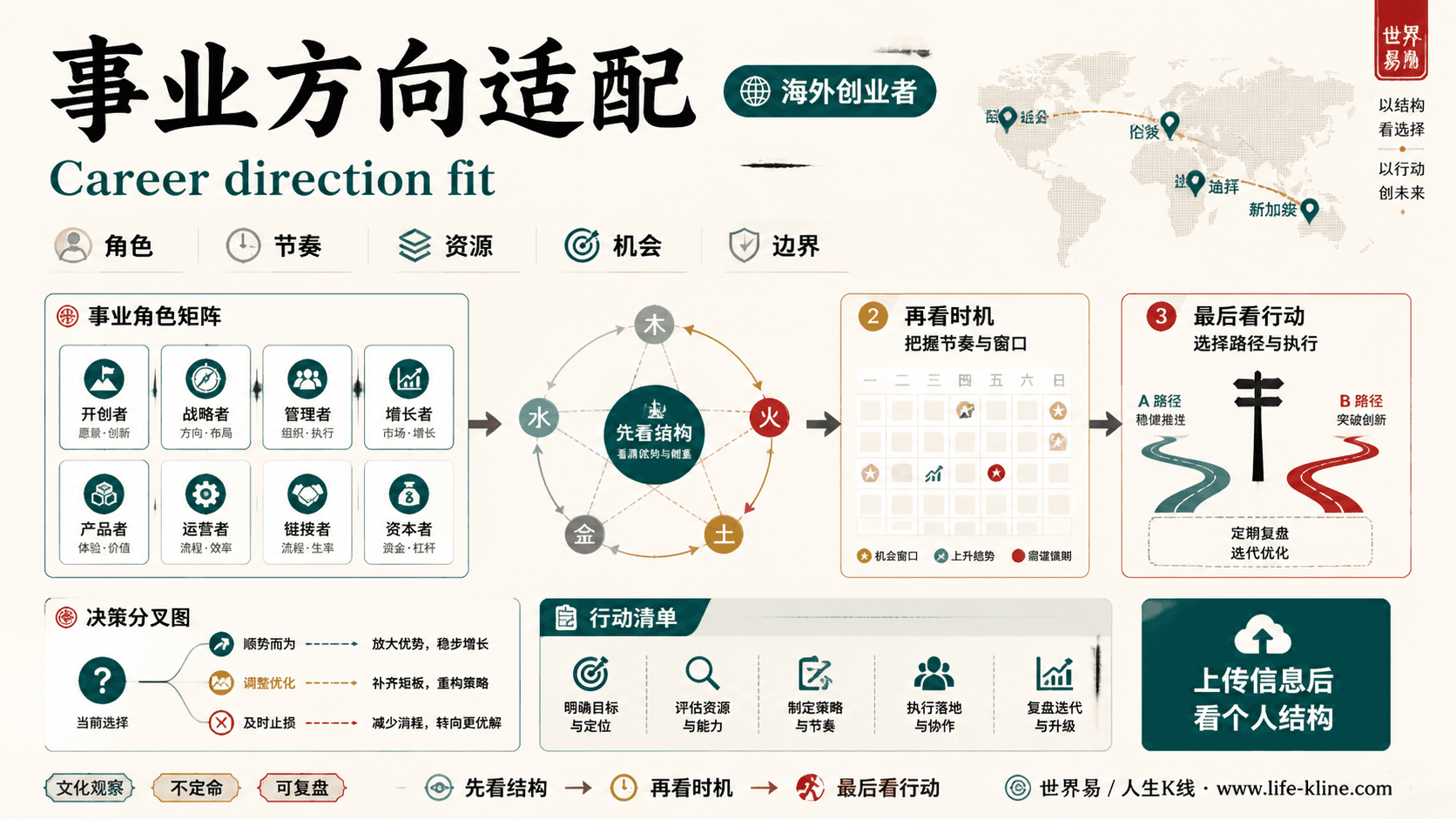
事业方向适配|海外创业者
这张图把《Metaphysical Analysis and Practical Guide for Entrepreneurs Choosing Between Starting Their Own Business and Staying in an Organization》里的命理概念转成关系、边界和应用场景,适合先看图建立结构,再回到知识文章正文理解细节。
事业方向适配不应被写成固定结论。更适合海外创业者的读法,是把传统术语翻译成结构、时机、环境、行动和复盘。
查看图片解读