Entrepreneur Industry Compatibility Analysis: A Metaphysical Guide to Career Decisions
把这篇文章落到自己身上验证:先看结构,再进入个人分析,不做泛泛阅读。
Why This Decision Is Especially Difficult for This Industry
Entrepreneurs face significant challenges in making industry compatibility decisions, primarily due to the accumulation of multiple pressures. Financial pressure forces entrepreneurs to accurately judge market directions; otherwise, the risk of a broken cash flow chain is very high. At the same time, difficulties in recruiting and retaining talent directly affect team stability and execution power, while the uncertainty of policy risks further complicates industry selection. Entrepreneurs often find themselves in a personal hero phase, bearing heavy responsibilities and needing to balance family and career, resulting in enormous physical and mental stress.
From the perspective of income structure, early-stage entrepreneurship generally involves unstable income. The correctness of industry choice directly relates to cash flow and subsequent financing possibilities. Incorrect judgments cause consumption not only economically but may also strain family relationships. If an entrepreneur’s metaphysical structure supports strong execution ability, resource integration capacity, and resilience under pressure, they will have an advantage on the entrepreneurial path.
In metaphysics, the strength of the Day Master, the BaZi pattern, and the Yong Shen directly reflect an individual’s inherent abilities and adaptability to the external environment. For example, entrepreneurs with Qi Sha (Seven Killings) or Pian Cai (Indirect Wealth) as main elements often show strong ambition and resource control but may also face internal conflicts and psychological pressure. If the chart’s Yong Shen is strong and the Da Yun and Liu Nian align well, it favors smooth entrepreneurial decision-making; otherwise, decision errors or weak execution are prone to occur.
Therefore, in industry compatibility decisions, entrepreneurs must consider not only market and policy factors but also scientifically evaluate their own metaphysical strengths and weaknesses. This helps avoid blindly following trends or overreaching, ensuring sustainable career development.
Three Core Dimensions of Metaphysical Judgment
First, the strength of the Day Master and its associated Five Element determine the entrepreneur’s core energy and environmental adaptability foundation. For example, a Xin Metal (辛, Xin) Day Master with balanced strength indicates resilience and flexibility, suitable for a dynamic entrepreneurial environment. In contrast, a slightly strong Bing Fire (丙, Bing) Day Master reveals passion and action but requires attention to internal consumption.
Second, the BaZi pattern reflects the overall structural characteristics of the chart. Patterns such as Zheng Cai (Direct Wealth), Zhuan Wang (Exclusive Strength), and Zheng Guan (Direct Officer) each have their advantages and disadvantages. Zheng Cai emphasizes resource and financial management abilities; Zhuan Wang represents a wholehearted career focus; Zheng Guan indicates adherence to rules and regulations, suitable for policy-sensitive environments. The coordination between the pattern and Yong Shen is key to judging whether an entrepreneur fits a particular industry.
Third, the Yong Shen and Ji Shen (unfavorable element) reveal which Five Elements the Day Master needs to supplement or avoid. This directly influences decision-making rhythm and resource allocation during entrepreneurship. For example, if the Yong Shen is Earth, it implies stability and support, while Ji Shen being Fire means avoiding excessive impulsiveness and dissipation. Proper use of the Yong Shen can enhance resilience and team cohesion.
Additionally, Da Yun (decade luck cycles) and Liu Nian (annual fortune) represent fluctuations in fortune at different stages. Favorable luck periods suit active expansion, stable periods favor consolidation and adjustment, and adverse periods call for caution and observation. Entrepreneurs should combine Da Yun and Liu Nian rhythms to reasonably arrange industry choices and key decisions, avoiding blind impulsiveness.
Three Real BaZi Chart Cases
Case 1: A female entrepreneur with a Xin Metal (辛, Xin) Day Master of balanced strength, a Zheng Cai (Direct Wealth) pattern, and Yong Shen being Earth. She is currently in the Wu Chen (戊辰, Wu Chen) Da Yun (ages 39-48, a very auspicious luck cycle) with the Liu Nian of Bing Wu (丙午, Bing Wu). The balanced Xin Metal Day Master shows her ability to balance internal and external factors, while the Zheng Cai pattern strengthens her control over resources and management. The Earth Yong Shen provides stability, countering the consumption caused by the Fire Ji Shen, especially under financial pressure and policy risks, demonstrating strong endurance. In the entrepreneurial environment, she is more suited to stable industries with clear financial management. The current Da Yun is auspicious, making it suitable to seize opportunities to expand business. The recommended judgment sequence is to first ensure cash flow stability and core team members, then formulate expansion plans based on the Liu Nian trend.
Case 2: A male entrepreneur with a Bing Fire (丙, Bing) Day Master that is slightly strong, a Zhuan Wang (Exclusive Strength) pattern, Yong Shen being Earth, and Ji Shen being Wood. He is currently in the Geng Zi (庚子, Geng Zi) Da Yun (ages 48-57, a stable luck cycle) with the Liu Nian of Bing Wu (丙午, Bing Wu). The slightly strong Bing Fire Day Master reflects strong initiative and leadership. The Zhuan Wang pattern supports a personal heroism style, suitable for high-pressure, fast-paced industries. However, the Wood Ji Shen may cause internal conflicts and resource loss, while the Earth Yong Shen reminds the need for stability and regulation. The Da Yun is stable, and the Liu Nian requires adaptability. Regarding industry compatibility, he fits innovative industries but should avoid overexpansion. The suggested judgment sequence is to first assess team stability and resource allocation, then adjust strategies according to industry policies, emphasizing risk prevention.
Case 3: A male entrepreneur with a Ji Earth (己, Ji) Day Master that is slightly strong, a Zheng Guan (Direct Officer) pattern, Yong Shen being Wood and Water, and Ji Shen being Fire. He is currently in the Geng Yin (庚寅, Geng Yin) Da Yun (ages 51-60, auspicious luck) with the Liu Nian of Bing Wu (丙午, Bing Wu). The slightly strong Ji Earth Day Master represents steadiness and reliability. The Zheng Guan pattern emphasizes rule-following and system compliance, suitable for policy-sensitive industries. The Wood and Water Yong Shen help regulate the over-strong Earth, while the Fire Ji Shen requires avoiding impulsive decisions. The current Da Yun is auspicious, with progress in career and wealth, suitable for steady expansion and management optimization. In terms of industry compatibility, industries sensitive to policy changes are more suitable. The judgment sequence should start from policy environment changes, combined with personal Yong Shen adjustment ability, to formulate long-term plans.
Common Misjudgments and Blind Spots in This Industry
One common misjudgment by entrepreneurs is over-reliance on momentary passion and momentum, neglecting the balance between Yong Shen and Ji Shen in their metaphysical chart. This leads to hasty decisions and excessive resource consumption, making long-term development difficult to sustain. Additionally, ignoring the fluctuations brought by Da Yun and Liu Nian changes, blindly expanding or transforming, often results in broken cash flow chains and team splits.
Another blind spot is the oversimplification of BaZi patterns. Entrepreneurs often focus only on the strength of the Day Master, neglecting the strategic guidance provided by the overall pattern. For example, Zheng Guan pattern entrepreneurs ignoring rules and policy risks, or Zheng Cai pattern entrepreneurs overlooking financial management details, can both cause industry compatibility deviations.
At the same time, entrepreneurs balancing family obligations and career pressure tend to underestimate the internal consumption caused by Ji Shen, failing to timely adjust mindset and pace, which affects decision quality and execution efficiency. Insufficient attention to the Ji Shen in the metaphysical structure is a common blind spot in industry choice and decision-making.
Finally, entrepreneurs often mistakenly consider metaphysics merely as a fortune-telling tool, overlooking its profound revelation of personal energy structure and environmental adaptability. This results in a lack of scientific basis in industry selection and difficulty achieving true industry compatibility.
Practical Judgment Sequence
First, determine the strength of the Day Master and the BaZi pattern type to understand your core energy and strategic positioning. Entrepreneurs should judge whether they have sufficient resource integration ability and execution power based on the Day Master’s Five Element and pattern, clarifying their role in the industry.
Second, analyze Yong Shen and Ji Shen to identify potential internal consumption and resource drain points during entrepreneurship. Properly utilize the Yong Shen and avoid negative impacts from the Ji Shen to ensure team stability and cash flow safety.
Finally, review the current Da Yun and Liu Nian, combining industry policies and market environment to judge the timing of actions. Favorable Da Yun periods suit active expansion; stable periods favor consolidation and adjustment; adverse periods call for caution and waiting. Entrepreneurs should flexibly adjust industry choices and strategic layouts according to fortune rhythms, acting in harmony with trends.
FAQ
Question 1: How do Yong Shen and Ji Shen influence entrepreneurial industry selection? Answer: Yong Shen represents the Five Elements the Day Master needs to supplement and depend on, enhancing abilities and resource integration. It serves as a beneficial reference in industry selection. Ji Shen is the element to avoid or control; if the industry attributes conflict with Ji Shen, it may cause internal conflicts and resistance, requiring caution.
Question 2: What specific guidance do Da Yun and Liu Nian provide for entrepreneurial decisions? Answer: Da Yun and Liu Nian reflect the strength of fortune in different time periods. Favorable luck periods suit active business expansion; stable periods suit consolidation and adjustment; adverse periods are suitable for caution and risk control. They help entrepreneurs grasp the best timing for actions.
Question 3: Is there a necessary relationship between Day Master strength and entrepreneurial success? Answer: The strength of the Day Master reflects an individual’s core energy. Strong Day Masters suit high-pressure, fast-paced environments, while weaker ones need to rely on teams and external resources. Reasonable judgment of Day Master strength helps match suitable industries and decision rhythms, but success also depends on other metaphysical factors and real-world capabilities.
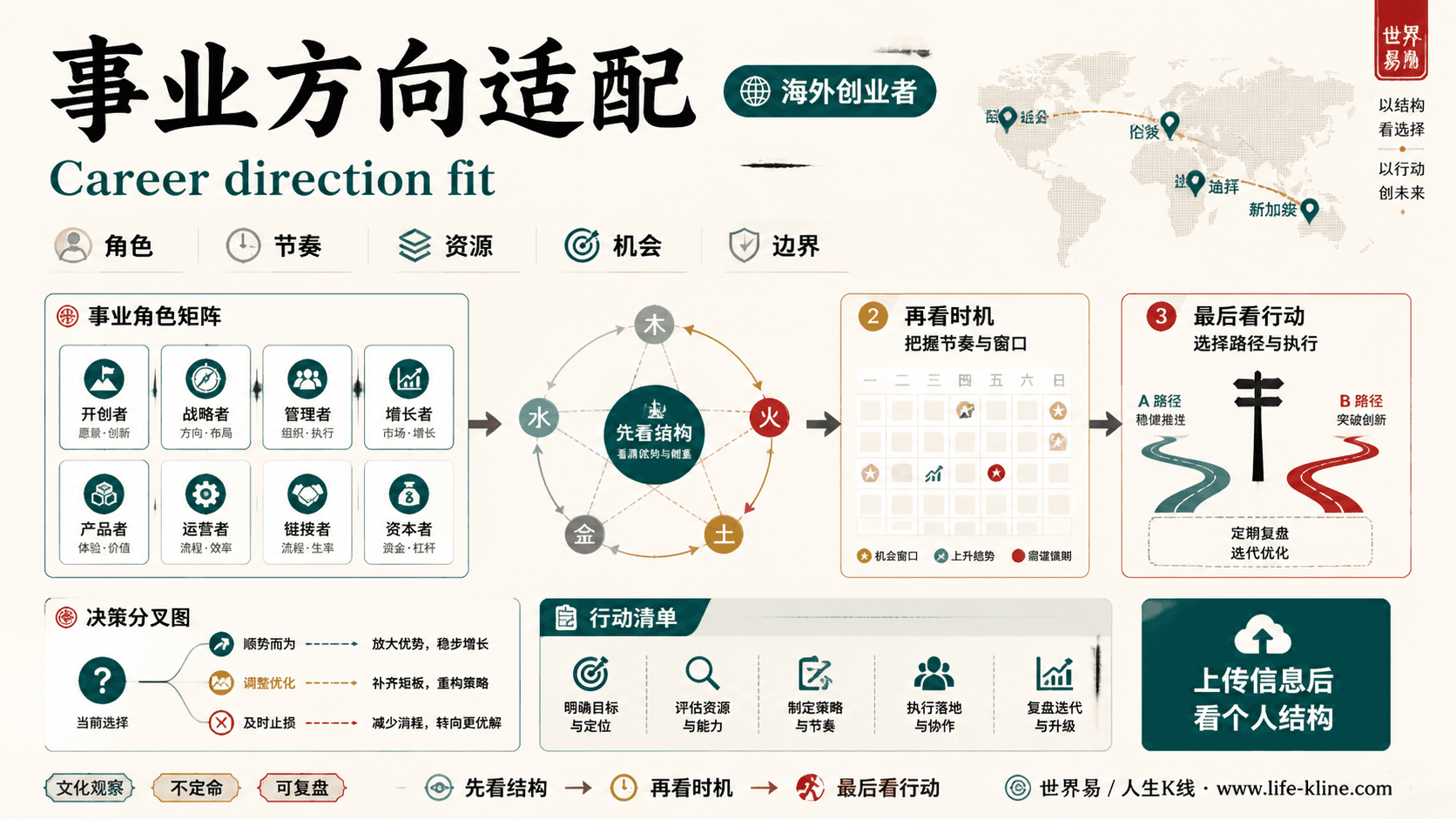
事业方向适配|海外创业者
这张图把《Entrepreneur Industry Compatibility Analysis: A Metaphysical Guide to Career Decisions》里的命理概念转成关系、边界和应用场景,适合先看图建立结构,再回到知识文章正文理解细节。
事业方向适配不应被写成固定结论。更适合海外创业者的读法,是把传统术语翻译成结构、时机、环境、行动和复盘。
查看图片解读