BaZi Analysis and Decision Guidance on Financial Negotiations of Engagement Betrothal Gifts
把这篇文章落到自己身上验证:先看结构,再进入个人分析,不做泛泛阅读。
Why This Decision Is Especially Difficult at This Stage of the Relationship
Engagement, as a key preliminary step in marriage, centers the negotiation on the amounts of betrothal gifts and dowry between both families. Betrothal gifts not only represent the groom’s family sincerity but also bear the social expectations of maintaining the relationship, while dowry reflects the bride’s family support. Differences in economic conditions, cultural views, and future plans across multiple dimensions make it difficult to reach consensus on financial matters.
Moreover, the time window from engagement to wedding is usually short, concentrating economic pressures from various preparations. The baseline and concession space for financial allocation become real tests. Both families focus not only on immediate amounts but also on the distribution and use of joint property after marriage. Insufficient financial transparency and trust can easily trigger latent conflicts.
BaZi structure, as an important traditional cultural tool reflecting individual and family wealth management ability, can indicate psychological expectations and behavioral patterns regarding wealth issues. Especially the positions of wealth stars and Bi Jian/Jie Cai structures in the BaZi chart reflect a person’s control and protection over wealth, amplifying or suppressing conflicts and negotiation attitudes in reality.
Therefore, financial decisions during the engagement betrothal gift stage are both a concentrated reflection of multiple social pressures and a psychological and behavioral negotiation influenced by the BaZi wealth structure. Understanding how BaZi mirrors reality helps both sides reasonably define their baseline and concession space, balancing family expectations and individual endurance.
Three Core Dimensions of BaZi Judgment
The strength of the Day Master and its pattern form the foundation for analyzing wealth decisions. A relatively strong Day Master usually means abundant self-energy and more initiative in financial matters. Patterns such as Yang Ren (Yang Blade) or Zheng Guan (Proper Officer) affect an individual’s rigidity or flexibility in handling wealth and their sense of family responsibility. Yong Shen (favorable element) and Ji Shen (unfavorable element) directly indicate the flow or obstruction of wealth, influencing emotional and rational trade-offs during decisions.
The spouse palace and spouse star positions are key metaphysical windows into wealth sharing and conflicts. If the spouse palace is afflicted by clashes or punishments, it indicates a higher likelihood of financial disputes requiring more compromise and communication. A strong spouse star shows the partner has significant influence over finances, necessitating alignment of wealth concepts between both parties.
The interaction between Da Yun (decade luck cycle) and Liu Nian (annual fortune) reflects the auspiciousness or adversity of the timing. When Da Yun is favorable and Liu Nian aligns, wealth negotiations are easier to reach consensus; otherwise, financial disagreements must be handled cautiously to avoid impulsive decisions. Whether the Yong Shen in Da Yun is supported by Liu Nian also affects the flexibility and success rate of wealth decisions.
Combining these three dimensions, the BaZi structure reveals the underlying patterns of wealth flow during the engagement betrothal gift stage, guiding both sides on how to grasp initiative and baseline in negotiations to achieve harmonious financial outcomes.
Three Real BaZi Chart Cases
Case 1: The male’s BaZi chart has a relatively strong Day Master Yi Wood (乙, Yi), with a Yang Ren (Yang Blade) pattern. The Yong Shen are Metal and Earth, while Water is Ji Shen. He is currently in the 9th year of the Xin Wei (辛未, Xin Wei) Da Yun, with the Liu Nian being Bing Wu (丙午, Bing Wu). Overall, the Da Yun is auspicious and the Liu Nian supports the flow. The Yang Ren pattern reflects a relatively firm personality. The wealth star (Metal) as Yong Shen shows strong ability in financial management and wealth accumulation. The smooth luck in Xin Wei Da Yun favors wealth negotiations. In reality, the male side may insist on his baseline regarding the betrothal gift amount, emphasizing actual wealth accumulation and protection. If the female side demands a higher betrothal gift, attention should be paid to the male’s rigidity from the Yang Ren pattern. It is recommended to start from joint property planning and use the auspicious Da Yun period to negotiate gradually, avoiding excessive conflict over amounts at the early stage.
Case 2: The male’s BaZi chart has a relatively strong Day Master Yi Wood (乙, Yi), with a Zheng Guan (Proper Officer) pattern. The Yong Shen is Fire, and Ji Shen is Water. He is currently in the 3rd year of the Jia Wu (甲午, Jia Wu) Da Yun, with the Liu Nian being Bing Wu (丙午, Bing Wu). The Da Yun is stable and favors maintaining the status quo. The Zheng Guan pattern symbolizes a strong sense of responsibility and adherence to norms. The Fire Yong Shen reflects enthusiasm and active maintenance of wealth. Though the Jia Wu Da Yun is stable, it emphasizes preservation, indicating the male side tends to be prudent and conservative regarding betrothal gift and dowry issues. In practice, the male side may show conservative and rational attitudes toward the betrothal gift amount, aiming to balance interests of both families. It is recommended that both families focus on communication and expectation management, leveraging the male’s Zheng Guan pattern’s stability to avoid tension from excessive disputes and focus on reasonable long-term joint property planning.
Case 3: The female’s BaZi chart has a relatively strong Day Master Gui Water (癸, Gui), with a Jie Cai (Rob Wealth) pattern. The Yong Shen is Metal, and Ji Shen is also Metal. She is in the 9th year of the Yi Wei (乙未, Yi Wei) Da Yun, with the Liu Nian being Bing Wu (丙午, Bing Wu). The Da Yun is stable, favoring adaptability. The Jie Cai pattern indicates the female side has strong independence and competitiveness regarding wealth. Although Metal is the Yong Shen providing support, Metal is also Ji Shen here, suggesting internal contradictions in wealth management. During this stable Da Yun period, it is suitable to maintain and adjust. In reality, the female side may show strong autonomy in dowry and joint property, expecting to take some initiative in financial arrangements. Regarding betrothal gifts, both sides need to pay attention to the female’s independent demands from the Jie Cai pattern. It is recommended to use financial transparency and institutionalized joint property agreements as a bridge to ease potential conflicts and achieve wealth sharing.
These three cases demonstrate from different perspectives how the Day Master pattern, Yong Shen and Ji Shen, as well as Da Yun and Liu Nian, influence financial negotiations during the engagement betrothal gift stage, helping identify both parties’ wealth attitudes and negotiation space.
Common Misjudgments and Blind Spots at This Stage
Many families fall into the simplistic numerical negotiation trap regarding betrothal gifts, neglecting the deep influence of both sides’ BaZi structures on wealth management and psychological expectations. While the betrothal gift amount is important, ignoring the strength or weakness of wealth stars and Bi Jian/Jie Cai structures in the chart may lead to unreasonable wealth distribution and subsequent post-marriage conflicts.
Another common blind spot is rashly increasing betrothal gift or dowry amounts during unfavorable Da Yun or Liu Nian periods, ignoring the volatility of luck cycles. This easily causes both parties to bear economic pressures beyond their capacity, affecting marital quality. The Yong Shen, Ji Shen, and auspicious timing indicated by BaZi should be important references in financial decisions, rather than relying solely on social customs or impulsiveness.
Additionally, the clash or combination status of the spouse palace and spouse star is often overlooked. If the spouse palace is afflicted, financial disagreements are more likely. Without early anticipation and communication preparation, minor conflicts can escalate. These details in BaZi structure are key to interpreting the baseline and concession space in wealth negotiations; neglecting them leads to unbalanced decisions.
In summary, rationally integrating BaZi with reality and avoiding one-dimensional misjudgments effectively reduces financial risks during the engagement betrothal gift stage, promoting harmonious and mutually beneficial family relations.
Practical Judgment Sequence
First, start with the Day Master’s strength and pattern to assess one’s dominance and flexibility in wealth management. Those with a relatively strong Day Master and rigid patterns should clarify their baseline and avoid easy concessions; those with weaker Day Masters or constrained Yong Shen should moderately adjust expectations and maintain openness.
Second, combine the status of the spouse palace and spouse star to evaluate cooperation potential and conflict risks in financial matters. If the spouse palace is clearly afflicted by clashes, it is advisable to establish financial communication mechanisms early to prevent misunderstandings from escalating. Also, pay attention to the strength of the spouse star to judge the partner’s role in financial discourse.
Finally, consider the current Da Yun and Liu Nian to judge the auspiciousness of timing. When Da Yun is smooth and Liu Nian is favorable, financial negotiations can be moderately advanced to seek better terms; if Da Yun is stable but Liu Nian fluctuates, maintain flexibility and avoid aggressive decisions. If necessary, major financial arrangements can be postponed until a more favorable time.
The overall judgment sequence emphasizes synchronized evaluation of BaZi and reality, combined with the actual situation of both families, to rationally formulate negotiation strategies for betrothal gifts, dowry, and joint property.
FAQ
Question 1: Does a strong wealth star in the BaZi chart guarantee winning the betrothal gift negotiation? Answer: A strong wealth star indicates stronger wealth management ability, but betrothal gift negotiations are also influenced by both families’ economic conditions and attitudes. It is necessary to comprehensively consider Yong Shen, Ji Shen, and the spouse palace status, avoiding conclusions based solely on the strength of the wealth star.
Question 2: Does an unfavorable Da Yun mean it is unsuitable for engagement or betrothal gift negotiations? Answer: An unfavorable Da Yun increases negotiation difficulties but does not mean engagement is completely unsuitable. The key lies in adjusting strategies and communication methods, choosing appropriate timing and concession space to reduce risks and ensure stable progress.
Question 3: If the spouse palace is afflicted, how to alleviate betrothal gift and financial disputes? Answer: An afflicted spouse palace indicates a higher likelihood of financial disagreements. It is recommended to establish financial transparency mechanisms early, use joint property agreements to clarify rights and responsibilities, strengthen communication, and avoid conflicts caused by misunderstandings. Neutral third-party mediation can also assist coordination.
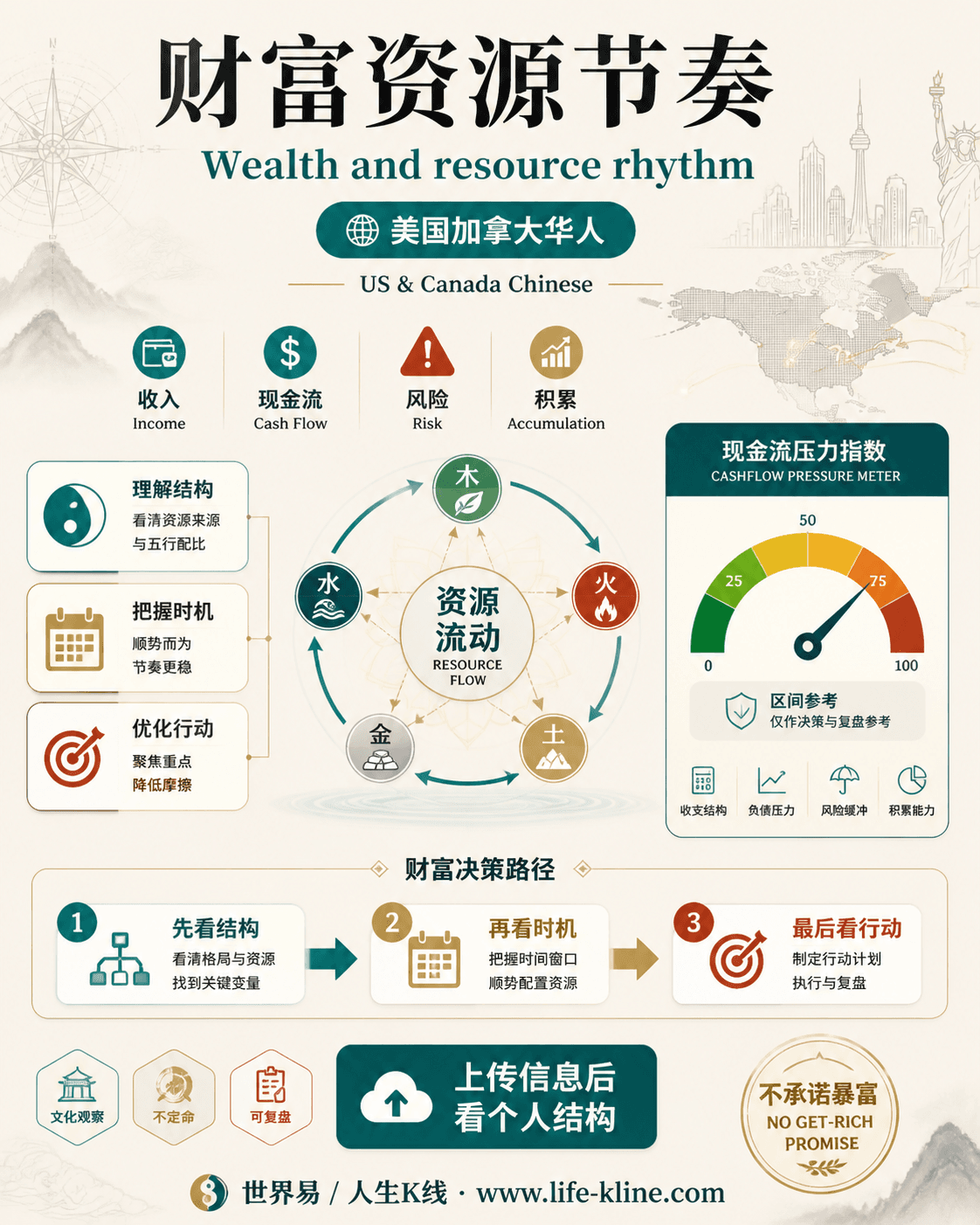
财富资源节奏|美国加拿大华人
这张图把《BaZi Analysis and Decision Guidance on Financial Negotiations of Engagement Betrothal Gifts》里的命理概念转成关系、边界和应用场景,适合先看图建立结构,再回到知识文章正文理解细节。
财富资源节奏不应被写成固定结论。更适合美国加拿大华人的读法,是把传统术语翻译成结构、时机、环境、行动和复盘。
查看图片解读