BaZi Rhythms and Decision-Making References for Persisting or Pivoting in E-commerce Entrepreneurship
把这篇文章落到自己身上验证:先看结构,再进入个人分析,不做泛泛阅读。
Why This Decision Is Especially Difficult in the E-commerce Industry
The operational structure faced by e-commerce entrepreneurs is extremely complex. The continuous surge in traffic costs directly squeezes profit margins, while inventory pressure and return rates increase capital turnover and operational costs. At the same time, frequent adjustments to platform rules bring uncertainty, making it difficult for companies to grasp the rhythm of strategic adjustments. Fine management of traffic ROI becomes a daily core task, and even slight misjudgments can lead to tight cash flow.
On the psychological level, entrepreneurs often fall into the cognitive misconception that 'persistence equals victory.' Especially after investing substantial resources, the uncertainty and costs brought by pivoting can be daunting, leading to stubborn adherence to existing models and ignoring market change signals. On the other hand, blind pivoting may cause loss of core competitiveness and trap entrepreneurs in a vicious cycle of frequent trial and error.
BaZi structures can provide a rhythmic auxiliary perspective in this decision-making. For example, the strength of the Day Master reflects personal energy and stress resistance; the combination of financial stars (Cai Xing) and Bi Jian / Jie Cai (peer and competitor stars) represents capital and resource flow; the presence of Zheng Guan / Qi Sha (official and killing stars) hints at external competitive pressure and impacts from rule changes. The interaction between Da Yun (decade luck cycle) and Liu Nian (annual fortune) reveals the alignment between industry cycles and personal career rhythms, helping entrepreneurs judge whether to persist in optimization or pivot timely.
Therefore, the difficulty of deciding whether to persist or pivot in the e-commerce industry lies in balancing internal and external pressures with personal resource matching. Reasonably utilizing BaZi rhythm prompts alongside commercial data enables scientific identification of risks and opportunities during industry bottlenecks, avoiding operational risks caused by emotional decisions.
Three Core Dimensions of BaZi Judgment
First, the relationship between the Day Master and financial stars. The strength of the Day Master determines the entrepreneur’s energy and stress tolerance, while financial stars represent capital and profit flow. When the Day Master is relatively strong and the Yong Shen (favorable element) is Wood, but the financial stars are restrained, caution is needed regarding cash flow and inventory pressure; if the Day Master is relatively weak, attention should be paid to timely capital replenishment and external support.
Second, Bi Jian (peer) and Jie Cai (competitor) stars relate to partnership relations. Bi Jian and Jie Cai represent competition and similar resources; when overly strong, they can cause internal consumption, and when too weak, they lack support. The smoothness of partnerships or team collaboration affects the stability and flexibility of decision execution, which is especially critical in the fiercely competitive environment for traffic and customer resources in e-commerce.
Third, Zheng Guan / Qi Sha (official and killing stars) reflect external rules, competitors, and policy pressures. Excessive presence of these stars may indicate shocks from frequent platform rule changes, requiring entrepreneurs to respond flexibly. Zheng Yin / Pian Yin (resource stars) represent information and resource support; a strong presence helps acquire new resources and ideas during pivot periods.
Additionally, the interaction between Da Yun and Liu Nian reflects phase-specific career fortunes. Acting with the trend allows for steady persistence; going against it calls for cautious pivoting. Combining this with financial and market data helps identify risk points, achieving effective integration of BaZi rhythms and business strategies.
Three Real BaZi Chart Cases
Case 1: This gentleman’s Day Master is 丁火 (Ding Fire), relatively strong, with a Zhuan Wang pattern (special strong pattern). The Yong Shen is Wood, and the Ji Shen (unfavorable element) is Metal. He is currently in the 壬申 (Ren Shen) Da Yun, with the 丙午 (Bing Wu) Liu Nian. The Ren Shen Da Yun is stable and suitable for maintaining achievements; the Bing Wu year brings mobility and adaptability. His BaZi shows abundant internal energy and smooth resource flow, but the Ji Shen Metal indicates sensitivity to external constraints such as platform rules. When facing rising traffic costs and rule changes in e-commerce, it is advisable to persist with existing advantages, optimize inventory and customer relationship management, and avoid blind expansion. It is recommended to monitor cash flow combined with financial data, and when inventory pressure and return rates exceed preset thresholds, moderately adjust product lines or marketing strategies rather than a full pivot.
Case 2: This gentleman’s Day Master is 丙火 (Bing Fire), relatively weak, with a Qi Sha (Seven Killings) pattern. The Yong Shen is Wood, and the Ji Shen are Earth and Metal. He is in the 乙亥 (Yi Hai) Da Yun, with the 丙午 (Bing Wu) Liu Nian. The Yi Hai Da Yun is auspicious, with career and financial progress. The weak Day Master and Ji Shen Earth and Metal indicate insufficient capital and resource support, with significant external competition and platform rule pressure. The Qi Sha pattern brings pressure and challenges, suitable for proactive actions but requires careful risk identification. In e-commerce entrepreneurship, facing soaring traffic costs and platform rule changes, this BaZi suggests maintaining high sensitivity, timely recognizing market signals, and that timely pivoting may better align with BaZi rhythms. It is advised to first conduct small-scale pilot pivots combined with market research and financial stress tests, gradually shifting business focus to avoid blind expansion causing cash flow breaks.
Case 3: This lady’s Day Master is 丁火 (Ding Fire), relatively strong, with a Yang Ren (Goat Blade) pattern. The Yong Shen is Water, and the Ji Shen is Wood. She is in the 辛亥 (Xin Hai) Da Yun, with the 丙午 (Bing Wu) Liu Nian. The current Da Yun is auspicious, with progress in career and finances. The Yang Ren pattern symbolizes strong personal drive and momentum; the Yong Shen Water nourishes the Day Master, beneficial for information and resource integration. The Ji Shen Wood warns to guard against shocks from external competition and rule changes. In e-commerce entrepreneurship, this BaZi suits leveraging personal strengths to persist in core business while paying attention to external challenges. It is recommended to optimize existing business persistently while actively exploring digital and technological upgrade pivot paths, adjusting strategies according to policy and market dynamics to avoid missing pivot windows due to neglecting external risks.
Common Misjudgments and Blind Spots in This Industry
One common misjudgment among e-commerce entrepreneurs is over-reliance on short-term traffic dividends, ignoring the diminishing marginal returns caused by soaring traffic costs, resulting in worsening losses while stubbornly sticking to old models. When financial stars are restrained in BaZi, this blind persistence is particularly risky.
Another blind spot is neglecting the pressure from platform rule changes, overly optimistic about natural market recovery, ignoring the external environmental risks indicated by heavy Zheng Guan / Qi Sha stars, thus delaying pivot timing.
Additionally, some entrepreneurs are overly impatient during pivot decisions, lacking systematic financial and market research support. Entrepreneurs with weak Day Masters and damaged Yong Shen in BaZi who do not conduct stable pilot pivots are prone to cash flow breaks and team instability.
Finally, neglecting the balance of team and partnership relations is a pitfall; both excessive and insufficient Bi Jian / Jie Cai stars affect execution capability and risk resistance, causing persistence or pivot decisions to fail in effective implementation.
Practical Judgment Sequence
Step one: Analyze the BaZi pattern along with the current Da Yun and Liu Nian to assess personal energy and resource flow status. If the Day Master is relatively strong and the Da Yun is auspicious, it is suitable to persist and optimize; if the Day Master is weak and the Da Yun unfavorable, carefully consider pivot timing.
Step two: Combine financial data and market feedback, focusing on cash flow, inventory turnover rate, return rate, and traffic ROI trends. When these key indicators continuously deteriorate and BaZi indicates increasing external pressure, priority should be given to adjusting the business model or product structure.
Step three: Evaluate whether the team and partnership relations are stable, ensuring reasonable allocation of Bi Jian / Jie Cai resources to avoid excessive internal consumption. Stable team support is the foundation for successful persistence or pivot.
Overall, BaZi rhythm prompts indicate trends and possibilities of risk amplification or hedging. Entrepreneurs should combine professional financial and market analysis to scientifically formulate action plans, avoid blind operations, and achieve growth by following the trend steadily.
FAQ
Question 1: Can BaZi determine whether to persist or pivot in e-commerce entrepreneurship? Answer: BaZi provides a rhythmic and energetic reference perspective to help entrepreneurs identify trends in pressure and resource flow, but it cannot replace detailed commercial due diligence and financial analysis. Decisions still require comprehensive consideration of multiple factors.
Question 2: How to combine BaZi judgment when coping with soaring traffic costs? Answer: When financial stars are restrained and Zheng Guan / Qi Sha stars are heavy in BaZi, it indicates significant external pressure. Entrepreneurs should pay close attention to changes in traffic costs and ROI, timely adjust marketing strategies or pivot to avoid blindly increasing investment.
Question 3: How do Yong Shen and Ji Shen in BaZi affect pivot decisions? Answer: Yong Shen represents resources and supportive forces, while Ji Shen represents limiting and destructive factors. When Yong Shen is strong, entrepreneurs have better capacity to adjust and pivot; when Ji Shen is strong, caution is needed as it may indicate higher pivot risks requiring more detailed risk management.
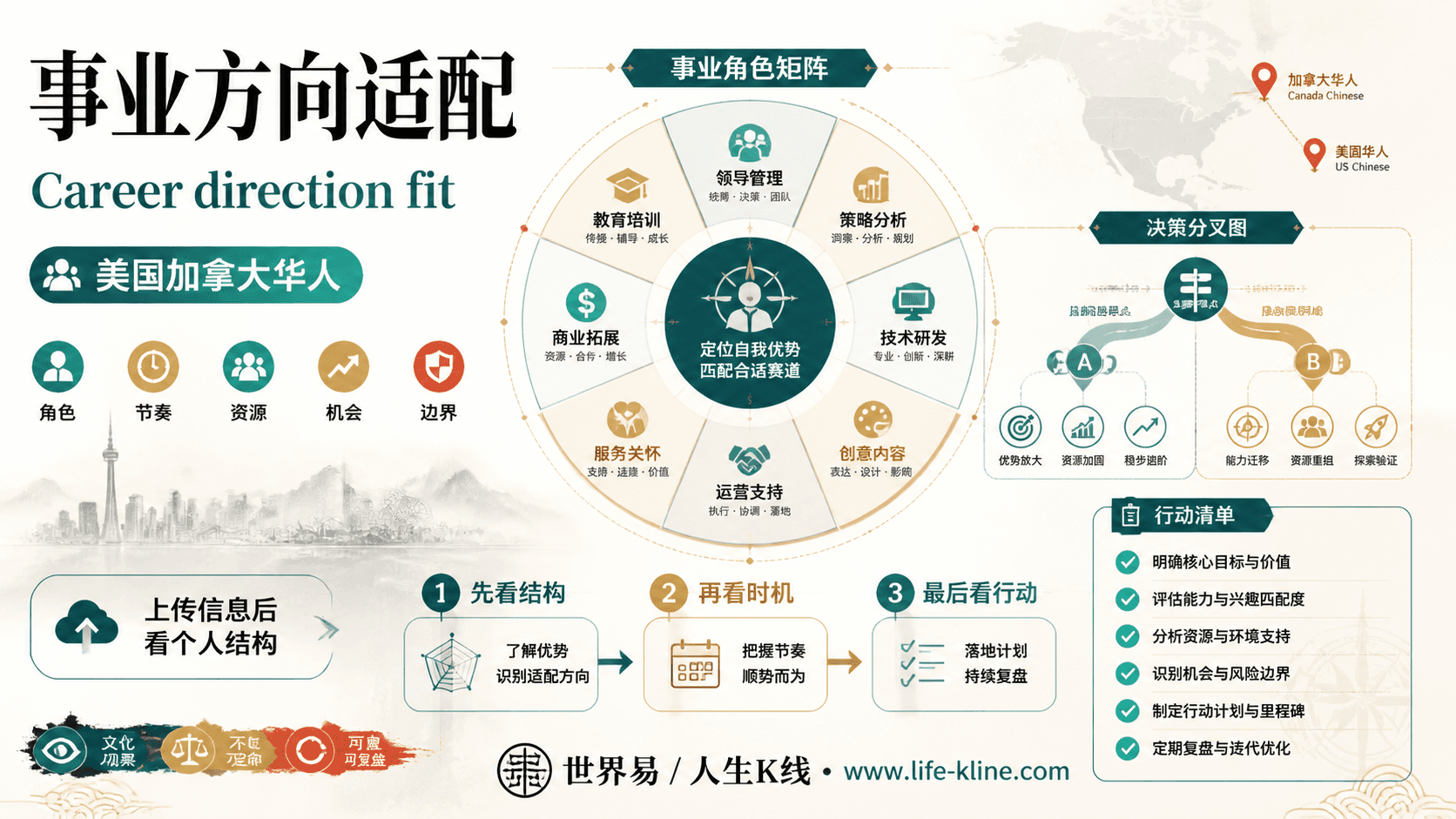
事业方向适配|美国加拿大华人
这张图把《BaZi Rhythms and Decision-Making References for Persisting or Pivoting in E-commerce Entrepreneurship》里的命理概念转成关系、边界和应用场景,适合先看图建立结构,再回到知识文章正文理解细节。
事业方向适配不应被写成固定结论。更适合美国加拿大华人的读法,是把传统术语翻译成结构、时机、环境、行动和复盘。
查看图片解读