BaZi Analysis for FIRE Early Retirement: Medical and Longevity Risk Hedging Decisions
把这篇文章落到自己身上验证:先看结构,再进入个人分析,不做泛泛阅读。
Why This Decision Is Especially Difficult in This Scenario
FIRE early retirement, meaning achieving financial independence between ages 35-45, involves voluntarily foregoing traditional social security and corporate pension protections, thereby facing dual pressures of sustainable asset withdrawal rates and medical out-of-pocket gaps. Due to discontinuous social security contributions, medical expenses often must be self-funded, increasing unpredictable financial burdens. Family opposition and identity anxiety frequently accompany decision-makers’ psychological stress, affecting rational planning. BaZi structures at this stage reveal implicit signals about health, wealth flow, and family support. Integrating BaZi judgment to identify potential risk points can guide reasonable insurance and annuity hedging strategies.
Medical and longevity risks are particularly prominent at this stage because early retirees face significant gaps in social medical coverage. Insurance and annuities become the primary tools for risk mitigation. The interaction of the Ten Gods—such as Wealth stars (Cai Xing), Shi Shen (Eating God), Yin stars (Print stars), and Guan Sha (Officer and Killing stars)—especially during late-life Da Yun (decade luck cycles), reflects potential changes in financial support and health conditions. Proper adjustment of Day Master strength and pattern Yong Shen can help assess risk tolerance, guiding when to prioritize insurance products and when to increase retained risk appropriately.
Additionally, early retirees often exhibit high autonomy and planning willingness but may fall into psychological blind spots of excessive optimism or ignoring latent risks. BaZi-assisted judgment offers a rhythmic reference to detect possible risk signals in Da Yun and Liu Nian (annual fortune), promoting rational decisions. Considering the retirement structure’s social security gaps, medical needs, family relations, and psychological state, medical and longevity risk hedging becomes the core challenge in FIRE decisions, requiring precise auxiliary judgment.
Three Core Dimensions of BaZi Judgment
First, the relationship between the Day Master and late-life Da Yun determines the individual’s health and mental stability in old age. A relatively strong or weak Day Master, combined with stable or volatile current Da Yun, reflects the individual’s capacity to endure and recover from medical risks. For example, a strong Day Master during a stable Da Yun usually indicates good physical health and higher risk tolerance; a weak Day Master may suggest the need for more cautious risk hedging.
Second, the condition of the Wealth stars directly relates to wealth liquidity and the stability of disposable assets. A flourishing Wealth star with effective Yong Shen indicates strong wealth accumulation and sustainable withdrawal ability; if the Wealth star is restrained by Ji Shen (unfavorable elements), it may imply limited asset extraction, necessitating enhanced insurance and annuity protection to guard against sudden medical expenses.
Finally, the combination of Shi Shen (Eating God), Yin stars (Print stars), and Guan Sha (Officer and Killing stars) reflects psychological state, family support, and medical dependency. A strong Shi Shen suggests a proactive life attitude suitable for active medical management; strong Yin stars indicate solid family and social support, facilitating access to medical resources; Guan Sha relates to regulations and legal support, highlighting the importance of medical compliance and estate planning. Overall, the harmonious coordination of these three provides multidimensional BaZi references for medical and longevity risk hedging.
Three Real BaZi Case Studies
Case 1: Male, age 40-45, Day Master 癸 (Gui, Water) relatively strong, pattern is Zheng Yin (Proper Print), Yong Shen is Metal, Ji Shen is Metal, current Da Yun is 丙子 (Bing Zi, 37-46 years) stable, Liu Nian is 丙午 (Bing Wu). This chart’s relatively strong Day Master and prominent Yin star indicate good physical and mental condition; Yin star represents stable medical support and family reliance. However, Yong Shen Metal is also Ji Shen, suggesting potential obstruction in wealth flow and pressure on asset withdrawal. The stable Bing Zi Da Yun favors maintaining status quo with moderate risk. In the FIRE early retirement context, this chart shows potential risk in medical out-of-pocket gaps, especially when wealth liquidity is constrained, leading to possible fund shortages. It is recommended to prioritize medical insurance and annuity products to hedge out-of-pocket medical risks, while closely monitoring Da Yun and Liu Nian changes to flexibly adjust asset allocation.
Case 2: Female, age 20-25, Day Master 丙 (Bing, Fire) relatively weak, pattern is Shi Shen (Eating God), Yong Shen is Fire, Ji Shen are Earth and Metal, current Da Yun is 庚寅 (Geng Yin, 12-21 years) stable, Liu Nian is 丙午 (Bing Wu). The weak Day Master with Fire as Yong Shen indicates insufficient personal energy, possibly fragile health and mental state. The Shi Shen pattern brings positive life attitude, but Ji Shen Earth and Metal suggest limited wealth and resource flow. Although the Geng Yin Da Yun is stable, the weak Day Master and Ji Shen constraints imply higher medical and longevity risks with significant retained risk. For FIRE early retirement, this chart requires great caution; it is advised to prioritize comprehensive medical insurance to strengthen risk hedging and avoid financial depletion due to health issues. Using insurance and annuities to balance long-term financial risks can also reduce family and psychological pressure.
Case 3: Male, age 45-50, Day Master 辛 (Xin, Metal) balanced, pattern is Pian Cai (Indirect Wealth), Yong Shen is Earth, Ji Shen is Fire, current Da Yun is 庚子 (Geng Zi, 43-52 years) stable, Liu Nian is 丙午 (Bing Wu). The balanced Day Master and Pian Cai pattern indicate good asset liquidity and stable wealth accumulation. Yong Shen Earth supports wealth, while Ji Shen Fire may bring hidden health concerns, but the overall Da Yun is stable. This chart reflects strong asset protection capability and relatively stable health, with low medical out-of-pocket risk and solid family or social support. In the FIRE early retirement retirement game, this chart can tolerate higher retained risk; insurance and annuity allocations can be moderately reduced, focusing on health management and continuous asset growth. Regular health assessments combined with professional medical advice are recommended to flexibly adjust insurance types and coverage amounts.
Common Misjudgments and Blind Spots in This Scenario
Many early retirees are overly optimistic about sustainable asset withdrawal rates, neglecting the financial pressure from medical out-of-pocket and longevity risks. Ignoring the balance between Yong Shen and Ji Shen in BaZi often leads to misjudging financial safety boundaries and risk exposure. Particularly, neglecting late-life Da Yun and Liu Nian changes and lacking dynamic adjustment strategies is a frequent blind spot.
Another misconception is over-relying on social security gap compensation mechanisms while ignoring the importance of family support and psychological adaptation. The roles of Yin stars and Shi Shen in BaZi are often overlooked, causing insufficient medical resource access and psychological adjustment, resulting in unbalanced risk management. If family opposition and identity anxiety are not fully recognized and resolved, decision conflicts and risk amplification may worsen.
Furthermore, treating BaZi as an independent decision tool without integrating financial planning, legal, and medical professional advice is a major misjudgment. BaZi serves only as a rhythmic auxiliary reference and cannot replace professional analysis. Any insurance and annuity allocation decisions require serious evaluation of legal compliance and medical needs to avoid blind following or self-reinforcing biases.
Practical Judgment Sequence
First, examine the individual BaZi chart’s Day Master strength and Yong Shen/Ji Shen relationships to assess basic health and financial flow capacity, identifying potential medical and wealth risks. Next, combine current Da Yun and Liu Nian to determine whether the individual is in a stable maintenance phase or a volatile period, judging the timing and extent of risk exposure to decide if insurance and annuity allocation should be accelerated or delayed.
Then, consider the retirement structure’s social security gaps, out-of-pocket medical needs, and family support status to evaluate a reasonable range of retained risk. BaZi’s Yin stars and Shi Shen conditions can assist in judging the support level of medical resources and psychological state, guiding whether external protection needs strengthening. Finally, integrate professional financial planning and legal-medical advice to formulate a dynamic adjustment plan, maintaining sensitivity to risks and flexibility in response.
In practice, it is recommended to increase insurance coverage during BaZi phases where Ji Shen is restrained or the Day Master is weak to prevent sudden medical risks from eroding assets; when the Day Master is strong and Da Yun stable, the retained risk ratio can be moderately increased to optimize fund utilization efficiency. The entire process requires dynamic monitoring of BaZi signals synchronized with professional planning to avoid isolated decision-making.
FAQ
Question 1: Can BaZi judgment replace financial planning and legal advice? Answer: No. BaZi only provides auxiliary rhythmic references for risk; financial planning, legal, and medical advice form the basis and guarantee of decisions and must be comprehensively evaluated to form a plan.
Question 2: How should insurance be prioritized when Ji Shen is restrained? Answer: Ji Shen restraint usually indicates obstructed wealth flow or increased health risks. Medical insurance and annuity products should be prioritized to ensure fund liquidity and medical expense coverage.
Question 3: If the Day Master is strong and Da Yun stable, can one fully retain risk? Answer: Full risk retention is not recommended. Although tolerance is stronger, insurance should still be reasonably allocated based on actual medical needs and family conditions to guard against emergencies.
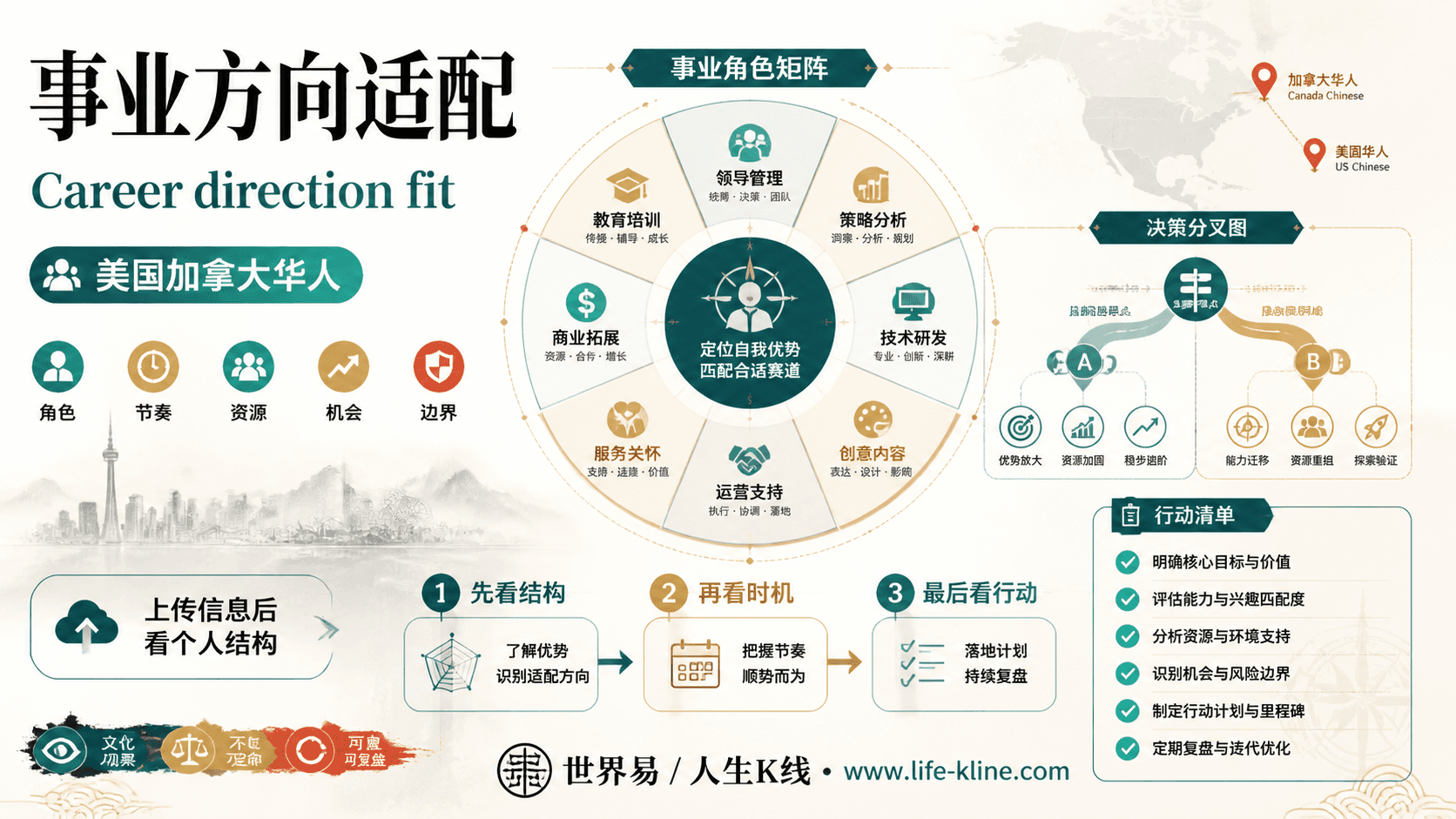
事业方向适配|美国加拿大华人
这张图把《BaZi Analysis for FIRE Early Retirement: Medical and Longevity Risk Hedging Decisions》里的命理概念转成关系、边界和应用场景,适合先看图建立结构,再回到知识文章正文理解细节。
事业方向适配不应被写成固定结论。更适合美国加拿大华人的读法,是把传统术语翻译成结构、时机、环境、行动和复盘。
查看图片解读