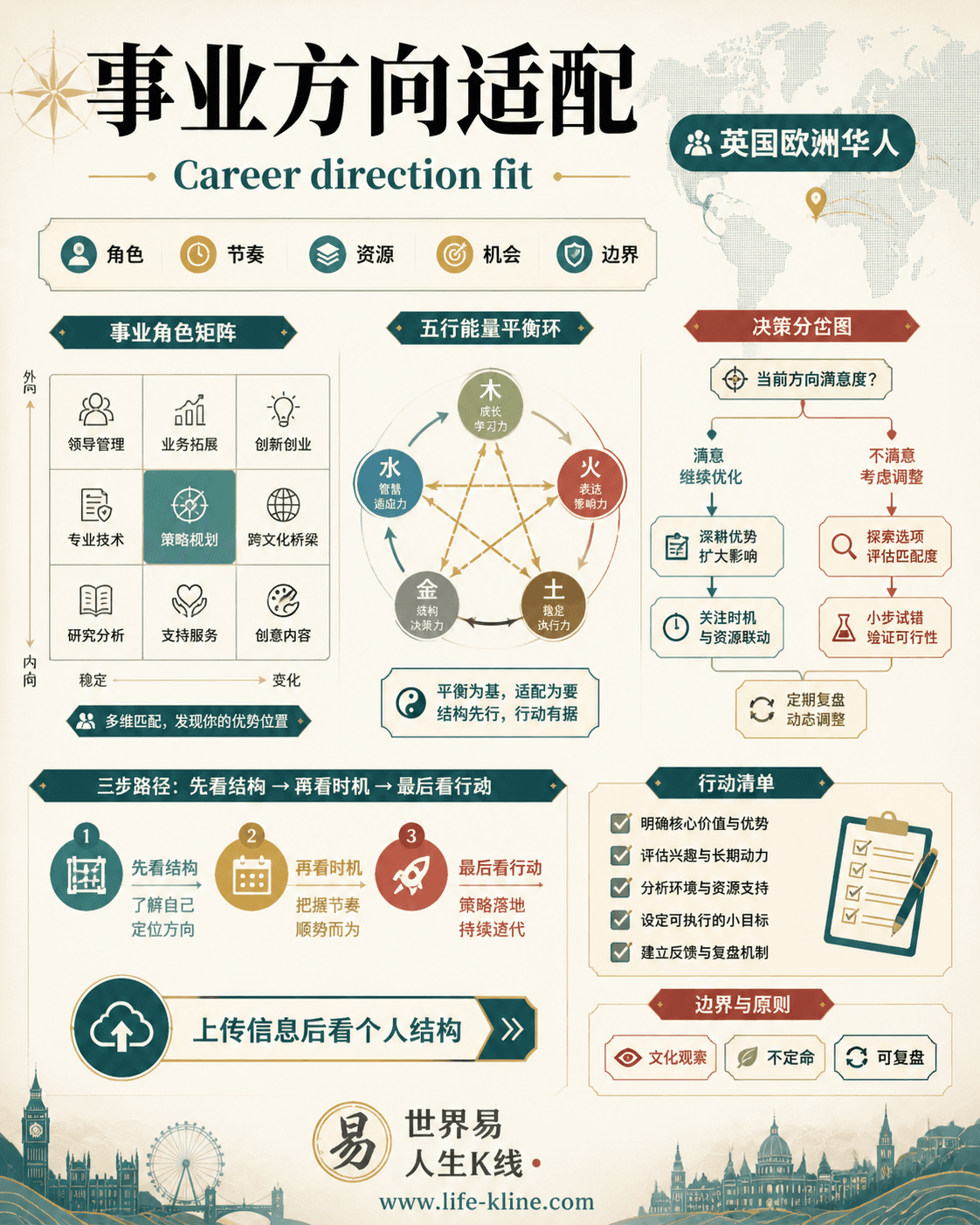
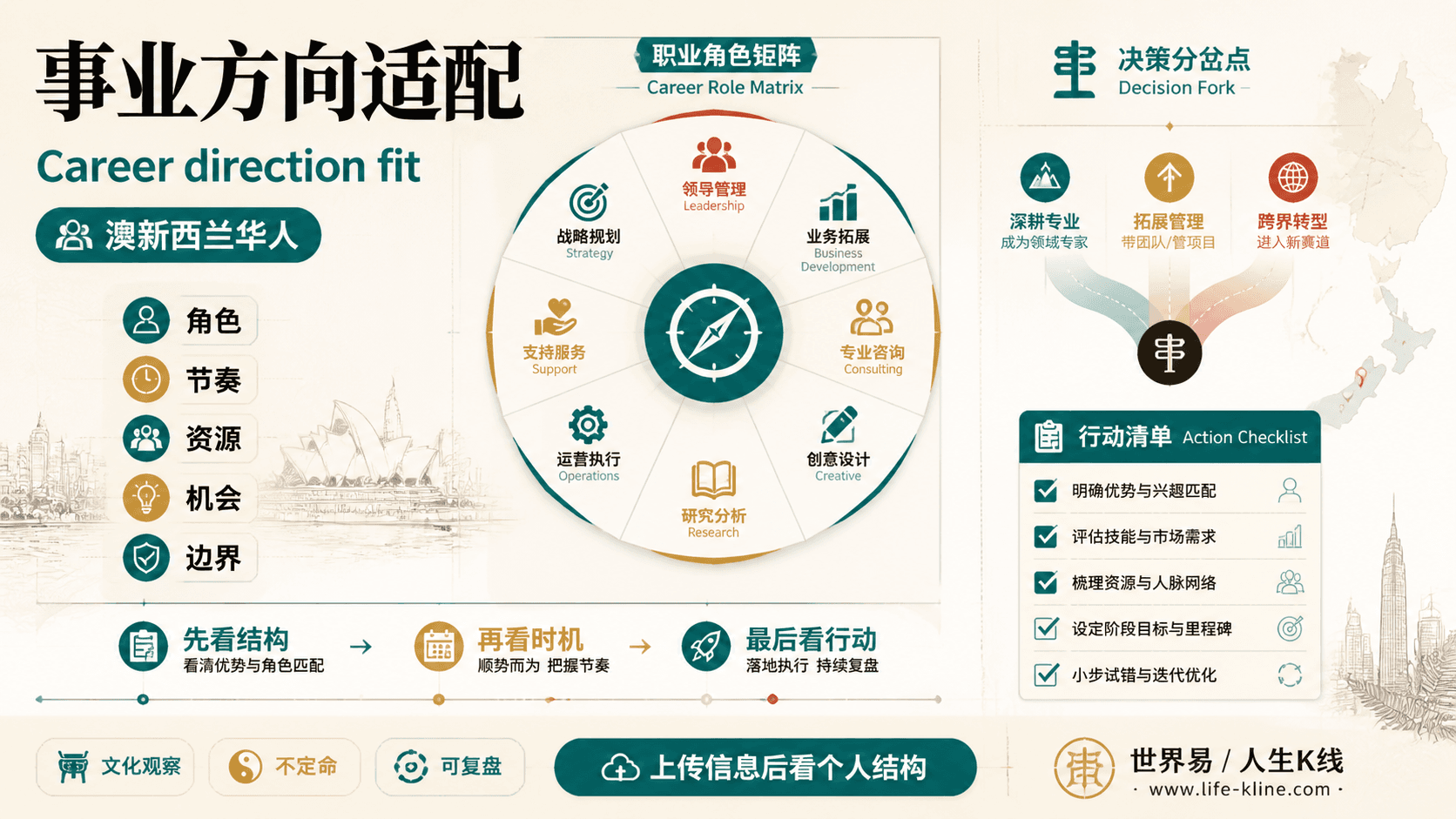
BaZi Analysis and Decision Guidance for Career Direction Shift at Ages 25-32
把这篇文章落到自己身上验证:先看结构,再进入个人分析,不做泛泛阅读。
Why This Decision Is Especially Difficult at This Life Stage
Ages 25 to 32 mark a significant turning point in a professional career. The initial career positioning has gradually stabilized, yet pressures from society and self-expectations remain intense. This stage commonly faces challenges of identity recognition, increasing responsibilities in intimate relationships and family, and fluctuations in physical and psychological endurance. A second career direction shift means not only facing uncertainties brought by job changes or further studies but also dealing with practical constraints such as city choices. Living costs and social evaluations become unavoidable sources of pressure.
At this stage, societal expectations primarily emphasize stability and continuous growth. Switching to a new career track is often viewed as risky or even irrational, increasing the psychological burden of decision-making. On the other hand, the BaZi structure’s Day Master strength, pattern, and Yong Shen influence an individual’s capacity to endure career changes. This internal energy combined with external realities further amplifies the difficulty of deciding to switch tracks.
Moreover, the interaction between Da Yun (decade luck cycle) and Liu Nian (annual fortune) reveals the stability or volatility of the career environment. If the Da Yun tends to be stable, it is advisable to maintain the status quo; frequent shifts may bring risks. Conversely, changes in Da Yun or Liu Nian may indicate opportunities and necessities for transformation. Therefore, discerning from the BaZi perspective whether the signals truly indicate a career transformation or just temporary fatigue is the key challenge in decision-making at this stage.
In summary, making a second career direction shift decision during the 25-32 career period requires not only managing identity and responsibility constraints but also integrating internal BaZi structural cues to clarify genuine needs versus impulses, enabling a stable and personally suitable career choice.
Three Core Dimensions of BaZi Judgment
First, the strength of the Day Master reflects the individual’s intrinsic vitality and ability to cope with environmental changes. A relatively strong or balanced Day Master usually indicates strong self-drive and stress tolerance, whereas a weak Day Master may more easily feel fatigued or confused when facing career changes. During critical career periods, the Day Master’s condition determines the psychological and action foundation for switching tracks.
Second, the pattern (geju) and Yong Shen reveal the energy configuration and suitable development directions for the individual. Patterns such as Yang Ren (Goat Blade), Jie Cai (Rob Wealth), and Shang Guan (Hurting Officer) each have different dynamics and impact. The balance of Yong Shen (favorable element) and Ji Shen (unfavorable element) indicates which resources to absorb and which risks to avoid. The prosperity or decline of the Yong Shen directly affects the smoothness and success potential of career transitions.
Third, the interaction between Da Yun and Liu Nian provides the temporal environmental context. A stable Da Yun generally suggests a phase suitable for maintaining and accumulating, while Liu Nian’s fluctuations may bring opportunities or challenges. If Da Yun and Liu Nian form a supportive relationship, the timing for switching tracks is more favorable; if they clash, careful evaluation of timing and intensity of actions is required.
Additionally, although the palace environment is not specifically provided, the BaZi chart facts indicate that both Da Yun and Liu Nian belong to stable luck cycles, with the overall environment leaning toward maintaining status quo. Integrating these three dimensions, decisions on a second career direction shift should be based on the Day Master’s strength, centered on pattern and Yong Shen, and combined with Da Yun and Liu Nian to judge timing, forming a scientific decision-making framework.
Three Real BaZi Chart Cases
Case 1: The Day Master is Wu (戊, Earth), relatively strong, belonging to the Yang Ren (Goat Blade) pattern. The Yong Shen is Metal, and the Ji Shen is Fire. Currently in the Ji Chou (己丑) Da Yun (ages 26-35), the luck cycle is stable, favoring maintaining the status quo, with the Liu Nian being Bing Wu (丙午), requiring flexible adaptation. A woman aged 30-35 is at a critical career period, facing dual pressures of family responsibilities and societal expectations for stability. The relatively strong Wu Earth Day Master provides strong self-drive and stress resistance; the Yang Ren pattern grants impact capability during changes. However, the presence of Fire as Ji Shen requires attention to emotional and environmental depletion. The Da Yun suggests maintaining status quo; frequent track changes may be unfavorable. It is recommended to first assess the support level of Metal elements and the consumption by Fire in the current career environment, prioritize internal resource adjustments, and then cautiously consider job changes or transformations according to Liu Nian changes, avoiding impulsive actions.
Case 2: The Day Master is Xin (辛, Metal), relatively weak, belonging to the Jie Cai (Rob Wealth) pattern. The Yong Shen is Earth, and the Ji Shen are Water and Wood. Currently in the Gui You (癸酉) Da Yun (ages 23-32), the luck cycle is stable, favoring maintaining status quo, with the Liu Nian being Bing Wu (丙午), requiring flexible adaptation. A woman aged 25-30 is establishing her second career direction, facing dual challenges of self-awareness and external resources. The relatively weak Day Master indicates insufficient energy; the Jie Cai pattern brings competitive pressure and peer relationship challenges. The Yong Shen Earth suggests the need to stabilize and cultivate resources, while Ji Shen Water and Wood may cause emotional or environmental disturbances. The stable Da Yun is not conducive to drastic changes; it is advised to focus on supplementing Earth energy before switching tracks, such as improving skills and accumulating resources, avoiding rash decisions caused by emotional fluctuations, and gradually verifying the suitability of new fields.
Case 3: The Day Master is Geng (庚, Metal), balanced, belonging to the Shang Guan (Hurting Officer) pattern. The Yong Shen is Fire. Currently in the Xin Hai (辛亥) Da Yun (ages 14-23), the luck cycle is stable, favoring maintaining status quo, with the Liu Nian being Bing Wu (丙午), requiring flexible adaptation. A young woman aged 20-25 is in the early career exploration stage, a key period for career path discovery. The balanced Geng Metal Day Master has some resilience; the Shang Guan pattern brings creativity and expressive desire, with Fire as Yong Shen needing to stimulate internal motivation. The stable Da Yun suggests a phase suitable for foundation accumulation, while Liu Nian offers timely opportunities. In a second career direction shift, this chart requires synchronizing internal motivation and external opportunities. It is recommended to build on the existing foundation through further study or part-time attempts in new directions, while paying attention to stimulating and controlling Fire to avoid emotional decisions leading to resource waste.
Common Misjudgments and Blind Spots at This Stage
A common misjudgment during the critical career period of ages 25-32 is mistaking temporary fatigue or career burnout as a signal for a complete transformation. When the Day Master is relatively weak or the Yong Shen is damaged, individuals tend to feel overwhelmed. Ignoring the stable indications from Da Yun and Liu Nian and rashly switching tracks often leads to greater risks and uncertainties.
Another blind spot is over-relying on external environmental changes to decide career direction while neglecting the limitations and advantages of the internal BaZi structure. For example, a relatively strong Day Master but with a strong Ji Shen may lead to impulsive job changes, which ultimately hinder stable development. Conversely, a weak Day Master supported by Yong Shen is more suited to steady accumulation rather than hasty changes.
Furthermore, societal expectations and family responsibilities at this stage cannot be overlooked. Ignoring practical constraints and merely pursuing the so-called “turning point” indicated by BaZi may cause a disconnect between ideals and reality. BaZi judgment should be combined with real-world conditions to avoid blindly following trends or passively waiting.
Lastly, many tend to overlook the interaction between Da Yun and Liu Nian, mistakenly treating minor annual fluctuations as signals for comprehensive changes. Correctly understanding the dominant role of Da Yun and the auxiliary role of Liu Nian is key to avoiding misjudgments.
Practical Judgment Sequence
First, clarify your Day Master’s strength and pattern attributes, assessing whether your internal energy supports the pressures and challenges of career transformation. If the Day Master is weak, prioritize supplementing and strengthening the Yong Shen, avoiding rash actions when energy is insufficient; if the Day Master is strong, pay attention to interference from Ji Shen, controlling emotions and impulses.
Second, examine the external environment’s stability by combining the current Da Yun’s nature. If Da Yun is stable, career shifts should focus on maintaining status quo and seek gradual adjustment paths; if Da Yun changes, it may be considered a timing for transformation, but the short-term effects of Liu Nian still require cautious evaluation.
Finally, integrate the flexible information from Liu Nian to judge the timing of specific actions. When Liu Nian brings favorable conditions, moderate proactive moves can be made; when unfavorable, it is better to observe, adjust mindset and strategy. The entire judgment process should dynamically track changes in BaZi and reality, combine personal career planning and life responsibilities, gradually verify the rationality of the shift, avoiding haste while not missing good opportunities.
FAQ
Question 1: How to distinguish between career fatigue indicated by the BaZi chart and a genuine transformation signal? Answer: The core lies in observing the Day Master’s strength and Yong Shen’s condition. If the Day Master is weak and Yong Shen is damaged, it usually indicates temporary fatigue suitable for rest; if the Day Master is strong and Yong Shen is activated, it may be a genuine transformation opportunity. Additionally, a stable Da Yun suggests maintaining status quo; transformation signals should be interpreted cautiously.
Question 2: Does a stable Da Yun period mean it is unsuitable to change jobs or transform? Answer: A stable Da Yun indicates an overall stable environment, suitable for accumulation and maintaining status quo, but it does not absolutely forbid changes. The key is whether Liu Nian brings opportunities and whether personal BaZi has the energy foundation to endure changes. Seeking progress steadily is a more reasonable strategy.
Question 3: How do the relationships between Yong Shen and Ji Shen affect career decision-making? Answer: Yong Shen guides which elements are suitable to absorb and strengthen, helping enhance career development potential; Ji Shen represents factors to avoid or weaken, which may cause obstacles or depletion. Career decisions should maximize Yong Shen’s influence and control Ji Shen’s impact, creating a BaZi environment conducive to stability and growth.
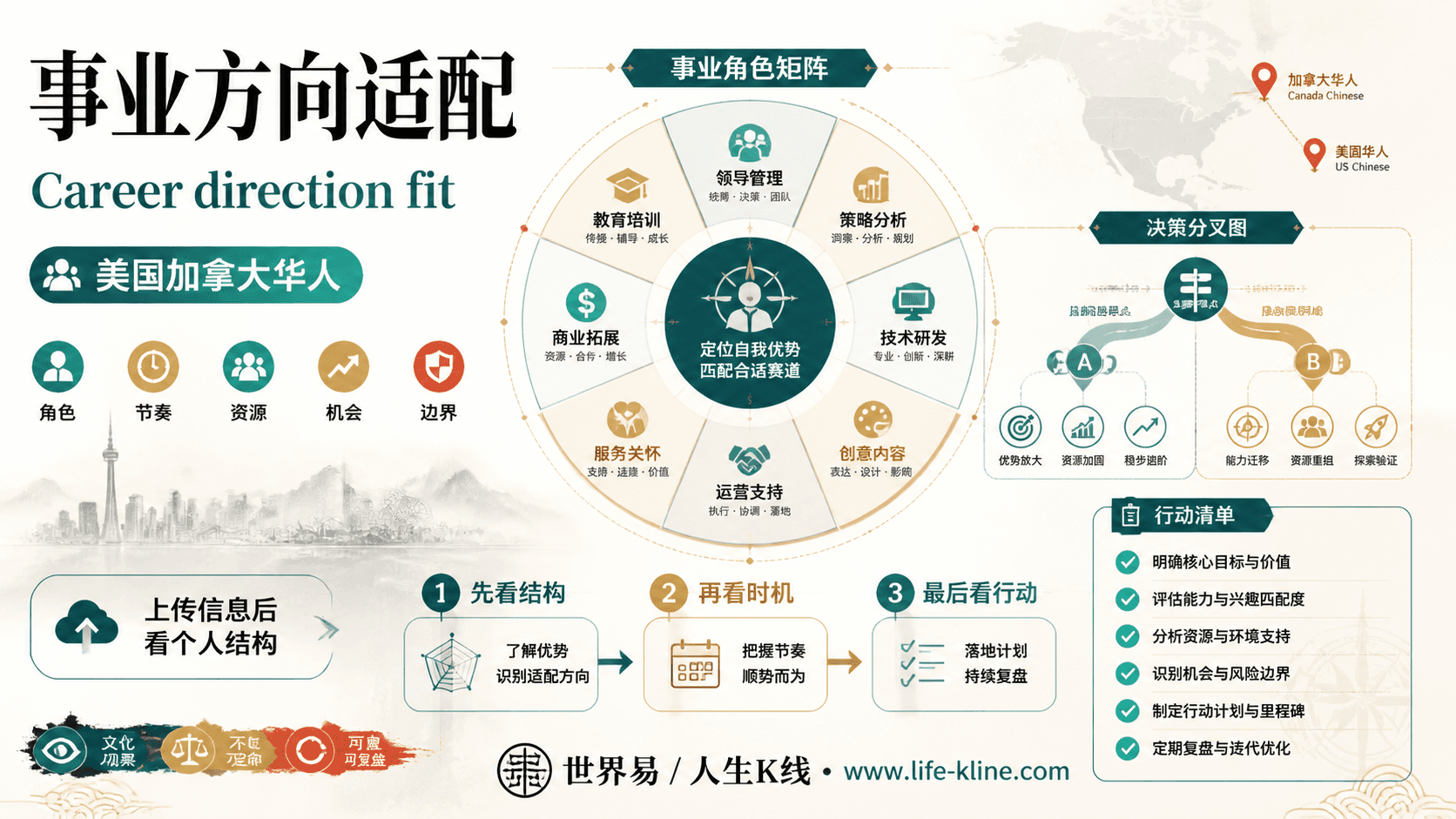
事业方向适配|美国加拿大华人
这张图把《BaZi Analysis and Decision Guidance for Career Direction Shift at Ages 25-32》里的命理概念转成关系、边界和应用场景,适合先看图建立结构,再回到知识文章正文理解细节。
事业方向适配不应被写成固定结论。更适合美国加拿大华人的读法,是把传统术语翻译成结构、时机、环境、行动和复盘。
查看图片解读