Metaphysical Interpretation and Decision-Making Guide for Partner Selection During the Career Establishment Period (Ages 25-32)
把这篇文章落到自己身上验证:先看结构,再进入个人分析,不做泛泛阅读。
你现在搜索的,
其实是一个要落到自己身上的判断。
当前页面主要回答「Life Stages」这类搜索问题;真正有价值的下一步是把这套结构带进自己的报告、工具与案例验证。
Why This Decision Is Especially Difficult at This Life Stage
Ages 25-32 represent a critical career establishment period in life, where individuals face multiple real-world challenges such as initial career path determination, job changes, further education, and city selection. Career pressure and self-growth needs run in parallel, while society’s expectations for success and stability make partner selection particularly complex. At this stage, a partner is not only an emotional support but also a pillar for career and life, thus partner decisions carry greater responsibility and risk.
Meanwhile, changes in physical condition and psychological endurance, as well as the distribution of responsibilities in intimate relationships, impact the stability and satisfaction of partnerships. The uncertainty and mobility of career development require individuals to balance long-term planning with practical compromises when choosing a partner, intensifying the difficulty of decisions.
The influence of metaphysical structure is also especially prominent at this stage. The rhythm and boundary indications in the BaZi chart reflect differences in emotional needs, resource allocation, and psychological endurance, amplifying internal conflicts or advantages in partner selection. Correctly identifying these signals helps clarify key focuses in choosing a partner and avoids blindly following social expectations or personal emotions.
Therefore, partner selection decisions during the career establishment period (ages 25-32) must find a balance between real-world constraints and metaphysical insights, paying attention both to career stability and development as well as the health and growth of emotional relationships. This multidimensional consideration makes the decision-making process particularly complex and critical.
Three Core Dimensions of Metaphysical Judgment
First, the strength of the Day Master and the formation of the pattern constitute the core personality traits and energy distribution of the individual. A Day Master that is either relatively strong or weak reflects internal motivation and adaptability to the external environment, while patterns such as Yang Ren, Shang Guan (Hurting Officer), Pian Yin (Partial Seal), etc., reveal the Day Master’s mode of expression and potential challenges. These factors directly affect how an individual performs and what they need in a partner relationship.
Second, the distinction between Yong Shen (favorable elements) and Ji Shen (unfavorable elements) indicates which elements the individual needs to supplement or avoid in terms of emotions and resources. Yong Shen usually represents key factors for maintaining balance and stability, while Ji Shen points to directions that may cause conflict or energy depletion. In partner selection, relationships that satisfy Yong Shen needs are more conducive to emotional harmony and support.
Finally, the interaction of Da Yun (decade luck cycle) and Liu Nian (annual fortune) injects temporal rhythm changes into the BaZi chart. Da Yun represents longer-term fortune trends, while Liu Nian reflects environmental changes in the current year. Their combination reveals the favorable or unfavorable conditions and opportunities for partner relationships during this stage, determining whether to act with the trend or cautiously maintain, thus influencing the timing and strategy of partner selection.
In summary, the Day Master and pattern determine the internal foundation, Yong Shen and Ji Shen guide emotional resource allocation, and Da Yun and Liu Nian provide external timing context. These three dimensions together form the core framework for metaphysical interpretation of partner selection during the career establishment period.
Three Real BaZi Chart Cases
Case 1: This female’s BaZi chart has a relatively strong Jia (甲, Wood) Day Master with a Yang Ren pattern. Her Yong Shen are Metal and Earth, and Ji Shen is Water. She is currently in the 10th year of the Bing Chen (丙辰) Da Yun, and the Liu Nian is Bing Wu (丙午). Overall, the Da Yun is auspicious and the Liu Nian is favorable. Positioned in the critical 25-32 career establishment period, she faces the progress of career and wealth bringing self-value realization and independence needs. In partner selection, the Yang Ren pattern’s aggressive energy inclines her to seek a partner who can supplement Metal and Earth elements and stabilize emotions to counteract the emotional fluctuations and uncertainties caused by the Ji Shen Water. It is recommended that the judgment sequence first confirms whether the partner can stabilize their own emotions and provide practical support, then evaluates the compatibility of values and career rhythms.
Case 2: This female’s BaZi chart has a relatively weak Yi (乙, Wood) Day Master with a Shang Guan (Hurting Officer) pattern. Her Yong Shen is Water, and Ji Shen are Fire and Earth. She is in the 6th year of the Xin Si (辛巳) Da Yun, with the Liu Nian being Bing Wu (丙午). The Da Yun is stable, and the Liu Nian requires adaptability. Although her age is slightly outside the 25-32 range, her partner selection logic during maturity can be referenced inversely. The Shang Guan pattern symbolizes expression and emotional outwardness, while Water as Yong Shen points to emotional nourishment and flow. In partner selection, she should focus on relationships that provide emotional nourishment and avoid the torment of Fire and Earth, emphasizing emotional resonance and support. The recommended judgment sequence is to start with emotional compatibility and communication style to ensure smooth and balanced emotional flow in the relationship.
Case 3: This male’s BaZi chart has a relatively strong Jia (甲, Wood) Day Master with a Pian Yin (Partial Seal) pattern. His Yong Shen are Metal and Earth, and Ji Shen is Water. He is in the 3rd year of the Wu Xu (戊戌) Da Yun, with the Liu Nian being Bing Wu (丙午). Overall, the Da Yun is very auspicious and affairs proceed smoothly. Although he is aged 35-40, beyond the 25-32 stage, his Pian Yin pattern represents traits of dependence and learning, emphasizing integration of resources and wisdom. In partner selection during the career period, the Pian Yin pattern requires balancing partner resource support and spiritual resonance. Especially during a very auspicious Da Yun, this is a key period to promote a win-win for career and relationship. It is recommended to first assess whether the partner can provide synergistic support materially and spiritually, then examine the consensus on future planning.
Common Misjudgments and Blind Spots at This Stage
Many people during the 25-32 career establishment period are easily swayed by social expectations and external pressures, neglecting the actual needs of rhythm and boundaries indicated in their BaZi charts. For example, individuals with a relatively strong Day Master may overly pursue independence and self-realization, overlooking the need for softness and tolerance in the partnership, leading to relationship tension.
Another blind spot is insufficient understanding of Yong Shen and Ji Shen, failing to recognize whether the partner truly supplements their metaphysical deficiencies, and instead choosing partners who exacerbate Ji Shen influences, causing emotional exhaustion and energy imbalance.
At the same time, inadequate grasp of timing in Da Yun and Liu Nian leads to ignoring the impact of favorable or unfavorable annual trends on decisions, resulting in making major partner decisions at inopportune times, increasing risks and uncertainties.
In summary, neglecting the interaction between metaphysical rhythm and the real environment, blindly following trends or making emotional decisions are common pitfalls in partner selection at this stage.
Practical Judgment Sequence
First, start from the strength of the Day Master and the pattern in the BaZi chart to clarify one’s internal energy and emotional expression characteristics, understanding which partner traits can effectively supplement or harmonize one’s deficiencies.
Second, combine the analysis of Yong Shen and Ji Shen to specifically assess whether the partner can bring positive support and avoid strengthening Ji Shen factors, ensuring resource flow and emotional stability in the relationship.
Finally, examine the current Da Yun and Liu Nian to judge whether it is a favorable time to enter a relationship or a period to maintain stability, reasonably grasping the timing of partner selection to avoid rash decisions during unfavorable annual or decade luck cycles. Overall judgment should follow the principle of "balancing internal and external factors with timing priority" to ensure partner selection aligns with internal metaphysical needs and external environmental changes.
FAQ
Question 1: How to determine if the Yong Shen in the BaZi chart has been satisfied by the partner’s traits? Answer: Yong Shen represents the element needed to supplement the chart. Observing the partner’s Five Elements attributes and personality traits to see if they align with the Yong Shen and provide balance and nourishment indicates satisfaction.
Question 2: How significant is the impact of Da Yun and Liu Nian on partner selection? Answer: Da Yun and Liu Nian determine overall fortune trends and yearly environmental changes. Favorable periods suit active decisions, while unfavorable periods call for cautious waiting, affecting timing and risk in decision-making.
Question 3: How to avoid being overly influenced by social expectations in partner selection during the career establishment period? Answer: By using metaphysical self-awareness to clarify personal needs and rhythms, combined with rational analysis of real situations, one can avoid blindly conforming to external pressures and ensure decisions are based on internal balance and practical feasibility.
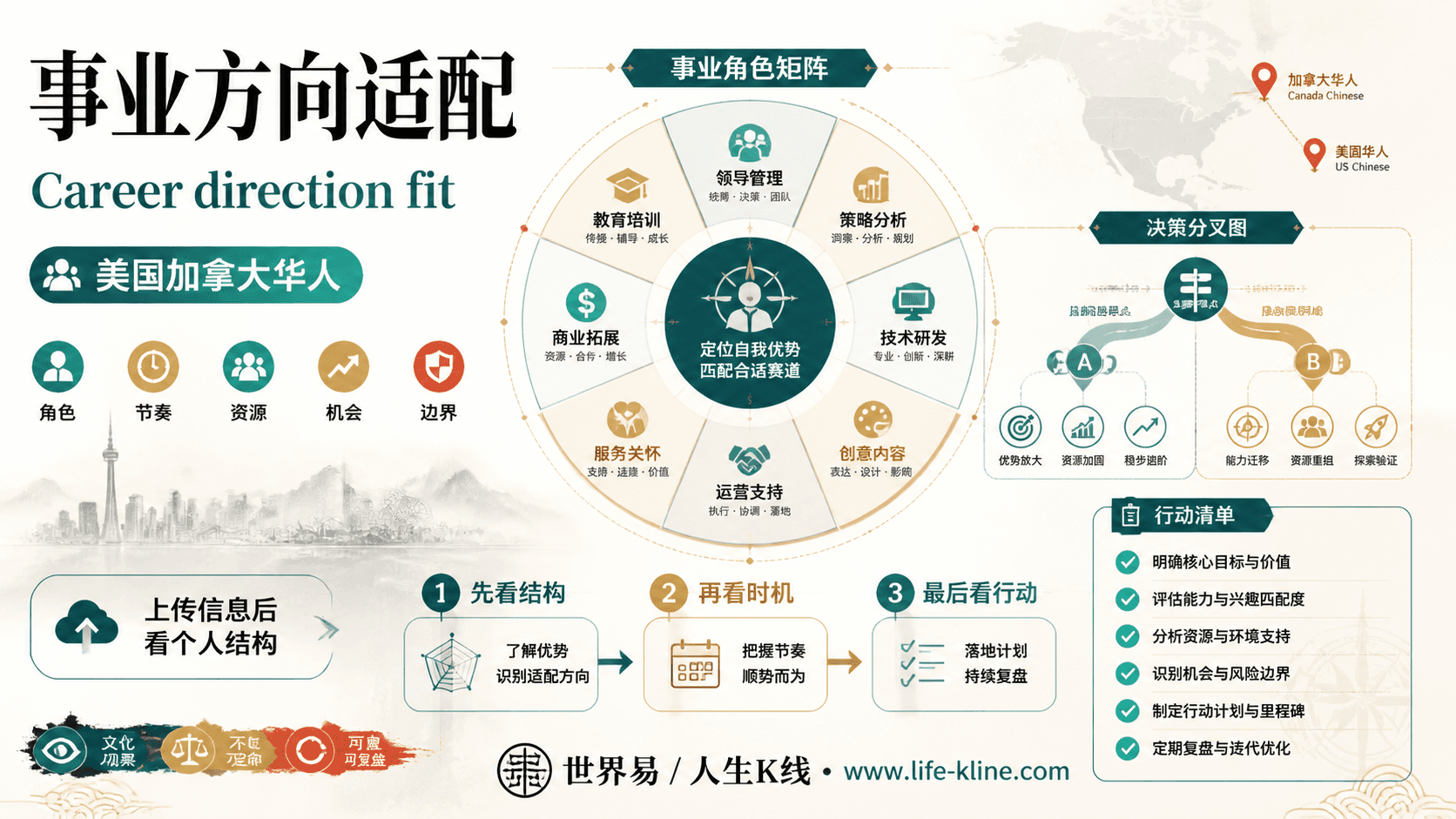
事业方向适配|美国加拿大华人
这张图把《Metaphysical Interpretation and Decision-Making Guide for Partner Selection During the Career Establishment Period (Ages 25-32)》里的命理概念转成关系、边界和应用场景,适合先看图建立结构,再回到知识文章正文理解细节。
事业方向适配不应被写成固定结论。更适合美国加拿大华人的读法,是把传统术语翻译成结构、时机、环境、行动和复盘。
查看图片解读