Detailed Explanation of Yin Earthly Branch: Five Elements Hidden Stems and Combination-Clash Relationships
把这篇文章落到自己身上验证:先看结构,再进入个人分析,不做泛泛阅读。
Concept Definition
Yin (寅, Yin) is the third of the twelve Earthly Branches, classified as a Yang branch with the Five Element Wood. In the metaphysical system, Earthly Branches not only represent divisions of time but also carry Five Element and Yin-Yang attributes. Yin’s Yang nature and Wood element endow it with unique symbolic meaning. The primary energy (Ben Qi) of Yin is Wood, indicating characteristics of growth and upward vitality.
The hidden Heavenly Stems (藏干, Hidden Stems) within Yin include Jia (甲, Wood), Bing (丙, Fire), and Wu (戊, Earth). Jia Wood is the principal energy, while Bing Fire and Wu Earth serve as auxiliary energies. This multi-layered hidden stem structure means Yin in a BaZi chart embodies not only the Wood element’s growth but also the supportive roles of Fire and Earth, enriching its metaphysical connotation.
Additionally, Yin has specific combination, clash, punishment, and harm relationships with other Earthly Branches. Yin and Shen (申) form a Liu Chong (六冲, six clashes), indicating strong conflict and change between them; Yin forms a Liu He (六合, harmonious combination) with Hai (亥), showing a supportive and harmonious relationship; while Yin and Si (巳) have Xing (刑, punishment) and Hai (害, harm) relations, representing certain restrictions and obstacles.
Metaphysical Characteristics and Symbolic Meaning
As a Yang branch, Yin exhibits positive, outward, and generative traits, which complement its Wood Ben Qi. Wood symbolizes growth and expansion, so Yin is often regarded as a symbol of beginnings, germination, and driving force, possessing vitality that propels development.
Among its hidden stems, Jia Wood is Yin’s principal energy, representing vitality and the power of growth. Bing Fire symbolizes warmth and brightness, which aids Jia Wood’s growth. Wu Earth serves as an auxiliary element providing stability and support, giving Yin a degree of tolerance and balance.
The Liu Chong (six clash) between Yin and Shen reflects the opposition and conflict between Wood and Metal, manifesting as contradictions and changes; whereas the Liu He (harmonious combination) with Hai represents the mutual generation between Wood and Water, bringing harmony and assistance. The Xing and Hai relationships with Si reveal the punishment and harm between Wood and Fire, which may cause conflicts and obstacles.
Practical Application and Interpretation
In practical BaZi interpretation, Yin’s Yang Wood nature often symbolizes growth and action, suitable for analyzing an individual’s vitality and pioneering ability. When Jia Wood dominates the hidden stems, it usually indicates strong vitality and a spirit of upward breakthrough; Bing Fire as auxiliary enhances enthusiasm and momentum; Wu Earth contributes steadiness and pragmatism.
When Yin encounters Shen, due to the Liu Chong (six clash) relationship, the chart may experience significant fluctuations or conflicts, requiring attention to harmonize the adverse effects caused by the clash; while the Liu He (harmonious combination) with Hai suggests energy harmony in the chart, favorable for cooperation and development, often considered an auspicious sign.
The Xing and Hai relationships with Si warn that in chart configuration, one should be cautious of conflicts between Wood and Fire, which might cause obstruction or depletion. These should be mitigated through adjustment by other Earthly Branches or Heavenly Stems.
Common Misconceptions
Some BaZi learners mistakenly believe Yin only hides Jia Wood, neglecting the presence of Bing Fire and Wu Earth. In fact, Yin’s multi-hidden stem structure is a crucial characteristic; ignoring the auxiliary energies leads to a one-sided understanding of Yin’s energy.
Another common misconception is confusing Yin’s combination and clash relationships with those of other Wood branches. The Liu Chong (six clash) between Yin and Shen is very clear and should not be mistaken for Liu He (harmonious combination) or San He (three harmony), as this would affect accurate judgment of chart conflicts and harmonies.
FAQ
Question: Why is Yin classified as a Yang branch? Answer: Earthly Branches are divided into Yin and Yang. Yin is the third branch among the twelve and is Yang, representing outward, active, and generative qualities consistent with its Wood growth attribute.
Question: Why does Yin’s hidden stem include Jia, Bing, and Wu? Answer: Jia Wood is Yin’s principal energy, while Bing Fire and Wu Earth jointly form the hidden stems, reflecting that Yin not only generates growth but also has auxiliary and stabilizing functions.
Question: What does the Liu Chong (six clash) between Yin and Shen signify? Answer: Liu Chong is the strongest clash relationship among Earthly Branches. Yin and Shen’s clash represents the Wood-Metal opposition, indicating possible significant changes or conflicts in the chart.
Question: How to understand the Liu He (harmonious combination) between Yin and Hai? Answer: Liu He is a harmonious and mutually supportive relationship between Earthly Branches. Yin and Hai’s combination means Wood and Water mutually generate, promoting energy flow and cooperation, favorable for auspiciousness and smoothness.
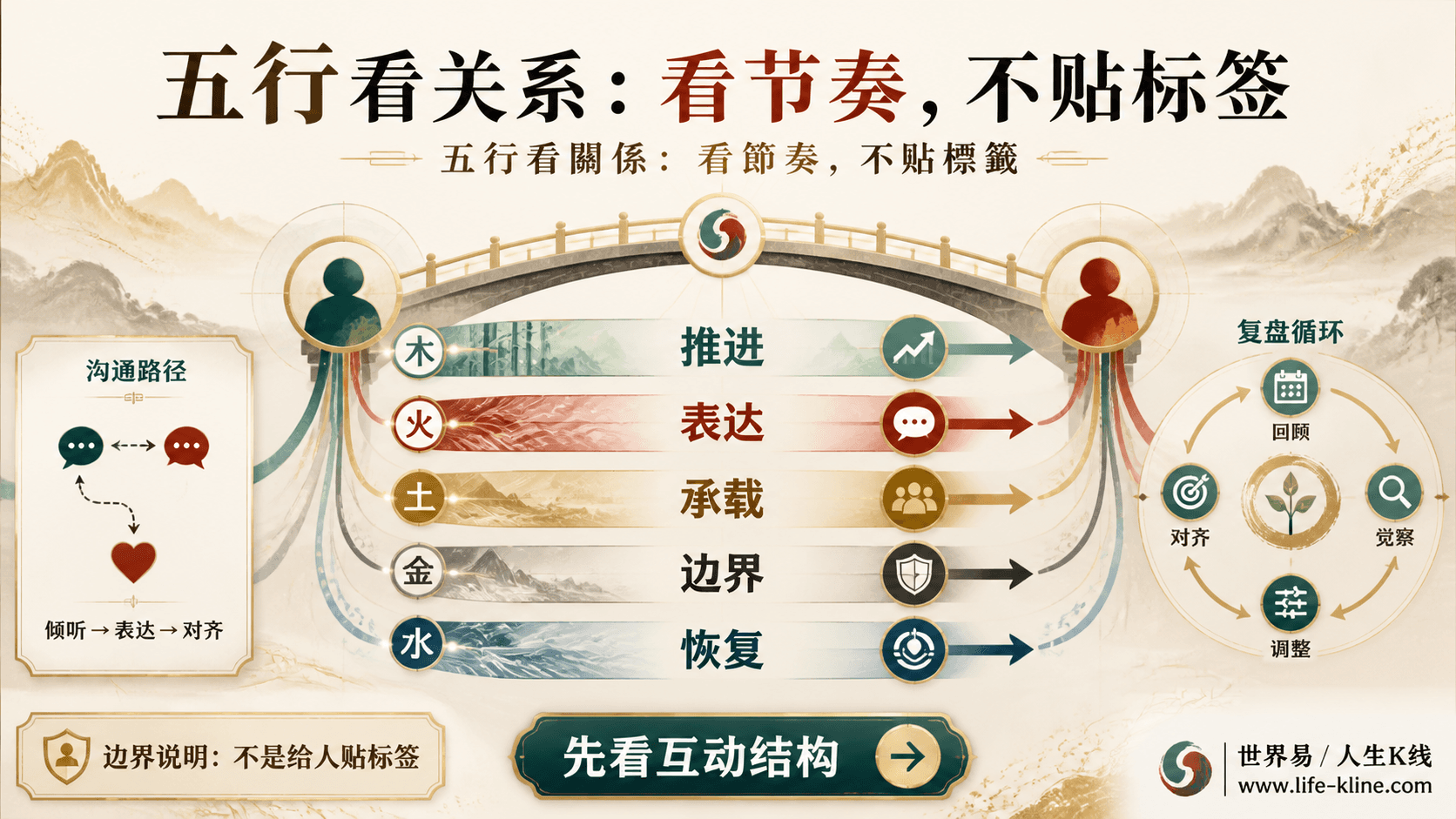
五行与关系节奏图
这张图把《Detailed Explanation of Yin Earthly Branch: Five Elements Hidden Stems and Combination-Clash Relationships》里的命理概念转成关系、边界和应用场景,适合先看图建立结构,再回到知识文章正文理解细节。
五行提供一种结构化视角,帮助观察关系中的推进、表达、承载、边界与恢复节奏。它不是性格定型工具,而是辅助我们留意互动的时位、环境与动作选择。
查看图片解读