Interpretation and Application of the Earthly Branch Mao (卯) in Destiny Analysis
把这篇文章落到自己身上验证:先看结构,再进入个人分析,不做泛泛阅读。
Concept Definition
Mao (卯) is one of the twelve Earthly Branches (Di Zhi) in traditional Chinese metaphysics, classified as a Yin branch with the Five Element of Wood. As a Yin branch, Mao's nature is relatively gentle, representing the Yin aspect within the Yin-Yang balance. Its principal element is Wood, embodying growth and development. The hidden Heavenly Stem (Cang Gan) of Mao is Yi (乙), which symbolizes a soft and flexible wood energy, often interpreted as delicate and adaptable vitality.
In the interrelationships among Earthly Branches, Mao forms a Liu Chong (six冲, clash) relationship with You (酉), which generally signifies conflict and change, indicating a certain opposition and impact between Mao and You. Additionally, Mao forms a Liu He (six合, harmony) relationship with Xu (戌), which symbolizes harmony and complementarity in destiny studies; the Mao-Xu combination brings balance and cooperation. Mao is also affected by mutual punishment (Xiang Xing) with Zi (子) and mutual harm (Xiang Hai) with Chen (辰), reflecting the complex interactions Mao has within a destiny chart.
Destiny Characteristics and Symbolic Meaning
As a Yin branch of Wood, Mao symbolizes the morning light of spring and new life, representing the power of growth and vitality. In destiny analysis, Mao's Wood nature manifests as flexible yet vigorous life force, suitable for expressing qualities such as delicacy, tolerance, and strong adaptability. The hidden stem Yi (乙) reflects Mao's intrinsic qualities of gentle and resilient wood energy.
The Liu Chong (six冲) relationship between Mao and You symbolizes the conflict between Wood and Metal, with Wood being controlled by Metal. This suggests that in destiny analysis, clashes between Mao and You may bring contradictions and challenges. Conversely, the Liu He (six合) relationship between Mao and Xu represents the complementarity between Wood and Earth; this harmony helps to mitigate conflicts and promotes balance and peace. The mutual punishment (Xiang Xing) with Zi and mutual harm (Xiang Hai) with Chen indicate that under certain combinations, Mao may encounter punitive or harmful influences, affecting the stability of the chart.
Practical Configuration and Interpretation
In BaZi destiny analysis, the presence of Mao often represents the Wood element's growth energy, which is favorable when combined with Fire or Earth elements to enhance vitality or balance the Five Elements. For example, when Mao Wood meets Xu Earth in a Liu He (six合) harmony, it can be seen as Wood nurturing Earth, beneficial for career and interpersonal development. Conversely, encountering You Metal in a Liu Chong (six冲) clash requires caution, as it may indicate conflict and pressure, signaling potential changes or challenges.
At the same time, the gentle characteristic of Yi Wood hidden in Mao can manifest as meticulousness and flexibility when cooperating with other Earthly Branches. Attention should be paid to the relationships of mutual punishment with Zi (Water) and mutual harm with Chen (Earth), as these may cause obstacles that need to be resolved through appropriate Five Element adjustments. In Feng Shui, Mao is often used to symbolize the Eastern Wood element, helping to enhance vitality and energy within a space.
Common Misconceptions
A common misconception is to simply equate Mao with the Wood element's growth energy while neglecting its Yin branch attribute. As Yin Wood, Mao possesses gentle and delicate qualities, differing from Yang Wood; thus, destiny analysis requires distinguishing the Yin-Yang differences.
Another misconception is overlooking the complex relationships Mao has with other Earthly Branches, such as Liu Chong (six冲), Liu He (six合), mutual punishment (Xiang Xing), and mutual harm (Xiang Hai). Viewing Mao's Five Element attribute in isolation may lead to one-sided conclusions; it is essential to analyze its interactions with You, Xu, Zi, and Chen comprehensively to understand its full impact within the destiny chart.
FAQ
Question: Why is Mao classified as a Yin branch? Answer: Mao is categorized as a Yin branch among the twelve Earthly Branches, representing the Yin aspect in the Yin-Yang duality. Its nature is relatively gentle and complements the Yang branches. This classification originates from ancient Yin-Yang and Five Element theories.
Question: What does the Liu Chong (six冲) relationship between Mao and You mean? Answer: Mao and You form a Liu Chong (six冲) clash relationship, representing the conflict between Wood and Metal. In destiny studies, this usually indicates contradictions and changes, potentially bringing pressure and challenges that require harmonization through other Five Elements.
Question: What influence does the hidden stem Yi have on Mao? Answer: The hidden Heavenly Stem of Mao is Yi (乙), symbolizing a soft and delicate wood energy. It endows Mao with gentle and flexible characteristics, affecting how the Wood element manifests and functions within the destiny chart.
Question: How should the Liu He (six合) relationship between Mao and Xu be interpreted? Answer: The Liu He (six合) harmony between Mao and Xu represents the complementary relationship between Wood and Earth. It helps to resolve conflicts and promotes balance and smoothness in the destiny chart, positively influencing career and interpersonal relationships.
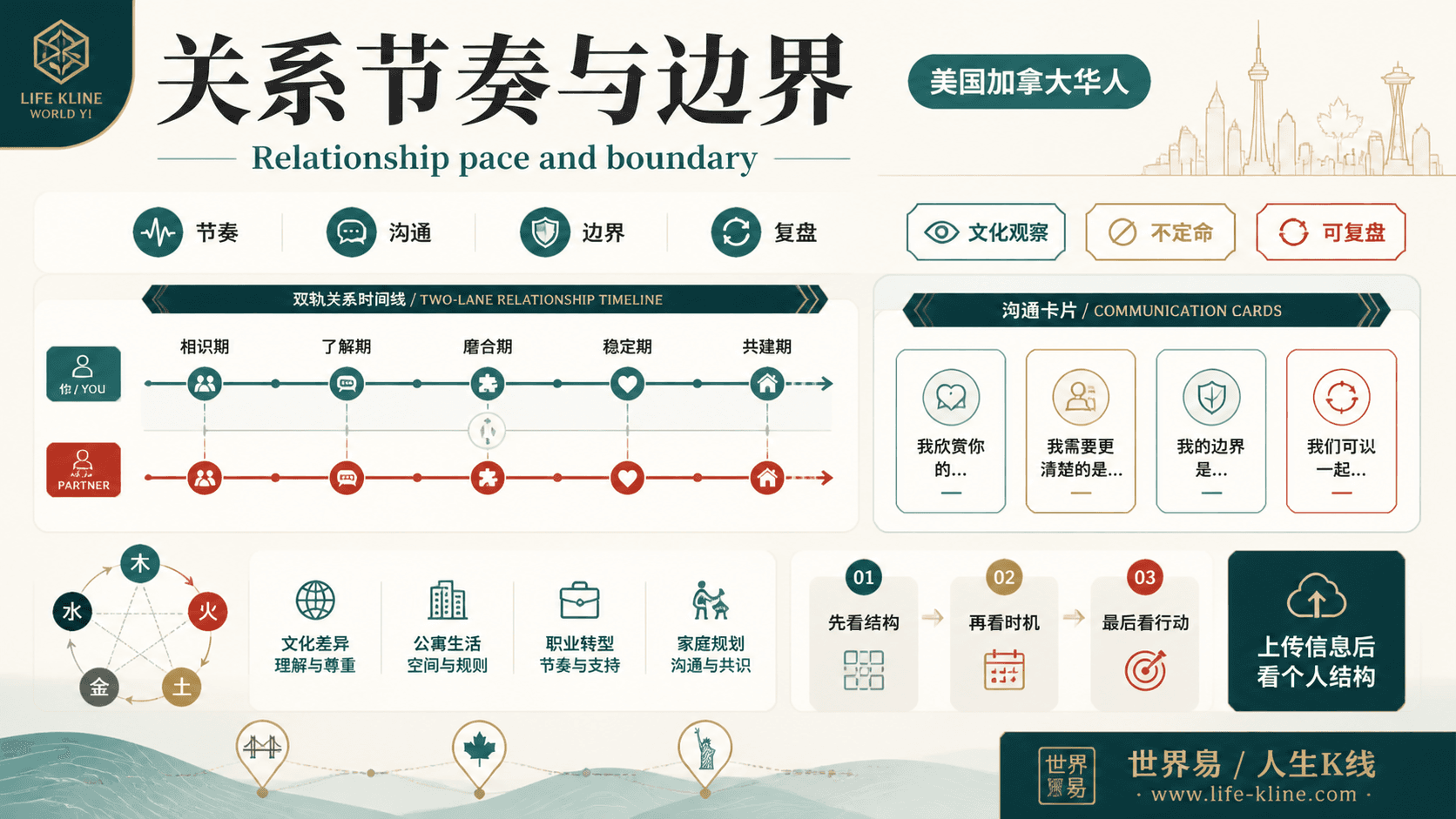
关系节奏与边界|美国加拿大华人
这张图把《Interpretation and Application of the Earthly Branch Mao (卯) in Destiny Analysis》里的命理概念转成关系、边界和应用场景,适合先看图建立结构,再回到知识文章正文理解细节。
关系节奏与边界不应被写成固定结论。更适合美国加拿大华人的读法,是把传统术语翻译成结构、时机、环境、行动和复盘。
查看图片解读