Analysis and Decision Guidance on the Wealth Structure in Property Division during Divorce Reconciliation
把这篇文章落到自己身上验证:先看结构,再进入个人分析,不做泛泛阅读。
Why This Decision Is Particularly Difficult at This Stage of the Relationship
During the divorce and reconciliation stage, property division becomes the core conflict in real-life relationships, especially when it involves bride price, dowry, and jointly accumulated wealth. Both families often hold very firm positions. Bride price and dowry are not merely economic issues but also represent family dignity and social face, making financial negotiations prone to emotional conflicts.
Moreover, disputes over child custody further intensify financial bargaining pressure. Parents seek a balance between child custody and economic security, making property division not only about immediate interests but also long-term responsibilities, significantly increasing decision complexity.
BaZi structures potentially influence both parties’ psychology and strategies at this stage. For example, the strength of wealth stars and Bi Jian/Jie Cai, the condition of the spouse star and the spouse palace, all amplify the parties’ bottom lines and concession spaces under real-world pressure. The relationship between Yong Shen (favorable elements) and Ji Shen (unfavorable elements), combined with Da Yun and Liu Nian, can also indicate when to hold firm or when to compromise proactively.
Therefore, financial decisions at this stage are not only legal and economic matters but also an interplay of metaphysical energy fields and real family relationships. Understanding the wealth characteristics in both BaZi charts helps scientifically analyze risks and opportunities to find practical solutions.
Three Core Dimensions of BaZi Judgment
First, the strength and pattern type of the Day Master serve as the foundation for analyzing financial bottom lines and concession space. A relatively strong or weak Day Master represents the individual’s subjective initiative strength. Patterns such as Yang Ren (Sheep Blade), Jie Cai (Rob Wealth), and Shang Guan (Hurting Officer) correspond to distinct personalities and financial attitudes. For example, a strong Day Master often shows leadership and persistence, while a weak Day Master is more susceptible to environmental influence.
Second, the position and condition of the spouse palace and spouse star directly affect the stability of the relationship and the possibility of reconciliation. A flourishing spouse palace usually indicates a stable emotional foundation and room for financial communication; if the spouse palace is clashed or the spouse star is restrained, financial negotiations tend to reach deadlock, making it difficult to narrow bottom lines.
Third, the interaction between the current Da Yun and Liu Nian provides dynamic reference. When the Da Yun is auspicious and aligns well, financial negotiations are more likely to progress positively; conversely, an inauspicious Da Yun or conflicting Liu Nian can bring major setbacks or decision risks. Combining Da Yun and Liu Nian with Yong Shen and Ji Shen helps judge the best timing to act or wait.
Integrating these three dimensions, BaZi analysis is not merely a fate description but offers a scientific framework to reconcile internal and external conflicts and seize timing in real-world marital financial decisions.
Three Real BaZi Case Studies
Case 1: This male’s Day Master is 戊 (Wu, Earth), relatively strong, belonging to the Yang Ren (Sheep Blade) pattern. His Yong Shen are Wood and Water, while the Ji Shen is Fire. Currently, he is in the 壬子 (Ren Zi) Da Yun (very auspicious), with the Liu Nian being 丙午 (Bing Wu) which supports the trend. The strong Yang Ren Day Master indicates strong leadership and persistence in financial matters, but the Yong Shen Wood and Water suggest a need to moderate the impulsiveness caused by the Fire Ji Shen. At the divorce reconciliation stage, regarding bride price and joint property division, he tends to defend his financial bottom line. However, the Ren Zi Da Yun aids him in acting in harmony with circumstances. It is advised to communicate proactively with rationality and strategy to avoid emotional outbursts triggered by the Fire Ji Shen. Judgment sequence: first assess both families’ financial bottom lines and demands, then combine Da Yun and Liu Nian to identify negotiation windows, and compromise timely to preserve reconciliation possibilities.
Case 2: This male’s Day Master is 乙 (Yi, Wood), relatively weak, belonging to the Jie Cai (Rob Wealth) pattern. His Yong Shen is Water, and Ji Shen are Fire and Earth. He is currently in the 己丑 (Ji Chou) Da Yun (inauspicious), with the Liu Nian being 丙午 (Bing Wu), requiring caution. The weak Jie Cai Day Master means he is more easily influenced financially by external factors. Although Water as Yong Shen helps harmonize, the inauspicious Da Yun increases risk. The spouse palace is not flourishing, making reconciliation more difficult. During bride price and dowry division, he may face the other party’s strong stance and must be especially wary of conflicts triggered by the Fire and Earth Ji Shen. Recommended sequence: first stabilize personal emotions to avoid escalating conflicts; second, evaluate family support and consider conceding some financial claims to gain emotional repair opportunities; finally, dynamically adjust strategies according to Liu Nian changes.
Case 3: This male’s Day Master is 癸 (Gui, Water), relatively weak, belonging to the Shang Guan (Hurting Officer) pattern. His Yong Shen is Fire, and Ji Shen is Wood. He is currently in the 己巳 (Ji Si) Da Yun (stable), with the Liu Nian being 丙午 (Bing Wu), requiring flexible responses. The weak Shang Guan Day Master shows emotional richness and adaptability. The Fire Yong Shen suggests he is suited to take initiative, but the Wood Ji Shen may indicate interference factors in financial negotiations. The spouse palace is stable, indicating reconciliation is possible. He is relatively flexible in joint property and dowry division and suitable for a gradual approach. Suggested judgment sequence: first assess the gap in financial demands, then leverage the stability of the Ji Si Da Yun to gradually secure interests; finally, adjust negotiation pace based on Liu Nian to avoid decision errors caused by external interference.
Common Misjudgments and Blind Spots at This Stage
First, ignoring the interaction between Da Yun and Liu Nian and making decisions solely based on current emotions or legal provisions often leads to missing the best negotiation window or escalating conflicts. The auspicious or inauspicious relationships between Da Yun and Liu Nian indicate timing and risks; neglecting this leads to misjudgments such as being "overly aggressive" or "excessively retreating" in financial bargaining.
Second, overemphasizing the strength or weakness of the wealth star while neglecting the Day Master’s own strength and the spouse palace’s condition. Although the wealth star represents wealth, the spouse palace and spouse star directly relate to the relationship foundation. Ignoring emotional stability often results in difficulties reaching financial consensus and missing reconciliation opportunities.
Third, simply concluding that a "strong Day Master must insist on the bottom line" or a "weak Day Master must concede" oversimplifies complex financial relationships and overlooks the regulatory role of Yong Shen and Ji Shen as well as social pressures. Bride price and dowry often involve family face and social expectations, so pure metaphysical strength judgments are insufficient.
Finally, a common blind spot is failing to integrate real social factors such as child custody, family attitudes, and gender expectations, causing BaZi analysis to disconnect from practical operations and making it difficult to form feasible solutions.
Practical Judgment Sequence
First, comprehensively investigate both parties’ financial bottom lines, combining BaZi factors such as Day Master strength, wealth star and Bi Jian/Jie Cai structures, and spouse palace and spouse star conditions to judge each party’s persistence points and possible concession spaces. This step helps clarify true needs and avoid pointless disputes.
Second, combine the current Da Yun and Liu Nian situation to judge negotiation timing. When Da Yun is auspicious and Liu Nian aligns well, actively strive and communicate; otherwise, exercise patience and avoid impulsive decisions. Pay special attention to the mutual generation and restriction between Yong Shen and Ji Shen to adjust psychological expectations and action strategies.
Finally, flexibly formulate concession or persistence strategies based on real social pressures such as bride price and dowry customs, family face, and child custody issues. If the reconciliation window is limited, prioritize protecting core interests and seek emotional repair; if the situation is unfavorable, rationally withdraw to preserve future development. Using BaZi to assist judgment enables balancing reason and emotion and progressing step by step.
FAQ
Question 1: How does the strength of the wealth star in BaZi affect the financial bottom line in property division? Answer: A strong wealth star indicates a strong desire and persistence in controlling wealth, resulting in a higher bottom line; a weak wealth star may be more willing to compromise. Combined with Day Master strength and Yong Shen/Ji Shen, it helps determine when to insist or concede in accordance with one’s BaZi characteristics.
Question 2: How do the spouse palace and spouse star conditions affect negotiations on bride price and dowry reconciliation? Answer: A flourishing spouse palace and a good spouse star usually indicate a stable emotional foundation and greater room for financial negotiation, facilitating consensus. If the spouse palace is clashed or the spouse star restrained, emotional trust declines, making financial negotiations prone to deadlock and requiring careful handling.
Question 3: How to use Da Yun and Liu Nian to judge the best timing for reconciliation? Answer: When Da Yun is auspicious and Liu Nian aligns well, actions are more effective, suitable for proactive communication and striving; when Da Yun is inauspicious or Liu Nian conflicts, caution is advised to avoid escalating conflicts. Combining the regulatory effect of Yong Shen and Ji Shen allows flexible strategy adjustments to maximize reconciliation success.
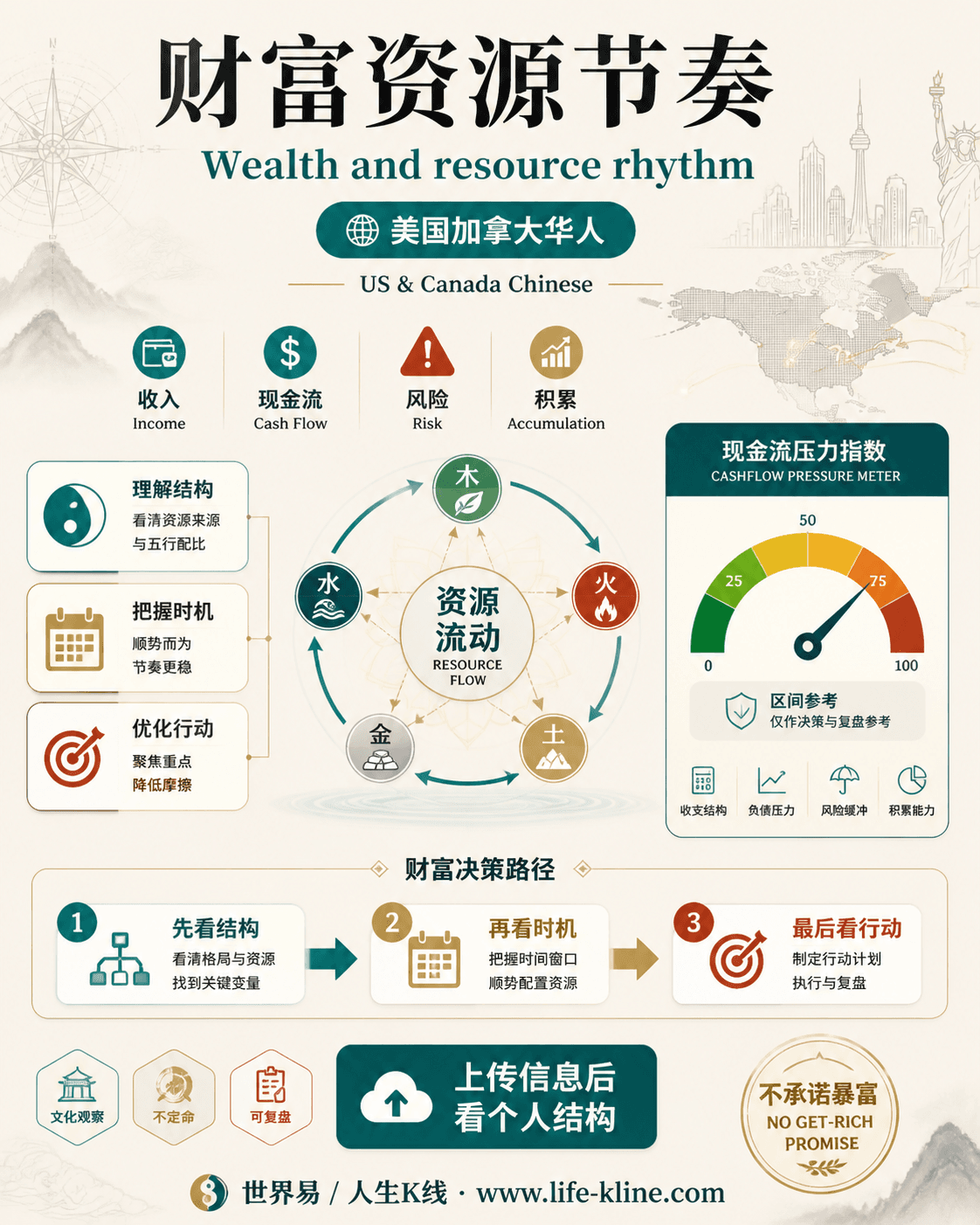
财富资源节奏|美国加拿大华人
这张图把《Analysis and Decision Guidance on the Wealth Structure in Property Division during Divorce Reconciliation》里的命理概念转成关系、边界和应用场景,适合先看图建立结构,再回到知识文章正文理解细节。
财富资源节奏不应被写成固定结论。更适合美国加拿大华人的读法,是把传统术语翻译成结构、时机、环境、行动和复盘。
查看图片解读