Divorce Litigation: Filing or Settlement Decisions from a Metaphysical Perspective on Legal Timing
把这篇文章落到自己身上验证:先看结构,再进入个人分析,不做泛泛阅读。
Why This Decision Is Especially Difficult in This Legal Context
Divorce litigation involves multiple complex issues such as emotional entanglements, property division, and custody of minor children. In practice, choosing between settlement and litigation often tips the balance of interests for the parties involved. While settlement saves time and effort, it is often difficult to reach agreement due to hidden assets, challenges in proving domestic violence, and emotional fluctuations. Litigation, on the other hand, involves complicated procedures, high evidence collection costs, enforcement difficulties, and strict time limits; any delay may affect rights protection.
Moreover, Chinese law emphasizes mediation first, with courts generally encouraging settlement. Legal fees and litigation risks are also realistic factors parties must consider. Against this backdrop, grasping the appropriate timing for filing and the rhythm of settlement negotiations becomes critical; even slight misjudgments may lead to litigation failure or loss of rights.
BaZi structure as an auxiliary tool can, through the strength of the Day Master, pattern characteristics, Yong Shen, and Da Yun/Liu Nian changes, indicate the party’s psychological state and action strength at different stages. Especially the interactions of the Ten Gods such as Zheng Guan (official), Qi Sha (seven kill), Shang Guan (hurting officer), and Bi Jian (peer), correspond to internal rhythms of power struggles, confrontational expression, and resource competition in reality.
Therefore, integrating the timing nodes of litigation procedures in legal practice with BaZi rhythms can help parties scientifically assess the current dispute situation and reasonably choose whether to immediately proceed with legal action or temporarily settle and negotiate further, thereby reducing litigation risks and improving dispute resolution efficiency.
Three Core Dimensions of Metaphysical Judgment
First, the strength of the Day Master and the pattern type determine the party’s dominant power in the dispute. A relatively strong Day Master usually manifests as strong self-awareness and initiative, suitable for proactive action. However, if the pattern has strong Zheng Guan (official) or Qi Sha (seven kill), it indicates authoritative pressure; strong Shang Guan (hurting officer) expresses strong desire, which may escalate conflicts. Strong Bi Jian (peer) suggests resource sharing or competition, affecting interpersonal relationships in property division.
Second, the coordination between Yong Shen (favorable element) and Ji Shen (unfavorable element) reflects the adjustment strategies the party should adopt. Yong Shen such as Fire or Wood, which generate vitality, suggest actively adjusting emotions and communication; Ji Shen such as Earth or Metal may represent obstacles or concealment, warning of risks like the opposing party hiding assets or difficulty in evidence collection. The clash and combination between Da Yun/Liu Nian and Yong Shen/Ji Shen directly affect the party’s sense of dispute resolution rhythm and risk resistance.
Third, special attention is paid to the interaction among the Ten Gods of Zheng Guan (official), Qi Sha (seven kill), and Shang Guan (hurting officer). Zheng Guan represents legal authority pressure and external enforcement; Shang Guan relates to expression, argument, and emotional release; Bi Jian (peer) involves resource competition and rivalry among equals. The strength and combination state of these three indicate when the party should proactively file to leverage legal authority and when it is appropriate to settle to avoid overly intense emotional confrontation, thus reasonably arranging litigation and mediation timing.
Combined with Da Yun and Liu Nian, especially the stability of the current Da Yun and the clash or harmony of Liu Nian, one can judge the party’s endurance and flexibility in legal procedures, assisting decision-makers in finding a balance between litigation and settlement.
Three Real BaZi Chart Cases
Case 1: Male, aged 30-35, Day Master Xin Metal (辛), relatively strong, pattern belongs to Yang Ren (羊刃) pattern, Yong Shen are Fire and Wood, Ji Shen is Earth. Currently in the first year of Ding Chou (丁丑) Da Yun, with Bing Wu (丙午) Liu Nian. The Yang Ren pattern with a relatively strong Day Master shows strong initiative and decisiveness. Fire and Wood as Yong Shen suggest focusing on adjusting communication to avoid stubbornness. Considering the stability of Ding Chou Da Yun and the adaptability of Bing Wu Liu Nian, this indicates that although there is strength to initiate litigation proactively, flexibility is needed to handle possible asset concealment or evidence difficulties by the opposing party. In legal practice, it is recommended that the party proceed immediately with legal action when evidence is relatively complete and the opposing party is uncooperative; if the opposing party’s attitude is negotiable, attempting settlement first can avoid wasting litigation resources.
Case 2: Female, aged 45-50, Day Master Gui Water (癸), relatively strong, pattern is Shi Shen (食神) pattern, Yong Shen is Metal, but Metal is also Ji Shen. Currently in the 10th year of Ji Mao (己卯) Da Yun, with Bing Wu (丙午) Liu Nian. The Shi Shen pattern indicates strong expressive ability and emotional volatility. The presence of Metal as both Yong Shen and Ji Shen suggests internal conflict between emotion and rationality, prone to self-torment. Ji Mao Da Yun is stable, while Bing Wu Liu Nian brings some variability. In legal practice, such parties often show strong desire to express and fight in custody and property disputes but may become emotional and cause negotiation breakdown due to Ji Shen constraints. It is advised to first stabilize negotiations through mediation and psychological counseling; if the opposing party shirks responsibility or clearly hides assets, litigation should be decisively initiated to protect rights.
Case 3: Female, aged 55-60, Day Master Ding Fire (丁), moderate strength, pattern is Pian Yin (偏印) pattern, Yong Shen is Wood, Ji Shen is Water. Currently in the 2nd year of Ji Mao (己卯) Da Yun, with Bing Wu (丙午) Liu Nian. The Pian Yin pattern with a moderate Day Master is relatively gentle; Wood as Yong Shen favors steady thinking and careful response; Ji Shen Water warns against excessive emotional fluctuations. Both Da Yun and Liu Nian are stable, indicating the party is suitable for a conservative approach at this time. In legal context, this BaZi structure generally favors seeking settlement first to avoid the time and energy consumption of litigation that could affect quality of life. Only when the agreement is clearly unfair or there is substantial evidence of severe domestic violence should legal procedures be considered promptly to protect personal rights.
Common Misjudgments and Blind Spots in This Scenario
First, misjudging the intensity of emotional expression by interpreting strong expression as an immediate signal to litigate, ignoring the underlying legal evidence and procedural costs, leading to premature litigation with insufficient evidence preparation, which negatively affects outcomes. Second, overlooking the complexity of asset concealment and the difficulty of evidence collection; premature litigation may result in prolonged investigation periods, making property division plans hard to implement. Third, ignoring legal time limits and the mediation-first principle; blind filing may miss more favorable negotiation windows and increase legal fees and litigation burden.
Additionally, some parties overly rely on positive signals from BaZi structure, neglecting legal risks and procedural norms, resulting in unreasonable litigation strategies. Others, due to the appearance of Ji Shen, become overly fearful of litigation and abandon legitimate rights protection. Correct understanding is that BaZi is only an auxiliary reference for timing and psychological state; decisions must be based on legal provisions and evidence to avoid blind spots in judgment.
Practical Judgment Sequence
First, assess the strength of one’s Day Master and key Ten Gods combinations in the natal chart, combined with the current Da Yun and Liu Nian, to determine psychological and action readiness, clarifying whether there is internal momentum to immediately initiate litigation. Second, integrate the current status of legal evidence, especially completeness of property proofs and domestic violence records, to judge whether the basic requirements for litigation procedures are met, avoiding blind filing and risk of losing the case.
Third, consider legal time limits and the mediation-first principle. If evidence is incomplete and the opposing party’s attitude is negotiable, prioritize mediation and negotiation to seek settlement, adjusting strategy according to communication timing suggested by Yong Shen in BaZi. Finally, if the opposing party hides assets, there is conclusive domestic violence evidence, or negotiations break down, decisively initiate litigation procedures, cooperating with legal processes and professional lawyers to maximize rights protection.
Throughout the process, BaZi judgment should serve as an auxiliary reference for timing and psychological state, strictly coordinated with statutory procedures and legal consultation to ensure scientific and reasonable decision-making.
FAQ
Question 1: Does a strong Zheng Guan (official) in BaZi mean one must immediately file a lawsuit? Answer: A strong Zheng Guan represents legal authority pressure and external enforcement, but whether to file immediately must be combined with evidence completeness and legal procedures. BaZi indicates strong initiative suitable for proactive action, but must coordinate with legal procedures to avoid blind litigation.
Question 2: Does a strong Shang Guan (hurting officer) indicating emotional conflict mean litigation should be avoided? Answer: Strong Shang Guan reflects strong expression desire and emotional volatility, requiring cautious emotional control. However, this does not mean avoiding litigation; it is recommended to first use mediation and negotiation to ease relations and only initiate litigation when necessary.
Question 3: Does a stable Da Yun and Liu Nian mean one can delay settlement longer? Answer: Stable Da Yun and Liu Nian suggest the party is suitable for conservative and steady responses, but divorce litigation has statutory time limits. Excessive delay may cause rights loss. Timing should be arranged reasonably in combination with legal time limits and evidence status.
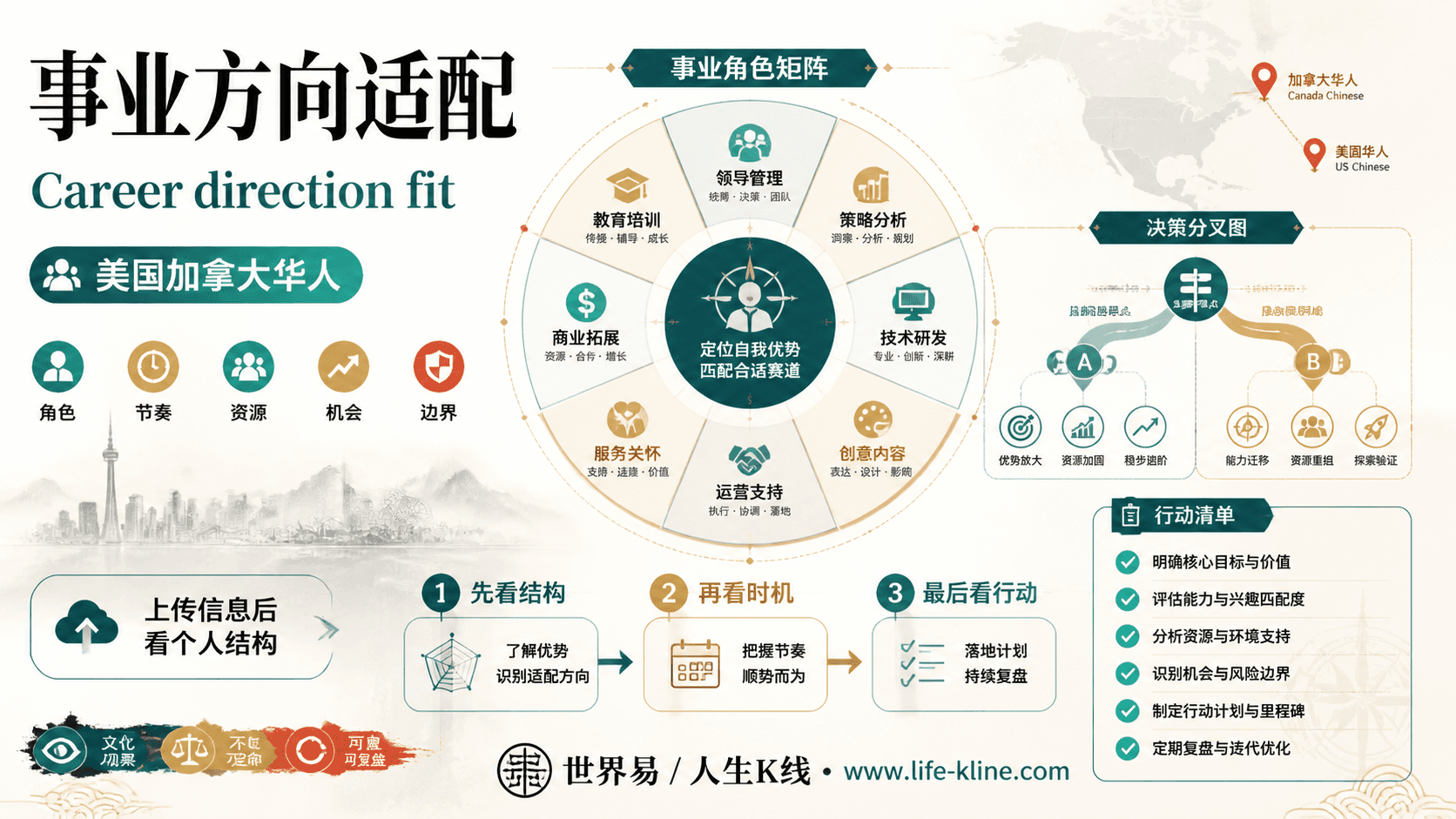
事业方向适配|美国加拿大华人
这张图把《Divorce Litigation: Filing or Settlement Decisions from a Metaphysical Perspective on Legal Timing》里的命理概念转成关系、边界和应用场景,适合先看图建立结构,再回到知识文章正文理解细节。
事业方向适配不应被写成固定结论。更适合美国加拿大华人的读法,是把传统术语翻译成结构、时机、环境、行动和复盘。
查看图片解读