Analysis of Optimal Timing and Rhythm Decisions in Divorce Litigation and Property Division
把这篇文章落到自己身上验证:先看结构,再进入个人分析,不做泛泛阅读。
Why This Decision Is Especially Difficult in This Legal Context
The complexity of legal decisions in divorce litigation and property division mainly lies in balancing agreements and litigation, custody disputes, defining joint property, and the difficulty of proving concealed assets. The litigation process itself is often time-consuming and labor-intensive, with high attorney fees, evidence collection costs, and enforcement difficulties, causing significant uncertainty for parties when choosing between initiating litigation or pursuing mediation first.
Moreover, civil litigation statutes of limitations and policies prioritizing mediation further intensify the urgency of decision-making. While mediation can save costs, the opposing party’s integrity and risks of asset concealment are hard to fully control. Litigation faces considerable pressure in evidence collection and proof, especially concerning domestic violence evidence and verifying asset authenticity.
From a metaphysical perspective, the interaction of the Day Master with Zheng Guan (Direct Officer), Qi Sha (Seven Killings), Shang Guan (Hurting Officer), and Bi Jian (Peer) in divorce disputes reflects the party’s intrinsic resistance and expressive abilities, as well as their capacity to endure and respond to external pressure in rhythm. The clashes and harmonies between Da Yun and Liu Nian serve as important references for judging the time window for litigation initiation or mediation, indicating how to follow natural rhythms to reduce resistance.
Therefore, the overlay of legal practice and metaphysical rhythms forms a multidimensional decision challenge. It is essential to comprehensively consider litigation costs, evidence preparation, and metaphysical timing hints, enabling parties to grasp the optimal litigation and mediation periods within a complex legal environment and improve the success rate of legal actions.
Three Core Dimensions of Metaphysical Judgment
Firstly, the strength or weakness of the Day Master determines the party’s initiative and resilience in legal disputes. A relatively strong Day Master possesses greater self-direction and resource integration capabilities, suitable for actively initiating litigation or asserting opinions when supported by Da Yun and Liu Nian. Conversely, a weak Day Master should leverage favorable Liu Nian to mediate smoothly and avoid excessive confrontation.
Secondly, Zheng Guan (Direct Officer) and Qi Sha (Seven Killings) represent law and authority; their presence and strength directly impact the legal pressure and confrontational nature during litigation. Shang Guan (Hurting Officer) symbolizes expression and counterattack ability; when strong, the party is better at verbal and evidential dispute, but excessive strength may escalate conflicts. Bi Jian (Peer) reflects peer support and resource competition, influencing resource integration and confrontation rhythm in property division.
Lastly, the clash and harmony relationships between Da Yun and Liu Nian reflect how external environmental changes affect legal event progress. Auspicious Da Yun combined with smooth Liu Nian favor litigation initiation and successful mediation; impulsive or unfavorable Liu Nian often indicate increased litigation resistance, necessitating cautious timing choices to prioritize stabilizing the situation and prevent litigation deadlocks or resource depletion.
Three Real BaZi Chart Cases
Case 1: The female’s BaZi chart shows a relatively strong Jia (甲, Wood) Day Master, belonging to the Yang Ren (Goat Blade) pattern, indicating a strong subjective consciousness and robust self-expression and resistance ability. The Yong Shen are Metal and Earth; the Ji Shen is Water. Currently in the Ding Hai (丁亥) Da Yun, where Ding (丁, Fire) supports Jia (甲, Wood), the Da Yun is stable and suitable for consolidation. The Bing Wu (丙午) Liu Nian features strong Fire, enhancing action capability. Legally, this chart suggests the party is suitable to adopt an active but not overly aggressive litigation strategy combining the late Da Yun period with the Fire-strong Liu Nian, reasonably using mediation rhythm to avoid impulsiveness that leads to insufficient evidence preparation. It is recommended to first collect property and domestic violence evidence steadily, advance mediation, and if mediation fails, select an appropriate time to initiate litigation, ensuring litigation rhythm synchronizes with metaphysical rhythm.
Case 2: This BaZi chart has a relatively weak Geng (庚, Metal) Day Master and is a Shang Guan (Hurting Officer) pattern. Shang Guan represents strong expression and counterattack ability, but due to the weak Day Master, actual pressure endured is considerable. The Yong Shen is Earth; the Ji Shen are Water and Wood. Currently in the Ji Chou (己丑) Da Yun, where Ji (己, Earth) supports Geng (庚, Metal), the Da Yun is auspicious and suitable for following the trend. The Bing Wu (丙午) Liu Nian has strong Fire, which is released by Shang Guan and thus benefits expression and defense. Combining legal practice, it is advised that the party actively promote mediation early in the Da Yun using the momentum of the Liu Nian, strengthening evidence presentation and persuasive ability to enhance negotiation advantage. If mediation fails, litigation can be initiated under Da Yun support, leveraging the auspicious Da Yun to ensure efficient litigation progress.
Case 3: The female’s BaZi chart has a moderate Ren (壬, Water) Day Master, from the Sha (Seven Killings) pattern. Zheng Guan (Direct Officer) and Qi Sha (Seven Killings) represent strong authority pressure. The Yong Shen are Earth and Fire; the Ji Shen are Metal and Water. Currently in the Gui Wei (癸未) Da Yun, where Gui (癸, Water) supports Ren (壬, Water), and the Bing Wu (丙午) Liu Nian has strong Fire, which generates Earth, the overall Da Yun is stable and the Liu Nian allows flexible response. Legally, this structure indicates the party faces considerable authority pressure in litigation and needs to rely on Yong Shen Earth and Fire to stabilize the situation, preventing litigation risks caused by impulsive Zheng Guan and Qi Sha. It is recommended to prioritize mediation, use the stable Da Yun period to gradually consolidate evidence and negotiation foundation, and during the Fire-strong Liu Nian appropriately push key litigation points while avoiding premature conflict escalation, ensuring litigation rhythm aligns with metaphysical rhythm.
Common Misjudgments and Blind Spots in This Scenario
A common misjudgment in divorce litigation and property division is overreliance on short-term emotions and misunderstanding of legal procedures, neglecting litigation statutes of limitations and mediation priority principles, resulting in filing too early or too late and affecting case handling efficiency. The strength of the Day Master and changes in Da Yun and Liu Nian in metaphysics are often overlooked, failing to reasonably arrange litigation timing in accordance with actual rhythm.
Another blind spot is misunderstanding Zheng Guan (Direct Officer) and Shang Guan (Hurting Officer), mistakenly considering strong Shang Guan as an inevitable litigation advantage, ignoring that excessive Shang Guan may intensify conflicts and cause loss of mediation opportunities. Bi Jian (Peer) resources are not properly utilized, leading to isolation during litigation.
Additionally, in legal practice, the difficulty of proving concealed assets and domestic violence evidence is underestimated, and the influence of Ji Shen (unfavorable elements) in the metaphysical structure is not integrated, missing opportunities to timely supplement evidence and adjust litigation strategy at critical Liu Nian or Da Yun nodes, resulting in passive litigation rhythm.
Practical Judgment Sequence
First, examine the strength of the Day Master and the relationship between Yong Shen and Ji Shen to assess the party’s intrinsic resistance and pressure response, combined with the current Da Yun and Liu Nian, to confirm whether internal and external timing for litigation or mediation is favorable. It is recommended to prioritize initiating legal procedures during auspicious Da Yun and Liu Nian phases and avoid filing hastily during impulsive or unfavorable Liu Nian.
Second, evaluate existing evidence and legal costs, especially the difficulty of proving domestic violence and asset concealment, to decide whether to mediate first or litigate directly. The mediation phase should fully utilize favorable expression and persuasion timings within Liu Nian and Da Yun to strengthen negotiation leverage.
Finally, based on mediation results and litigation statutes of limitations, combined with metaphysical rhythm changes, flexibly adjust litigation strategy and appeal timing to ensure legal actions synchronize with metaphysical rhythm, minimizing litigation resistance and maximizing dispute resolution feasibility and efficiency.
FAQ
Question 1: Can metaphysics determine the guaranteed winning timing for divorce litigation? Answer: Metaphysics provides auxiliary references for litigation rhythm and timing, combined with legal procedures and evidence preparation, helping parties reasonably arrange litigation nodes, but it cannot replace legal judgment nor guarantee certain victory.
Question 2: How to combine metaphysics to judge the priority between mediation and litigation? Answer: By evaluating the strength of the Day Master and the relationship between Yong Shen and Ji Shen, assessing the party’s resistance and expressive ability, combined with auspiciousness of Da Yun and Liu Nian, one can decide whether to mediate first to save costs or litigate directly to gain initiative.
Question 3: When domestic violence evidence is difficult to fully obtain, how does metaphysics suggest adjusting litigation rhythm? Answer: It is recommended to first utilize periods within Da Yun and Liu Nian when expression and persuasion abilities are stronger to steadily collect evidence, combine mediation to reduce litigation risk, and initiate formal litigation when evidence is sufficient, avoiding litigation obstruction due to insufficient evidence.
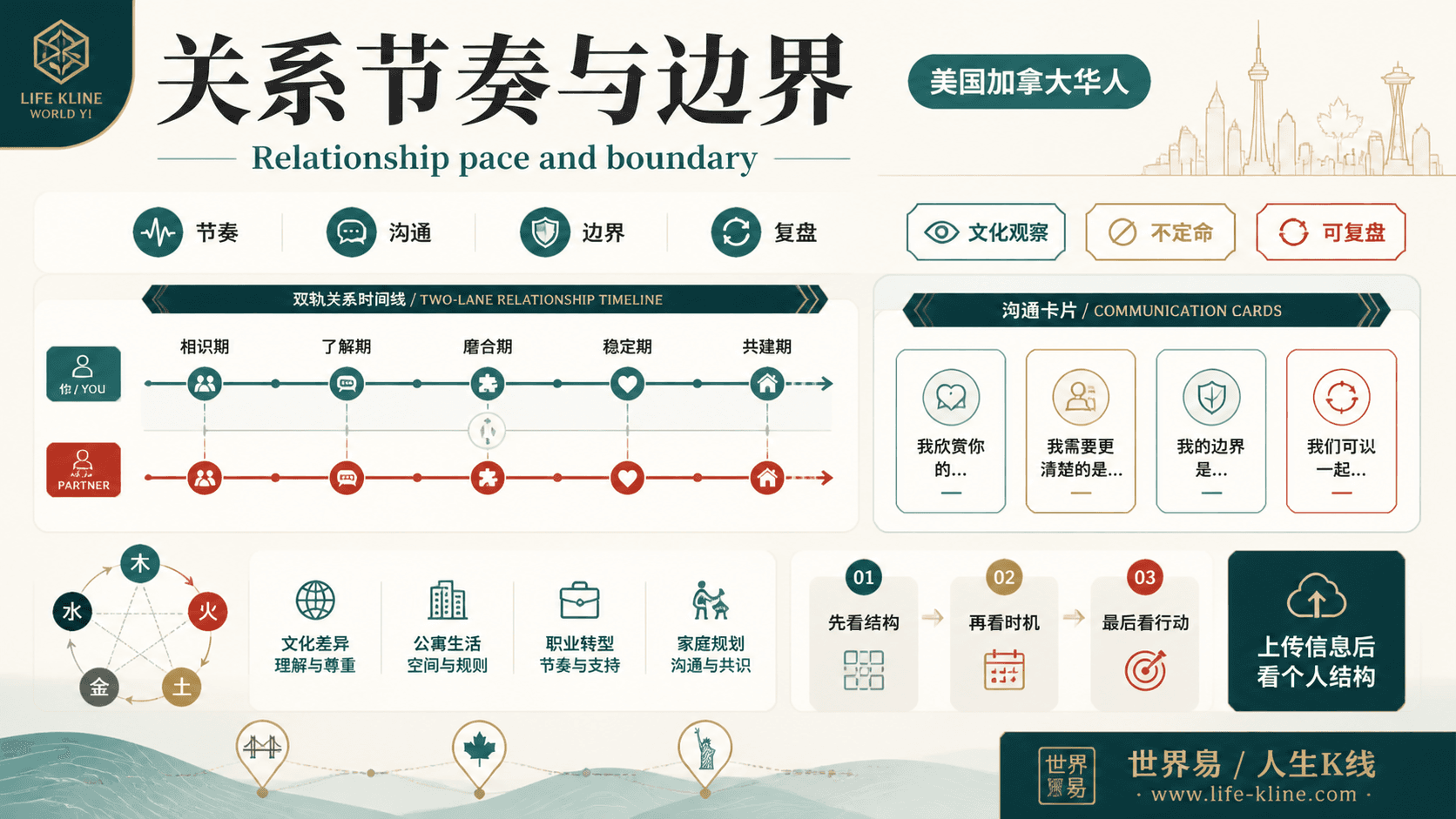
关系节奏与边界|美国加拿大华人
这张图把《Analysis of Optimal Timing and Rhythm Decisions in Divorce Litigation and Property Division》里的命理概念转成关系、边界和应用场景,适合先看图建立结构,再回到知识文章正文理解细节。
关系节奏与边界不应被写成固定结论。更适合美国加拿大华人的读法,是把传统术语翻译成结构、时机、环境、行动和复盘。
查看图片解读