Decision-Making for Designers' Side Careers: A Metaphysical Analysis of Shi Shen, Cai, and Yin Structures
把这篇文章落到自己身上验证:先看结构,再进入个人分析,不做泛泛阅读。
Why This Decision Is Especially Difficult in This Profession
The core characteristic of the designer profession is a heavy reliance on aesthetic intuition and creative inspiration. Client demands are variable and often require repeated revisions, resulting in an unstable work rhythm frequently accompanied by overtime. In terms of income structure, although the main design work has some stability, freelancers experience significant fluctuations, making side careers an important avenue for wealth diversification. However, side career choices often need to align with one’s metaphysical structure to avoid disrupting the main career rhythm and causing professional risks.
In metaphysics, Shi Shen (Eating God) and Shang Guan (Hurting Officer) represent a designer’s inspiration and expressive ability; Cai (Wealth Stars) symbolize channels for wealth accumulation; and Yin (Seal Stars) relate to support and resources. How to reasonably apply these metaphysical elements in side careers to ensure sustainability without interfering with the stability of the main career is a core challenge for designers. If the side career conflicts with the aesthetic and expressive aspects of the main career, it may cause energy dispersion and negatively impact overall wealth growth.
At the same time, designers’ side career decisions must also consider conflicts with family and personal life. Especially under the influence of overtime and creative cycles, time and energy allocation becomes extremely tight. The relationship between Yong Shen (favorable elements) and Ji Shen (unfavorable elements) in the metaphysical structure can provide direction and pacing for action, avoiding negative impacts caused by blind expansion. Overall, choosing a side career direction for designers is a complex decision balancing inspiration, wealth luck, and life harmony.
Three Core Dimensions of Metaphysical Judgment
First, the strength and pattern of the Day Master determine the designer’s core energy and resource allocation. A relatively strong Day Master usually indicates abundant inspiration and is suitable for diversified development but must be cautious of Ji Shen restrictions; a weaker Day Master relies on the support of Yong Shen, so side career choices should prioritize stability and avoid excessive expansion. Common design-related patterns include Shi Shen (Eating God) and Qi Sha (Seven Killings), representing innovative expressive ability and a challenging spirit respectively. Side career directions should align with these traits.
Second, the relationship between Yong Shen and Ji Shen affects the advantages and disadvantages of side careers. For designers whose Yong Shen is Fire, side careers that continue the aesthetic and creative expression of the main career are suitable. The strength or weakness of Cai (Wealth Stars) indicates the potential for wealth accumulation. Yin (Seal Stars), as a supportive force, can help designers establish stable resources in side careers and prevent resource loss caused by excessive change. The dynamic balance between Yong Shen and Ji Shen is key to judging side career directions.
Finally, Da Yun (decade luck cycles) and Liu Nian (annual fortune) provide temporal guidance. When Da Yun is favorable, designers are suited to expand side careers, especially when Liu Nian supports Da Yun, making actions more effective. Conversely, when Da Yun is stable or Liu Nian brings pressure, it is better to maintain the status quo or adjust the pace of side careers to prevent side career loss of control affecting the main career. Combining the Ten Gods (Shi Shen, Cai, Yin, etc.) allows designers to precisely grasp timing and strategy for side career development.
Three Real BaZi Chart Cases
Case 1: This male designer’s Day Master is Bing Fire (丙, Bing), relatively strong, with a Shi Shen (Eating God) pattern. His Yong Shen is Fire, and Ji Shen is Wood. He is currently in the Jia Xu (甲戌, Jia Xu) Da Yun (ages 34-43) and Bing Wu (丙午, Bing Wu) Liu Nian. His chart shows outstanding inspiration and expressive ability, suitable for synchronous development of main and side careers. Side careers related to the Fire element, such as visual design and creative planning, are recommended, while avoiding excessive Wood element interference. The Jia Xu Da Yun is stable, so side career development should seek steady progress, paying attention to avoiding resource dispersion caused by the Wood Ji Shen. It is advised to first evaluate the impact of side career projects on main career time, prioritizing side careers that stimulate main career inspiration and support financial growth.
Case 2: This female designer’s Day Master is Ding Fire (丁, Ding), relatively weak, with a Qi Sha (Seven Killings) pattern. Her Yong Shen is Metal, and Ji Shen is Earth. She is in the Wu Yin (戊寅, Wu Yin) Da Yun (ages 42-51) and Bing Wu (丙午, Bing Wu) Liu Nian. The chart indicates insufficient main career strength, requiring Metal Yong Shen support. Side career directions should focus on stable financial management or craft design related to Metal. Blind expansion should be avoided. The Ji Shen Earth represents obstacles, suggesting avoidance of heavy burdens and complex projects. The current Da Yun is stable, so side career development should emphasize maintenance and risk control, prioritizing financial security and long-term accumulation. Side career choices should introduce Metal Yong Shen elements while avoiding areas with excessive Earth.
Case 3: A young female designer with a relatively strong Bing Fire (丙, Bing) Day Master and a Yang Ren (羊刃) pattern. Her Yong Shen are Water and Metal, and Ji Shen is Wood. She is in the Xin Hai (辛亥, Xin Hai) Da Yun (ages 19-28) and Bing Wu (丙午, Bing Wu) Liu Nian. The chart shows very strong creativity and drive. Side careers suit high-risk, high-return fields such as new media design or digital art. The Yong Shen Water and Metal point to technical and resource integration abilities, while the Wood Ji Shen advises avoiding overexpansion that leads to energy dispersion. The current Da Yun is auspicious, making side career timing favorable, but pacing must be controlled to avoid impulsiveness harming the main career. It is recommended to follow the order of Yong Shen in the chart: first solidify technical foundations, then gradually expand the side career market.
These three cases illustrate how different Day Master strengths and patterns provide metaphysical guidance aligned with practical work situations for designers’ side careers. They emphasize the dynamic coordination of Yong Shen, Ji Shen, Da Yun, and Liu Nian, helping designers balance wealth accumulation and career stability.
Common Misjudgments and Blind Spots in This Profession
One common misjudgment designers make in side career decisions is ignoring the restrictions of Ji Shen in their metaphysical structure and blindly pursuing side careers completely different from their main career, leading to energy dispersion and resource waste. Especially for designers with heavy Wood Ji Shen, side careers involving abundant Wood element industries may cause fluctuations in career and wealth.
Another blind spot is underestimating the influence of Da Yun and Liu Nian. Many designers overlook the temporal dimension and blindly expand side careers during unfavorable Liu Nian, resulting in counterproductive outcomes. The interaction of Da Yun and Liu Nian reveals the best timing for maintaining or expanding, and ignoring this often causes side career failure.
Additionally, designers tend to rely excessively on creative cycles and neglect the financial stability of side careers. Although Shi Shen and Shang Guan can enhance creativity, if Cai (Wealth Stars) are weak or Yin (Seal Stars) support is insufficient, side careers struggle to accumulate wealth. Side career choices should balance inspiration and financial stability rather than solely pursue creative breakthroughs.
Practical Judgment Sequence
First, clarify the strength and pattern of the Day Master to understand core energy and advantage areas, judging whether the side career complements the main career’s energy. Next, identify Yong Shen and Ji Shen, selecting side career directions that align with Yong Shen and avoid Ji Shen to ensure the side career brings resources rather than consumes them.
Then, combine the current Da Yun and Liu Nian to judge the timing for side career development. When Da Yun is favorable and Liu Nian supports, actively expand side careers; if Da Yun is stable or Liu Nian brings pressure, maintain the status quo or adjust the pace to avoid blind expansion.
Finally, integrate the Ten Gods combinations to evaluate the side career’s impact on the main career, especially focusing on the interaction between Shi Shen and Cai. Ensure the side career can both express aesthetic ability and steadily accumulate wealth. It is recommended that designers formulate phased side career plans, gradually testing and adjusting, using metaphysics as the foundational logic to guide timing and direction.
FAQ
Question 1: Why is it important for designers to focus on Yong Shen and Ji Shen when choosing side careers? Answer: Yong Shen represents the most needed supportive elements in the chart, enhancing personal energy and resources. Ji Shen are elements that cause conflict and resource loss. Side career choices that align with Yong Shen bring assistance, while Ji Shen should be avoided to prevent negative impacts on the main career and wealth stability.
Question 2: How do Da Yun and Liu Nian affect side career decisions? Answer: Da Yun represents multi-year trends, and Liu Nian represents the annual situation. Their interaction determines auspicious timing for actions. When Da Yun is smooth and Liu Nian supports, it is suitable to expand side careers; otherwise, it is better to maintain or adjust pace to avoid reckless advancement.
Question 3: How can designers balance creative cycles and wealth accumulation in side careers? Answer: They need to combine the Shi Shen and Cai structures in their BaZi charts, choosing side careers that both stimulate creativity and provide stable income. They should also arrange investment pacing according to metaphysical timing to avoid financial instability caused by fluctuating inspiration.
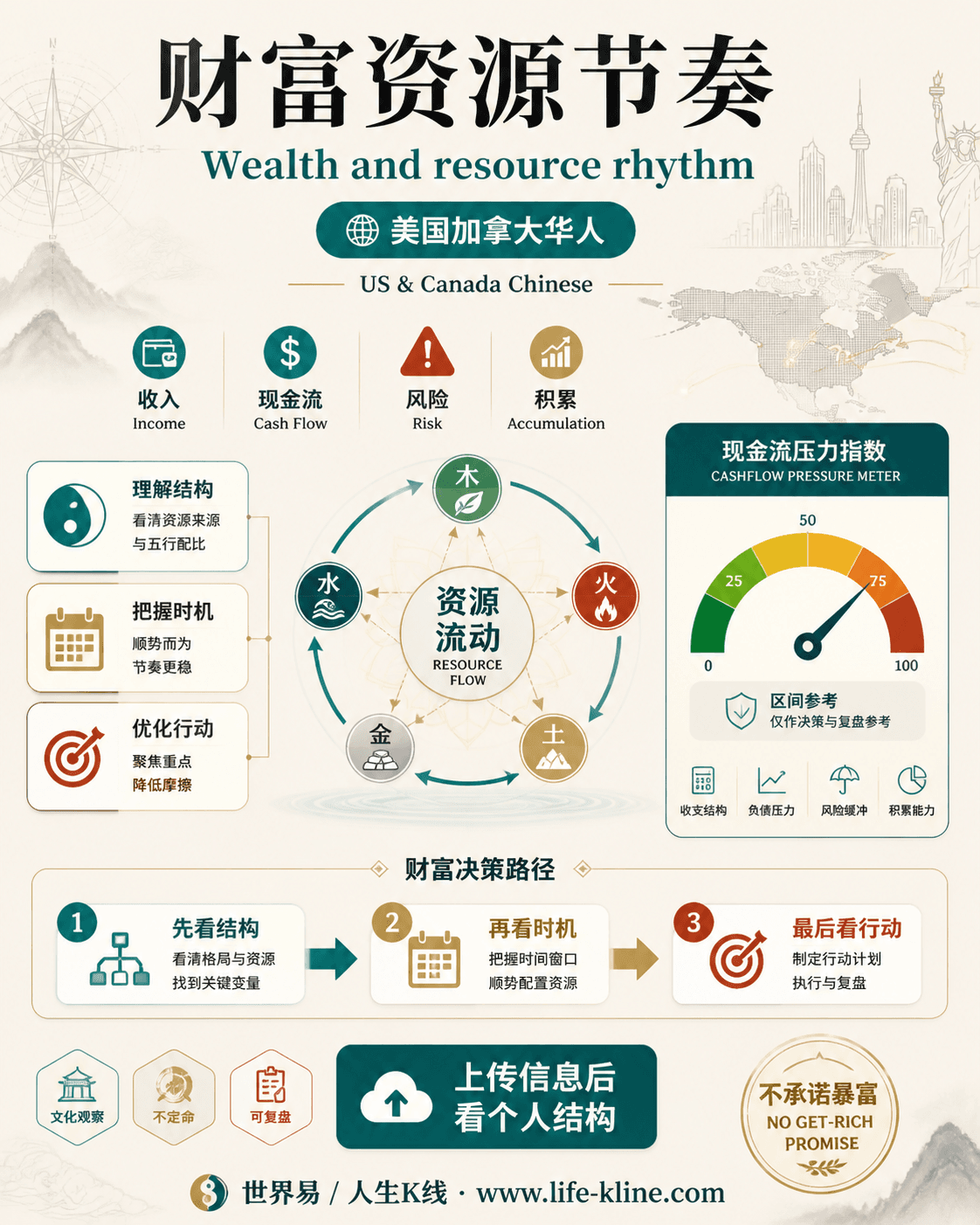
财富资源节奏|美国加拿大华人
这张图把《Decision-Making for Designers' Side Careers: A Metaphysical Analysis of Shi Shen, Cai, and Yin Structures》里的命理概念转成关系、边界和应用场景,适合先看图建立结构,再回到知识文章正文理解细节。
财富资源节奏不应被写成固定结论。更适合美国加拿大华人的读法,是把传统术语翻译成结构、时机、环境、行动和复盘。
查看图片解读