Interpreting the Timing for Designers' Job Changes and Career Transitions: A Metaphysical Perspective on Career Decisions
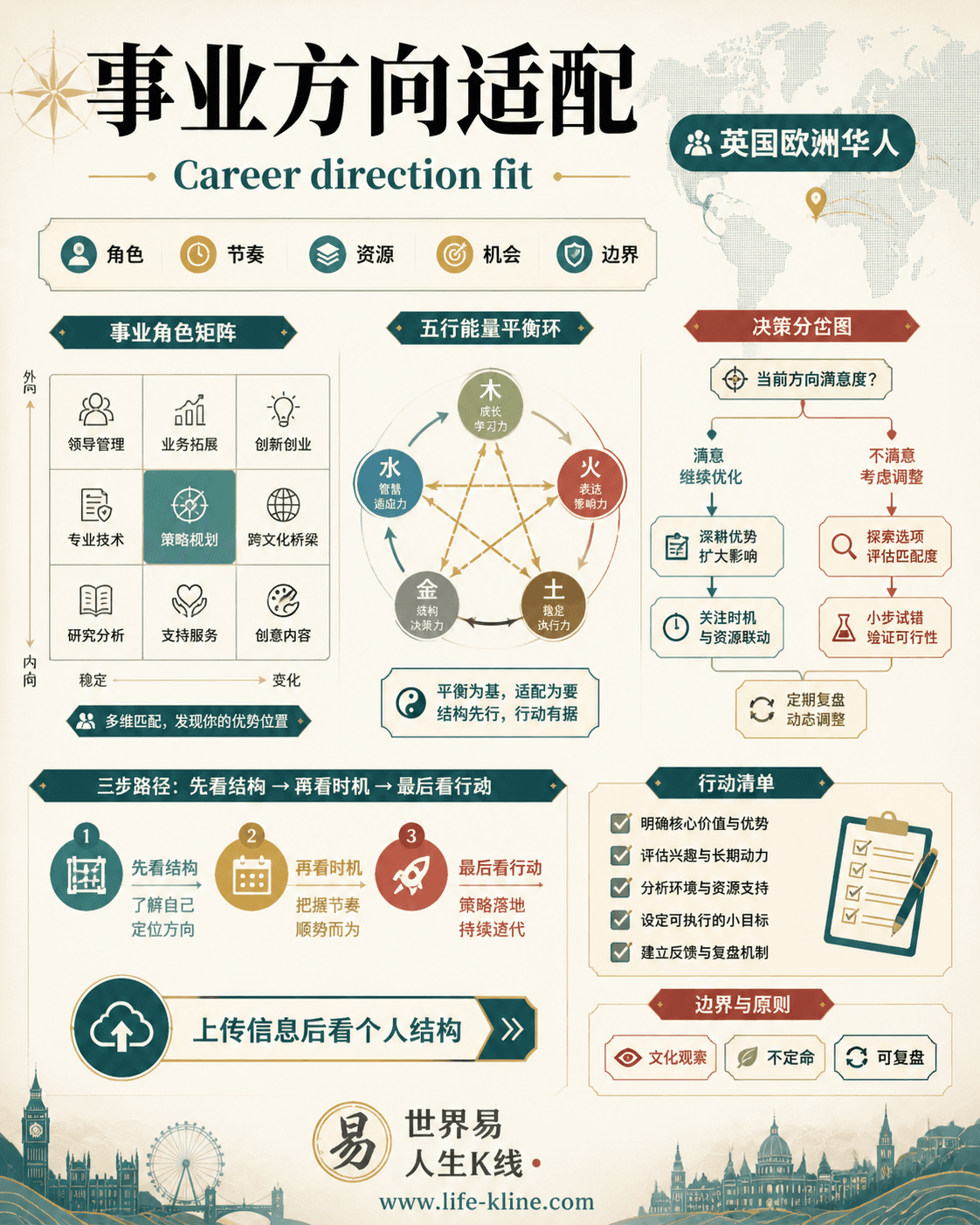
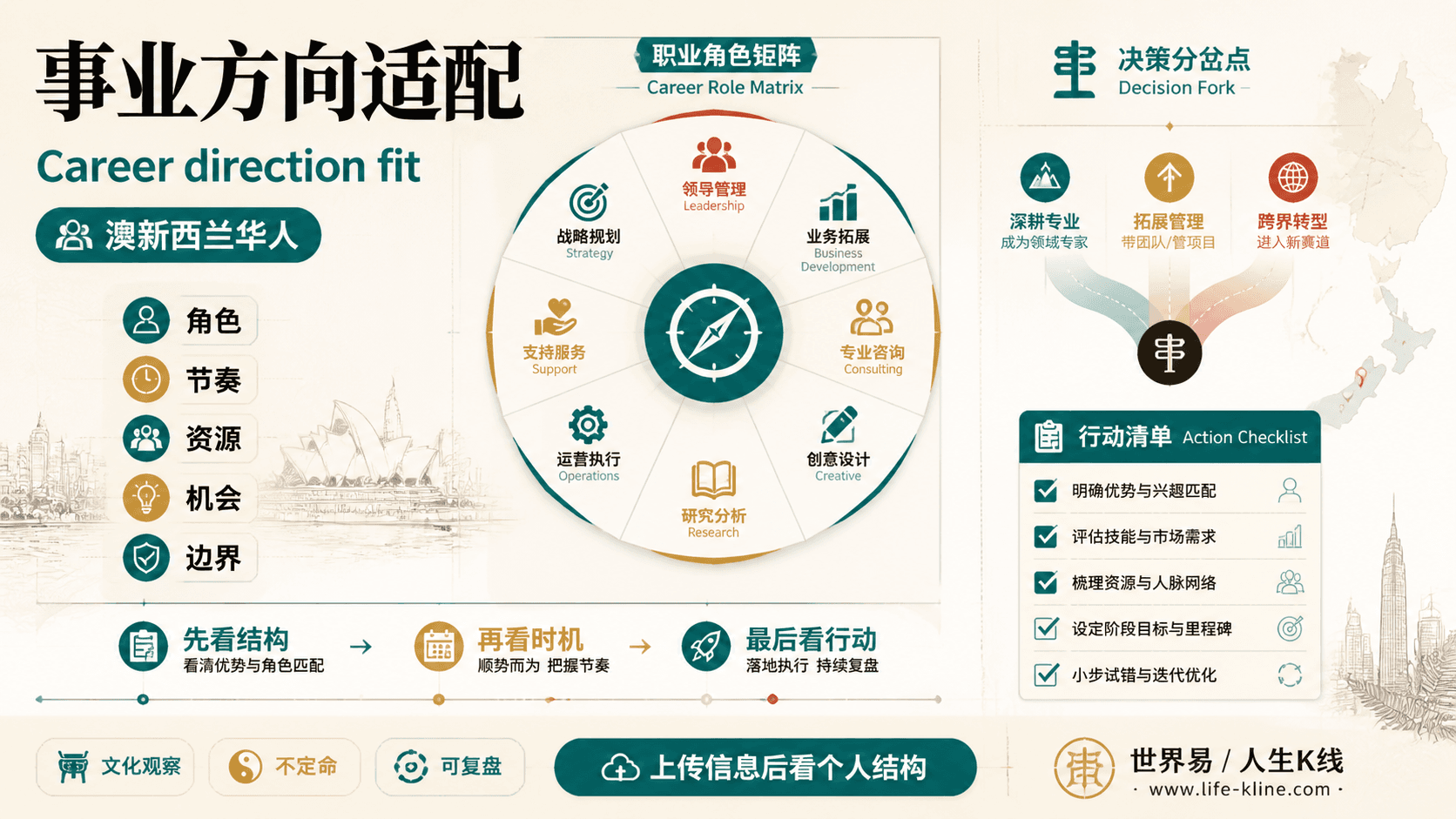
把这篇文章落到自己身上验证:先看结构,再进入个人分析,不做泛泛阅读。
Why This Decision Is Particularly Difficult in This Field
The designer profession inherently relies heavily on aesthetic intuition and inspiration cycles. Work rhythms often fluctuate due to client demands and project urgencies, resulting in concentrated overtime. Freelancers especially face unstable income and work fluctuations, making the judgment of job change and career transition timing directly impact career stability and income sources.
Against this backdrop, a designer’s job change or career transition is not merely a positional shift but involves repositioning their personal style adaptability, market demand, and creative capacity. Choosing the wrong timing may lead to a sharp income drop or career bottlenecks, causing family financial pressure and psychological burdens.
Metaphysical structure plays a key role in this process. Designers commonly have Shang Guan (Hurting Officer) and Shi Shen (Eating God) as the main Ten Gods reflecting aesthetic and expressive abilities, while the strength of the Day Master influences their resilience against client fluctuations and inspiration cycles. The combination of Da Yun and Liu Nian reflects the alignment between career development stages and external environment, directly affecting transition success rates.
Therefore, the difficulty in decision-making for designers’ job changes and transitions lies in how to integrate their metaphysical strengths with industry realities, accurately grasping the opportunities and challenges brought by Da Yun and Liu Nian changes, avoiding blind actions or passive waiting, and maximizing career development potential.
Three Core Dimensions of Metaphysical Judgment
The first dimension is the Day Master and its strength, representing the designer’s core energy and self-expression ability. A relatively strong Day Master usually indicates robust creativity and adaptability, enabling stable output in the competitive design industry; a weak Day Master is more susceptible to external influences and requires reliance on Yong Shen for balance.
The second dimension is the pattern (Ge Ju) and Yong Shen. A Zheng Yin (Proper Seal) pattern often reflects the designer’s delicacy and stability; Pian Cai (Indirect Wealth) pattern emphasizes resource integration and external opportunities; Bi Jian (Peer) pattern highlights peer competition and self-breakthrough. The choice of Yong Shen elements such as Water, Metal, Fire, or Wood determines the focus of adjustment during transitions, helping to balance the BaZi chart.
The third dimension is the interaction between Da Yun and Liu Nian. Da Yun represents long-term career trends, while Liu Nian reflects specific annual changes. Designers should take action during periods when Da Yun is auspicious and Liu Nian is favorable—for example, when Da Yun is beneficial and Liu Nian has no clashes, the success rate significantly increases; otherwise, it is advisable to maintain stability and accumulate strength.
Additionally, the combination of Ten Gods and the configuration of Ji Shen (unfavorable elements) also influence decisions. When Ji Shen is overly strong, transition risks increase and require balancing through Yong Shen. A comprehensive evaluation of these three dimensions is necessary to scientifically assess the optimal timing for designers’ job changes and career transitions.
Three Real BaZi Chart Cases
Case 1: This female designer has a relatively strong Ding Fire (丁火, Ding Huo) Day Master, with a Zheng Yin (Proper Seal) pattern. Her Yong Shen are Water and Metal, while Wood is Ji Shen. She is currently in the 10th year of the Ji Wei (己未, Ji Wei) Da Yun, which is a stable luck cycle, and the Liu Nian is Bing Wu (丙午, Bing Wu). Overall, the Da Yun is steady, and the Liu Nian requires adaptability. This BaZi chart manifests as a stable aesthetic foundation and delicate expressive ability, enabling her to cope well with client fluctuations and inspiration cycles. During job changes or transitions, it is advisable to maintain stability due to the steady Da Yun and avoid major moves until a clearly favorable Liu Nian aligns with the Da Yun, focusing on accumulating resources and improving skills.
Case 2: This female designer has a relatively weak Jia Wood (甲木, Jia Mu) Day Master, with a Pian Cai (Indirect Wealth) pattern. Her Yong Shen is Water, and Ji Shen are Fire and Earth. She is currently in the 10th year of the Xin Chou (辛丑, Xin Chou) Da Yun, which is stable, with Liu Nian Bing Wu (丙午, Bing Wu). The weak Day Master indicates susceptibility to external influences, especially unfavorable when Ji Shen Fire and Earth are strong. She has strong resource integration ability but needs to regulate Ji Shen pressure. When considering job changes or transitions, she should avoid acting rashly during years when Ji Shen is excessive, instead stabilizing existing client resources and leveraging the Yong Shen Water for internal adjustments, waiting for clear support from Da Yun or Liu Nian before making proactive changes.
Case 3: This female designer has a relatively strong Xin Metal (辛金, Xin Jin) Day Master, with a Bi Jian (Peer) pattern. Her Yong Shen are Fire and Wood, with Earth as Ji Shen. She is currently in the 2nd year of the Yi Hai (乙亥, Yi Hai) Da Yun, which is auspicious, with progress in career and wealth, and the Liu Nian is Bing Wu (丙午, Bing Wu), aligning well. The strong Day Master and auspicious Da Yun indicate strong self-breakthrough ability and competitiveness, enabling active exploration of new fields in design. The timing for job changes and transitions is significantly favorable, especially with Liu Nian bringing inspiration and opportunities. It is recommended to seize the advantageous timing of the current Da Yun and Liu Nian for proactive action, while paying attention to the influence of Ji Shen Earth to avoid decision errors caused by environmental pressure.
These three cases respectively reflect different metaphysical patterns of designers and their rhythms of career stability and transformation. Considering actual work pressures and client fluctuations, it is crucial to reasonably arrange the timing for job changes and transitions.
Common Misjudgments and Blind Spots in This Field
One common misjudgment among designers in job change and transition decisions is over-reliance on short-term inspiration or market trends while neglecting the long-term trend of their metaphysical structure. Although inspiration cycles are important, if the Da Yun does not support it, blind actions often lead to career fluctuations and unstable income.
Secondly, frequent job changes are mistakenly seen as a quick way to enhance skills and resources. However, without integrating Yong Shen balance and Ji Shen control, this can instead increase career pressure and strain client relationships, negatively affecting long-term development.
Some designers also overlook the importance of Da Yun and Liu Nian interactions, failing to identify when to consolidate and when to break through and transition. This leads to missed critical opportunities or reckless advancement, causing financial and psychological burdens on the family.
Finally, ignoring the impact of Ji Shen is another major blind spot. When Ji Shen is overly strong, reckless transitions carry high risks. It is necessary to first regulate through Yong Shen and stabilize the current situation to accumulate energy for the next transformation.
Practical Judgment Sequence
Step one is to clarify the strength of the Day Master and the pattern, along with the specific configuration of Yong Shen and Ji Shen, to evaluate core energy and adjustment directions. This forms the foundational judgment framework for job changes and transitions.
Step two is to combine the current Da Yun and Liu Nian to observe whether one is in an auspicious phase. If Da Yun is stable or favorable and Liu Nian has no obvious clashes, the success rate of transitions is higher and action can be considered; if Da Yun or Liu Nian is under Ji Shen control or conflict, it is better to maintain stability.
Step three is to assess actual industry conditions, including current work pressure, client relationships, and income structure, to judge whether there are sufficient resources and psychological capacity for job changes or transitions. If both external environment and metaphysics are unfavorable, focus should be on skill enhancement and capital accumulation while waiting for better timing.
Overall, designers’ job change and transition decisions should follow the dual synchronization of metaphysical rhythm and industry reality, avoiding decisions based solely on emotional judgment or short-term market fluctuations.
FAQ
Question 1: If a designer’s Day Master is weak, does that mean they are unsuitable for job changes? Answer: A weak Day Master does not absolutely restrict job changes but indicates the need to pay more attention to balancing through Yong Shen and support from Da Yun and Liu Nian. One should choose timing and methods that suit their energy and avoid acting rashly during periods when Ji Shen is overly strong.
Question 2: How to determine if a Liu Nian is favorable for a designer’s career transition? Answer: Liu Nian should complement Da Yun; if Liu Nian has no clashes and enhances Yong Shen energy, it represents a favorable momentum and a good opportunity for transition. Conversely, if Liu Nian conflicts with Ji Shen, caution is advised and maintaining stability is preferable.
Question 3: Can metaphysics help choose a specific industry when designers change jobs or transition? Answer: Metaphysics mainly reflects personal energy and career rhythms, assisting in judging when to act and adjust direction. However, choosing a specific industry still requires comprehensive consideration of personal interests, professional skills, and market demand.
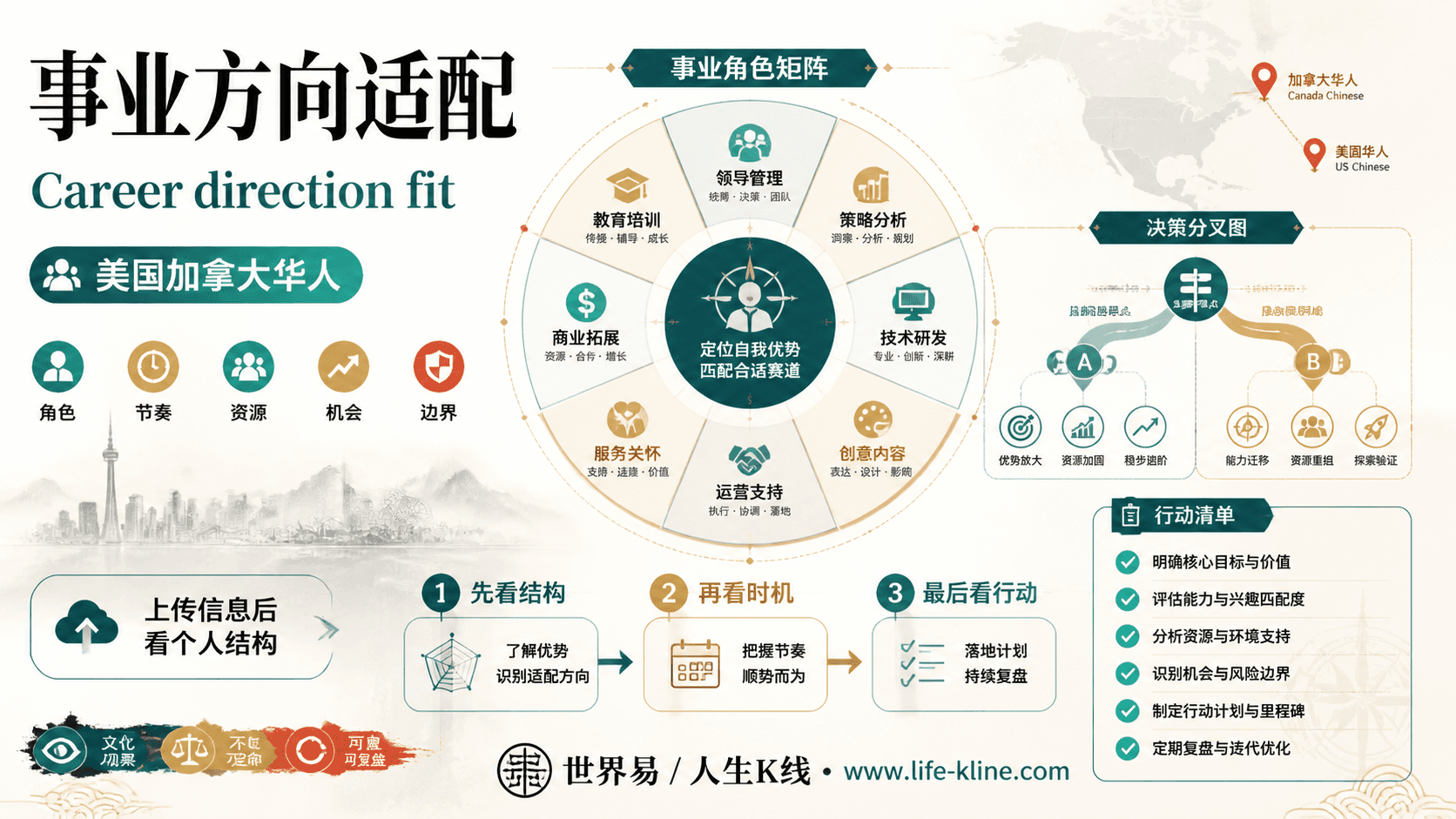
事业方向适配|美国加拿大华人
这张图把《Interpreting the Timing for Designers' Job Changes and Career Transitions: A Metaphysical Perspective on Career Decisions》里的命理概念转成关系、边界和应用场景,适合先看图建立结构,再回到知识文章正文理解细节。
事业方向适配不应被写成固定结论。更适合美国加拿大华人的读法,是把传统术语翻译成结构、时机、环境、行动和复盘。
查看图片解读