Metaphysical Decision Analysis for Relationship Repair and Withdrawal in Early Dating
把这篇文章落到自己身上验证:先看结构,再进入个人分析,不做泛泛阅读。
Why This Decision Is Especially Difficult at This Stage of the Relationship
The early dating stage is when emotions gradually deepen but have not yet fully stabilized. Both parties often experience significant emotional fluctuations, and suitability remains unclear, making decisions about repair or withdrawal full of uncertainty. At this time, the influence of original family backgrounds begins to manifest, intertwining expectations and pressures, especially involving practical issues such as bride price, housing, and future children’s custody, which easily activate latent conflicts.
The younger generation, caught between traditional and modern values, often has inconsistent control over the pace of relationships. Moving too fast or retreating excessively can both lead to negative consequences. Conflicts at this stage often manifest as a tug-of-war between emotion and reason. The contrast in family backgrounds intensifies psychological pressure on both sides, making genuine understanding and acceptance of each other more complicated.
Metaphysical structure plays an important role in emotional activation and relationship stability during this stage. The strength or weakness of the spouse palace and spouse star, the Day Master’s vigor, and the regulation by the Yong Shen all amplify or suppress conflicts. This layered metaphysical effect requires that decisions consider not only practical factors but also metaphysical signals, avoiding subjective emotions from dominating judgment.
Especially when emotional cracks appear, discerning whether the relationship has repair potential or requires rational withdrawal becomes a critical test of both parties’ wisdom. Decisions at this stage affect the foundation of future marriage, so it is necessary to combine metaphysical and real-world dimensions to precisely grasp the sustainability of the emotional bond.
Three Core Dimensions of Metaphysical Judgment
The Day Master represents the individual’s core energy and personality tendencies. Its strength determines the person’s dominance and endurance in the relationship. An overly strong Day Master usually indicates a firm personality and a proactive attitude toward problems, while a weak or balanced Day Master is more susceptible to external influences and emotional fluctuations.
The position and nature of the spouse palace and spouse star are important metaphysical indicators reflecting the quality of the spousal relationship. When the spouse palace is affected by clashes or combinations, conflicts and instability often accompany the relationship. If the spouse star is supported by the Da Yun and Liu Nian through beneficial interactions, the relationship has repair potential; otherwise, conflicts may worsen.
The configuration of Yong Shen (favorable element) and Ji Shen (unfavorable element) reflects the individual’s ability to regulate internal and external environments. A strong Yong Shen means better capacity to resolve conflicts and harmonize the relationship, while an excessive Ji Shen may amplify negative emotions and disputes. The influence of Da Yun and Liu Nian on the Yong Shen and spouse palace determines whether the relationship is progressing smoothly or facing resistance, guiding the timing for repair or withdrawal decisions.
Three Real BaZi Chart Cases
Case 1: The female’s Day Master is Bing Fire (丙, Bing), which is somewhat strong, with a Zheng Yin (正印) pattern. Her Yong Shen are Water and Metal, while Ji Shen is Wood. Currently, she is in a favorable Ji Hai (己亥, Ji Hai) Da Yun, with smooth career and financial progress; the Bing Wu (丙午, Bing Wu) Liu Nian aligns well with her flow. When encountering problems in early dating, her strong Day Master indicates a positive attitude toward relationship repair, but the Ji Shen Wood may cause emotional entanglement. The Da Yun and Liu Nian support her overall state, favoring rational communication and relationship adjustment. It is recommended first to check whether strengthening the Yong Shen (Water and Metal) can alleviate conflicts and to express true feelings appropriately to avoid emotional escalation. If conflicts cannot be eased through Yong Shen regulation, then temporary withdrawal to preserve personal mental health should be considered.
Case 2: The female’s Day Master is Jia Wood (甲, Jia), balanced in strength, with a Cong Cai (从财) pattern. Her Yong Shen are Earth and Fire, while Ji Shen are Water and Wood. She is currently in a stable Xin Si (辛巳, Xin Si) Da Yun, suitable for maintaining status quo; the Bing Wu (丙午, Bing Wu) Liu Nian requires flexible adaptation. A balanced Day Master reflects strong adaptability, but the Ji Shen Water and Wood easily trigger inner unrest and external pressure. Emotional problems in early dating that activate Ji Shen tend to cause emotional entanglement. The chart suggests she should rely on the stabilizing power of Yong Shen Earth and Fire to strengthen the practical foundation (such as family support and material security) to stabilize the relationship. If conflicts center on Ji Shen-induced emotional and value clashes and Yong Shen cannot harmonize, rational withdrawal should be considered to avoid prolonged emotional depletion.
Case 3: The male’s Day Master is Xin Metal (辛, Xin), somewhat strong, with a Zhuan Wang (专旺) pattern. His Yong Shen is Fire, and Ji Shen is Water. He is in a stable Ji You (己酉, Ji You) Da Yun, suitable for maintaining status quo; the current Bing Wu (丙午, Bing Wu) Liu Nian requires flexible adaptation. A strong Day Master with a Zhuan Wang pattern shows strong dominance and autonomy in the relationship. The Yong Shen Fire helps soften the rigidity caused by an overly strong Day Master. When problems arise in early dating, the chart structure supports repair through proactive adjustment and communication, especially under the influence of a Liu Nian that encourages flexible responses. It is advised to first assess the regulating effect of his Yong Shen Fire; if it can effectively guide emotions and resolve conflicts, then active repair is recommended. If conflicts stem from Ji Shen Water interference that cannot be resolved, rational evaluation of withdrawal necessity is advised to avoid relationship stagnation.
All three cases demonstrate how metaphysical structure influences emotional activation and real-world pressures in early dating relationships. Combining Da Yun and Liu Nian allows more precise judgment of the timing and strategy for repair or withdrawal.
Common Misjudgments and Blind Spots at This Stage
In early dating, strong emotional fluctuations often cause both parties to either overestimate or underestimate the severity of problems, lacking rational analysis, and frequently misjudge temporary conflicts as fundamental relationship fractures. Metaphysically, when Ji Shen or the spouse palace is affected by clashes, failure to consider Da Yun and Liu Nian trends can lead to missing the best repair opportunities.
Additionally, contrasting original family backgrounds intensifies psychological pressure, and many times differences in family backgrounds are mistakenly seen as irreconcilable obstacles, neglecting the regulating role of Yong Shen in metaphysics. Lack of understanding of Yong Shen and Ji Shen often reduces emotional management and conflict resolution abilities, weakening repair willingness.
Another blind spot is premature external intervention, such as strong family involvement or overreliance on outside opinions, ignoring the natural rhythm of Da Yun and Liu Nian changes in the metaphysical structure. This often causes the relationship progression to accelerate too quickly or withdrawal to happen too abruptly, ultimately exacerbating conflicts rather than alleviating them.
In summary, most misjudgments stem from ignoring the intertwined influences of metaphysics and reality, lacking scientific investigation and decision logic that follows natural trends.
Practical Judgment Sequence
First, combine the individual’s Day Master strength and pattern to confirm their dominance and endurance in the relationship, which determines the basic psychological baseline and willingness to repair when facing conflicts. Next, focus on examining the current Da Yun and Liu Nian influences on the spouse palace and spouse star to judge whether clashes and combinations in the relationship are in a favorable or unfavorable phase, identifying potential trends of conflict escalation or mitigation.
Third, analyze the power balance between Yong Shen and Ji Shen to determine whether both parties can internally regulate and resolve conflicts. If Yong Shen is strong and supported by Da Yun and Liu Nian, repair is favorable, and communication and adjustment should be maintained. Conversely, if Ji Shen is excessive and cannot be harmonized, rational withdrawal should be considered to avoid prolonged emotional depletion.
Finally, combine real-world marriage and dating pressures, such as family attitudes, material conditions, and future planning, to assess the social feasibility of emotional repair. Only when both metaphysical and practical factors indicate repair potential should active progress be pursued; otherwise, maintain rationality and withdraw timely to avoid blind maintenance.
FAQ
Question 1: Frequent emotional activation in early dating—how to use metaphysics to determine if it is temporary fluctuation? Answer: Focus on the Day Master’s strength and the stability of Yong Shen’s power. If Yong Shen is supported by Da Yun and Liu Nian, emotional fluctuations are mostly temporary and suitable for repair; if Ji Shen dominates with frequent fluctuations, cautious evaluation is needed.
Question 2: Does a clash in the spouse palace always mean the relationship cannot be repaired? Answer: Not necessarily. It depends on the influence of Da Yun and Liu Nian on the spouse palace and whether Yong Shen can regulate the conflict. If the clash is in a favorable phase and Yong Shen is strong, the relationship still has repair potential.
Question 3: How to decide when real-world pressures conflict with metaphysical indications? Answer: Priority should be given to the feasibility of real-world conditions, while also referencing the trends in Da Yun and Liu Nian. If real-world pressures are too great and metaphysics indicates high repair difficulty, rational withdrawal is safer; if metaphysics supports repair and real conditions allow, active repair can be promoted.
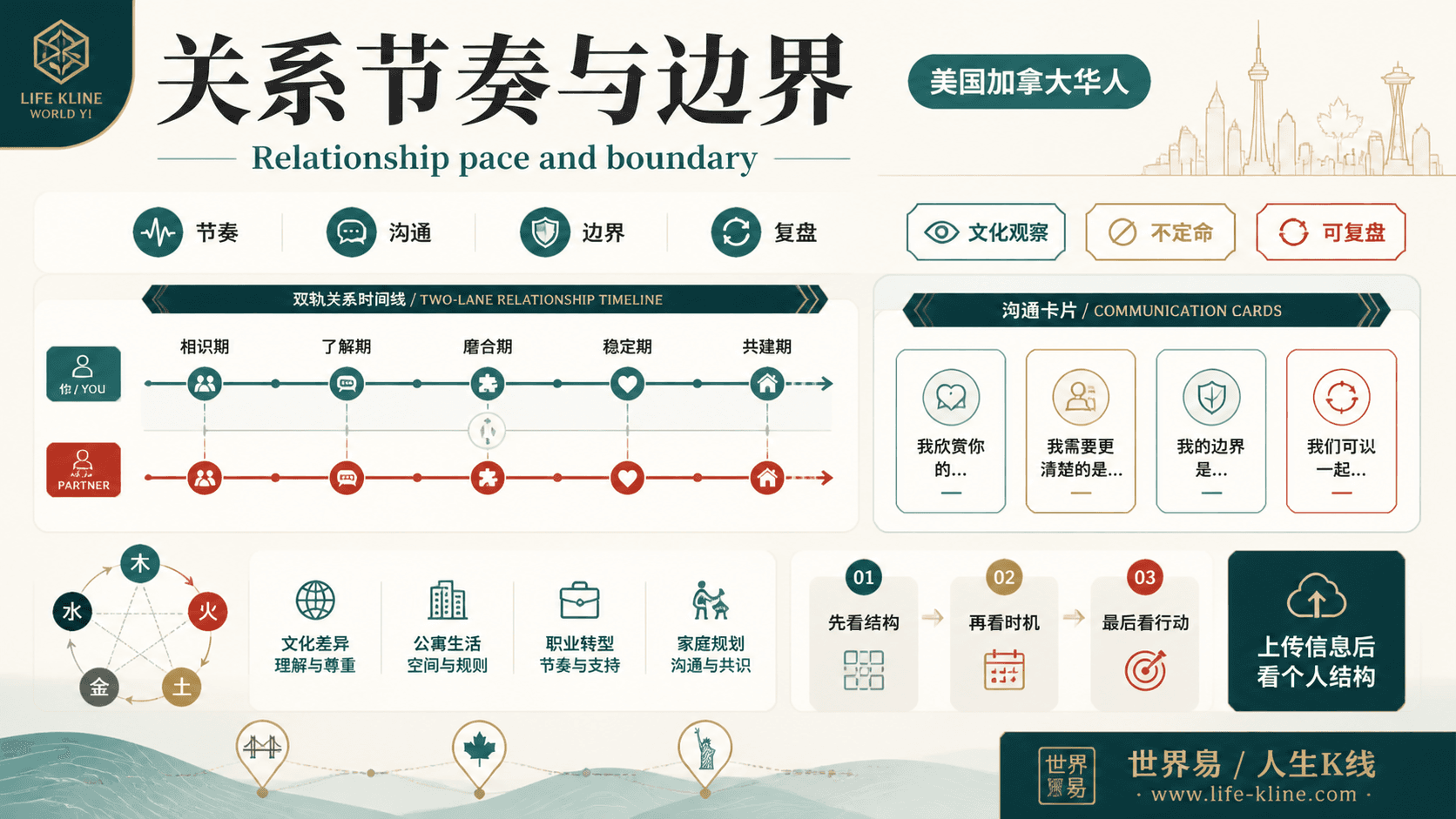
关系节奏与边界|美国加拿大华人
这张图把《Metaphysical Decision Analysis for Relationship Repair and Withdrawal in Early Dating》里的命理概念转成关系、边界和应用场景,适合先看图建立结构,再回到知识文章正文理解细节。
关系节奏与边界不应被写成固定结论。更适合美国加拿大华人的读法,是把传统术语翻译成结构、时机、环境、行动和复盘。
查看图片解读