BaZi Analysis of Adult Children Maintaining or Severing Ties with Controlling Parents
把这篇文章落到自己身上验证:先看结构,再进入个人分析,不做泛泛阅读。
Why This Decision Is Particularly Difficult in This Scenario
The relationship between controlling parents and adult children often falls into a complex situation of blurred boundaries and emotional manipulation. Psychologically, adult children desire independence yet find it difficult to completely detach from their original family, leading to suppression of self-identity. In this context, any decision about whether to continue maintaining, downgrade, or sever the relationship is not merely a simple familial choice but a profound challenge to personal boundaries and emotional needs.
From a psychological perspective, emotional manipulation often causes children to feel guilt and pressure, making it easy for family expectations to constrain their decisions, hindering choices that truly align with their own interests. Cultural and social emphasis on filial piety further intensifies this conflict, making severing ties often viewed as an extreme and negatively labeled action.
BaZi structure provides a rhythmic auxiliary reference in this context. Especially the strength of the Day Master, the pattern’s Yong Shen and Ji Shen (unfavorable elements) combinations, and the current interaction between Da Yun and Liu Nian can to some extent amplify or suppress the risk of family conflicts, indicating when it is more appropriate to persist in repairing the relationship and when rational withdrawal is necessary to protect oneself.
However, BaZi judgment can only serve as an auxiliary tool and cannot replace professional psychological counseling and family therapy. In cases of extreme situations such as PUA (psychological abuse) or violence, seeking professional help should be prioritized. Overall, the integration of BaZi and psychological dynamics can more comprehensively support adult children’s decision-making processes in complex family relationships.
Three Core Dimensions of BaZi Judgment
First, the relationship between the Day Master and the Yin Stars (印星, supporting stars) is key to observing an individual’s internal energy and emotional support system. Whether the Day Master is relatively strong or weak directly affects self-expression and self-protection abilities. Yin Stars, as forces nurturing the Day Master, represent family, education, and psychological nourishment; strong Yin Stars help children maintain psychological resilience when facing family pressure.
Second, Bi Jian (比肩) and Jie Cai (劫财), as stars of the same type or helpers to the Day Master, reflect support from siblings or peers and personal autonomy. When Bi Jian and Jie Cai are strong, the individual tends to strive for independence and self-worth realization, but excessive strength may escalate conflicts. In relationships with controlling parents, the role of Bi Jian and Jie Cai is especially critical, influencing how children set boundaries.
Third, the combination of Guan Sha (官杀) and Cai Stars (财星) involves authority pressure and emotional exchange. Guan Sha represent parental authority and social norms; when overly strong, they can bring authoritative suppression and emotional manipulation. Cai Stars connect emotional giving and receiving; when restrained, children may feel emotionally held hostage. Da Yun and Liu Nian represent the temporal rhythm, where auspicious or inauspicious transitions can amplify or alleviate these conflicts.
By integrating these three major dimensions with reasonable configurations of Yong Shen and Ji Shen, one can determine whether the BaZi structure tends to support persistence in repairing and harmonizing relationships or suggests maintaining safe distance or even severing ties to protect oneself when family conflicts reach a deadlock.
Three Real BaZi Case Studies
Case 1 (Based on Fact Set 1): This BaZi chart has a Day Master of 甲 (Jia) Wood, relatively strong, with a Jie Cai pattern, representing a strong self-awareness and self-protection consciousness. The Yong Shen are Metal and Earth, and the Ji Shen is Water. The individual is currently in the 庚辰 (Geng Chen) Da Yun, which is auspicious, and the 丙午 (Bing Wu) Liu Nian aligns favorably. The Jie Cai pattern shows that when facing controlling parents, this person tends to exhibit resistance and support from peers. The auspicious Geng Chen Da Yun provides external resources and inner strength to persist in repairing the relationship. If conflicts arise, the BaZi suggests attempting to maintain the relationship through reasonable communication and boundary setting, but attention should be paid to the emergence of Ji Shen Water potentially causing emotional fluctuations, and psychological counseling is recommended to prevent escalation of emotional manipulation.
Case 2 (Based on Fact Set 2): This BaZi chart has a Day Master of 辛 (Xin) Metal, relatively strong, with a Yang Ren (羊刃) pattern, which inherently carries connotations of impact and pressure. The Yong Shen is Water, and the Ji Shen is Earth. The individual is currently in the 戊辰 (Wu Chen) Da Yun, which is inauspicious, and the 丙午 (Bing Wu) Liu Nian requires caution. The Yang Ren pattern in controlling parent relationships often manifests as intense internal struggle and emotional outbursts, and the weak Da Yun exacerbates the risk of upheaval. Under this structure, the child tends to fall into loss of control or passive defense when facing blurred boundaries and emotional manipulation. The BaZi suggests the current environment is unfavorable for maintaining the relationship; priority should be given to protecting personal boundaries and carefully evaluating whether downgrading or severing ties is necessary, supported by professional psychological assistance to avoid emotional breakdown causing deeper harm.
Case 3 (Based on Fact Set 3): This BaZi chart has a Day Master of 丁 (Ding) Fire, relatively strong, with a Yang Ren pattern, and the Yong Shen are Water and Metal, while the Ji Shen is Wood. The individual is in the 辛未 (Xin Wei) Da Yun, an auspicious period, and the 丙午 (Bing Wu) Liu Nian aligns favorably. The Yang Ren pattern indicates strong self-expression and resistance ability. The auspicious Da Yun brings career and financial progress, showing an external environment supportive of self-development. The balance of Yong Shen Water and Metal provides good regulation ability and rational judgment when facing controlling parents. This BaZi suggests that when relationship conflicts arise, one can attempt to maintain the relationship through active communication and boundary reconstruction, while being alert to emotional fluctuations caused by Ji Shen Wood. Psychological counseling is recommended to gradually establish a healthy interaction pattern and avoid the negative impact of emotional manipulation.
Common Misjudgments and Blind Spots in This Scenario
Many adult children facing controlling parents tend to attribute all conflicts solely to the parents’ “faults,” neglecting their own responsibility and ability in boundary setting and emotional expression. This extreme stance often leads to relationship deterioration and overlooks the regulatory possibilities indicated by the Day Master’s strength and Yong Shen configuration in BaZi.
On the other hand, some people, due to cultural and emotional pressure, mistakenly believe they must maintain family relationships unconditionally, ignoring the importance of self-protection. Ji Shen and inauspicious luck signals in BaZi are often overlooked, resulting in prolonged emotional manipulation and psychological suppression, increasing the risk of psychological trauma.
Additionally, over-reliance on BaZi as the sole decision-making basis while neglecting professional psychological support and family therapy is a common blind spot. BaZi can only provide rhythmic and trend-based assistance and cannot replace actual emotional healing and boundary management skills.
Finally, ignoring the interaction between Liu Nian and Da Yun leads to misjudgment of timing for family relationship changes. For example, forcibly maintaining ties during inauspicious luck periods may exacerbate conflicts, whereas timely adjustments during auspicious periods are more conducive to relationship repair.
Practical Judgment Sequence
Step one: Examine the BaZi chart for the strength of the Day Master and the Yong Shen configuration to assess the individual’s internal energy and psychological resilience. When the Day Master is relatively strong and the Yong Shen is well established, the individual has stronger self-protection and boundary-setting abilities and is suitable to attempt maintaining and repairing the relationship; otherwise, caution is advised with self-protection as the priority.
Step two: Combine Da Yun and Liu Nian analysis to evaluate the current luck’s auspiciousness or inauspiciousness. When the Da Yun and Liu Nian are favorable, family conflicts can be gradually alleviated through communication and boundary adjustments; during inauspicious Da Yun or Liu Nian impacts, priority should be given to preventing emotional outbursts and psychological harm, assessing whether downgrading the relationship or waiting for a better time is appropriate.
Step three: Closely monitor the dynamics of Guan Sha and Cai Stars in the BaZi to interpret the balance between authority pressure and emotional giving. If Guan Sha is overly strong without proper mitigation, it may indicate intensified emotional manipulation, and clear boundaries should be decisively drawn. When Cai Stars are constrained, be alert to the risk of emotional hostage-taking, and cooperate with professional psychological counseling to establish healthy emotional boundaries.
Overall, BaZi provides a cyclical rhythm reference; ideal decisions should integrate feedback from psychological counseling and family therapy and be implemented progressively. In cases of severe emotional abuse or PUA behavior, seeking professional help immediately takes precedence over any BaZi judgment.
FAQ
Question 1: Does a relatively strong Day Master in BaZi necessarily mean one can persist in repairing the relationship? Answer: A relatively strong Day Master indicates stronger internal energy and some self-protection and expression ability, but it does not guarantee success in repairing the relationship. It must be comprehensively judged together with Yong Shen, Da Yun, Liu Nian, and actual family conditions.
Question 2: If the Da Yun is inauspicious, does it mean severing ties is mandatory? Answer: An inauspicious Da Yun signals higher risks and tensions or conflicts in the current stage, but whether to sever ties depends on specific family dynamics and psychological conditions. BaZi serves only as auxiliary reference; professional counseling is key.
Question 3: Can BaZi help resist emotional manipulation caused by controlling parents? Answer: When Bi Jian and Jie Cai are strong or Yin Stars are powerful in BaZi, the individual’s psychological resilience is relatively stronger, which helps resist emotional manipulation. However, fundamentally, reliance should be on psychological counseling, boundary training, and professional support; BaZi only provides rhythmic assistance.
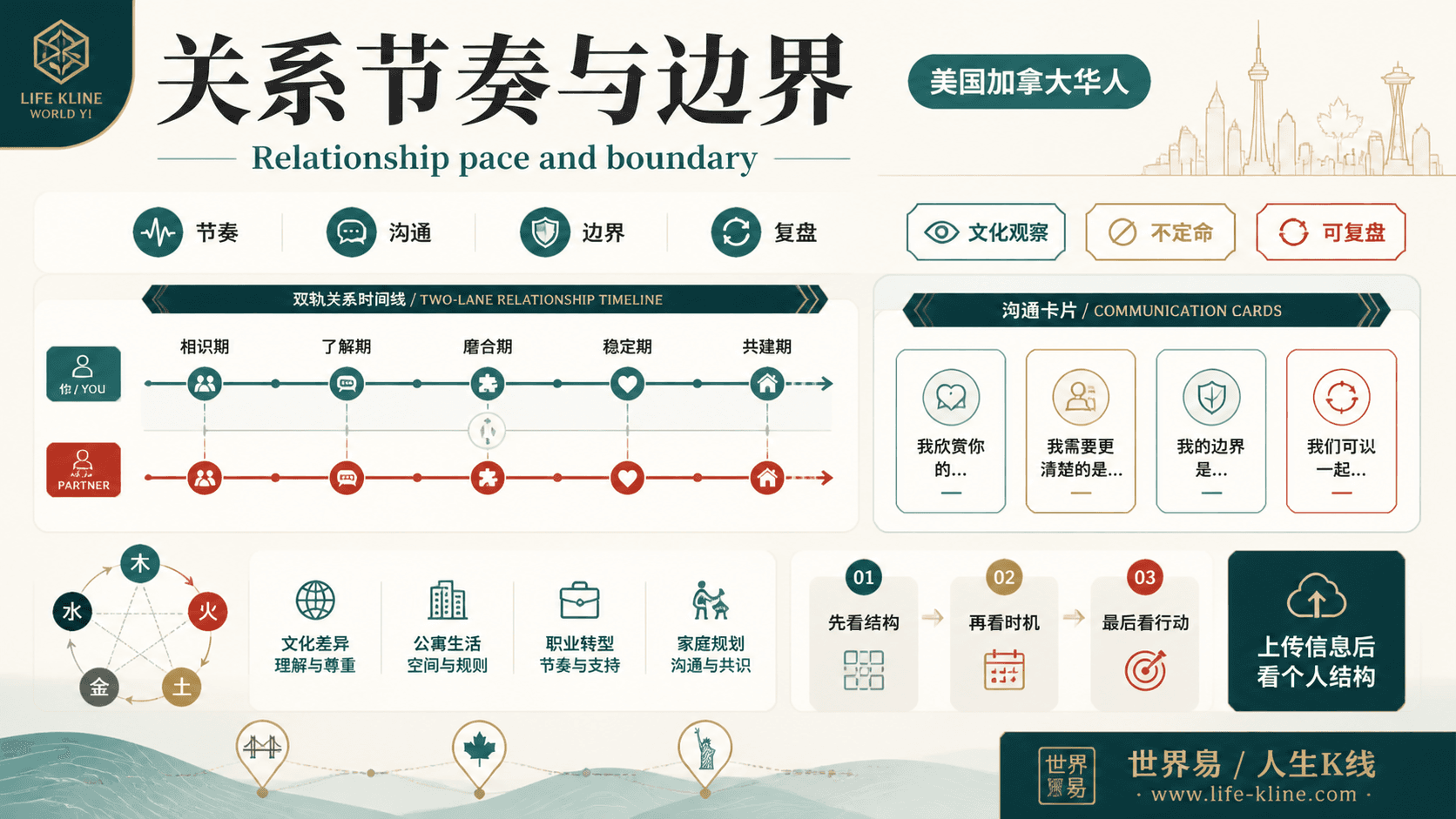
关系节奏与边界|美国加拿大华人
这张图把《BaZi Analysis of Adult Children Maintaining or Severing Ties with Controlling Parents》里的命理概念转成关系、边界和应用场景,适合先看图建立结构,再回到知识文章正文理解细节。
关系节奏与边界不应被写成固定结论。更适合美国加拿大华人的读法,是把传统术语翻译成结构、时机、环境、行动和复盘。
查看图片解读