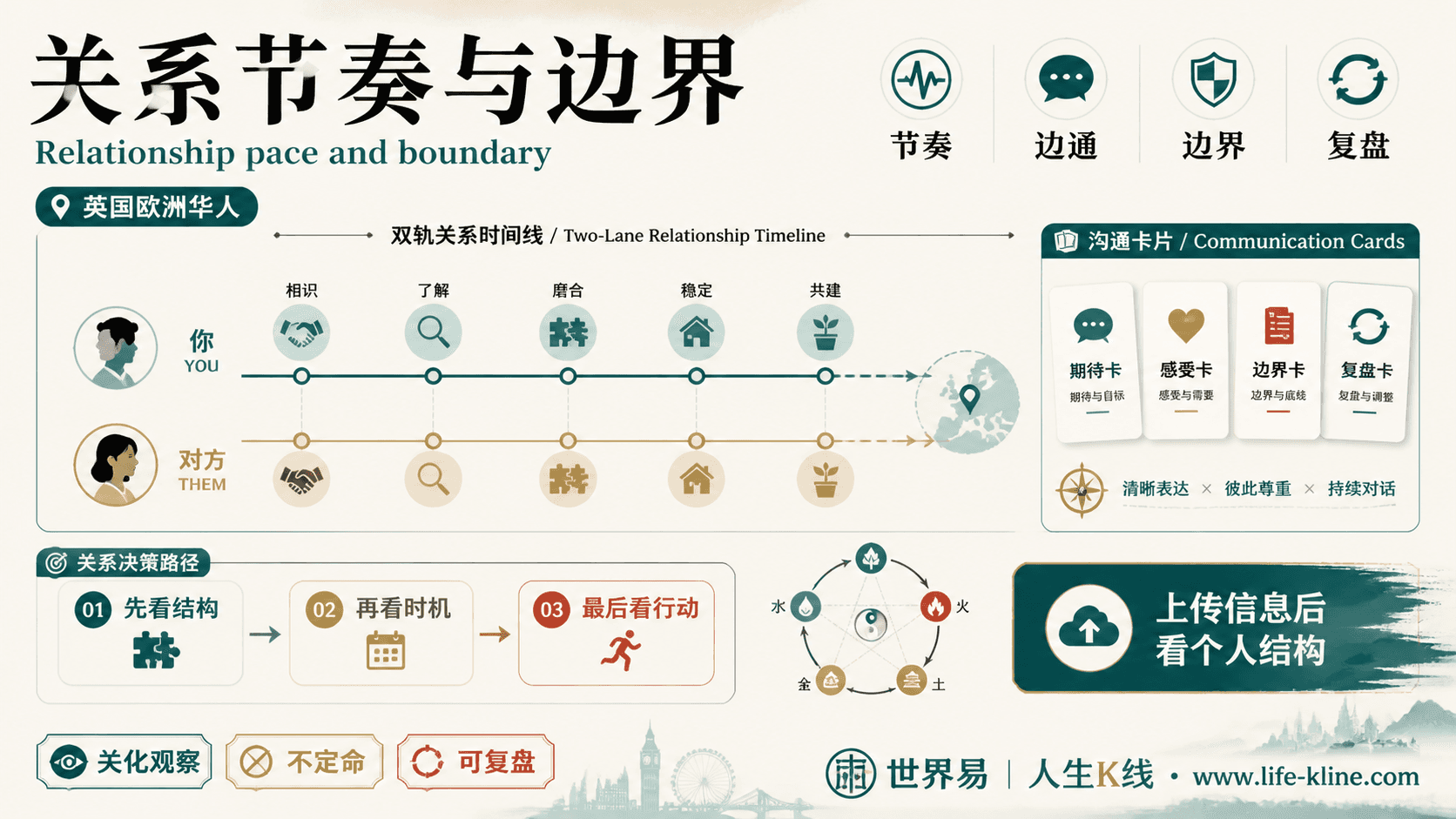
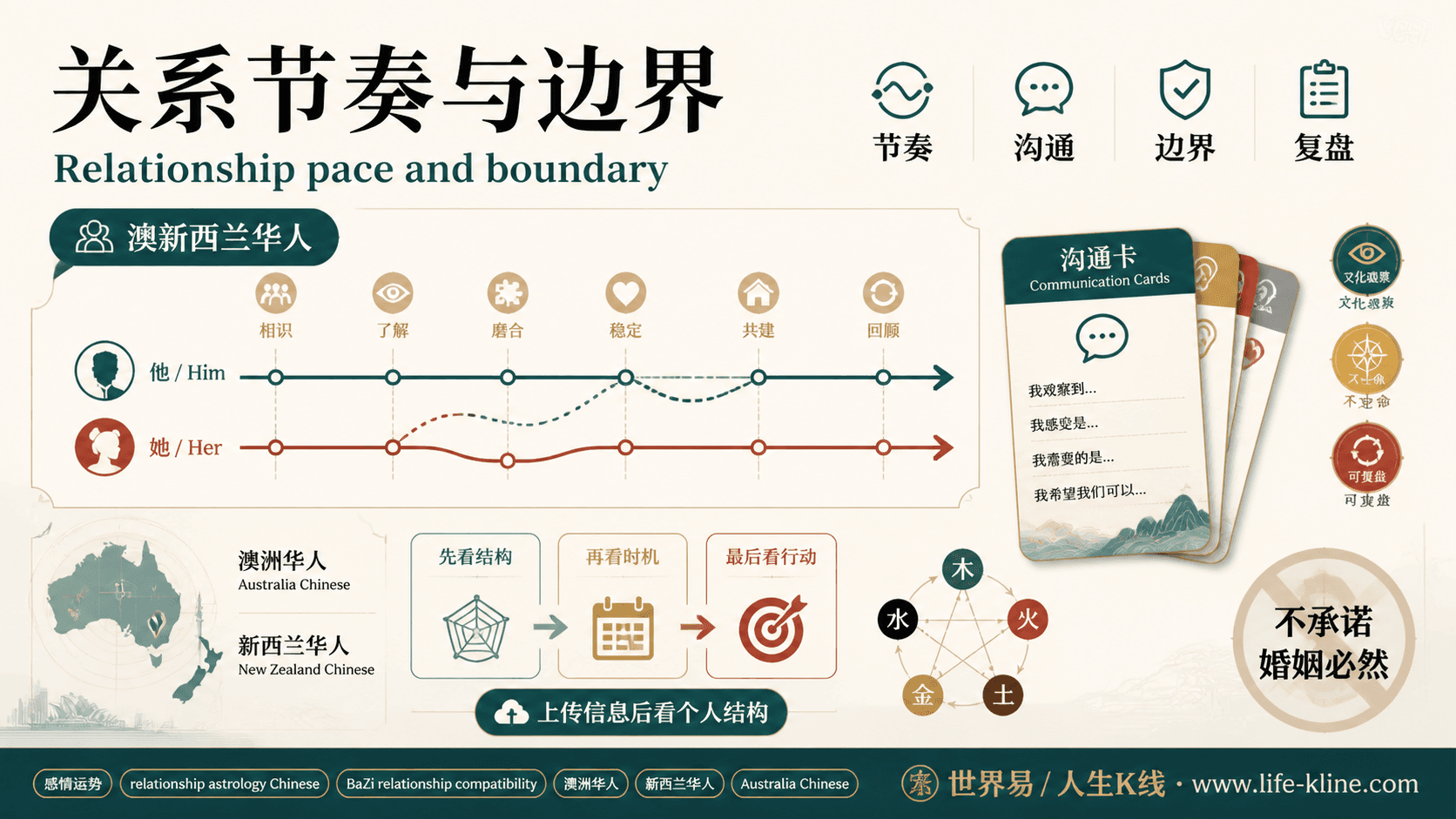
Decision Analysis on Distance Between Controlling Parents and Adult Children: To Set Boundaries or Continue Observing
把这篇文章落到自己身上验证:先看结构,再进入个人分析,不做泛泛阅读。
你现在搜索的,
其实是一个要落到自己身上的判断。
当前页面主要回答「Parent-Child Relationship」这类搜索问题;真正有价值的下一步是把这套结构带进自己的报告、工具与案例验证。
Why This Decision Is Especially Difficult in This Scenario
In relationships between controlling parents and adult children, boundaries are often blurred. Parents tend to use emotional manipulation and interfere with decisions, while adult children face repression of self-identity. In such family dynamics, emotional dependence and resistance intertwine, and psychological trauma is hidden yet profound, making decisions difficult to simply categorize as "right" or "wrong."
When adult children attempt to set boundaries, they often feel intense guilt and anxiety because cultural expectations and family role definitions reinforce the sense of responsibility in filial affection. On the other hand, parents’ controlling desire stems from needs for security and maintaining authority. The emotions and behaviors of both sides interweave into a complex interaction cycle, where any action may trigger a chain reaction.
From the BaZi perspective, rhythmic information such as the strength of the Day Master, the distribution of Yin stars (Zheng Yin / Pian Yin) and Bi Jian / Jie Cai (Peer stars) can reflect an individual’s internal resources and capacity to withstand external pressure. The combination of Guan Sha (official and killing stars) and Cai stars (wealth stars) reflects authority relationships and material dependence, while the interaction of Liu Nian (annual fortune) and Da Yun (decade luck cycle) reveals the rhythm of environmental changes. Integrating these dimensions helps judge whether it is more appropriate to actively set boundaries amid complex emotions and external pressures, or to adopt a wait-and-see approach with self-adjustment.
However, BaZi is only an auxiliary tool and cannot replace professional psychological counseling and family therapy. Especially when emotional manipulation and psychological trauma are involved, psychological intervention is necessary to avoid misjudgments that could worsen family relationships.
Three Core Dimensions of BaZi Judgment
First, the strength of the Day Master is key to understanding an individual’s stress resistance and self-expression ability. A relatively strong Day Master, such as 癸 (Gui) Water or 戊 (Wu) Earth, usually has strong self-protection awareness and initiative, which helps in actively setting boundaries; a relatively weak Day Master, such as 丁 (Ding) Fire, tends to feel external pressure more easily and is inclined to endure and internalize emotions.
Second, the configuration of Yin stars (Zheng Yin / Pian Yin) and Bi Jian / Jie Cai (Peer stars) reflects the degree of dependence and peer support. Strong Yin stars indicate a robust protection and support system in the family or original environment, while Bi Jian / Jie Cai represent the strength of peers or siblings. Excessive strength may intensify internal competition or pressure, affecting the timing and manner of boundary setting.
Third, the combination of Guan Sha (official and killing stars) and Cai stars (wealth stars) reveals the dual pressures of authority and material relationships. Guan Sha represent parental or elder authority influence; strong Guan Sha often accompanies a heavy controlling desire. Cai stars involve economic dependence or resource exchange; when Cai stars are strong, economic entanglements may become obstacles to boundary setting.
Finally, the interaction between Liu Nian (annual fortune) and Da Yun (decade luck cycle) reveals the rhythm of the current situation. When Da Yun is stable, it is advisable to maintain the status quo and observe; when Da Yun is auspicious and Liu Nian is favorable, it is suitable to take action; if Liu Nian is unpredictable, flexible responses and timing are required.
Three Real BaZi Chart Cases
Case 1: This male’s Day Master is 癸 (Gui) Water, relatively strong, belonging to the Yang Ren (Yang Blade) pattern, emphasizing strong yet introverted self-awareness. The Yong Shen (favorable elements) are Earth and Fire, and the Ji Shen (unfavorable element) is Metal. Currently in the 乙亥 (Yi Hai) Da Yun (ages 16-25, advisable to maintain status quo) and 丙午 (Bing Wu) Liu Nian, which brings variability. His BaZi shows strong self-power but stable Da Yun, suggesting maintaining the status quo. When facing controlling parental interference, it is recommended to first observe family dynamics and accumulate internal Earth and Fire energy to stabilize self-boundaries. If emotional manipulation is frequent and affects mental health, psychological counseling should be combined to gradually attempt boundary setting, avoiding direct conflicts that may escalate.
Case 2: This male’s Day Master is 戊 (Wu) Earth, relatively strong, also belonging to the Yang Ren pattern, symbolizing resilience and directness. Yong Shen are Wood and Water, Ji Shen is Fire. Currently in the 壬子 (Ren Zi) Da Yun (very auspicious and smooth) and 丙午 (Bing Wu) Liu Nian with good interaction. The overall Da Yun is auspicious and the energy flow smooth. Under this structure, when facing controlling parents, the individual has strong initiative and resource support, suitable for actively setting reasonable boundaries when emotions and environment permit. It is recommended to first assess parental reactions, reasonably utilize the auspicious Da Yun period, and cooperate with family therapy to guide dialogue, reducing the impact of emotional manipulation and promoting independent coexistence.
Case 3: This female’s Day Master is 丁 (Ding) Fire, relatively weak, with the Jie Cai (Rob Wealth) pattern, reflecting strong external peer dependence. Yong Shen is Wood, Ji Shen are Earth and Metal. Currently in the 庚午 (Geng Wu) Da Yun (stable, advisable to maintain status quo) and 丙午 (Bing Wu) Liu Nian, overall rhythm is stable but requires flexibility. In this BaZi, self-expression is relatively limited, and facing controlling parents tends to cause pressure and restraint. It is recommended to mainly observe and self-adjust, strengthen the Yong Shen Wood element, and enhance internal support systems. If family conflicts intensify, priority should be given to psychological counseling and gradual boundary adjustment.
Overall, the Yang Ren pattern in BaZi often manifests strong self-awareness and resistance, suitable for proactive boundary setting; the Jie Cai pattern tends toward dependence and endurance, requiring more cautious observation and self-strengthening. The coordination of Da Yun and Liu Nian determines the appropriateness of timing for action; premature conflict may increase risks, while prolonged endurance may deepen psychological wounds.
Common Misjudgments and Blind Spots in This Scenario
Many adult children mistakenly believe that setting boundaries means breaking off relationships, neglecting the long-term psychological exhaustion caused by blurred boundaries, which leads to hesitation in taking action and deepens internal repression. When the Day Master is relatively weak in BaZi, this misconception is more likely, overlooking the importance of gradually establishing boundaries with external support.
On the other hand, some individuals with relatively strong BaZi structures impulsively decide to set boundaries without fully considering the overall family atmosphere and parents’ psychological state, which easily triggers intense confrontations. They ignore the rhythm of Liu Nian and Da Yun, missing more appropriate communication opportunities.
Additionally, overreliance on BaZi judgment while neglecting professional psychological intervention is a common blind spot. BaZi reveals rhythms and trends but cannot replace psychological counseling and family therapy, especially when emotional manipulation or psychological trauma exists. Professional consultation is indispensable.
Finally, cultural and social expectations greatly influence family relationships. Purely interpreting from the BaZi perspective while ignoring socio-cultural factors may lead to misjudgments of family dynamics, thus missing more effective decision-making paths.
Practical Judgment Sequence
Step 1: Assess the strength of your Day Master and pattern, combined with Yong Shen and Ji Shen to judge internal resources and stress capacity. When the Day Master is relatively strong and Da Yun and Liu Nian are favorable, prepare to actively set boundaries; when the Day Master is weak or Da Yun is stable, prioritize observation and self-adjustment.
Step 2: Combine Liu Nian and Da Yun to see if the current environment supports action. When Da Yun is auspicious and Liu Nian is favorable, it is suitable to actively communicate and set boundaries; when Liu Nian is volatile or Da Yun is stable, it is recommended to respond flexibly and avoid impatience.
Step 3: Integrate the current family dynamics, focusing on the specific manifestations of emotional manipulation and boundary ambiguity, and assess psychological tolerance. If necessary, prioritize seeking professional psychological counseling and family therapy, coordinating with BaZi rhythms to develop a gradual boundary-setting plan.
In summary, BaZi provides rhythm references, psychological counseling offers deep support, and combining both effectively addresses the complex relationships with controlling parents, protecting individual physical and mental health.
FAQ
Question 1: Does a relatively strong Day Master in BaZi mean I must set boundaries immediately? Answer: Not necessarily. A strong Day Master indicates abundant internal energy, but whether to set boundaries also depends on Da Yun, Liu Nian, and actual family circumstances. Acting too early may cause conflict; it is recommended to proceed gradually with psychological support.
Question 2: Can BaZi help me judge when to resist emotional manipulation? Answer: BaZi can provide a reference for energy rhythms. It is more suitable to resist when Da Yun and Liu Nian are auspicious, but you still need to evaluate your psychological endurance and specific family environment. Professional psychological support is best combined.
Question 3: What if BaZi suggests maintaining the status quo but family conflicts are intense? Answer: BaZi rhythms indicate trends and do not exclude urgent handling in special cases. In cases of severe emotional manipulation or violence, professional psychological and legal assistance should be sought first. BaZi cannot replace professional intervention.
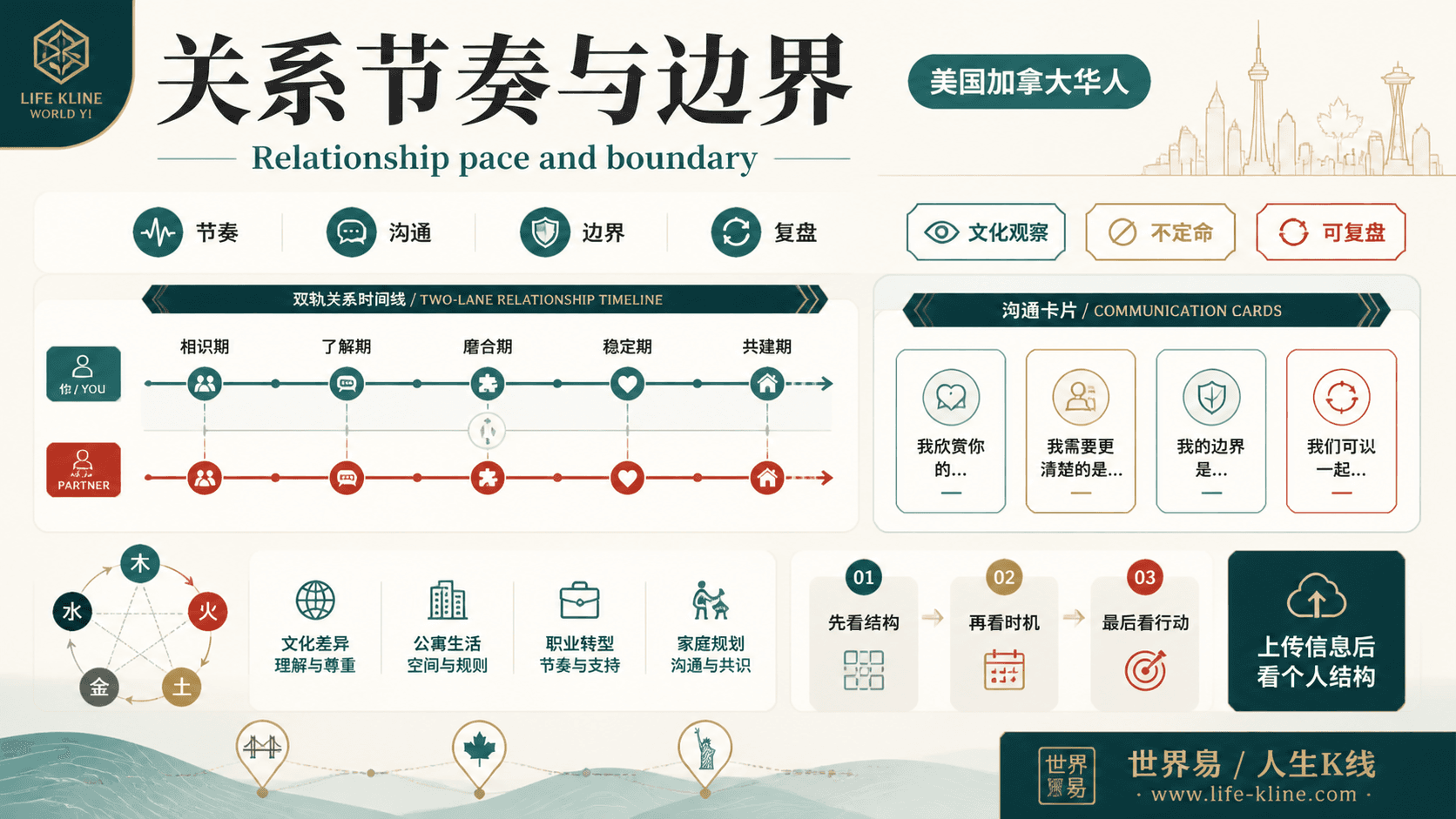
关系节奏与边界|美国加拿大华人
这张图把《Decision Analysis on Distance Between Controlling Parents and Adult Children: To Set Boundaries or Continue Observing》里的命理概念转成关系、边界和应用场景,适合先看图建立结构,再回到知识文章正文理解细节。
关系节奏与边界不应被写成固定结论。更适合美国加拿大华人的读法,是把传统术语翻译成结构、时机、环境、行动和复盘。
查看图片解读