Adult Children’s Distance Decisions in Controlling Parent Relationships: BaZi Insights from Yin Star, Bi Jian, and Guan Sha
把这篇文章落到自己身上验证:先看结构,再进入个人分析,不做泛泛阅读。
你现在搜索的,
其实是一个要落到自己身上的判断。
当前页面主要回答「Parent-Child Relationship」这类搜索问题;真正有价值的下一步是把这套结构带进自己的报告、工具与案例验证。
Why This Decision Is Especially Difficult in This Scenario
The decision regarding distance between controlling parents and adult children often involves two core challenges: blurred boundaries and emotional manipulation. Psychologically, adult children are often influenced by both the cultural expectations of their original family and suppressed self-identity, making it difficult to clearly define psychological boundaries and causing emotional interference during decision-making.
Within this family dynamic, parents often influence adult children’s autonomous decisions through authority or emotional coercion. Adult children simultaneously desire independence and fear losing familial emotional support, creating a contradictory attachment state. This condition turns the choice to distance or approach into an emotional and rational struggle.
The BaZi structures involving Yin Star (印星), Bi Jian (比肩), and Guan Sha (官杀) reflect an individual’s dependence, sense of security, self-expression, and authority pressure within the parent-child relationship. Different chart combinations can invisibly strengthen or weaken adult children’s tolerance and response strategies to parental control, affecting their choice of distance.
Therefore, this decision is not merely a superficial family relationship adjustment but the result of the interaction between the adult child’s internal BaZi rhythm and external family dynamics. Rational understanding and professional psychological support are indispensable aids.
Three Core Dimensions of BaZi Judgment
First, the relationship between the Day Master (日主) and Yin Star (印星) reflects the individual’s dependence and nourishment status within the family. Yin Star represents parental or elder support and protection. When the Day Master is relatively weak and Yin Star is strong, there tends to be excessive emotional dependence on parents, with prominent boundary blurring issues. Distancing requires careful consideration of one’s emotional endurance.
Second, Bi Jian (比肩) represents competition for resources and self-expression among peers or siblings. A strong Bi Jian indicates a strong self-awareness and resistance to external control, tending to actively distance oneself to maintain personal boundaries. A weak Bi Jian may be more susceptible to emotional manipulation, necessitating strengthened self-awareness during decision-making.
Third, Guan Sha (官杀) represents authority pressure and rule restrictions. In controlling parent scenarios, the strength of Guan Sha reflects the intensity of parental authority and the adult child’s attitude of resistance or compliance. When Guan Sha is strong and the Day Master is weak, adult children tend to endure greater control pressure; distancing risks increase but repair becomes more difficult.
Finally, the interaction between Da Yun (大运) and Liu Nian (流年) provides temporal rhythm references. When luck cycles are stable or auspicious, adult children are more capable of positive communication and repair. When luck is weak, distancing may cause greater psychological impact, requiring professional psychological support and cautious decision-making.
Three Real BaZi Chart Cases
Case 1: Female, Day Master 癸 (Gui) Water is relatively weak, Zheng Yin (正印) pattern, Yong Shen (favorable element) Fire, Ji Shen (unfavorable element) Wood, currently in Yi You (乙酉) Da Yun (stable period) and Bing Wu (丙午) Liu Nian. The chart’s strong Zheng Yin indicates strong emotional dependence on parents, while the weak Day Master shows weak self-boundaries. The family exhibits blurred boundaries and emotional manipulation prominently, so distancing may trigger significant inner unrest. With stable Da Yun and Liu Nian, it is suitable to cautiously attempt repair, leveraging external support to strengthen self-identity. Judgment suggestion: prioritize strengthening self-boundary construction, cautiously test distancing, and gradually adjust parental relationships combined with psychological counseling.
Case 2: Female, Day Master 戊 (Wu) Earth is relatively strong, Pian Cai (偏财) pattern, Yong Shen Wood, Ji Shen Fire, currently in Ding Wei (丁未) Da Yun (weaker period) and Bing Wu (丙午) Liu Nian. The relatively strong Day Master supported by Yong Shen Wood indicates strong self-ability, but parental authority (Guan Sha) influence remains significant, with emotional manipulation present. The weaker Da Yun suggests caution in handling parent-child boundaries. The Pian Cai pattern reflects a desire for external resources and emotional connection, and the adult child may oscillate between distancing and approaching. Judgment suggestion: cautiously evaluate family dynamics, attempt limited distancing first, observe parental reactions, and combine professional guidance to reduce emotional conflict.
Case 3: Male, Day Master 甲 (Jia) Wood is relatively weak, Shang Guan (伤官) pattern, Yong Shen Water, Ji Shen Fire and Earth, currently in Ren Shen (壬申) Da Yun (auspicious luck) and Bing Wu (丙午) Liu Nian. The Shang Guan pattern indicates strong self-expression desire and a wish to break parental control. Yong Shen Water supports the Day Master, showing strong self-regulation ability. With auspicious Da Yun and good career and financial progress, psychological resources are sufficient. This chart suits actively distancing to establish clear boundaries and reduce emotional manipulation pressure. Judgment suggestion: maintain rational communication, actively set boundaries, and seek family therapy support if necessary to promote healthy relationship transformation.
Common Misjudgments and Blind Spots in This Scenario
A common misjudgment when deciding to distance or approach is over-reliance on a single BaZi symbol interpretation, simplifying complex parent-child relationships into fixed fate trajectories, while ignoring the variability of family dynamics and the complexity of individual psychological states.
Another blind spot is neglecting the psychological trauma caused by blurred boundaries, especially in charts with strong Yin Star and weak Day Master. Adult children may be unable to clearly define themselves due to excessive dependence, causing ongoing emotional manipulation that cannot be fully resolved by BaZi guidance alone.
Additionally, the strength of Guan Sha in BaZi is often misunderstood as only indicating either submission or rebellion against parental authority. In reality, this pressure fluctuates with Liu Nian and Da Yun, and blind actions may intensify conflicts, overlooking the necessity of emotional rhythm and psychological adjustment.
In summary, family relationship adjustments require integrating BaZi rhythms with psychological counseling, avoiding black-and-white judgments, and emphasizing gradual and dynamic adjustment processes.
Practical Judgment Sequence
Step one: Assess the strengths of Yin Star, Bi Jian, and Guan Sha in one’s BaZi chart, combined with the current Da Yun and Liu Nian rhythms, to preliminarily judge the dominant levels of emotional dependence and authority pressure, thereby determining internal endurance and action space.
Step two: Combine one’s psychological state and emotional responses to identify specific manifestations of blurred boundaries and emotional manipulation. Prioritize professional psychological counseling and family therapy interventions to build a support system and enhance self-identity and emotional regulation.
Step three: Based on comprehensive feedback from psychological support and BaZi rhythms, cautiously choose specific strategies to distance or approach. It is recommended to adopt a gradual approach, observe parental reactions and personal emotional changes, and adjust the pace as needed to avoid escalating family conflicts.
FAQ
Question 1: Can BaZi determine whether I should immediately distance myself or continue to approach my parents? Answer: BaZi provides rhythms and energy tendencies but cannot directly decide specific actions. It is recommended to combine psychological counseling, assess your emotional endurance and family interaction dynamics, and rationally judge the best timing for action.
Question 2: Does a strong Yin Star mean I must depend on my parents and cannot be independent? Answer: A strong Yin Star represents parental support and a tendency to depend but does not mean absolute dependence. Through self-growth and psychological adjustment, you can gradually establish independent boundaries and achieve a healthy parent-child relationship.
Question 3: If BaZi shows strong Guan Sha, am I destined to be controlled by my parents? Answer: Strong Guan Sha indicates significant authority pressure, but individuals still have free will. Combining Da Yun, Liu Nian, and psychological support, you can find suitable communication and boundary-setting methods to alleviate the negative effects of control.
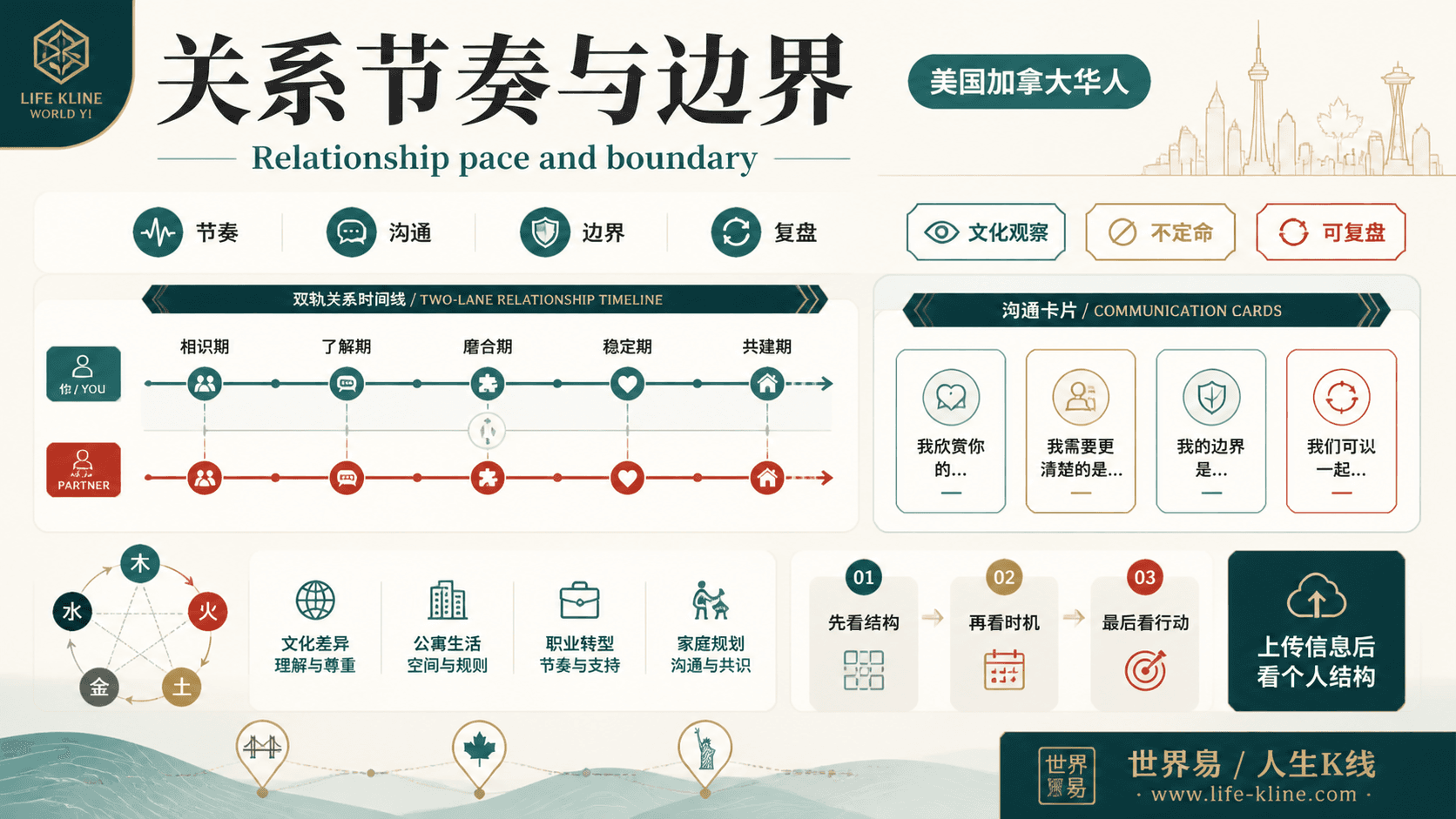
关系节奏与边界|美国加拿大华人
这张图把《Adult Children’s Distance Decisions in Controlling Parent Relationships: BaZi Insights from Yin Star, Bi Jian, and Guan Sha》里的命理概念转成关系、边界和应用场景,适合先看图建立结构,再回到知识文章正文理解细节。
关系节奏与边界不应被写成固定结论。更适合美国加拿大华人的读法,是把传统术语翻译成结构、时机、环境、行动和复盘。
查看图片解读