Analysis of the Best Timing for Communication and Confrontation Between Adult Children and Controlling Parents
把这篇文章落到自己身上验证:先看结构,再进入个人分析,不做泛泛阅读。
Why This Decision Is Especially Difficult in This Context
The relationship between controlling parents and adult children is often constrained by blurred boundaries and emotional manipulation. Adult children seeking independence and self-identity frequently encounter strong parental interference and psychological pressure. Within this family dynamic, the lack of a clear sense of boundaries leads to communication that easily falls into conflict or compromise, making genuine confrontation difficult to achieve.
When facing controlling parents, adult children are often influenced by cultural expectations and emotional dependence on their original family. Psychologically, they experience strong feelings of guilt and responsibility. This psychological burden makes it difficult for them to grasp the right timing for confrontation and makes them prone to being emotionally swayed, resulting in ineffective communication.
In BaZi structure, especially the strength or weakness of the Day Master, the configuration of Yong Shen and Ji Shen, and the clash and combination relationships between Da Yun and Liu Nian, manifest as changes in emotions and power within family interaction rhythms. For example, the Yin star (印星, Zheng Yin/Pian Yin) represents parental influence, and the Guan Sha stars (官杀, Zheng Guan/Qi Sha) symbolize authoritative pressure. Changes in Liu Nian and Da Yun can amplify or suppress communication resistance.
Under such complex overlapping factors, adult children face the challenging task of choosing a timing that neither escalates conflicts nor undermines boundary-setting and clear communication intentions. This requires integrating family dynamics with BaZi rhythms to assist in making informed judgments.
Three Core Dimensions in BaZi Judgment
First, the relationship between the Day Master and the Yin star reflects the emotional connection and dependence between children and parents. When the Yin star is strong, parental influence is significant, boundaries tend to be blurred, and adult children’s self-identity struggles to stand out; when the Yin star is weaker, children have stronger independence but may lack an emotional foundation during communication.
Second, the Bi Jian (比肩) and Jie Cai (劫财) stars represent siblings and self-competition power, also symbolizing the struggle for self-resources. When Bi Jian/Jie Cai stars are strong, children have a stronger self-awareness and ability to resist but may also intensify conflicts if too forceful, necessitating careful control of intensity.
Third, the Guan Sha stars represent parental authoritative pressure and rule constraints, while the Cai stars relate to resource and emotional flow. The clash and combination between Liu Nian and Da Yun determine the energetic field during communication. For example, when Liu Nian supports the Yong Shen, communication flows more smoothly; otherwise, obstacles abound. Additionally, the presence of Ji Shen often signals emotional fluctuations and communication resistance, requiring special attention.
Three Real BaZi Case Studies
Case 1 Based on Data Set 1: This male has a Gui (癸, Gui) Water Day Master that is slightly strong, with a Yang Ren (羊刃) pattern. The Yong Shen are Earth and Fire, and the Ji Shen is Metal. He is currently in the 7th year of the Yi Hai (乙亥) Da Yun, with the Bing Wu (丙午) Liu Nian. The Yi Hai Da Yun is stable and suitable for maintaining status quo, while the Bing Wu Liu Nian emphasizes adaptability. The Yin star is relatively weak, so parental influence is not extreme, but the presence of Ji Shen Metal indicates communication obstacles, especially involving emotional manipulation. The family dynamic shows the Day Master Water’s sensitivity, and the Yang Ren pattern makes his communication direct but potentially intense. For confrontation timing, it is recommended to choose periods when Liu Nian’s Wood and Fire are strong and Ji Shen Metal is controlled, combined with psychological counseling to gradually establish boundaries and avoid emotional conflicts.
Case 2 Based on Data Set 2: This male has a Wu (戊, Wu) Earth Day Master that is slightly strong, with a Yang Ren pattern. The Yong Shen are Wood and Water, and the Ji Shen is Fire. He is currently in the 8th year of the Ren Zi (壬子) Da Yun, with the Bing Wu (丙午) Liu Nian. The Ren Zi Da Yun is very auspicious and favors going with the flow. Although the Liu Nian has the Fire Ji Shen, the Da Yun’s Water and Wood are vigorous, which benefits emotional regulation and rational communication. Parental authoritative pressure (Guan Sha) is relatively controllable, and the child’s Bi Jian star is strong, indicating a robust ability to compete for self-resources. Within the family struggle, the stable Wu Earth Day Master suits proactive communication strategies during smooth Da Yun and Liu Nian synergy. It is advised to confront during auspicious Da Yun periods when the Fire Ji Shen is restrained, combined with professional guidance to establish boundaries while avoiding parental defensiveness.
Case 3 Based on Data Set 3: This female has a Ding (丁, Ding) Fire Day Master that is relatively weak, with a Jie Cai pattern. The Yong Shen is Wood, and the Ji Shen are Earth and Metal. She is currently in the 1st year of the Geng Wu (庚午) Da Yun, with the Bing Wu (丙午) Liu Nian. The Da Yun is stable, and the Liu Nian emphasizes adaptability. The Yin star is not prominent, parental authoritative pressure (Guan Sha) is strong, and the Ji Shen Earth and Metal suggest communication barriers and emotional stagnation. The Jie Cai pattern indicates she assumes a strong self-protection and resistance role within the family, but the weak Day Master limits her psychological endurance. In this BaZi chart, the best communication timing should avoid periods when Ji Shen are strong, using relatively stable windows in Da Yun and Liu Nian to slowly advance boundary setting, combined with psychological therapy to reduce the impact of emotional manipulation.
Common Misjudgments and Blind Spots in This Scenario
Many adult children mistakenly believe that confronting controlling parents directly during emotional highs can quickly resolve conflicts, overlooking emotional manipulation and psychological dependence within family dynamics. This often escalates communication into conflict, deepening boundary blurring and mutual harm.
Another common blind spot is ignoring the rhythmic changes of Ji Shen and Da Yun/Liu Nian in BaZi and acting blindly. For example, during periods when Ji Shen Metal or Fire is strong, parental authoritative pressure intensifies and communication resistance increases. Without emotional management and psychological support, confrontation outcomes are poor.
There is also misunderstanding regarding the strength of the Day Master and the Yong Shen. A strong Day Master tends to be aggressive, while a weak Day Master tends to retreat. Both require tailored communication strategies based on the BaZi structure, avoiding simplistic uniform approaches that ignore individual rhythms and the complexity of family interactions.
Practical Judgment Sequence
Step one: Examine the current Da Yun and Liu Nian changes of Yong Shen and Ji Shen in the BaZi chart to confirm whether the emotional and energetic field is favorable for communication. Periods when the Yong Shen is nourished and the Ji Shen is restrained are usually more suitable for boundary establishment and positive communication.
Step two: Combine family dynamics by assessing parental authoritative pressure (Guan Sha) and the intensity of emotional manipulation, evaluating one’s emotional endurance to avoid rash actions during emotional highs or strong parental defensiveness.
Step three: Choose timing to cooperate with professional psychological counseling or family therapy, gradually cultivating self-identity and emotional regulation. During favorable BaZi rhythmic windows, attempt confrontation and clarify boundaries, ensuring communication is rational expression rather than emotional venting.
FAQ
Question 1: Can BaZi completely determine the success or failure of communication and confrontation? Answer: BaZi provides auxiliary references on rhythms and energetic fields to help select relatively favorable timing but cannot replace professional psychological counseling and family therapy. Especially when emotional manipulation and psychological trauma are involved, professional support is indispensable.
Question 2: If Ji Shen is strong in the BaZi chart, does it mean communication is impossible? Answer: A strong Ji Shen indicates greater communication resistance, requiring more cautious and gradual boundary establishment combined with emotional management and external support. It is not advisable to confront rashly, but it does not mean communication is absolutely impossible.
Question 3: How to combine BaZi and psychological counseling to improve decision-making effectiveness? Answer: BaZi is used to grasp emotional rhythms and energy changes, while psychological counseling helps address original family trauma and emotional dependence. Combining both allows communication and confrontation to be conducted with a healthier mindset and strategy during favorable timing, reducing the risk of family conflict.
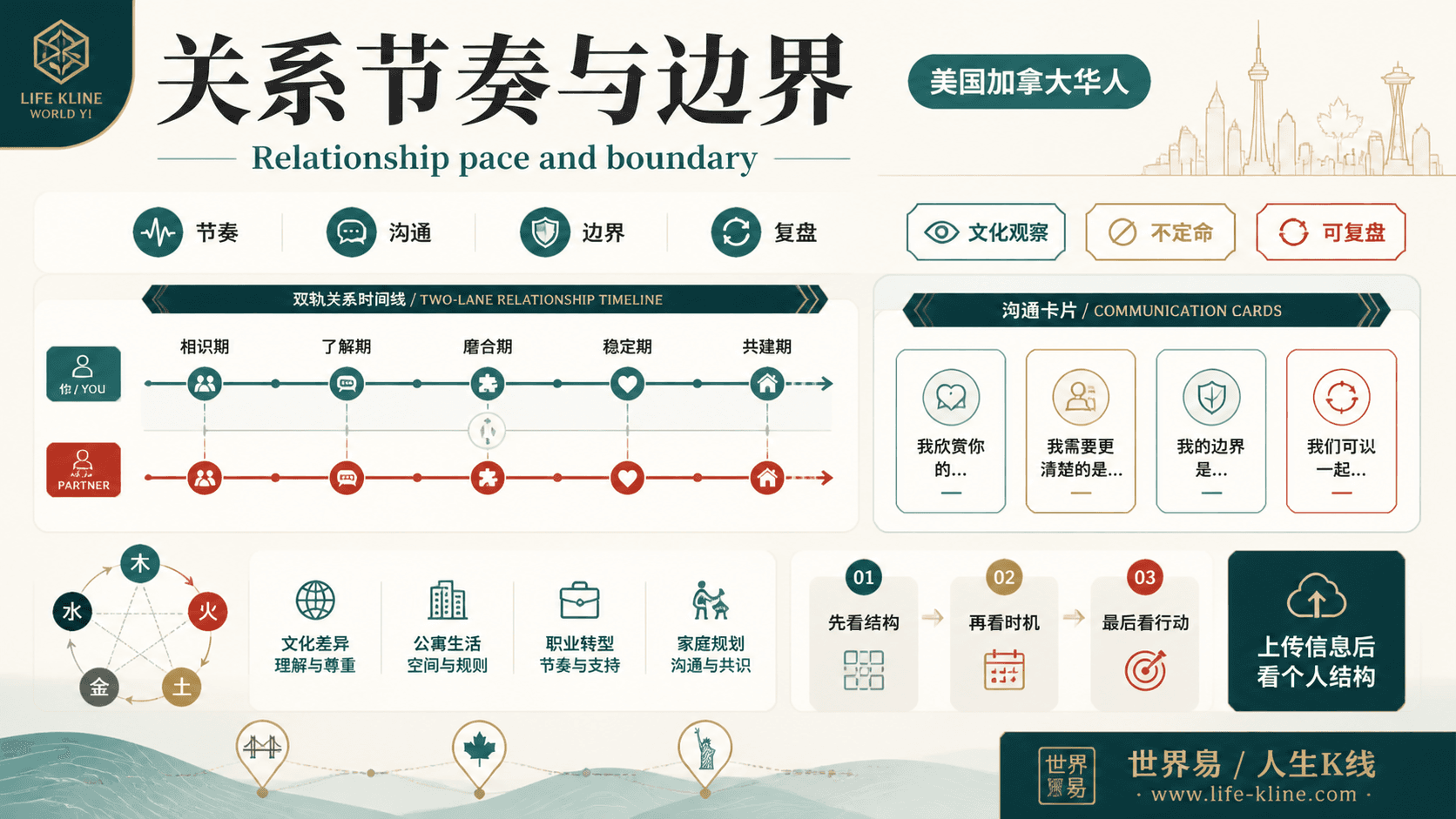
关系节奏与边界|美国加拿大华人
这张图把《Analysis of the Best Timing for Communication and Confrontation Between Adult Children and Controlling Parents》里的命理概念转成关系、边界和应用场景,适合先看图建立结构,再回到知识文章正文理解细节。
关系节奏与边界不应被写成固定结论。更适合美国加拿大华人的读法,是把传统术语翻译成结构、时机、环境、行动和复盘。
查看图片解读