Metaphysical Decision-Making Reference for Consulting Startups: Partnership or Sole Proprietorship
把这篇文章落到自己身上验证:先看结构,再进入个人分析,不做泛泛阅读。
Why This Decision Is Particularly Difficult in This Industry
The core resource in the consulting and professional services industry is human capital. Project income heavily depends on professional skills and personal branding, with client structures often concentrated among a few major clients. This results in relatively low initial capital pressure but makes the stability of partnerships and project continuity critical. Partnership models can leverage multiple resources and complementary expertise but also bring risks of profit distribution conflicts and decision-making disputes. Sole proprietorship maintains control but bears all pressures and human resource risks alone.
Psychologically, entrepreneurs often lean toward sole proprietorship due to confidence in their own abilities, overlooking the advantages of resource sharing and risk distribution that partnerships offer. Conversely, blind partnerships may lead to internal conflicts due to lack of trust. From a metaphysical perspective, Bi Jian (Peer Stars) reveal competitive and cooperative relationships, Zheng Guan/Qi Sha (Officer Stars) reflect pressure and external challenges, and Yin Stars (Resource Stars) relate to support and resource introduction. These structures intertwine with industry operational characteristics, influencing decision outcomes.
Specifically, in BaZi structure, Wealth Stars represent project cash flow and client resources; Bi Jian indicates the influence of partners or competitors; Zheng Guan/Qi Sha expose career pressures and management difficulties; Yin Stars symbolize intellectual support and team collaboration. Understanding how these dimensions interact helps entrepreneurs rationally identify potential risks and opportunities when choosing between partnership and sole proprietorship.
Therefore, consulting startup decisions must comprehensively consider industry business models and metaphysical rhythms, guard against personal subjective biases, and scientifically evaluate partnership stability and sole proprietorship endurance. Decisions should align with the current Da Yun (decade luck cycle) and Liu Nian (annual fortune) to maximize sustainable business growth potential.
Three Core Dimensions of Metaphysical Judgment
First, the relationship between the Day Master and Wealth Stars is key to judging the stability of startup funding and client resources. The Day Master represents the entrepreneur’s own energy strength, while Wealth Stars symbolize the most direct income and client resources in the business. In consulting, a strong Wealth Star combined with a moderate Day Master suggests stable project income, making it more suitable to bear sole proprietorship pressures. If the Wealth Star is weak, partnership to share risks is more appropriate.
Second, the role of Bi Jian (Peer Stars) reflects the influence of partners and competitors. A strong Bi Jian indicates many collaborators nearby, fostering a team cooperation atmosphere but possibly causing resource dispersion and internal competition. A weak Bi Jian suggests strong independence, favoring sole proprietorship. When combined with strong Yin Stars (Resource Stars), it implies a stable support system and intellectual resources, beneficial for partnership stability.
Third, Zheng Guan/Qi Sha (Officer Stars) reveal external pressures and management challenges during the entrepreneurial process. When Zheng Guan/Qi Sha are strong but favorable (Yong Shen), the entrepreneur has strong ability to handle external challenges and manage teams, which supports partnership startups. Overly strong Zheng Guan/Qi Sha may cause excessive pressure, requiring careful partner selection to prevent internal conflicts. The interaction of Liu Nian and Da Yun with Zheng Guan/Qi Sha and Bi Jian also determines whether it is suitable to expand cooperation or contract operations currently.
In summary, the combination of Wealth Stars, Bi Jian, Zheng Guan/Qi Sha, and Yin Stars in BaZi, along with Day Master strength and current Da Yun and Liu Nian, provides rhythmic auxiliary reference for consulting entrepreneurs deciding between partnership and sole proprietorship. It indicates when to expand partnerships, when to maintain sole proprietorship, and how to avoid potential risks.
Three Real BaZi Chart Cases
Case 1: This female chart’s Day Master is 丁火 (Ding Fire), with a Cong Er (From Child) structure. The Day Master is balanced, Wealth Stars are Earth and Metal serving as Yong Shen (favorable elements), Bi Jian (Peer Stars) are Wood acting as Ji Shen (unfavorable elements). She is currently in the 8th year of the 戊午 (Wu Wu) Da Yun, with the 丙午 (Bing Wu) Liu Nian. The 丁火 Day Master with Earth and Metal Wealth Stars indicates relatively stable project funding and client resources, and the current Da Yun is auspicious, showing progress in career and wealth. The weak Wood Bi Jian Ji Shen suggests low partnership competitive pressure, favoring harmonious cooperation. In consulting, this chart suits partnership startups to utilize complementary partner resources and share project pressures, but caution is needed to avoid resource contention from excessive Bi Jian. It is recommended to prioritize partnership after confirming cash flow stability through financial due diligence, leveraging the Yin Stars (Earth and Metal) to strengthen team support, while monitoring Da Yun and Liu Nian changes to avoid blind expansion during adverse years.
Case 2: This male chart’s Day Master is 乙木 (Yi Wood), relatively weak, with a Zheng Cai (Proper Wealth) structure. Water is the Yong Shen, Fire and Earth are Ji Shen. He is currently in the 3rd year of the 壬子 (Ren Zi) Da Yun, with the 丙午 (Bing Wu) Liu Nian. The weak 乙木 Day Master and Ji Shen Fire and Earth indicate insufficient personal energy, requiring external resources for reinforcement. The Zheng Cai pattern shows Wealth Stars as the main income channel; Water as Yong Shen implies that capital flow and client resources are critical. Bi Jian is not prominent, and Zheng Guan/Qi Sha are moderate, indicating manageable pressure. This chart suits a cautious sole proprietorship model to avoid lack of voice caused by weak personal strength in partnerships. It is advised to align with financial status, maintain momentum with Liu Nian, focus on personal brand building, and be prudent in partner selection to prevent increased career pressure from cooperation conflicts.
Case 3: This male chart’s Day Master is 甲木 (Jia Wood), relatively weak, with a Shi Shen (Eating God) structure. Water is Yong Shen, Fire and Earth are Ji Shen. He is currently in the 1st year of the 壬午 (Ren Wu) Da Yun, with the 丙午 (Bing Wu) Liu Nian. The Shi Shen structure emphasizes expression and creativity, showing the entrepreneur has strong professional ability and innovation potential. Water as Yong Shen supports capital and client flow; Ji Shen Fire and Earth warn against management and external pressures. Bi Jian is weak, Zheng Guan/Qi Sha are stable, indicating limited competitive pressure in partnerships but existing management pressure. This chart is more suitable for initial sole proprietorship to stabilize core clients and projects, accumulate experience, and consider partnership expansion later. It is recommended to combine financial due diligence and risk management, adjust cooperation models flexibly based on market feedback, and follow Da Yun and Liu Nian rhythms to avoid blind expansion.
These three cases integrate metaphysical perspectives with consulting industry operational structures, providing partnership versus sole proprietorship judgment ideas based on different Day Master strengths, structures, and Yong Shen. They emphasize the importance of combining metaphysical rhythms with business due diligence.
Common Misjudgments and Blind Spots in This Industry
Entrepreneurs in consulting and professional services often misjudge their own abilities and resources, being overconfident in sole proprietorship and neglecting the resource sharing and risk distribution advantages of partnerships. This leads to overreliance on single clients or personal brand risks. Metaphysically, they overlook the balance between Bi Jian and Yin Stars, failing to identify potential cooperative pressures and support systems, resulting in solitary struggles.
Conversely, entrepreneurs who blindly enter partnerships ignore the management pressures and cooperation conflict risks brought by strong Zheng Guan/Qi Sha, especially when these stars are overly strong without sufficient risk assessment. This causes intensified internal conflicts and decreased project execution efficiency. The mismatch of Zheng Guan/Qi Sha and Bi Jian in BaZi reflects latent team collaboration hazards, which, if unrecognized, exacerbate entrepreneurial risks.
Additionally, neglecting changes in Da Yun and Liu Nian rhythms often causes blind expansion or cooperation during unfavorable years, missing optimal timing. Metaphysical rhythmic judgment without integrating industry policies, market competition, and financial conditions easily leads to decision blind spots. In summary, entrepreneurs must beware of personal subjective biases and one-sided metaphysical interpretations, achieving multidimensional comprehensive judgment.
A reasonable understanding of metaphysical structures as auxiliary in entrepreneurial decision-making, avoiding reliance on them as the sole basis, is key to preventing misjudgments.
Practical Judgment Sequence
First, entrepreneurs should assess their Day Master strength and Yong Shen support, combined with the stability of Wealth Stars to determine the steadiness of funding and client resources. This forms the basis for judging suitability for sole proprietorship. If the Day Master is weak and Wealth Stars unstable, partnership should be prioritized to share risks and resources.
Second, analyze Bi Jian and Zheng Guan/Qi Sha structures to evaluate cooperation and competition pressures within partnerships and assess team collaboration feasibility and management capacity. Strong Bi Jian with useful Zheng Guan/Qi Sha indicates favorable partnerships; overly strong Zheng Guan/Qi Sha require caution to prevent management pressure causing cooperation breakdown.
Finally, incorporate current Da Yun and Liu Nian rhythms to judge whether it is suitable to expand partnerships or maintain sole proprietorship. Auspicious luck cycles favor leveraging resource advantages to expand cooperation; unfavorable years suggest consolidation to avoid blind actions. Throughout the process, financial due diligence and business risk assessments must be integrated to ensure scientific and reasonable decisions, reducing entrepreneurial risks.
FAQ
Question 1: Does a strong Bi Jian in metaphysics necessarily mean partnership is suitable? Answer: A strong Bi Jian indicates the presence of cooperative or competitive forces nearby, but suitability for partnership must also consider the status of Wealth Stars and Zheng Guan/Qi Sha. Bi Jian strength alone cannot determine cooperation mode; it must be analyzed alongside business due diligence and team stability.
Question 2: How does strong Zheng Guan/Qi Sha affect entrepreneurial pressure? Answer: Strong Zheng Guan/Qi Sha usually bring significant career pressure and management challenges, which can stimulate competitiveness but, if excessive, may cause internal conflicts. Entrepreneurs should cautiously decide based on their endurance and partnership relationships.
Question 3: Can metaphysics replace financial and market analysis in decision-making? Answer: No. Metaphysics only provides auxiliary reference for rhythms and potential trends. Entrepreneurial decisions must be based on thorough financial due diligence, market analysis, and risk evaluation. Metaphysics is a support tool, not a decision-making foundation.
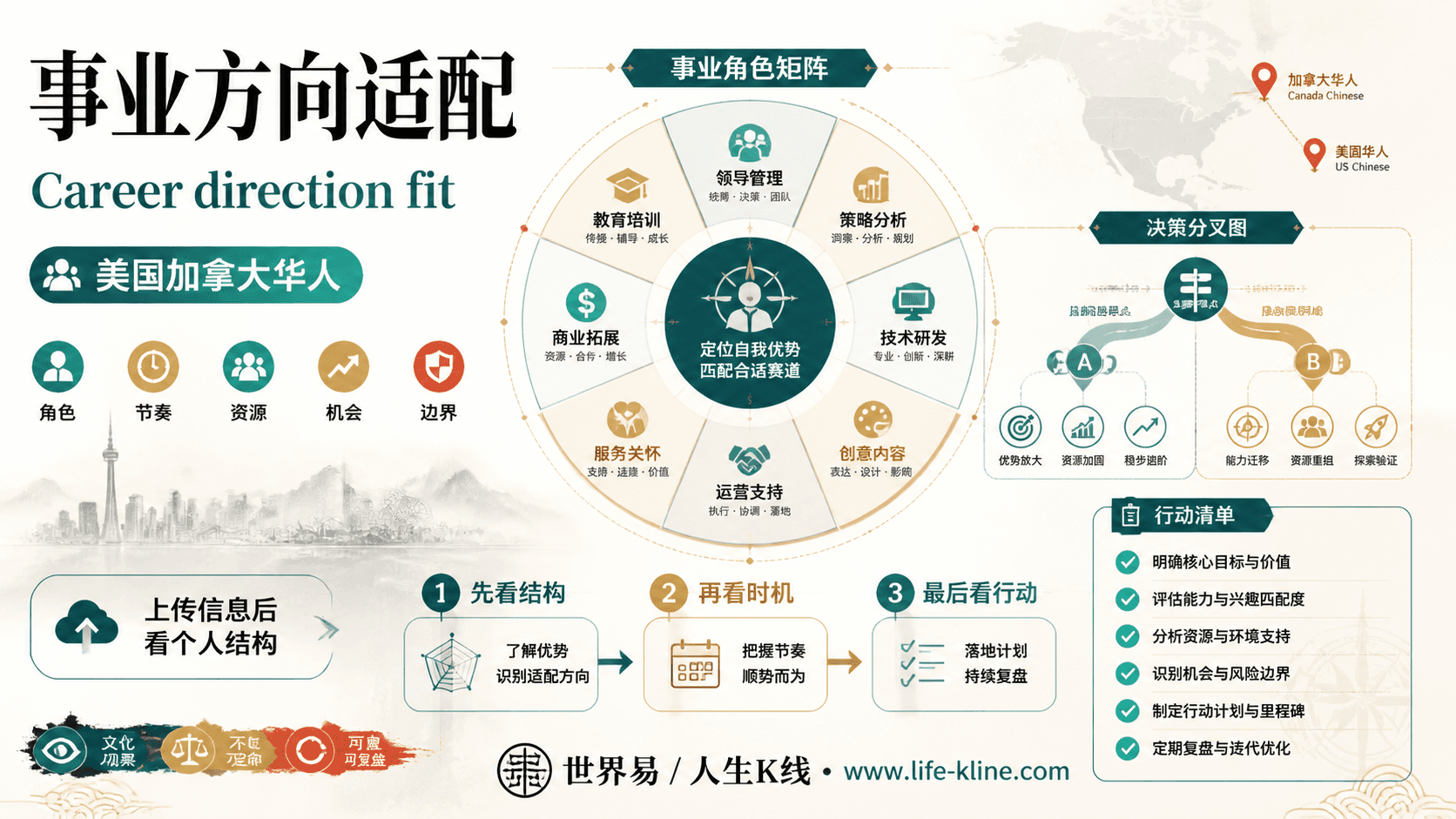
事业方向适配|美国加拿大华人
这张图把《Metaphysical Decision-Making Reference for Consulting Startups: Partnership or Sole Proprietorship》里的命理概念转成关系、边界和应用场景,适合先看图建立结构,再回到知识文章正文理解细节。
事业方向适配不应被写成固定结论。更适合美国加拿大华人的读法,是把传统术语翻译成结构、时机、环境、行动和复盘。
查看图片解读