Metaphysical Analysis and Practical Guide for Consulting Startup Exit Strategies and Selling Timing
把这篇文章落到自己身上验证:先看结构,再进入个人分析,不做泛泛阅读。
Why This Decision Is Especially Difficult in This Industry
The consulting and professional service industry is characterized by the distinct feature that "people are the productivity." Project revenues heavily depend on the core individual's personal brand and professional capabilities, with client structures often concentrated among a few major clients. This structure causes enterprise value at exit to be highly reliant on the entrepreneur’s personal reputation and professional network, making rapid transfer or smooth selling difficult.
Moreover, the industry is fiercely competitive, client demands are diverse and rapidly changing, and policy and market environments occasionally fluctuate. Decision-makers are prone to psychological biases, overly relying on short-term market signals or personal feelings, neglecting long-term strategic planning and financial health, thereby increasing exit risks.
From a metaphysical perspective, the entrepreneur’s Day Master strength, pattern type, and Yong Shen/Ji Shen combinations directly affect their capacity to bear pressure, integrate resources, and control timing. For example, the Cai Xing (Wealth Star) represents financial resources, Bi Jian (Peer) and Jie Cai (Rob Wealth) influence cooperative relationships, Guan Sha (Officer and Seven Killings) relate to pressure and external environment, and Yin Xing (Resource Star) concerns support and internal motivation. These factors combined form rhythmic cues for selling timing.
Considering the triple factors of business structure, psychology, and metaphysics, the difficulty in exit strategy lies in precisely identifying the selling window and balancing the cost of continuing operations against exit benefits. Premature or delayed exits can both cause value loss or greater operational pressure. Metaphysical assistance provides rhythm references but must be combined with commercial due diligence and financial analysis to improve decision quality.
Three Core Dimensions of Metaphysical Judgment
First, the relationship between the Day Master and Cai Xing (Wealth Star) reflects the entrepreneur’s core energy and financial resource status. For example, a weak Day Master requires reliance on Yong Shen (such as Earth, Wood, Water) for balance. The appearance of Cai Xing indicates the introduction of funds and client resources, serving as an important reference signal for selling timing.
Second, Bi Jian (Peer) and Jie Cai (Rob Wealth) stars represent partners and competitive relationships. If Bi Jian/Jie Cai are strong, the entrepreneur must be cautious of tense cooperation or resource dispersion, which can affect selling negotiations; conversely, reasonable Bi Jian/Jie Cai support team collaboration and risk sharing, enhancing the ability to persevere.
Third, the combination of Guan Sha (Officer and Seven Killings) and Yin Xing (Resource Stars) reveals external pressure and internal support. Excessive Guan Sha indicates high pressure, possibly urging premature exit or strategy adjustment; strong Yin Xing suggests a good support system and learning adaptability, beneficial for navigating operational difficulties and extending the perseverance window.
Additionally, the interaction between Da Yun (decade luck cycles) and Liu Nian (annual fortunes) reflects the rhythmic changes of the BaZi chart over different time phases. Stable Da Yun suits maintaining and waiting for selling windows, while conflicting or combining Da Yun signals opportunities and risks coexisting, requiring flexible responses. Comprehensive consideration of these dimensions enables more scientific judgment of selling timing and perseverance costs.
Three Real BaZi Chart Case Studies
Case 1: Male, age 30-35, Day Master Xin Metal (辛, Xin) relatively weak, Qi Sha (Seven Killings) pattern, Yong Shen Earth, Ji Shen Water and Wood, currently in the 9th year of Jia Shen (甲申, Jia Shen) Da Yun, and Bing Wu (丙午, Bing Wu) Liu Nian. The Jia Shen Da Yun is stable, suitable for maintaining status quo. This chart is a typical example in the consulting industry where professional ability reliance coexists with external pressure. The weak Xin Metal Day Master requires Earth Yong Shen for stabilization; the Qi Sha pattern indicates obvious external competitive pressure. Selling timing should focus on whether the Earth Yong Shen is strengthened. If Cai Xing appears in the Liu Nian and the Jia Shen Da Yun remains stable, it indicates sufficient funds and suitability for negotiation and sale; if Ji Shen Water and Wood appear, it signals a complex external environment and higher cost to persevere, requiring cautious evaluation of team resources and client relationships. It is recommended to prioritize initiating selling procedures when Yong Shen is strong and Da Yun/Liu Nian are stable, combined with financial status and client concentration.
Case 2: Male, age 45-50, Day Master Ji Earth (己, Ji) relatively strong, Yang Ren (Goat Blade) pattern, Yong Shen Wood and Water, Ji Shen Fire, currently in the 4th year of Ji Hai (己亥, Ji Hai) Da Yun, and Bing Wu (丙午, Bing Wu) Liu Nian. The Ji Hai Da Yun is stable, suitable for maintaining status quo. This chart’s strong Day Master represents the entrepreneur’s strong pressure-bearing capacity and resource integration ability. The Yang Ren pattern indicates fierce competition but also sprinting momentum. Yong Shen Wood and Water help alleviate pressure, while Ji Shen Fire should be avoided to prevent internal consumption. The key to judging selling timing is whether Yong Shen resources are fully activated, especially when Wood and Water strength increase, creating favorable conditions for sale. If the Liu Nian brings Fire’s impact, careful evaluation of exit costs is needed to avoid value loss due to excessive external pressure. It is recommended to start selling when Yong Shen coordination is confirmed and financial audits are complete, while monitoring cooperation stability and client structure changes.
Case 3: Female, age 25-30, Day Master Ren Water (壬, Ren) relatively strong, Pian Yin (偏印, Indirect Resource) pattern, Yong Shen Water, Ji Shen Metal, currently in the 7th year of Ding Si (丁巳, Ding Si) Da Yun, and Bing Wu (丙午, Bing Wu) Liu Nian. The Ding Si Da Yun is stable, suitable for maintaining status quo. The strong Ren Water Day Master and Pian Yin pattern indicate the entrepreneur has strong learning adaptability and resource integration ability. Yong Shen Water strengthens self-energy, while Ji Shen Metal represents potential competition or resource consumption. Selling timing should focus on whether Yong Shen Water remains strong, especially when water-element resources are abundant in the Liu Nian, indicating a good selling window and potential for higher valuation. If Metal impact occurs, it signals intensified competition or internal resource damage, increasing the cost of perseverance. It is recommended to adjust exit strategies timely according to industry policy trends and client demand changes to avoid blind persistence causing value depreciation.
Common Misjudgments and Blind Spots in This Industry
Consulting and professional service entrepreneurs often find it difficult to objectively evaluate enterprise value due to heavy reliance on personal brand, leading to overestimation of selling timing and neglect of potential market fluctuations and client attrition risks, resulting in failed sales or valuation decline.
Another blind spot is overlooking the importance of team and cooperative relationships. The role of Bi Jian/Jie Cai stars in metaphysics is often underestimated; when the team is unstable or partnership relations are tense, the cost of perseverance increases significantly, weakening negotiation power during selling.
Furthermore, entrepreneurs often ignore the influence of Da Yun and Liu Nian rhythms on decision timing, blindly pursuing short-term gains and neglecting metaphysical indications of maintenance periods and adaptive phases, causing missed exit opportunities or unnecessary operational pressure.
Psychological biases also manifest as misreading pressure (Guan Sha) and support (Yin Xing). Some entrepreneurs are overconfident and ignore risks, while others are overly fearful leading to premature exit; both scenarios hinder maximizing value.
Practical Judgment Sequence
Step one: Check whether the Yong Shen in the BaZi chart is strengthened, especially the interaction between Cai Xing (Wealth Star) and Bi Jian/Jie Cai (Peers/Rob Wealth), to judge whether financial and cooperative resources are sufficient. This is a crucial prerequisite for the selling window; without stable financial and team support, selling risks are high.
Step two: Combine Da Yun and Liu Nian rhythms to confirm whether the current phase is a stable maintenance or a favorable adaptive stage. Stable Da Yun suits steady waiting for selling timing; conflicting or combining Da Yun requires flexible strategy adjustment to avoid blind persistence or hasty sale.
Step three: Assess the balance between Guan Sha (pressure) and Yin Xing (support), identifying whether external environmental pressure and internal support systems match. Excessive pressure with insufficient support means the cost of perseverance is too high, so exit should be prioritized; conversely, the operation period can be moderately extended.
Finally, combine commercial due diligence and financial analysis to verify the practical feasibility of metaphysical judgments, ensuring selling timing aligns with rhythm indications and has solid financial and market foundations. Entrepreneurship involves risks; metaphysics serves only as auxiliary reference and cannot replace professional analysis.
FAQ
Question 1: Can metaphysics directly determine the best time to sell? Answer: Metaphysics provides rhythm and trend auxiliary references, helping identify approximate timing and risk warnings, but the specific best selling time must also consider market, financial, and client structure realities; it cannot rely solely on metaphysics.
Question 2: How should entrepreneurs with weak Day Masters judge whether to persevere? Answer: A weak Day Master indicates limited self-energy and reliance on Yong Shen support. If Yong Shen resources are sufficient and Da Yun/Liu Nian are stable, the cost of perseverance is relatively low; otherwise, exit should be evaluated to avoid further resource depletion, combining financial data for comprehensive judgment.
Question 3: What specific impact do Da Yun and Liu Nian conflicts and combinations have on selling? Answer: Conflicts and combinations represent rhythm changes; conflict Da Yun may bring sudden risks or opportunities, suitable for adaptive responses, causing selling timing fluctuations; combination Da Yun favors maintenance and steady waiting, beneficial for smooth selling and value preservation. Properly grasping these rhythms helps optimize exit strategies.
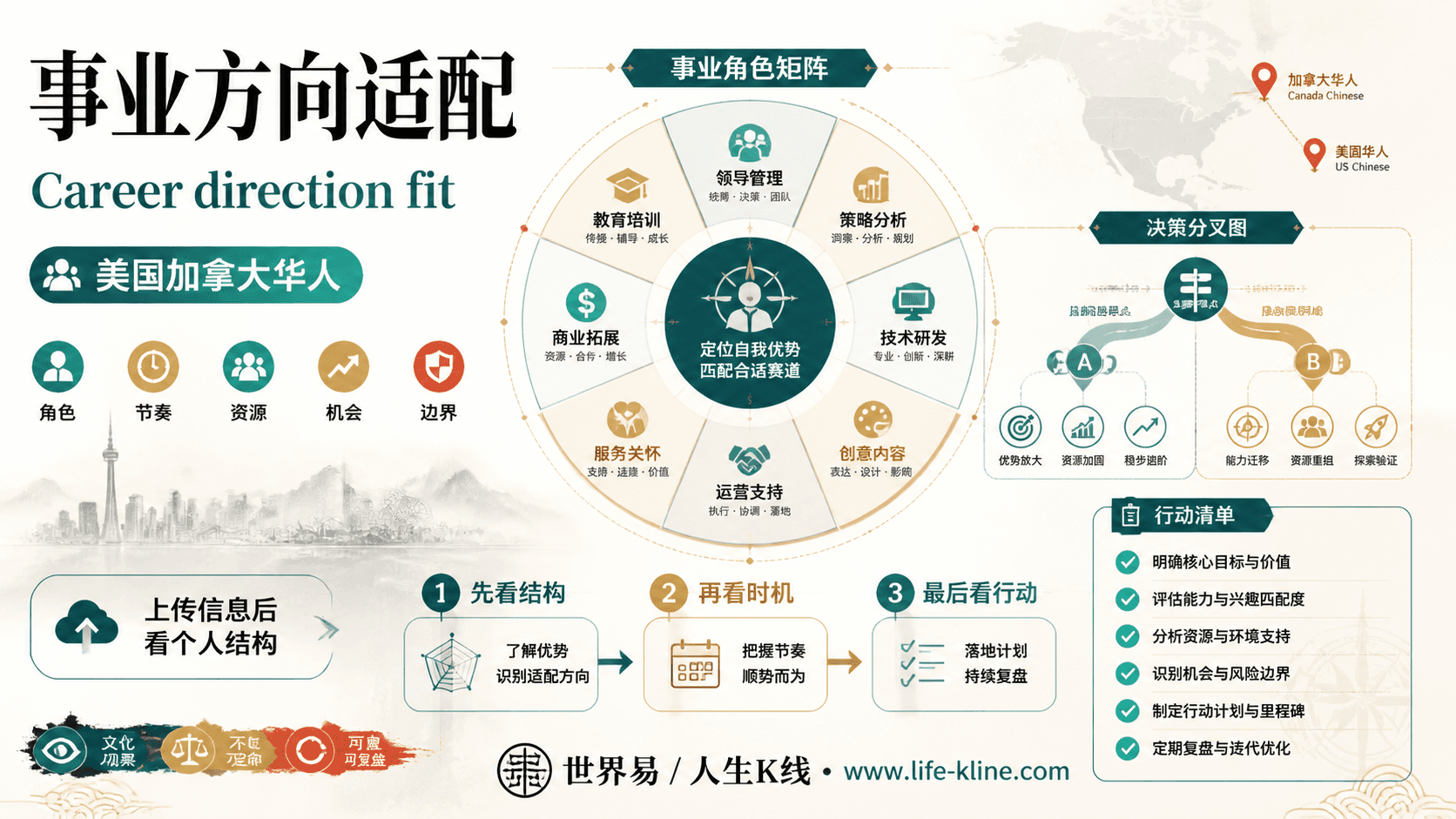
事业方向适配|美国加拿大华人
这张图把《Metaphysical Analysis and Practical Guide for Consulting Startup Exit Strategies and Selling Timing》里的命理概念转成关系、边界和应用场景,适合先看图建立结构,再回到知识文章正文理解细节。
事业方向适配不应被写成固定结论。更适合美国加拿大华人的读法,是把传统术语翻译成结构、时机、环境、行动和复盘。
查看图片解读