BaZi Analysis and Practical Guide for Partnership vs Sole Proprietorship Decisions in Community Small Shops
把这篇文章落到自己身上验证:先看结构,再进入个人分析,不做泛泛阅读。
Why This Decision Is Particularly Difficult in This Industry
Community small shops and local service industries have low entrepreneurial entry barriers, attracting many practitioners and resulting in extremely fierce competition. Rental costs often determine business survival; a slight misstep can cause cash flow difficulties. Customer repurchase heavily depends on personal relationships and service quality, forming a family-style operation closely integrated with the community.
Within this context, choosing partnership or sole proprietorship becomes a core dilemma for entrepreneurs. Partnerships can disperse financial pressure and operational risks but may also cause management conflicts and interest disputes, affecting operational efficiency. Sole proprietorship requires bearing all operational risks but offers more flexible decision-making, suitable for those with clear market judgment and sufficient resources.
From a psychological perspective, entrepreneurs often overly rely on personal experience or emotional decisions, neglecting the importance of teamwork and risk diversification. BaZi structures involving Bi Jian (Peer), Qi Sha (Seven Killings), and Yin stars (Resource stars) provide rhythmic references for this decision. By analyzing the Day Master’s strength and the relationships between Yong Shen (favorable elements) and Ji Shen (unfavorable elements), one can indicate tendencies toward partnership or sole proprietorship.
Combining business structure, psychological biases, and BaZi rhythms allows entrepreneurs to more comprehensively evaluate the pros and cons of partnership versus sole proprietorship, avoiding pitfalls caused by blind following or emotional decisions.
Three Core Dimensions in BaZi Judgment
The strength of the Day Master directly reflects the entrepreneur’s leadership ability and stress resistance. A relatively strong Day Master such as Wu Earth (戊, Wu), Xin Metal (辛, Xin), or Ding Fire (丁, Ding) represents strong resource control and self-drive, suitable for sole proprietorship or leading a partnership. A weaker Day Master relies more on external support, making partnership potentially better for resource complementarity.
The Bi Jian star (Peer) represents competition and resource sharing. A strong Bi Jian star indicates the entrepreneur is good at connecting resources and coordinating partnerships, but excessive strength may cause internal competition and interest conflicts. The Qi Sha star (Seven Killings) generally represents pressure and competitive environment; moderate Qi Sha can stimulate motivation, but if too strong, it requires Yin stars (Resource stars) to regulate and alleviate pressure and promote cooperation.
Yin stars (Resource stars) symbolize support and resource guidance, especially important in partnership decisions. Strong Yin stars provide a solid foundation for cooperation and operational support, helping to resolve conflicts caused by Bi Jian and Qi Sha stars. The interaction of Liu Nian (annual fortune) and Da Yun (decade luck cycle) reflects the dynamic rhythm of BaZi, suggesting adapting strategies according to favorable or conflicting periods.
Overall, BaZi elements such as Cai stars (Wealth stars representing capital and profit), Bi Jian (Peer), Qi Sha (Seven Killings), and Yin stars (Resource stars) form key dimensions for judging partnership versus sole proprietorship. These factors are particularly sensitive in highly competitive and low-entry-barrier industries like community small shops.
Three Real BaZi Case Studies
Case 1: Female, 45-50 years old, Day Master Wu Earth (戊, Wu) relatively strong, Yang Ren pattern (Yang Blade pattern), Yong Shen water, Ji Shen fire, currently in Yi Hai (乙亥, Yi Hai) Da Yun, Bing Wu (丙午, Bing Wu) Liu Nian. The relatively strong Day Master with Yang Ren pattern shows strong independence and stress resistance. Yong Shen water regulates excessive fire, indicating the need for external resource support to balance internal friction. The Yi Hai Da Yun is auspicious, with progress in career and wealth. In community small shop operations, this BaZi favors sole proprietorship to leverage personal leadership advantages, but attention should be paid to fire-induced operational pressure, with timely introduction of partnerships or franchise resources to mitigate risk. Judgment sequence suggestion: considering financial status and interpersonal resources, if stable partners and strong Yin star support exist, prioritize partnership; otherwise, favor sole proprietorship to maintain decision flexibility.
Case 2: Male, 50-55 years old, Day Master Xin Metal (辛, Xin) relatively strong, Yang Ren pattern, Yong Shen fire and wood, Ji Shen earth, currently in Jia Shen (甲申, Jia Shen) Da Yun, Bing Wu (丙午, Bing Wu) Liu Nian. The relatively strong Xin Metal Day Master with Yang Ren pattern indicates strong execution and decisiveness. Yong Shen fire and wood suggest the need for motivation and growth factors to stimulate potential, while Ji Shen earth indicates excessive earth may restrict development. Jia Shen Da Yun is auspicious with stable career and wealth. This BaZi favors partnership operations, as the interaction of Bi Jian and Qi Sha supports teamwork and resource sharing, maintaining competitive advantage. Judgment sequence suggestion: prioritize evaluating Yin star support (trust and resources) among partners; if cooperation foundation is solid, partnership effectively shares risks and costs; if conditions are insufficient, sole proprietorship allows flexible adjustments.
Case 3: Male, 25-30 years old, Day Master Ding Fire (丁, Ding) relatively strong, Jian Lu pattern (Establishment of Prosperity pattern), Yong Shen water and metal, Ji Shen wood, currently in Xin Si (辛巳, Xin Si) Da Yun, Bing Wu (丙午, Bing Wu) Liu Nian. The relatively strong Ding Fire Day Master represents enthusiasm and strong initiative. Jian Lu pattern indicates a stable resource base. Yong Shen water and metal regulate excessive fire, while Ji Shen wood warns of environmental changes. Xin Si Da Yun is auspicious with progress in career and wealth. In community small shop entrepreneurship, this BaZi tends toward sole proprietorship to leverage personal capability, but considering youth and limited experience, introducing partners or franchises appropriately can compensate for resource and experience gaps. Judgment sequence suggestion: combine market research and capital strength; if a partner with strong Yin star support is found, partnership can increase success probability; otherwise, sole proprietorship requires enhanced risk management and capital reserves.
Common Misjudgments and Blind Spots in This Industry
Many entrepreneurs overly rely on personal experience and emotional judgment, neglecting the high competition and cost pressures in the community small shop industry, leading to blind choices between partnership and sole proprietorship. While partnerships can share risks, lack of effective communication and trust often triggers interest conflicts, increasing operational risks.
Sole proprietors are often blinded by strong control desires and confidence, underestimating market volatility and financial pressure. Especially at the margin of rent and customer repurchase, sole proprietorship may fall into difficulties due to broken cash flow.
In BaZi interpretation, ignoring the regulation of Yong Shen and Ji Shen when analyzing Bi Jian and Qi Sha can lead to one-sided emphasis on competition and pressure, missing the resource support brought by Yin stars, causing unbalanced judgment. Lack of dynamic Liu Nian and Da Yun rhythm reference also misses opportunities for timely strategic adjustment.
Therefore, entrepreneurs must combine BaZi rhythms with real business structures and beware of oversimplified decision logic to avoid strategic errors caused by blind spots.
Practical Judgment Sequence
Step 1: Clarify the strength and pattern of your Day Master to judge whether you have the capacity to lead a sole proprietorship. A relatively strong Day Master with proper Yong Shen regulation suits sole proprietorship or leading partnerships; a weaker Day Master should prioritize partnership to obtain resource support.
Step 2: Assess the combination of Bi Jian, Qi Sha, and Yin stars to judge internal competition pressure and external support strength. Excessive Bi Jian warns of partnership conflicts; high Qi Sha pressure requires Yin stars to harmonize. Strong Yin stars indicate a solid partnership foundation, suitable for cooperative development.
Step 3: Combine current Da Yun and Liu Nian rhythms to follow the trend. Favorable luck periods suit expanding partnerships or sole proprietorship; conflicting Da Yun and Liu Nian require caution, prioritizing stable operations and avoiding blind expansion.
Step 4: Coordinate with business due diligence and financial analysis to evaluate capital strength, partner trustworthiness, and market environment, ensuring BaZi judgment integrates with real business for multidimensional decision support.
FAQ
Question 1: Does a strong Bi Jian star in BaZi always mean partnership is suitable? Answer: A strong Bi Jian star represents resource sharing and competitiveness, but excessive strength may cause internal conflicts. Suitability for partnership depends on Yin star support and Da Yun/Liu Nian conditions; it cannot be determined by Bi Jian strength alone.
Question 2: How to use BaZi to judge risks in sole proprietorship entrepreneurship? Answer: Focus on the Day Master’s strength and the influence of Ji Shen. If the Day Master is relatively strong with proper Yong Shen regulation, sole proprietorship risks are relatively controllable. Also, pay attention to Liu Nian and Da Yun; during Ji Shen conflicts, strengthen risk management and capital reserves.
Question 3: How to combine BaZi to decide on franchise models? Answer: Franchise models emphasize external resources and brand support, suitable for those with weaker Day Masters but strong Yin stars. BaZi suggests evaluating Yin star strength and Da Yun/Liu Nian rhythms to choose franchise timing that fits personal rhythm.
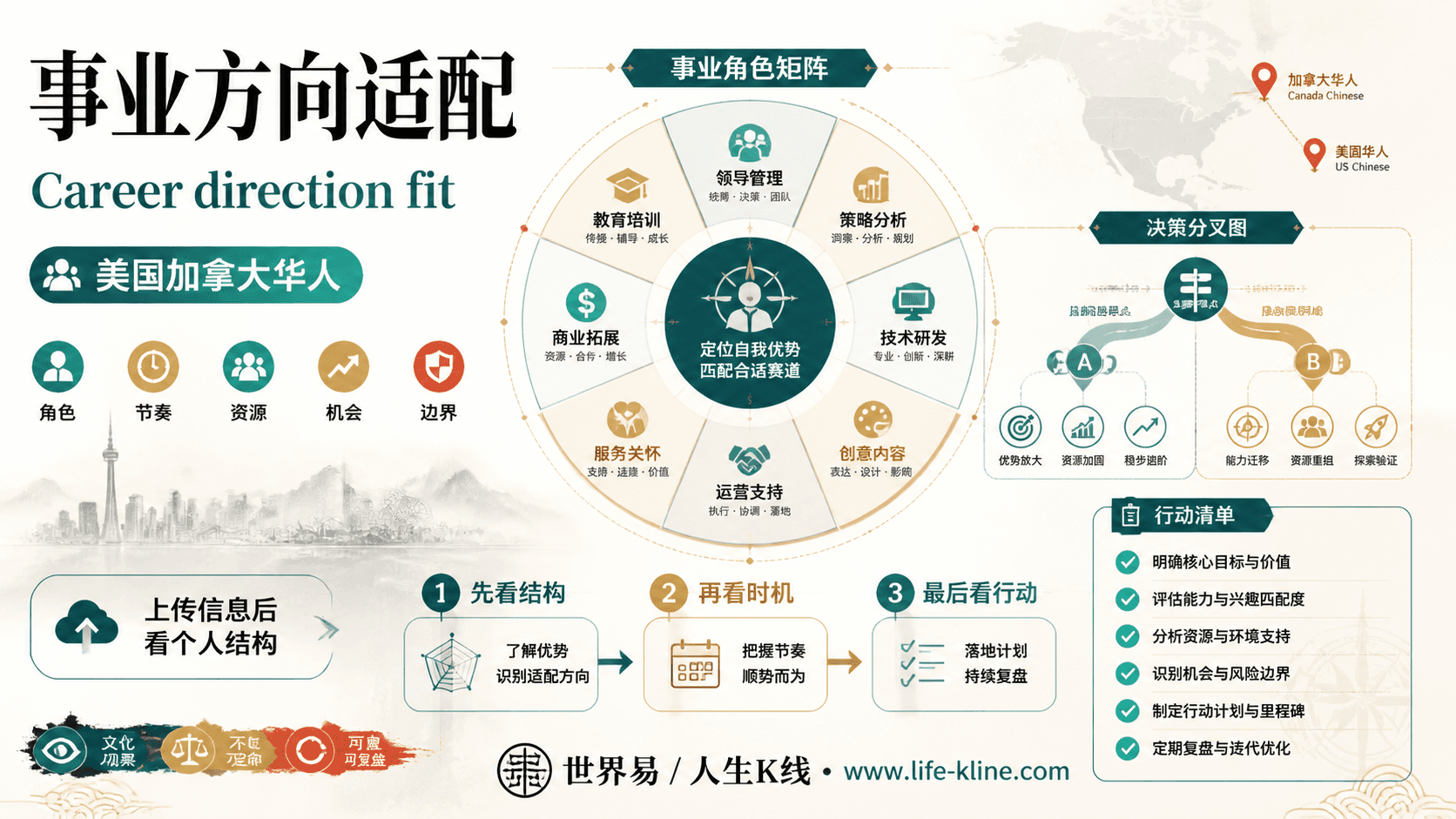
事业方向适配|美国加拿大华人
这张图把《BaZi Analysis and Practical Guide for Partnership vs Sole Proprietorship Decisions in Community Small Shops》里的命理概念转成关系、边界和应用场景,适合先看图建立结构,再回到知识文章正文理解细节。
事业方向适配不应被写成固定结论。更适合美国加拿大华人的读法,是把传统术语翻译成结构、时机、环境、行动和复盘。
查看图片解读