Metaphysical Decision Analysis on Startup Capital Scale and Leverage for Community Small Shops
把这篇文章落到自己身上验证:先看结构,再进入个人分析,不做泛泛阅读。
Why This Decision Is Especially Difficult in This Industry
Community small shops and local service industries have relatively low entry barriers but face fierce competition. Customer loyalty heavily depends on personal relationships and repeat purchases, while rental pressure is significant, often becoming a critical point for cash flow breaks. Entrepreneurs must consider how to meet initial operating costs and rental survival thresholds when deciding startup capital scale and leverage, while avoiding over-investment that tightens cash flow and affects operational stability.
Psychologically, entrepreneurs tend to prefer rapid market capture through large investments. However, in actual operations, excessive financial leverage can pose great risks, especially when customer turnover is unstable or market policies change, quickly amplifying financial pressure and impacting long-term development.
From a metaphysical perspective, the strength of the Day Master, the pattern, and the combination of Yong Shen (favorable element) determine the entrepreneur’s risk tolerance and adaptability. The strength of Bi Jian (Peer) stars reflects relationships with partners and self-resources; Cai stars symbolize capital inflow; Guan and Sha stars represent external pressures and challenges; Yin stars relate to support and wisdom. The interaction of Da Yun (decade luck cycle) and Liu Nian (annual fortune) further influences the rhythm of capital allocation and leverage use.
Therefore, decisions on startup capital scale and leverage are not merely financial calculations but must integrate metaphysical timing to identify capital risk signals, match industry operational structures, achieve both progressiveness and stability, and maximize reduction of entrepreneurial failure risk.
Three Core Dimensions of Metaphysical Judgment
The strength of the Day Master is key to assessing the entrepreneur’s own energy and stress resistance. A relatively weak Day Master needs to rely on the nurturing support of the Yong Shen to enhance its strength. Especially regarding capital investment, a weak Day Master is generally unsuitable for rash heavy-asset startups and should prioritize light-asset testing first, then increase investment as the Yong Shen support strengthens.
Cai stars represent capital and profits. If the Cai stars receive nurturing from the Yong Shen and coordinate well with the Day Master, it indicates smooth capital operations and stronger capacity to bear leverage risk. Conversely, if the Cai stars are suppressed by Ji Shen (unfavorable elements) or the Da Yun and Liu Nian are unfavorable, capital investment should be cautious to avoid cash flow breaks.
Bi Jian stars reflect partners and resource-sharing relationships around the entrepreneur. When strong, they favor partnership and mutual assistance, but excessive strength may cause resource dispersion and internal friction. Guan and Sha stars represent external competition and pressure; if overly strong or suppressed, cautious decision-making is required to avoid excessive risk from heavy assets. Yin stars symbolize wisdom support and external help, especially important in early entrepreneurship to buffer pressure and guide capital usage rhythm.
The interaction of Da Yun and Liu Nian indicates the timing for capital leverage use. Auspicious luck periods suit moderate leverage to break through and develop; stable periods favor maintaining achievements; weak or clashing luck periods require reducing leverage or even pausing large capital investments. Considering the industry’s low entry barriers and high competition, metaphysical dimensions provide a reference for capital investment rhythm, helping entrepreneurs dynamically adjust strategies.
Three Real BaZi Chart Cases
Case 1: This chart’s Day Master is Yi Wood (乙 Yǐ), relatively weak, with a Zheng Guan (Proper Authority) pattern. The Yong Shen is Water, and the Ji Shen are Fire and Earth. Currently in Ren Shen (壬申 Rén Shēn) Da Yun, an auspicious luck cycle, with career and financial progress. In the community small shop industry, the weak Yi Wood Day Master indicates limited stress resistance, but the Ren Shen Da Yun brings support from Cai stars; Water as the Yong Shen nurtures the Day Master, indicating relatively smooth capital flow. Rental and operating cost pressures can be managed with moderate leverage, but the presence of Fire and Earth as Ji Shen warns that excessive capital investment may cause resource depletion and excessive pressure, leading to cash flow breaks. Therefore, it is recommended that this entrepreneur adopt a light-asset trial strategy, first verifying the market through small-scale operation, then gradually expanding capital scale with the help of Water Yong Shen. Commercial due diligence and financial planning must be closely integrated to avoid risk amplification from over-leverage.
Case 2: This chart’s Day Master is Xin Metal (辛 Xīn), relatively weak, with a Shi Shen (Eating God) pattern. The Yong Shen is Water, and the Ji Shen is Wood. The current Da Yun is Ding Wei (丁未 Dīng Wèi), a stable luck cycle suitable for maintaining achievements. The weak Xin Metal Day Master means limited self-capacity; the Shi Shen pattern reflects certain creativity and flexibility. Water as Yong Shen improves capital flow and enhances risk resistance. The Ding Wei Da Yun is stable, suitable for steady operation and avoiding blind expansion. The low entry barrier and intense competition in community small shops require precise capital investment; heavy assets may cause tight cash flow due to rental and staffing costs. This chart suits moderate leverage at startup to maintain liquidity, relying on Shi Shen’s flexibility to adjust operational strategies. It is recommended that the entrepreneur prioritize market research and customer maintenance, gradually accumulating capital and experience through small-scale pilots, avoiding one-time heavy asset investment risks.
Case 3: This chart’s Day Master is Jia Wood (甲 Jiǎ), relatively weak, with a Zheng Yin (Proper Seal) pattern. The Yong Shen is Water, and the Ji Shen are Fire and Earth. Currently in Ding You (丁酉 Dīng Yǒu) Da Yun, a relatively weak luck cycle requiring caution. The weak Jia Wood Day Master and unfavorable Da Yun indicate significant external pressure and limited internal resource support. Although the Zheng Yin pattern provides wisdom and support, the current weak luck cycle means Water Yong Shen’s help cannot fully offset the adverse effects of Fire and Earth Ji Shen. The community small shop industry environment is complex, variable, and highly competitive; heavy-asset investment risks are very high. This chart advises the entrepreneur to strictly control startup capital scale, adopt a light-asset flexible operation model, and avoid financial pressure from excessive leverage. Commercial due diligence should focus on rental costs and customer stability; capital leverage must be used cautiously to maintain cash flow health and be prepared for market changes.
The above three cases all emphasize combining actual industry operational pressures with metaphysical rhythms to rationally assess capital leverage use and avoid blind heavy investment.
Common Misjudgments and Blind Spots in This Industry
Entrepreneurs often mistakenly believe that low entry barrier industries allow arbitrary heavy investment, ignoring the fragility of cash flow caused by high competition and rental pressure. In BaZi, a weak Day Master without adequate Yong Shen support who blindly increases leverage is prone to cash flow breaks and operational failure.
Another blind spot is over-reliance on partners and external resources (strong Bi Jian stars), neglecting the instability and potential internal friction of partnerships. Although strong partnership stars bring assistance, without integrating Da Yun and Liu Nian judgments, it easily leads to chaotic capital allocation and decision errors.
Entrepreneurs also tend to overlook the impact of Da Yun and Liu Nian on the rhythm of capital investment. Over-expansion during unfavorable luck cycles intensifies operational risks. Lack of attention to metaphysical rhythms often results in extremes of blind expansion or capital idleness.
Finally, neglecting the balance between Yong Shen and Ji Shen in BaZi is the fundamental cause of leverage imbalance. Startup capital decisions must minimize Ji Shen suppression and maximize Yong Shen nurturing to maintain healthy capital operation.
Practical Judgment Sequence
First, assess the strength of the Day Master and pattern positioning to clarify one’s stress resistance and Yong Shen needs. If the Day Master is weak and Yong Shen support insufficient, prioritize light-asset testing to avoid capital pressure from heavy assets.
Second, combine the current Da Yun and Liu Nian to judge the rhythm of capital investment. Auspicious luck periods allow moderate leverage to expand operations; stable periods favor steady maintenance; weak luck periods require extreme caution to reduce capital risk exposure.
Finally, integrate industry operational structure and commercial due diligence results to calculate rental, staffing, and other fixed costs, and reasonably plan capital liquidity. Capital planning should be dynamically adjusted to maintain Yong Shen nurturing, avoid Ji Shen intensification, and ensure leverage use is both progressive and safely margined.
FAQ
Question 1: How exactly do Yong Shen and Ji Shen influence startup capital decisions in metaphysics? Answer: Yong Shen represents favorable Five Elements that nurture the Day Master, enhancing the entrepreneur’s risk resistance and supporting smooth capital flow, thus favoring increased capital investment. Ji Shen suppresses the Day Master or Yong Shen, causing capital operation obstacles and increasing investment risk, so capital leverage should be cautiously controlled.
Question 2: Why can some charts with weak Day Masters moderately increase leverage while others must adopt light assets? Answer: The key lies in whether the Yong Shen receives effective nurturing and the auspiciousness of the current Da Yun and Liu Nian. When Yong Shen nurturing is sufficient and luck cycles are favorable, weak Day Masters can leverage capital to amplify operational advantages; otherwise, light-asset operation is advised.
Question 3: Can metaphysical judgment replace commercial due diligence and financial planning? Answer: Metaphysics is an auxiliary tool that helps grasp the rhythm and risk signals of capital investment but cannot replace concrete commercial due diligence and financial planning. Entrepreneurship involves risks; metaphysical advice must be combined with industry realities and professional consultation for decision-making.
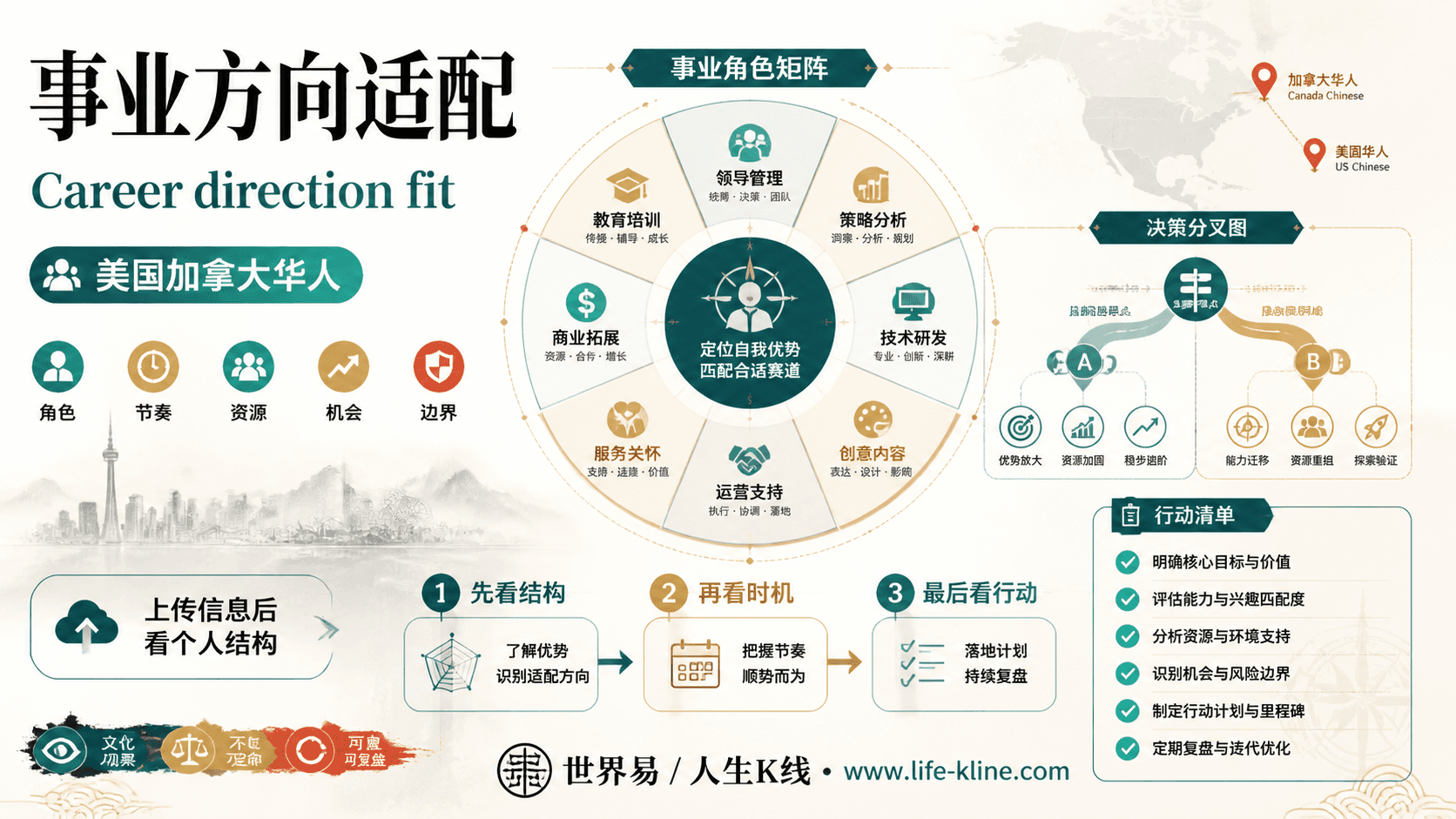
事业方向适配|美国加拿大华人
这张图把《Metaphysical Decision Analysis on Startup Capital Scale and Leverage for Community Small Shops》里的命理概念转成关系、边界和应用场景,适合先看图建立结构,再回到知识文章正文理解细节。
事业方向适配不应被写成固定结论。更适合美国加拿大华人的读法,是把传统术语翻译成结构、时机、环境、行动和复盘。
查看图片解读