Long-Term Growth Trajectory Analysis in University Major Selection and Transfer Decisions Using BaZi
把这篇文章落到自己身上验证:先看结构,再进入个人分析,不做泛泛阅读。
Why This Decision Is Especially Difficult at This Educational Stage
The university stage is a critical period for establishing one’s career path and academic interests. Facing the conflict between personal interests and employment prospects, students and parents often find themselves in a dilemma. In the current Chinese educational environment, although school district advantages and the high school entrance exam streaming policies have influenced basic education, the complexity of major selection has increased accordingly. The 'Double Reduction' policy has alleviated academic pressure but has not resolved deeper issues related to major matching and growth potential.
Moreover, the difficulty of changing or transferring majors cannot be overlooked. Many universities impose strict limits on major transfers, while pursuing double degrees requires balancing time and energy. Planning for guaranteed postgraduate admission or studying abroad demands precise grasp of the student's long-term potential. Parental anxiety is widespread, often relying on short-term academic results to predict the future, neglecting the dynamic changes in long-term growth trajectories.
BaZi structure plays a particularly important role at this stage. The strength of the Day Master, the nature of the chart pattern, the appropriateness of the Yong Shen (favorable element), and the interactions of Da Yun (decade luck) and Liu Nian (annual fortune) all become key reference points for judging which majors and future directions suit the child. BaZi not only reflects individual innate potential but also indicates underlying psychological and behavioral rhythms, helping families avoid blind trends and shortsighted decisions.
Therefore, combining educational realities with an understanding of how BaZi structures amplify or suppress risks in major selection and transfer decisions is key to guiding students toward long-term growth. Only by balancing reality and BaZi can a deep integration of science and humanities be achieved.
Three Core Dimensions of BaZi Judgment
First, the relationship between the Day Master and Shi Shen (Eating God) and Yin Star (Resource) directly affects learning ability and expressive capacity. Shi Shen represents creativity and the desire to express, while Yin Star symbolizes knowledge absorption and internalization. The strength of the Day Master determines the individual's self-energy intensity; a relatively strong Day Master is more suited to proactive expression and innovation, whereas a weaker Day Master requires support from Yin Star to supplement energy.
Second, the combination of Da Yun and Liu Nian reflects the growth environment and stage opportunities. Da Yun represents the dominant energy trend over approximately ten years; a stable Da Yun period is suitable for consolidation, while a turbulent period calls for cautious advancement. Liu Nian indicates specific yearly changes, and their interaction determines the timing and risk-reward balance in major selection and changes.
Third, the resonance between the parents’ and children’s palace positions reveals intergenerational influences and family educational atmosphere. The parents’ BaZi structure often affects the child’s learning attitude and psychological state, especially the interaction between Guan Sha (Officer and Killing Stars) and the children's palace, which can indicate hidden sources of pressure or support within family education.
By integrating these three dimensions, BaZi judgment not only helps identify the child’s potential learning advantages and psychological resilience but also provides rhythm references for planning reasonable major transfer paths, avoiding blind following of external trends, and maximizing long-term growth potential.
Three Real BaZi Chart Cases
Case 1: This male’s Day Master is Xin (辛, Metal), relatively strong, with a Zhuan Wang (special strong) pattern. The Yong Shen is Earth, and the Ji Shen (unfavorable element) is Wood. Currently in the Gui Wei (癸未) Da Yun (ages 24-33), a stable period suitable for consolidation, with the Liu Nian Bing Wu (丙午) indicating the need for flexible responses. The relatively strong Xin Metal Day Master reflects abundant self-energy, and the Zhuan Wang pattern emphasizes strong self-focus. Earth as the Yong Shen helps stabilize the foundation, making majors such as science and engineering, civil engineering, or architecture particularly suitable. The stable Da Yun suggests this stage is better for deepening expertise rather than frequent changes. The presence of Ji Shen Wood requires caution against interest dispersion and insufficient management ability.
In practical education, when this student faces the choice between interest and employment, it is advisable to firmly focus on one direction and avoid blind cross-major shifts. The long-term growth trajectory supported by Earth as Yong Shen favors steady development, but the Liu Nian Bing Wu brings changes that require flexible handling of unexpected academic issues. It is recommended to first confirm whether Ji Shen Wood interference is present; if not, consolidation and deep study are suitable. If there is strong interest related to Wood-element majors, the risks of transfer should be carefully weighed.
Case 2: This male’s Day Master is Ren (壬, Water), relatively weak, with a Zheng Yin (proper resource) pattern. The Yong Shen is Fire, and Ji Shen is Wood. Currently in the Gui You (癸酉) Da Yun (ages 15-24), a stable consolidation period, with Liu Nian Bing Wu (丙午) requiring flexible adaptation. The weak Ren Water Day Master needs nourishment from the Zheng Yin Fire star, which represents learning absorption ability, thus favoring majors in liberal arts, education, psychology, or other fields requiring continuous internalization. Ji Shen Wood may cause distraction and pressure, so study rhythm adjustments are necessary.
In the context of university major selection and transfer, this student is better suited to majors that enhance inner energy, avoiding excessive challenges to the core self. The stable Da Yun period is conducive to accumulating knowledge and skills, but the Liu Nian Bing Wu suggests the need to flexibly respond to external changes and moderately adjust the major direction. In the long-term growth trajectory, priority should be given to securing the support of the Fire Yin Star and preventing psychological fluctuations caused by Ji Shen Wood.
The recommended judgment sequence is to first assess whether the Fire Yin Star is sufficient; if insufficient, forced major transfer is not advisable. If Fire Yin is adequate and there is a clear interest direction, pursuing a minor or transfer to a related field can enhance comprehensive competitiveness.
Case 3: This female’s Day Master is Geng (庚, Metal), relatively strong, with a Shang Guan (Hurting Officer) pattern. The Yong Shen are Fire and Wood, and Ji Shen is Earth. Currently in the Geng Shen (庚申) Da Yun (ages 21-30), a stable consolidation period, with Liu Nian Bing Wu (丙午) requiring flexible adaptation. The Hurting Officer pattern manifests as very strong expressive and creative ability. The relatively strong Day Master combined with Fire and Wood as Yong Shen suits majors in media, arts, design, and other expressive disciplines. The presence of Ji Shen Earth indicates possible real-world constraints and resource limitations.
In practice, this student should focus on matching interests with expressive potential when choosing a major. When considering transfer, the influence of Earth should be evaluated to avoid severe disconnects between ideals and reality. Over time, the expressive advantage of the Hurting Officer pattern will strengthen, but proper guidance is needed to prevent conflicts or burnout caused by excessive self-expression.
The judgment sequence should first confirm the degree of Earth influence. If Earth is heavy, consolidating the current major and avoiding frequent switches is advisable. If Earth is light and expressive needs are strong, actively seeking transfer or minor opportunities to enhance expression and innovation abilities is suitable.
Common Misjudgments and Blind Spots at This Stage
Many parents and students overly rely on short-term academic results and transient interest fluctuations to make major decisions, neglecting the guiding significance of Da Yun, Liu Nian, and Day Master patterns in long-term growth. Shortsighted decisions may lead to frequent major changes, adversely affecting knowledge accumulation and professional depth.
Another blind spot is misunderstanding Yong Shen and Ji Shen. Some parents treat Ji Shen as an absolute taboo, ignoring the dynamic balance and flexibility emphasized in BaZi, resulting in overprotection or restrictions that limit the student’s development space.
At the same time, neglecting the roles of Shi Shen and Yin Star in expression and learning, and failing to adjust educational strategies according to the child’s actual personality and psychological state, can easily cause parent-child intergenerational conflicts and psychological stress accumulation. Parents should pay attention to psychological crisis signals and seek professional psychological assistance promptly; BaZi serves only as a reference tool for growth rhythms.
Finally, ignoring the integration of Da Yun and Liu Nian with specific academic year policies and social environments, relying solely on rigid BaZi guidance, makes major selection lack practical adaptability and increases educational investment risks.
Practical Judgment Sequence
Step one: Clarify the child’s Day Master strength and chart pattern type, evaluating core learning and expressive strengths as well as potential psychological resilience. For example, Zhuan Wang patterns tend to be stable and focused, while Hurting Officer patterns have strong expression but are susceptible to external influences.
Step two: Combine analysis of Yong Shen and Ji Shen to determine whether the current Da Yun and Liu Nian indicate a consolidation period or a transformation period, judging if it is suitable for major transfer or pursuing a minor in a new field. Consolidation periods favor deepening expertise, while transformation periods allow moderate adjustment but require careful risk assessment.
Step three: Comprehensively consider educational realities such as university transfer policies, employment prospects of disciplines, family resources, and psychological state, avoiding reliance solely on BaZi conclusions. Regularly review changes in BaZi rhythms and dynamically adjust decisions based on the child’s interests and abilities.
Finally, if the child shows obvious psychological stress or signs of depression, seek professional psychological help promptly. BaZi judgment is only an auxiliary reference; parents should use scientific methods to ensure the child’s physical and mental health.
FAQ
Question 1: How do Yong Shen and Ji Shen specifically influence major selection? Answer: Yong Shen represents the supportive elements needed for the child’s growth; choosing majors that match the Yong Shen attributes helps stimulate potential. Ji Shen represents conflicting and obstructive elements; majors involving Ji Shen may increase learning difficulty or psychological pressure and should be carefully considered.
Question 2: How do Da Yun and Liu Nian guide the timing of major transfer? Answer: Da Yun reflects the dominant energy over about ten years; consolidation periods are suitable for strengthening the professional foundation and avoiding frequent changes. Liu Nian represents annual energy fluctuations; if the Liu Nian brings favorable changes, moderate adjustment of the major can be considered, otherwise it is advisable to wait for a more mature opportunity.
Question 3: How to avoid one-sided interpretations in BaZi judgment? Answer: BaZi should be combined with the child’s actual interests, academic performance, and psychological condition, avoiding isolated use. Parents should pay attention to the child’s inner feelings, communicate timely, and cooperate with professional education and psychological counseling. BaZi serves only as a reference tool for growth rhythms and should not be used as an absolute decision-making basis.
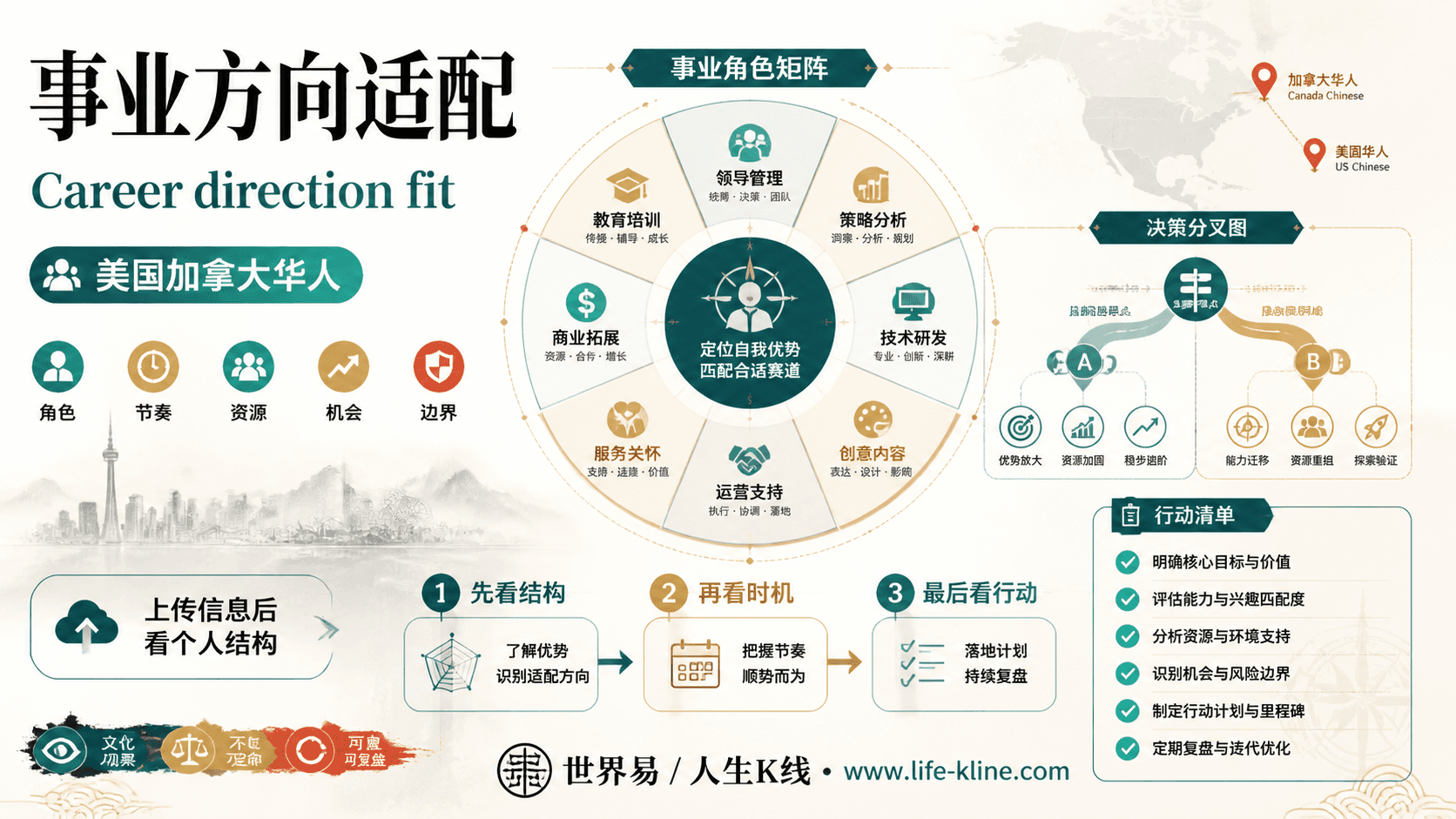
事业方向适配|美国加拿大华人
这张图把《Long-Term Growth Trajectory Analysis in University Major Selection and Transfer Decisions Using BaZi》里的命理概念转成关系、边界和应用场景,适合先看图建立结构,再回到知识文章正文理解细节。
事业方向适配不应被写成固定结论。更适合美国加拿大华人的读法,是把传统术语翻译成结构、时机、环境、行动和复盘。
查看图片解读