Metaphysical Analysis and Educational Decision Guidance for University Major Selection and Transfer Path Matching
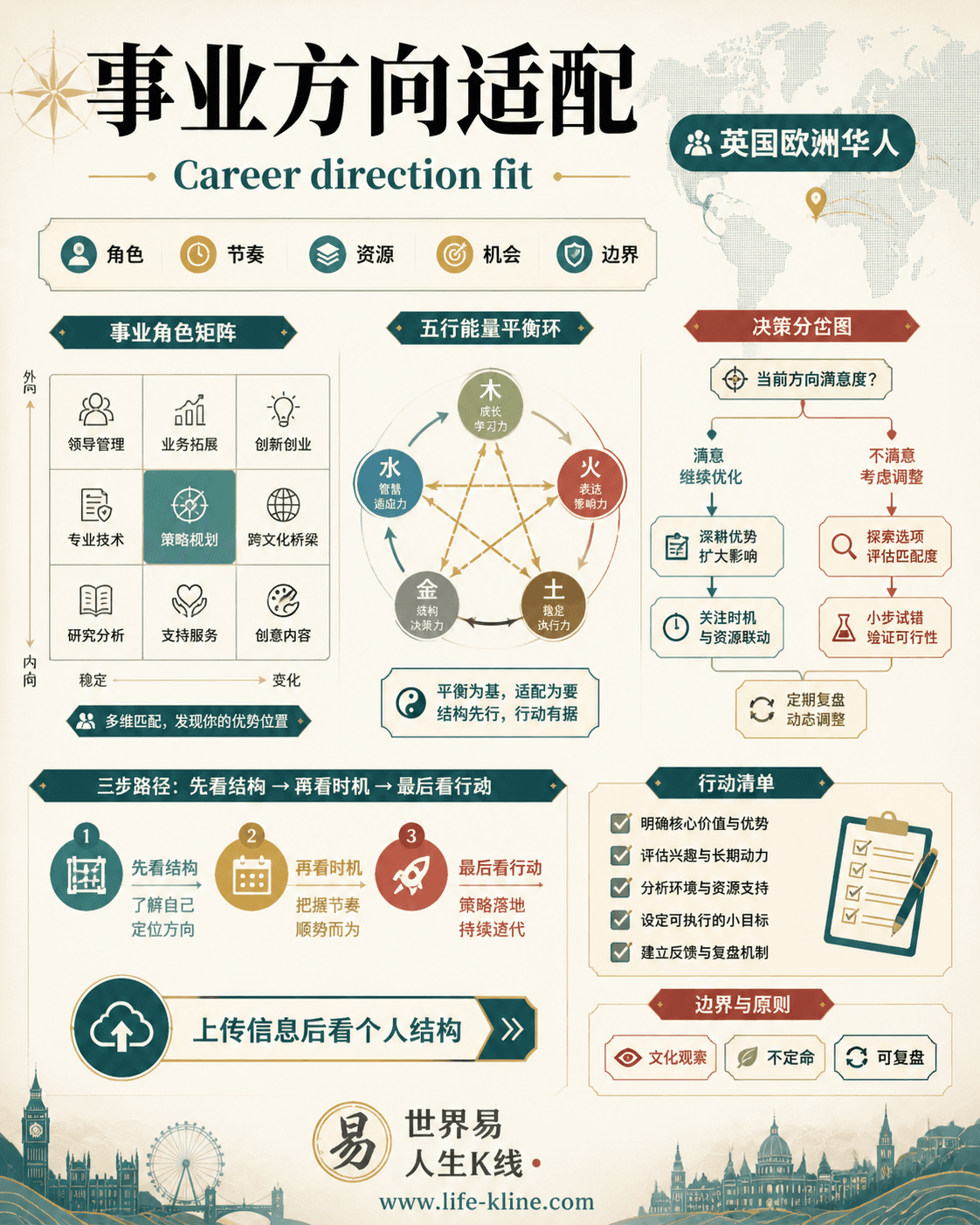
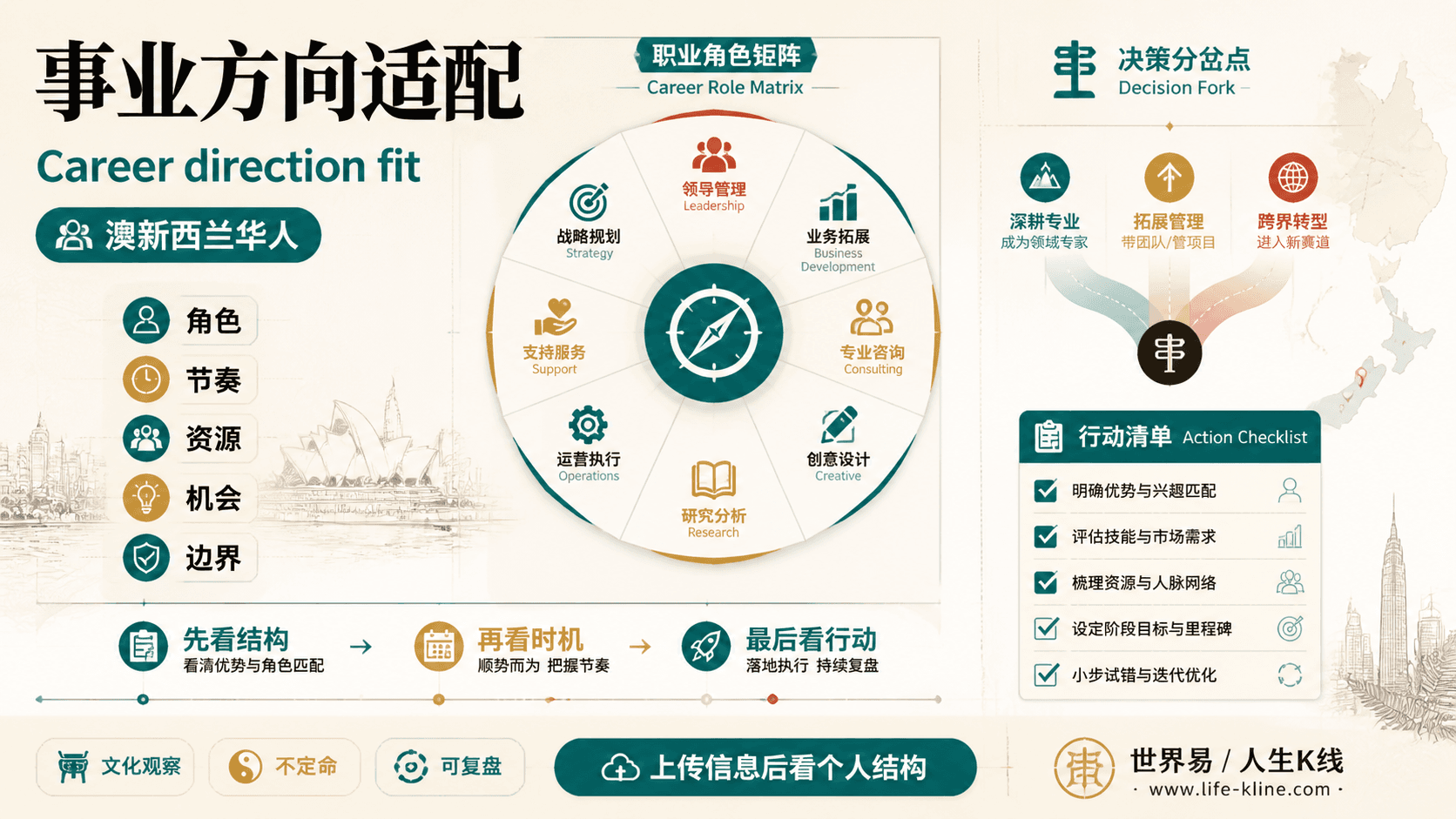
把这篇文章落到自己身上验证:先看结构,再进入个人分析,不做泛泛阅读。
Why This Decision Is Especially Difficult at This Educational Stage
The decision of university major selection and transfer is a focal concern for many Chinese families. Especially under the "Double Reduction" policy, although academic pressure has somewhat eased, competition for further education and employment remains fierce. Parents and students struggle to balance multiple factors such as personal interests versus employment orientation, cross-major difficulty, double degree minors, and guaranteed postgraduate or overseas study opportunities, often leading to anxiety and confusion.
Moreover, the streaming mechanism and school district advantages in the Chinese education system mean that different types of schools (public, private, international, vocational) have significant differences in resources and teaching models. These differences directly affect students’ academic rhythm and opportunities for expression, thereby influencing their major compatibility and success rate in transferring majors.
At this point, combining metaphysical structural analysis—especially focusing on the strength of the Day Master, pattern types, Yong Shen, and the changes in Da Yun (decade luck cycle) and Liu Nian (annual fortune)—can provide references for rhythm and timing. This helps to judge in which paths students are more likely to realize their potential, which stages should avoid risks, and assists parents and students in rationally planning their future.
Therefore, the path matching for university major selection and transfer is not only an academic choice but also a complex system involving family resource allocation, psychological adjustment, and dynamic overlay of metaphysical rhythms, requiring multidimensional comprehensive analysis.
Three Core Dimensions of Metaphysical Judgment
Firstly, the strength of the Day Master determines the student’s internal energy and self-expression ability. A relatively weak Day Master often needs to rely on the Yong Shen to harmonize and strengthen learning motivation and adaptability; a balanced Day Master generally has more flexibility in major selection. The Shi Shen (Food God, representing learning and expression) and Yin Xing (Resource Stars, representing support and resources) are especially critical. A good Shi Shen configuration aids academic performance, while Yin Xing corresponds to the level of family and educational resource support.
Secondly, pattern types such as Qi Sha (Seven Killings) and Zheng Guan (Proper Officer) reflect the student’s personality traits and strategies for coping with challenges. Qi Sha patterns often indicate drive and a spirit of breakthrough but may bring emotional fluctuations, requiring attention to psychological adjustment; Zheng Guan patterns tend toward norms and stability, better suited for steady academic paths and career planning. The choice of Yong Shen directly influences how the individual coordinates their internal rhythm through external environments (school types, major characteristics) at different stages.
Thirdly, the current Da Yun and Liu Nian interactions reveal the student’s present fate stage and risk points. During weak or unfavorable Da Yun phases, it is advisable to avoid major changes and excessive risks, favoring steady study paths; stable Da Yun phases are suitable for expansion and diverse attempts, beneficial for major transfers or cross-school advanced studies. Annual fortune changes remind parents to pay attention to possible signals of change in that year and adjust plans promptly.
By integrating these three dimensions and combining them with specific school types and major characteristics, one can more scientifically assess the student’s compatibility and future development potential across different educational paths, assisting families in making more targeted decisions.
Three Real BaZi Chart Cases
Case 1: This female Day Master is Yi Wood (乙, Yi) and relatively weak, belonging to the Qi Sha (Seven Killings) pattern. Her Yong Shen is Water, and her Ji Shen (unfavorable elements) are Fire and Earth. She is currently in the 10th year of the Ji Wei (己未, Ji Wei) Da Yun, which is an unfavorable luck phase, and the Liu Nian is Bing Wu (丙午, Bing Wu), with a weak interaction between Liu Nian and Da Yun. The weak Yi Wood Day Master combined with the Qi Sha pattern indicates a personality with strong breakthrough potential but facing significant pressure during this Da Yun, prone to emotional fluctuations and changes. In educational reality, she should avoid high-risk major transfers and excessive cross-disciplinary shifts, favoring majors with stable structures and strong support in public schools or focusing on foundational disciplines. Utilizing the Yong Shen Water element can harmonize and enhance learning adaptability. The recommended judgment sequence is first to confirm the synergy between the major and the Yong Shen Water, then assess whether school resources can stably support her, and finally cautiously consider the psychological and rhythm risks of transferring majors.
Case 2: This male Day Master is Geng Metal (庚, Geng) and relatively weak, belonging to the Zheng Guan (Proper Officer) pattern. His Yong Shen is Water, and his Ji Shen is Wood. He is currently in the 2nd year of the Geng Wu (庚午, Geng Wu) Da Yun, with an overall stable luck phase, and the Liu Nian is Bing Wu (丙午, Bing Wu), indicating a need for adaptability. The weak Geng Metal Day Master with the Zheng Guan pattern shows he has strong normativity and a sense of responsibility, suitable for steady and systematic learning. Educational decisions favor public or vocational technical schools, with major choices aiming for steady progress and avoiding large cross-major shifts. Double degree minors or international paths can be auxiliary strategies to broaden horizons but attention should be paid to potential pressure from the Ji Shen Wood element. The suggested judgment order is to evaluate the normative match between major and officer/killer stars, combine Da Yun and Liu Nian to assess change risks, and then use school type compatibility to formulate a stable major transfer plan.
Case 3: This female Day Master is Bing Fire (丙, Bing) and balanced, belonging to the Qi Sha (Seven Killings) pattern. Her Yong Shen is Wood, and her Ji Shen is Water. She is currently in the 4th year of the Ding Hai (丁亥, Ding Hai) Da Yun, with an overall stable luck phase, and the Liu Nian is Bing Wu (丙午, Bing Wu), indicating adaptability. The balanced Bing Fire Day Master with the Qi Sha pattern shows a personality combining motivation and balance, capable of effectively expressing initiative and creativity. Educational decisions can consider international schools or private schools with innovative features. Major selection is suitable for cross-major attempts and double degree minors, which leverage the Yong Shen Wood advantage to promote academic achievement and expression. Attention should be paid to emotional fluctuations potentially caused by the Ji Shen Water; parents are advised to monitor psychological status. The judgment sequence should first confirm whether the school and major align with the Yong Shen Wood, then analyze the feasibility and risks of transferring majors, and finally adjust academic rhythm reasonably based on Liu Nian and Da Yun.
Common Misjudgments and Blind Spots at This Stage
Many parents and students tend to overly rely on a single dimension such as interest or employment orientation when choosing or transferring university majors, neglecting the internal rhythm of academic expression and the influence of metaphysical structure. This often leads to insufficient learning motivation or adaptation difficulties after the decision. Especially for weak Day Masters during unfavorable Da Yun phases, rash major transfers or high-risk paths amplify risks and easily cause setbacks.
Another blind spot is ignoring the matching relationship between school types and the metaphysical Yong Shen. Different types of schools’ teaching models, resource support, and cultural environments have varying degrees of amplification or suppression effects on the student’s Shi Shen and Yin Xing in their BaZi chart. For example, a Zheng Guan pattern Day Master who prefers stability may have poor adaptation in the open environments of international or private schools, and vice versa.
Furthermore, the interaction between Liu Nian and Da Yun is often overlooked. Ignoring this can lead to making major changes during unfavorable Da Yun or Liu Nian periods, increasing academic setbacks and psychological burdens. Especially when psychological crisis signals appear, parents should promptly seek professional psychological assistance. Metaphysical rhythms serve only as a reference and cannot replace professional judgment.
In summary, misjudgments mostly stem from failing to integrate metaphysical rhythms with the real educational environment’s interactive effects, lacking a global perspective of dynamic adjustment and risk assessment.
Practical Judgment Sequence
First, clarify the student’s Day Master strength and pattern type, combine with Yong Shen to identify core energy needs and harmonizing strategies, and judge the suitable learning expression style and rhythm. Next, check the current Da Yun and Liu Nian to identify whether the student is in a risk or opportunity window, deciding whether to maintain stability or actively adjust the major transfer path.
Second, evaluate the compatibility between the intended school type (public, private, international, vocational) and the metaphysical Yong Shen, analyzing whether the school’s resources and teaching model can amplify the student’s Shi Shen and Yin Xing advantages or whether it may trigger Ji Shen conflicts, creating potential pressure.
Finally, integrate the cross-disciplinary difficulty and future employment trends of specific majors to reasonably plan minors, double degrees, or guaranteed postgraduate/overseas study paths, ensuring decisions balance metaphysical rhythm with real educational needs. When psychological pressure or learning obstacles arise at critical nodes, timely professional psychological support should be sought to avoid amplifying negative effects of metaphysical rhythms.
FAQ
Question 1: Why is Yong Shen in metaphysics so important for university major selection? Answer: Yong Shen represents the key elements in a student’s BaZi chart that harmonize and supplement the Day Master’s strength. Correct Yong Shen can enhance learning motivation, expression ability, and adaptability, effectively supporting the student to leverage advantages in their major studies and avoid academic bottlenecks caused by environmental pressures.
Question 2: How to combine Da Yun and Liu Nian in transfer major decisions? Answer: Da Yun reveals the long-term rhythm of a student’s fate, while Liu Nian reflects the annual fortune changes. When in unfavorable Da Yun or Liu Nian phases, transferring majors carries higher risks, and a conservative strategy is advisable; when Da Yun is stable and Liu Nian favorable, one can seize opportunities and flexibly adjust paths.
Question 3: If a child experiences a psychological crisis, what help can metaphysics provide? Answer: Metaphysics can offer rhythm references, alerting parents to stress signals during specific periods. However, psychological crises are a professional domain requiring immediate help from psychologists or specialized institutions. Metaphysics serves only as an auxiliary decision-making reference.
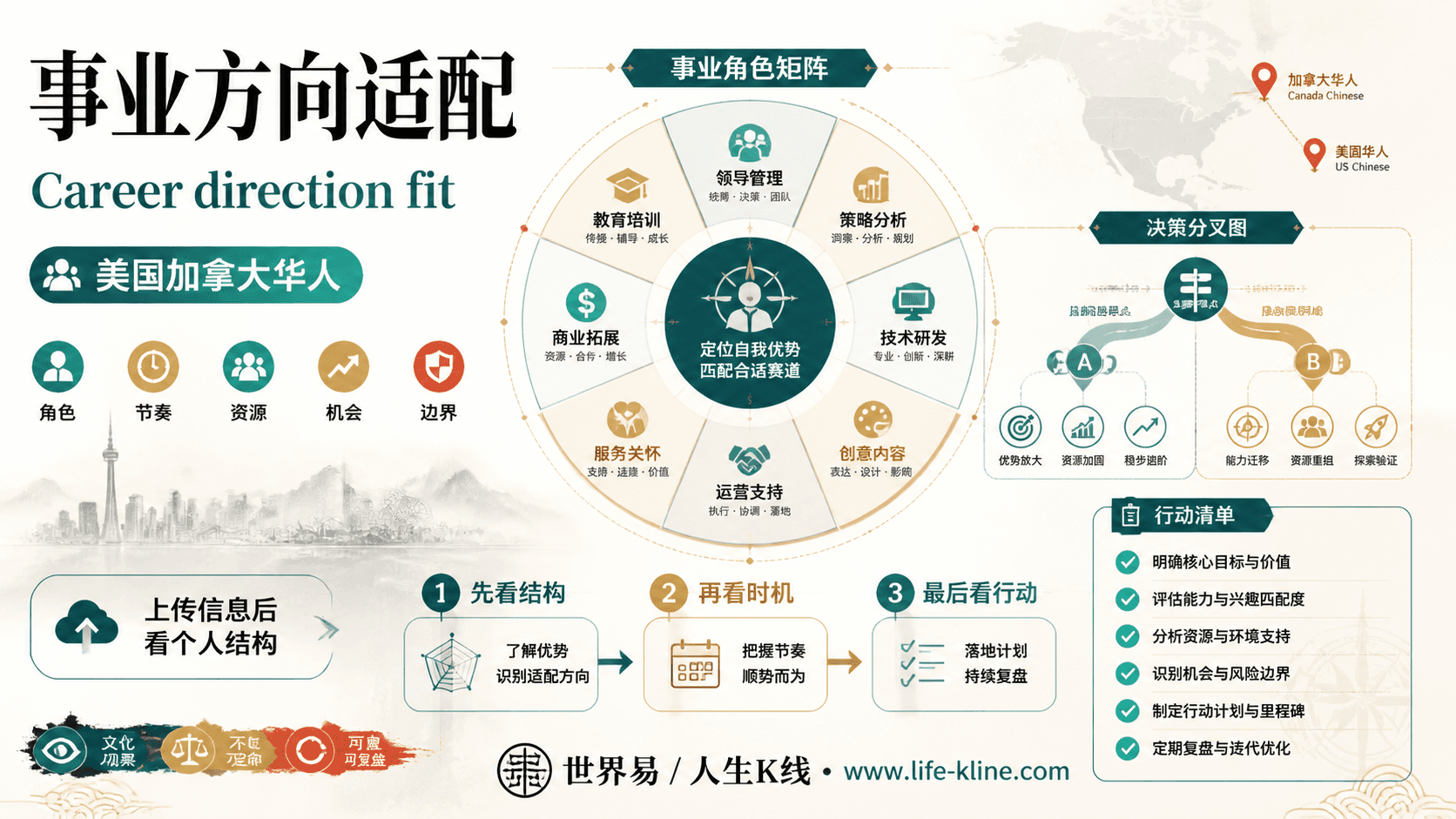
事业方向适配|美国加拿大华人
这张图把《Metaphysical Analysis and Educational Decision Guidance for University Major Selection and Transfer Path Matching》里的命理概念转成关系、边界和应用场景,适合先看图建立结构,再回到知识文章正文理解细节。
事业方向适配不应被写成固定结论。更适合美国加拿大华人的读法,是把传统术语翻译成结构、时机、环境、行动和复盘。
查看图片解读