Metaphysical Assistance in Family Portfolio Allocation for Collectibles and Alternative Investments
把这篇文章落到自己身上验证:先看结构,再进入个人分析,不做泛泛阅读。
Why This Decision Is Especially Difficult for This Category
Collectibles and alternative investments inherently suffer from poor liquidity, long transaction cycles, and high professional authentication thresholds, resulting in uncertain capital lock-in periods and high liquidation costs. Sub-markets such as artworks, antiques, and watches are also strongly influenced by cultural preferences. Their price fluctuations reflect supply and demand and market sentiment more than pure economic fundamentals, bringing significant uncertainty to family asset allocation.
During decision-making, family investors tend to overestimate the potential returns of collectibles due to their scarcity and emotional value, while neglecting liquidity risks and authentication risks. Especially regarding allocation proportions, pursuing excessively high positions often exacerbates the overall portfolio’s illiquidity risk, reduces capital flexibility, and increases financial pressure.
By combining the BaZi chart’s Wealth Stars (Cai Xing), Bi Jian (Peer Stars), and Yin Stars (Resource Stars) relationships, one can assist in understanding the investor’s wealth fortune and risk tolerance. For example, a chart with strong Wealth Stars but strong Bi Jian indicates the investor has strong wealth acquisition ability but may face peer competition or resource dispersion risks, while strong Yin Stars provide support for stable wealth accumulation.
Therefore, metaphysical rhythms can serve as auxiliary guidance in deciding the allocation proportion of collectibles, helping investors find a balance between complex market environments and their own fortune, reasonably plan positions, and avoid blind chasing or excessive conservatism.
Three Core Dimensions of Metaphysical Judgment
First, the strength of the Day Master (Ri Zhu) determines the individual’s energy foundation and adaptability to the external environment. Since collectibles have poor liquidity, investors need strong patience and risk tolerance; a relatively weak Day Master suggests more cautious allocation to avoid concentrated risks.
Second, the Wealth Stars (Cai Xing) reflect the source and absorption capacity of wealth. A Zheng Cai (Proper Wealth) pattern indicates stable and legitimate wealth sources, suitable for steady investment in collectibles; Bi Jian (Peer Stars) represent wealth sharing and competition. If Bi Jian is strong, the investor may face competition or resource dispersion, so over-concentration should be avoided.
Finally, the Yin Stars (Resource Stars) support the Day Master and Wealth Stars by providing knowledge, resources, and protection, beneficial for risk management. Strong Yin Stars help stabilize assets and buffer market volatility’s impact on collectible values. By observing the interactions of Wealth Stars, Bi Jian, and Yin Stars in the Da Yun (decade luck cycle) and Liu Nian (annual fortune), one can judge the timing and urgency of adjusting collectible investments.
Three Real BaZi Chart Cases
Case 1: This male Day Master is 丁火 (Ding Fire), relatively weak, with a Zheng Cai (Proper Wealth) pattern. His Yong Shen (favorable element) is Metal, and Ji Shen (unfavorable element) is Earth. Currently in the 6th year of the 丁酉 (Ding You) Da Yun, with the 丙午 (Bing Wu) Liu Nian, the overall luck cycle is auspicious, with progress in career and wealth. Metal as Yong Shen indicates his wealth acquisition depends on Metal-related resources, and the Zheng Cai pattern shows stable wealth sources. Given the poor liquidity of collectibles and the weak Ding Fire Day Master, the investor should cautiously control allocation proportions to avoid liquidity and authentication risks causing capital chain tightness. For family portfolio allocation, it is recommended to keep collectibles at a relatively low proportion, prioritize liquid assets, and adjust positions timely in line with the Da Yun.
Case 2: This male Day Master is 壬水 (Ren Water), relatively weak, with a Zheng Guan (Proper Authority) pattern. His Yong Shen is Fire, and Ji Shen is Wood. He is in the 3rd year of the 壬子 (Ren Zi) Da Yun, with the 丙午 (Bing Wu) Liu Nian. The Da Yun is stable, suggesting a conservative approach. The weak Ren Water Day Master and Zheng Guan pattern indicate his wealth acquisition relies heavily on external environment and rules, with limited risk tolerance. The high authentication risk and cultural preference in collectibles make quick liquidation difficult. The Ji Shen Wood, related to cultural attributes of collectibles, may cause investment judgment bias. This investor should keep collectibles allocation extremely low, as a diversification supplement, maintaining overall portfolio stability.
Case 3: This female Day Master is 丙火 (Bing Fire), balanced, with a Zheng Cai (Proper Wealth) pattern. Her Yong Shen is Wood, and Ji Shen is Water. She is in the 9th year of the 丙申 (Bing Shen) Da Yun, with the 丙午 (Bing Wu) Liu Nian. The overall fortune is stable, favoring a conservative stance. Wood as Yong Shen and strong Yin Stars indicate good risk management and wealth accumulation capacity. The cultural preference and authentication risks in collectibles can be buffered by her strong Yin Star support. Combined with the balanced Day Master and steady Da Yun, she is suitable to allocate a moderate proportion of collectibles in the family assets, using Yin Stars’ stability to diversify portfolio risk, while paying attention to liquidity changes and adjusting positions timely.
Common Misjudgments and Blind Spots in This Category
One common misjudgment in collectibles investment is over-reliance on emotional and scarcity valuation, ignoring poor liquidity and high authentication risks, causing capital to be locked long-term and affecting the family’s overall asset liquidity and emergency capability. Investors often overestimate market demand stability and underestimate price volatility.
Another blind spot is neglecting market regulation and tax costs. Collectibles involve authentication, maintenance, transaction fees, and potential tax burdens. Without fully considering these hidden costs, expected returns may deviate from reality, impacting overall investment effectiveness.
From a metaphysical perspective, lack of attention to the dynamic interaction of Wealth Stars, Bi Jian, and Yin Stars makes it difficult for investors to grasp cyclical changes in wealth fortune, ignoring metaphysical rhythms’ guidance on risk tolerance and investment timing, increasing risks of blind expansion or excessive conservatism.
Considering these misjudgments, collectibles should always maintain a reasonable proportion in family asset allocation. Combined with metaphysical auxiliary judgment, this helps avoid position loss caused by short-term market fluctuations or emotional impulses.
Practical Judgment Sequence
First, assess the strength of the Day Master and the Yong Shen and Ji Shen in your BaZi chart. Clarify the influence of the current Da Yun and Liu Nian on Wealth Stars, Bi Jian, and Yin Stars to judge the strength and stability of your wealth fortune. This step establishes your risk tolerance and wealth accumulation rhythm.
Second, considering the liquidity and authentication risks of the collectibles market, set a basic allocation range. If metaphysics shows strong Wealth Stars and powerful Yin Stars, you may moderately increase the allocation proportion; otherwise, compress it to avoid excessive capital pressure due to market fluctuations.
Finally, dynamically adjust positions according to the auspicious or inauspicious changes in Da Yun and Liu Nian interactions. For example, slightly increase positions during favorable Da Yun and Liu Nian to seize opportunities; reduce or hold positions when Da Yun or Liu Nian are volatile or Ji Shen appears. Risk management should be the core of all operations, avoiding neglect of professional financial advice and market fundamentals due to metaphysical guidance.
It is important to emphasize that metaphysics serves only as an auxiliary reference. Investment involves risks, and it is recommended to combine professional asset allocation advice and your financial situation to scientifically plan the proportion of collectibles in family assets.
FAQ
Question 1: Does strong Wealth Stars (Cai Xing) in metaphysics mean you can heavily allocate to collectibles? Answer: Strong Wealth Stars indicate strong wealth acquisition ability, but suitability for heavy collectibles allocation depends on the Day Master’s strength, Bi Jian, Yin Stars, and market liquidity. Since collectibles have poor liquidity, if Wealth Stars are strong but Yin Stars are weak or Bi Jian is strong, cautious allocation is advised to avoid liquidity risks caused by excessive position size.
Question 2: Why are Yong Shen (favorable element) and Ji Shen (unfavorable element) important for judging collectibles investment proportion? Answer: Yong Shen harmonizes the chart and supports wealth, while Ji Shen represents elements to be restrained or avoided. Collectibles investment involves cultural preferences and authentication risks; if Yong Shen aligns with collectibles’ attributes, risk control improves. When Ji Shen is prominent, judgment errors or capital pressure may arise, requiring reduced allocation.
Question 3: Can metaphysical auxiliary judgment replace professional financial advice? Answer: Metaphysics only provides auxiliary insight into individual wealth rhythms and risk tolerance. It cannot replace professional financial planning. Collectibles investment requires comprehensive consideration of market environment, asset liquidity, taxation, and personal finances. Combining metaphysics with professional advice enables more scientific allocation decisions.
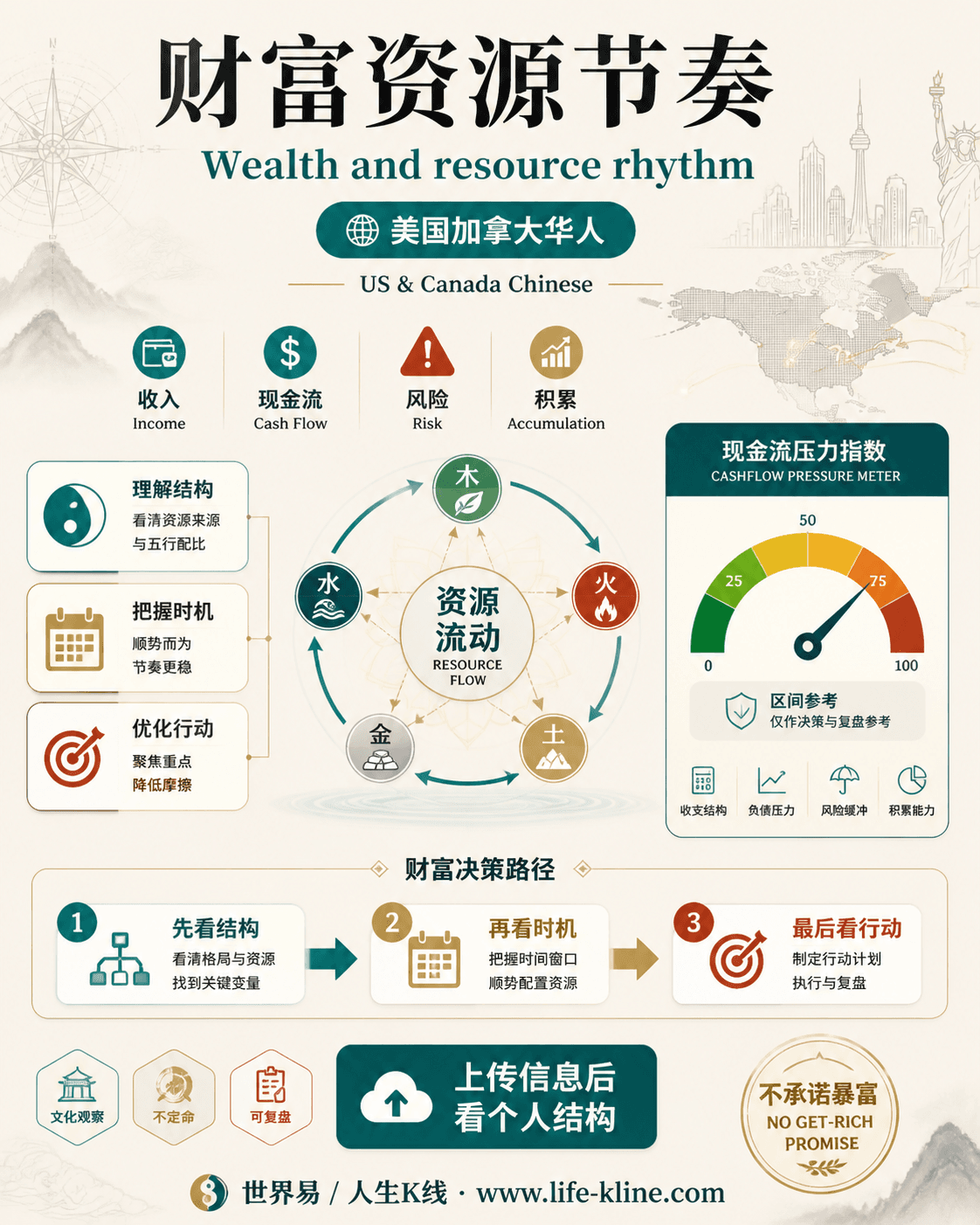
财富资源节奏|美国加拿大华人
这张图把《Metaphysical Assistance in Family Portfolio Allocation for Collectibles and Alternative Investments》里的命理概念转成关系、边界和应用场景,适合先看图建立结构,再回到知识文章正文理解细节。
财富资源节奏不应被写成固定结论。更适合美国加拿大华人的读法,是把传统术语翻译成结构、时机、环境、行动和复盘。
查看图片解读