Decisive Choices in Partnership Startups: A Metaphysical Perspective on Friend Relationship Decisions
把这篇文章落到自己身上验证:先看结构,再进入个人分析,不做泛泛阅读。
Why This Decision Is Especially Difficult in This Scenario
Partnership startups involve not only the distribution of economic benefits but also deep tests of trust and responsibility. Unequal equity and division of labor easily trigger jealousy and social comparison psychology. Especially when cooperation reaches a bottleneck, the intimate relationship between partners undergoes intense pressure, and the cost of trust collapse often exceeds expectations. At this time, any decision touches on emotional and psychological exhaustion, impacting far beyond money itself.
From the perspective of social dynamics, partnership relationships are not only reciprocal cooperation but also contain potential power struggles and role identification. Jealousy and insecurity may lead to relationship breakdowns, thereby affecting career development. Such complex psychological factors often cause cognitive biases during decision-making, such as over-optimism and attribution errors, blurring the boundary between severing ties and maintaining the partnership.
BaZi structure plays an auxiliary rhythmic role in this scenario, helping to identify when the situation is in a repair window and when risks have reached an irreversible state. The interaction between the Day Master and Bi Jian/Jie Cai (friends stars), the expression ability of Shi Shen/Shang Guan (output stars), the financial accounts represented by Cai Xing (wealth stars), and the shared pressure brought by Zheng Guan/Qi Sha (official stars) will amplify or suppress conflicts in tense relationships, guiding decisions. However, it should be noted that BaZi is only an aid; emotional and legal issues still require professional handling.
Therefore, the difficulty of severing or maintaining decisions in partnership startups lies in the entanglement of emotions and interests, imbalance of psychological expectations, and the multiple overlaps of BaZi rhythms with real-world conflicts. Decision-makers must sensitively grasp metaphysical signals while rationally coping with the complexities of social dynamics.
Three Core Dimensions of Metaphysical Judgment
The Day Master represents the core self, reflecting the partner’s main strength and internal stability within the cooperation. Bi Jian/Jie Cai, as friend stars, symbolize intimate competition and resource sharing. When strong, they may bring friction and contention in cooperation; when weak, they may cause excessive dependency, making it difficult to independently bear responsibility.
Shi Shen/Shang Guan (output stars) reflect expression and creativity abilities, representing communication and innovation vitality between partners in a startup. A strong output star indicates better expression and flexibility, aiding relationship repair and conflict resolution. If restricted, communication is limited, and contradictions tend to accumulate.
Cai Xing (wealth stars) represent interests and material relations, especially involving equity distribution and interpersonal financial accounts. When wealth stars are strong and supported by Yong Shen (favorable elements), economic interests in the partnership are relatively stable. If wealth stars are damaged or imbalanced, disputes over interests easily arise, leading to trust collapse.
Zheng Guan/Qi Sha (official stars) represent external pressure and authoritative rules, manifesting as legal contracts and responsibility constraints in cooperation. When reasonable, they provide protection and encourage all parties to abide by rules; when excessive or out of control, they may cause oppression and escalate conflicts.
Additionally, the interaction of Da Yun (decade luck cycle) and Liu Nian (annual fortune) reveals the current rhythm and trend of cooperation changes. When Da Yun is stable and suitable for maintaining, it is advised to rationally maintain the status quo. When Liu Nian brings shocks, one must be alert to sudden events and adjust strategies accordingly. Combining these dimensions, BaZi offers a dynamic perspective to evaluate social risks and opportunities.
Three Real BaZi Chart Cases
Case 1: The female Day Master is 甲木 (Jia Wood), with a balanced偏从杀格 (partial follower of Qi Sha pattern), emphasizing Metal and Earth as Yong Shen (favorable elements), and avoiding Water and Wood as Ji Shen (unfavorable elements). She is in the 己亥 (Ji Hai) Da Yun, which is stable, and the 丙午 (Bing Wu) Liu Nian brings adaptability. The Jia Wood Day Master has moderate flexibility; the Qi Sha pattern indicates some endurance and adaptability under pressure. Metal as Yong Shen symbolizes her emphasis on norms and rules in cooperation, while Earth supports a stable cooperative foundation. The Ji Hai Da Yun helps her maintain the status quo; the Bing Wu Liu Nian brings changes but not drastic shocks. In partnership startups, she tends to maintain relationships through rational communication and system improvement, avoiding severance caused by emotional loss of control. The suggested judgment sequence is: first check whether Metal and Earth resources in cooperation are sufficient. If financial and regulatory systems are sound and communication still exists, prioritize repair. If Metal and Earth Yong Shen are damaged and Liu Nian shocks are obvious, evaluate exit risks and stop losses in time.
Case 2: The female Day Master is 丁火 (Ding Fire), with a relatively strong Bi Jian pattern, emphasizing Water and Metal as Yong Shen, and avoiding Wood as Ji Shen. She is in the early stage of the 甲子 (Jia Zi) Da Yun, with the 丙午 (Bing Wu) Liu Nian bringing adaptability. The relatively strong Ding Fire Day Master shows strong self and leadership desires. The Bi Jian pattern emphasizes equal competition with partners. Water and Metal Yong Shen mean she relies on flexible communication and external resources to regulate relationships. The Jia Zi Da Yun is stable but in an accumulation phase; the Bing Wu Liu Nian brings active changes. Under this chart, cooperation easily experiences friction caused by equal competition. The Shi Shen (output stars) expression ability is strong, providing repair potential, but the fire element’s strength can cause impatience, so emotional loss of control must be guarded against. In decision-making, first assess whether the Bi Jian star’s conflicts have damaged the cooperative atmosphere. If communication is smooth and external resources support, it is suitable to continue adjustments. If Bi Jian conflicts are excessive and Cai Xing (wealth stars) are damaged, consider timely severance.
Case 3: The female Day Master is 戊土 (Wu Earth), relatively strong with a 羊刃格 (Yang Ren pattern), emphasizing Wood and Water as Yong Shen, and avoiding Fire as Ji Shen. She is currently at the end of the 壬申 (Ren Shen) Da Yun, with the 丙午 (Bing Wu) Liu Nian favoring following the trend. The strong Wu Earth Day Master with Yang Ren pattern indicates a resolute personality with strong endurance and leadership. Wood and Water Yong Shen show she needs soft resources and communication to balance her rigidity. The Ren Shen Da Yun is auspicious, with career and wealth progress; the Bing Wu Liu Nian aligns with the trend, creating an overall environment conducive to actively adjusting cooperative relationships. In partnership startups, she tends to persist and repair when facing obstacles due to strong pressure tolerance and stable resources. However, Ji Shen Fire means excessive conflict will damage relationships, so fierce confrontations should be avoided. The suggested judgment sequence is: assess whether Wood and Water resources in cooperation are sufficient and communication channels are smooth. If no major interest ruptures exist, prioritize repair. If Fire energy rises and communication is blocked, decisively adjust exit plans.
Common Misjudgments and Blind Spots in This Scenario
A common misjudgment in partnership cooperation is mistaking emotional fluctuations and short-term conflicts as irreversible rupture signals. Although BaZi structure can indicate rhythms and risks, it cannot directly predict the relationship’s future. Overreliance on BaZi may neglect concrete real-world issues, leading to blind persistence or hasty abandonment.
Another blind spot is ignoring the importance of legal and professional consultation. BaZi can reflect social rhythms and pressures, but when it comes to equity distribution and contract disputes, legal means must be used to protect rights; otherwise, risks cannot be effectively avoided.
Additionally, psychological biases such as confirmation bias and social comparison mentality exaggerate the other party’s shortcomings, causing the pressure symbols represented by Bi Jian/Jie Cai or Zheng Guan/Qi Sha to be overinterpreted, overlooking the mutual benefits and trust foundations still existing in cooperation.
Finally, mistaking Yong Shen and Ji Shen in BaZi as absolute good or bad signals, ignoring their dynamic balance and changes in Da Yun and Liu Nian, easily leads to one-sided conclusions and misses opportunities to adjust cooperation.
Practical Judgment Sequence
First, examine the status of Bi Jian/Jie Cai (friend stars) and Cai Xing (wealth stars) in the chart to confirm whether basic trust and economic reciprocity still exist between partners. If Bi Jian/Jie Cai are overly strong causing friction, or Cai Xing is damaged resulting in unfair interest distribution, be alert to escalating cooperation risks.
Second, assess whether Shi Shen/Shang Guan (output stars) expression ability is normal, as good communication is key to relationship repair. If output stars are restricted, conflicts are hard to resolve, and adjustment of cooperation structure or exit plans should be considered.
Finally, combine the interaction of Da Yun and Liu Nian to judge the stability of the current cooperative environment. When Da Yun is stable and suitable for maintaining, prioritize repair attempts. When Liu Nian shocks are obvious and Yong Shen are damaged, rationally evaluate the necessity of severance, and simultaneously seek legal and psychological professional support to avoid blind decisions.
The entire judgment process should maintain dynamic adjustment, avoiding using BaZi as the sole decision basis. Instead, it should be combined with real situations and professional advice, respecting emotions while protecting interests, minimizing cooperation risks and psychological exhaustion.
FAQ
Question 1: How does BaZi assess the risk of trust breakdown in cooperation? Answer: Mainly observe the strength and interaction of Bi Jian/Jie Cai stars. Strong Bi Jian/Jie Cai easily cause competition and friction; damaged Cai Xing highlights interest disputes; restricted Shi Shen blocks communication. If Da Yun and Liu Nian show clashes, it indicates high trust risk requiring early intervention.
Question 2: When is it appropriate to wait for repair in friend partnerships? Answer: When Yong Shen (supportive Five Elements) still exist in the chart and Da Yun/Liu Nian are stable, it indicates the possibility of relationship recovery. Especially if Shi Shen expression is good and communication channels are smooth, a patient repair strategy is advisable.
Question 3: How to avoid emotional decision-making in severance choices? Answer: BaZi can assist in identifying cooperation rhythms but should not replace rational analysis and legal consultation. It is recommended to combine metaphysical signals with actual financial and contractual conditions, calmly evaluate risks and benefits, and seek third-party professional opinions when necessary to prevent emotion-driven decisions.
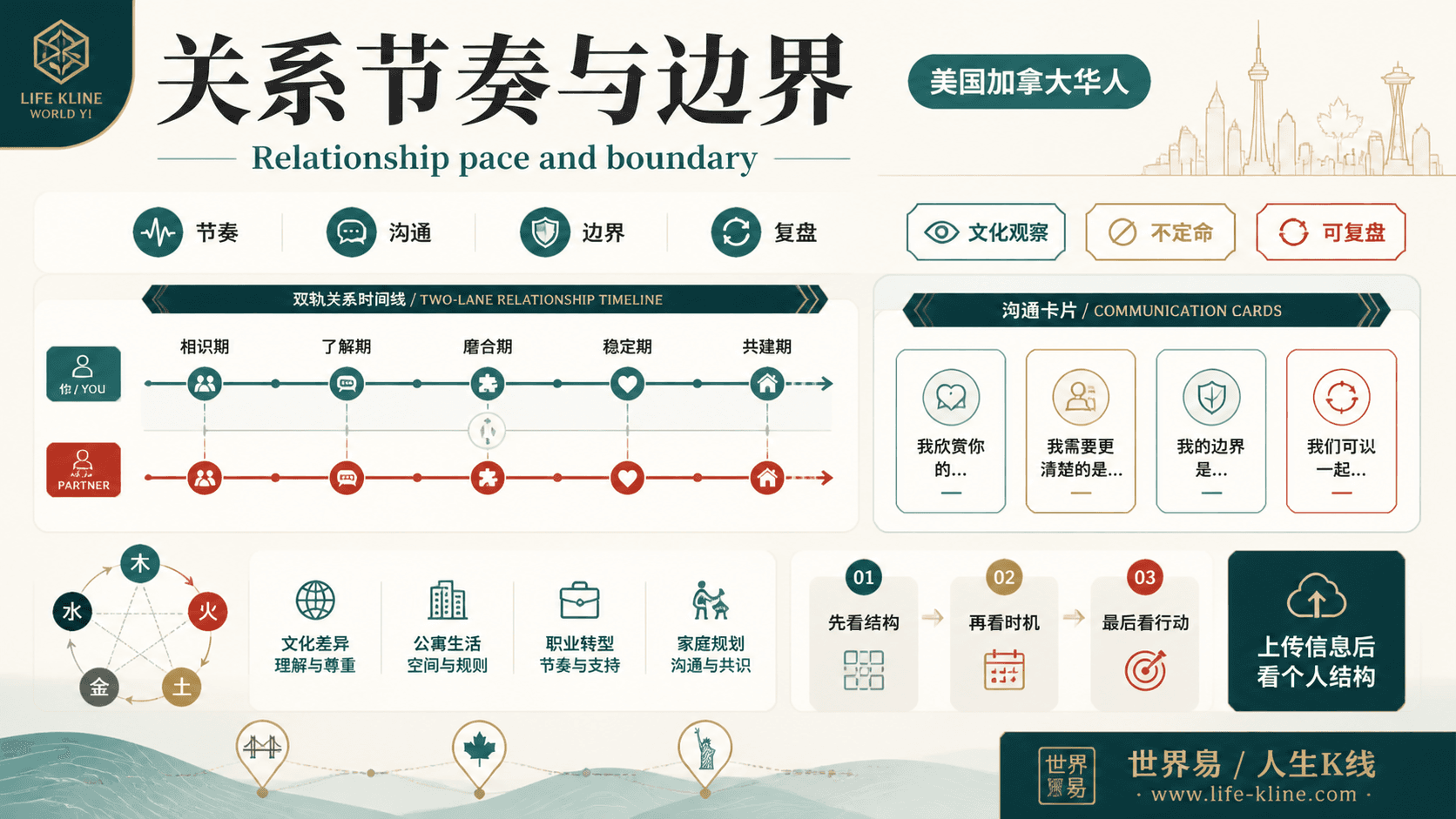
关系节奏与边界|美国加拿大华人
这张图把《Decisive Choices in Partnership Startups: A Metaphysical Perspective on Friend Relationship Decisions》里的命理概念转成关系、边界和应用场景,适合先看图建立结构,再回到知识文章正文理解细节。
关系节奏与边界不应被写成固定结论。更适合美国加拿大华人的读法,是把传统术语翻译成结构、时机、环境、行动和复盘。
查看图片解读