Analysis of Civil Servants' Side Business Wealth Directions: Insights into the Shi Shan-Cai-Yin Structure from a Metaphysical Perspective
把这篇文章落到自己身上验证:先看结构,再进入个人分析,不做泛泛阅读。
你现在搜索的,
其实是一个要落到自己身上的判断。
当前页面主要回答「Civil Servants」这类搜索问题;真正有价值的下一步是把这套结构带进自己的报告、工具与案例验证。
Why This Decision Is Especially Difficult in This Profession
The civil servant profession is characterized by stability as its core feature, with slow promotion pace and most positions limited by geographic binding and organizational structure, resulting in limited rapid growth in job changes and income. Although this stability guarantees basic living, it relatively restricts wealth creation. Therefore, many civil servants consider developing side businesses in middle age to enhance their economic strength.
However, the civil servant work environment emphasizes rules, regulations, and assessment discipline. The work pace is relatively slow but responsibilities are clear. Time and energy allocation for side businesses must be particularly cautious. If side businesses excessively encroach on official work time or are seen as violating regulations, they may negatively impact the main job, increasing professional risks and psychological pressure.
In the metaphysical structure, Zheng Guan (Proper Authority) and Zheng Yin (Proper Resource) are common main lines for civil servants, representing dependence on organizational norms and order. In side business decisions, the balance among Shi Shan (Food and Output), Cai Xing (Wealth Stars), and Yin Xing (Resource Stars) is especially critical, relating to whether one can maintain main job stability while growing side business wealth. Overreliance on Shi Shan’s creative or changeable manifestations in side businesses may conflict with the profession’s need for stability.
Additionally, the civil servant welfare system builds a fixed income foundation, but side business income growth is obviously volatile and uncertain. The choice of Yong Shen (favorable element) in the natal chart becomes a key indicator for wealth security and expansion. Under these compounded real pressures, selecting side business directions is more complex than pure financial considerations.
Three Core Dimensions of Metaphysical Judgment
First, the Day Master’s characteristics and pattern determine the dominant energy of the civil servant. Zheng Yin (Proper Resource) and Zheng Guan (Proper Authority) patterns represent advantages of belonging to an organization and receiving recognition and support, usually corresponding to the relatively stable work environment of civil servants. An overly strong or weak Day Master affects self-motivation and adaptability to side businesses.
Second, identifying Yong Shen (favorable element) and Ji Shen (unfavorable element) focuses on the resource orientation of the side business. In civil servants’ metaphysics, Wood and Water as Yong Shen generally indicate that side business choices should lean towards education, consulting, or resource integration fields. The strength of Cai Xing (Wealth Stars) reflects wealth absorption and risk tolerance, while Shi Shan (Food and Output) indicates the degree of innovation and expression in the side business.
Third, the changes in Da Yun (decade luck cycle) and Liu Nian (annual fortune) amplify the advantages and pressures of the current natal chart. A favorable Da Yun is a good time to launch side businesses, enabling smooth development by leveraging external resources and opportunities; if weak, caution is needed to avoid blind expansion causing adverse situations. The interactions in Liu Nian determine the focus and obstacles of the side business in that year, requiring appropriate judgment combined with main job pressures.
In summary, metaphysical factors from the Day Master’s strength or weakness, pattern type, Yong Shen and Ji Shen configuration, to Da Yun and Liu Nian auspiciousness interact with the civil servant’s stable work environment, sense of responsibility, and time resource conditions, jointly influencing the strategic layout of side business directions.
Three Real Natal Chart Cases
Case 1: This chart is of a female with a strong Day Master Wu Earth (戊, Wu), a Zheng Yin (Proper Resource) pattern, with Wood and Water as Yong Shen. She is currently in a favorable Ren Yin (壬寅, Ren Yin) Da Yun and Bing Wu (丙午, Bing Wu) Liu Nian. In her civil servant work, she is steady and relies on organizational support. Facing side business considerations after age 40, the Zheng Yin pattern and Yong Shen Wood and Water suggest side businesses related to service, culture, or education, aligning with the overall stable rhythm of civil service work and harmonizing the pressure caused by the Ji Shen Fire element. Side businesses should focus on long-term accumulation, avoiding the drastic changes and risks represented by Fire. It is recommended to first assess existing resources and skills, using Wood and Water-related fields as breakthrough points, then adjust action pace according to Liu Nian trends.
Case 2: The Day Master is Gui Water (癸, Gui) and relatively weak, with a Zheng Guan (Proper Authority) pattern. Fire is the Yong Shen and Wood is the Ji Shen. Currently in the 31-40 years old Jia Xu (甲戌, Jia Xu) Da Yun which is relatively weak, and the Bing Wu (丙午, Bing Wu) Liu Nian requires caution. The civil servant profession provides institutional and rule support, but the weak Day Master shows insufficient self-initiative. Side businesses suitable for development are related to the Yong Shen Fire, such as creative or passionate expressive work, but interference from Ji Shen Wood should be avoided. It is suggested to start side businesses on a small scale to reduce resource investment risks, enhance the quality and energy reserves of Yong Shen Fire, and leverage Da Yun changes to seize appropriate opportunities to accelerate side business development. Blind expansion should be avoided to prevent difficulties.
Case 3: Female with a strong Ding Fire (丁, Ding) Day Master and a Yang Ren (羊刃) pattern, mainly using Water and Metal as Yong Shen, with Wood as Ji Shen. Currently in a very auspicious Geng Shen (庚申, Geng Shen) Da Yun and a favorable Bing Wu (丙午, Bing Wu) Liu Nian. The civil servant’s rules and regulations provide stability for her work, but the Yang Ren pattern itself carries strong inner drive and impulse for change, creating tension with the profession’s stability. Side business directions should revolve around Yong Shen Water and Metal resources, such as finance, consulting, or technology fields, leveraging the strong energy advantage of her Day Master. It is recommended to actively seek side business cooperation and project opportunities during the current favorable luck but pay attention to the interference of Ji Shen Wood, and reasonably plan time to avoid affecting the main job. Starting with short-term trials and progressing steadily in the medium to long term, adjusting strategies according to Liu Nian changes.
Common Misjudgments and Blind Spots in This Profession
The most common misjudgment in civil servants’ side business decisions is over-reliance on the direct strength or weakness of Cai Xing (Wealth Stars), neglecting the balance between Yong Shen (favorable element) and Ji Shen (unfavorable element). Blindly expanding side businesses simply because Cai Xing is strong often results in being overwhelmed due to ignoring the stability needs of the main job and the overall coordination of the natal chart.
Another blind spot is ignoring the interactive influence of Liu Nian (annual fortune) and Da Yun (decade luck cycle), acting rashly without recognizing the current timing environment. The stability of the civil servant profession requires side businesses to be actively advanced during auspicious Da Yun, and to be cautiously maintained during unfavorable periods, otherwise financial risks and conflicts with the main job may arise.
Many people neglect the innovative and expressive function of Shi Shan (Food and Output) in side business planning, while overly relying on Yin Xing (Resource Stars), resulting in overly conservative side business directions or overlap with the main job, losing the benefit of side businesses as independent wealth growth engines. Additionally, geographic binding and civil servant identity restrictions are often underestimated, leading to side business choices unsuitable for their social environment.
In summary, all metaphysical factors should be judged comprehensively to avoid excessive expansion at a single point or blind shifts. The key lies in coordinating the stability of the main job with innovation in side businesses to ensure positive interaction between both.
Practical Judgment Sequence
When judging side business directions, first confirm the strength and pattern type of the Day Master to clarify self-motivation and external adaptability, reflecting the foundation of main job stability. At the same time, combine Yong Shen and Ji Shen preferences to provide primary directional references for side business fields, judging which fields are more likely to receive metaphysical support.
Second, evaluate the current Da Yun and Liu Nian luck, analyzing whether the timing is favorable for side business development. Auspicious Da Yun and Liu Nian are suitable for actively carrying out side businesses and increasing wealth accumulation; during weak or obstructive periods, it is recommended to remain conservative, focusing on risk control rather than expansion.
Finally, integrate the Shi Shan (Food and Output), Cai Xing (Wealth Stars), and Yin Xing (Resource Stars) structures in the natal chart to refine side business positioning. Shi Shan represents creativity and expression in side businesses, Cai Xing corresponds to wealth income, and Yin Xing indicates the support and resources relied upon. Coordinating these three elements complementarily can balance the main and side jobs and achieve steady wealth growth. The overall judgment process should be dynamically adjusted, waiting or acting at appropriate times to avoid short-sightedness.
FAQ
Question 1: Which industries are most suitable for civil servants’ side businesses according to metaphysics? Answer: It should be combined with the individual’s Yong Shen and Ji Shen in the natal chart. Generally, Zheng Yin (Proper Resource) patterns lean towards stable service side businesses such as education and consulting; Zheng Guan (Proper Authority) patterns suit professions with clear rules such as finance and management. Depending on the state of Shi Shan and Cai Xing, innovative side businesses can be considered moderately, but the stability of the main job must be ensured.
Question 2: When is the best time to start a side business? Answer: According to Da Yun and Liu Nian analysis, starting side businesses at auspicious times is easier for success. When Da Yun is smooth and Liu Nian aligns, active expansion is possible; during weak luck phases, cautious evaluation is advised, starting with small-scale trials to avoid risks that could affect the main job.
Question 3: Does the Ji Shen (unfavorable element) affect side business choices? Answer: Ji Shen is very important in side business selection because it reflects possible limitations and obstacles. For example, charts with Ji Shen Wood should avoid side business fields with excessively strong Wood elements to prevent excessive conflict causing energy disorder, which would affect side business progress and wealth stability.
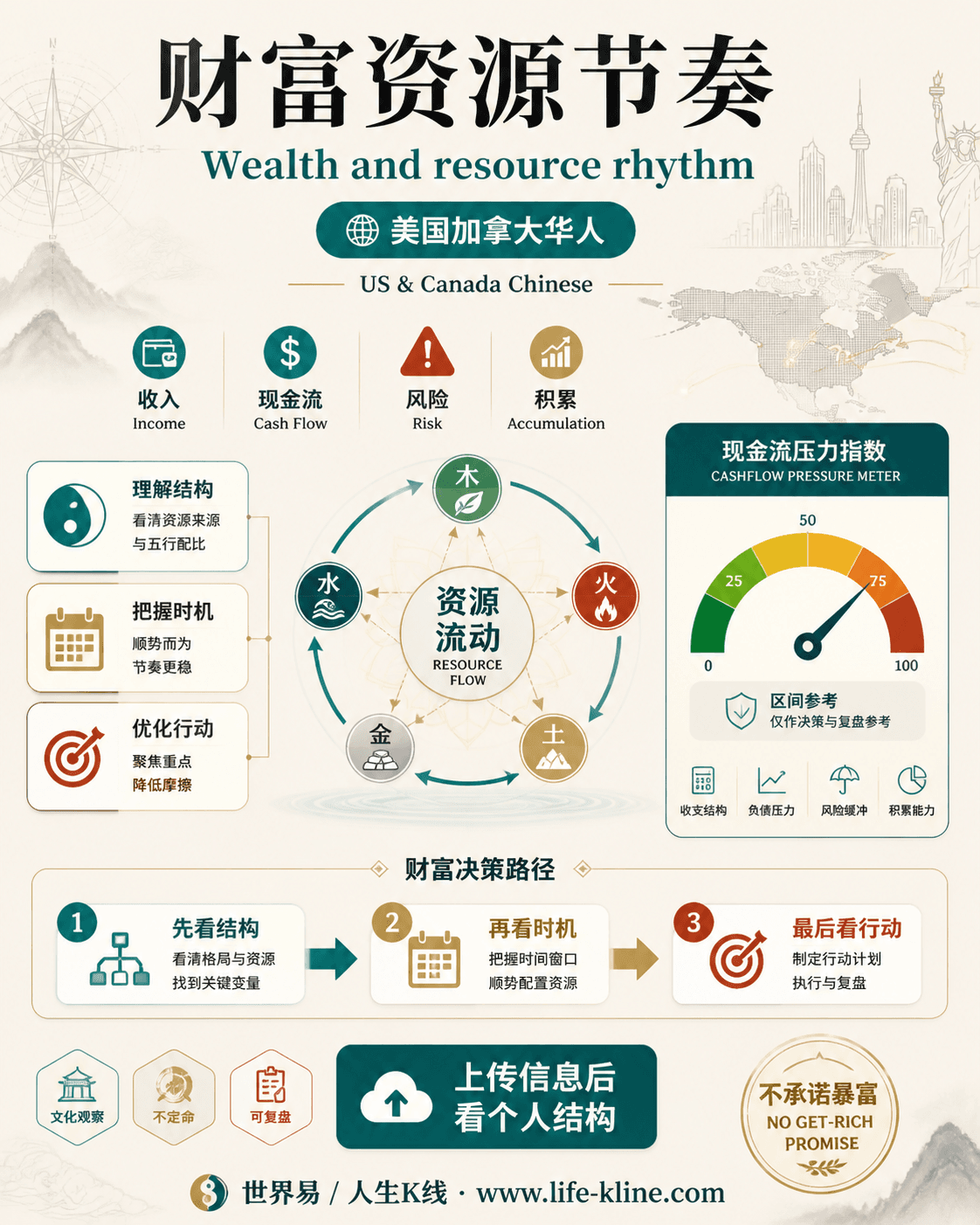
财富资源节奏|美国加拿大华人
这张图把《Analysis of Civil Servants' Side Business Wealth Directions: Insights into the Shi Shan-Cai-Yin Structure from a Metaphysical Perspective》里的命理概念转成关系、边界和应用场景,适合先看图建立结构,再回到知识文章正文理解细节。
财富资源节奏不应被写成固定结论。更适合美国加拿大华人的读法,是把传统术语翻译成结构、时机、环境、行动和复盘。
查看图片解读